

This Week’s Recipe: Thumbprint Cookies
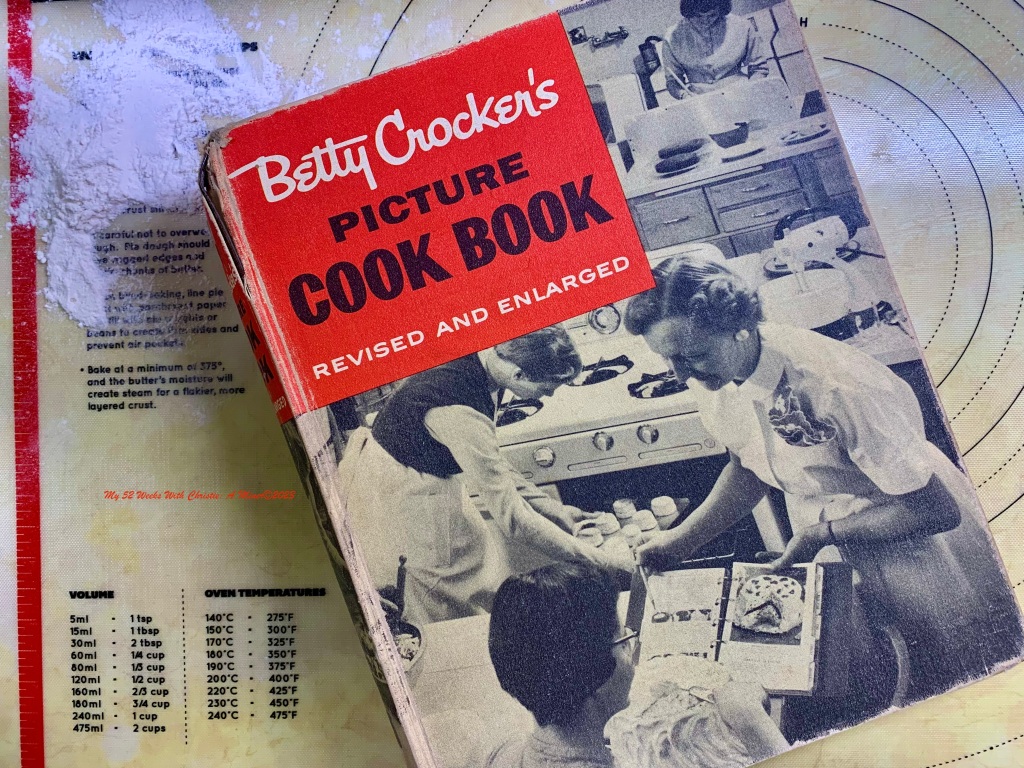
Inspiration: Recently, I found a vintage Betty Croker Cookbook at an estate sale and picked up a jar of lingonberry preserves from a German deli a few weeks later. Combine these separate events with a lemon themed going away party — you get thumbprint cookies.
Now, it’s been a hot minute since I made traditional thumbprint cookies. Yet, I still couldn’t keep myself from changing the recipe a bit, mainly because I cannot come into contact with nuts without blowing up. So I totally skipped the portion of the recipe where you whip an egg white, dip the dough in it, and then roll the dough ball in nuts.
Thereby illustrating what I love about Betty Crocker Picture Cook Books — the recipes inside are generally so basic it allows you to play with them and still produce edible bakes….about 95% of the time.
I also substituted lemon extract for vanilla and adding lemon zest to the dough. Not a huge change, I admit, but I felt confident in making them!
Even better, they turned out great! Lingonberry and lemon go really well together!
Christie: I can see Miss Marple baking these for an under-the-weather friend since you can slip some extra vitamin C into the mix to help them recover faster! Plus, taking baked goods to a neighbor is a wonderful way to get invited inside, where one can either exchange local news (aka gossip) or conduct a gentle interrogation over tea and biscuits!

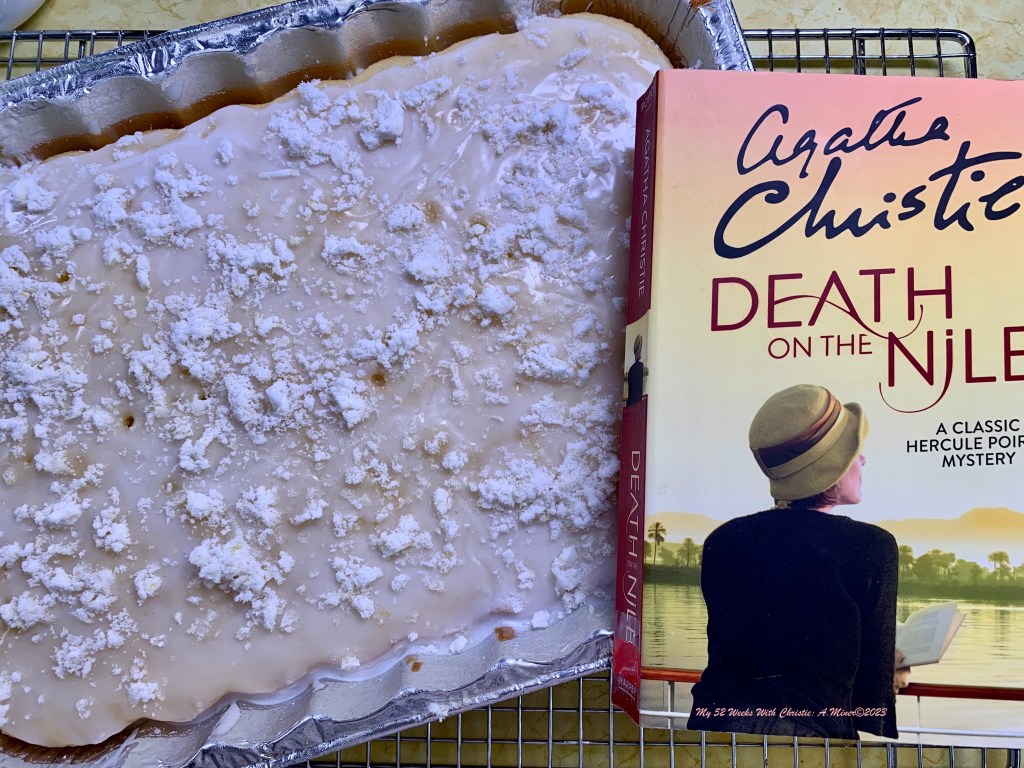
Here’s the final product of the Lemon Buttermilk Sheet Cake, which had far more color than this pic makes it appear. Between the glaze and crunchy lemon infused sugar and my bright kitchen counter plus book cover — the subtle yellow of the cake couldn’t compete!
But trust me, it looked great!
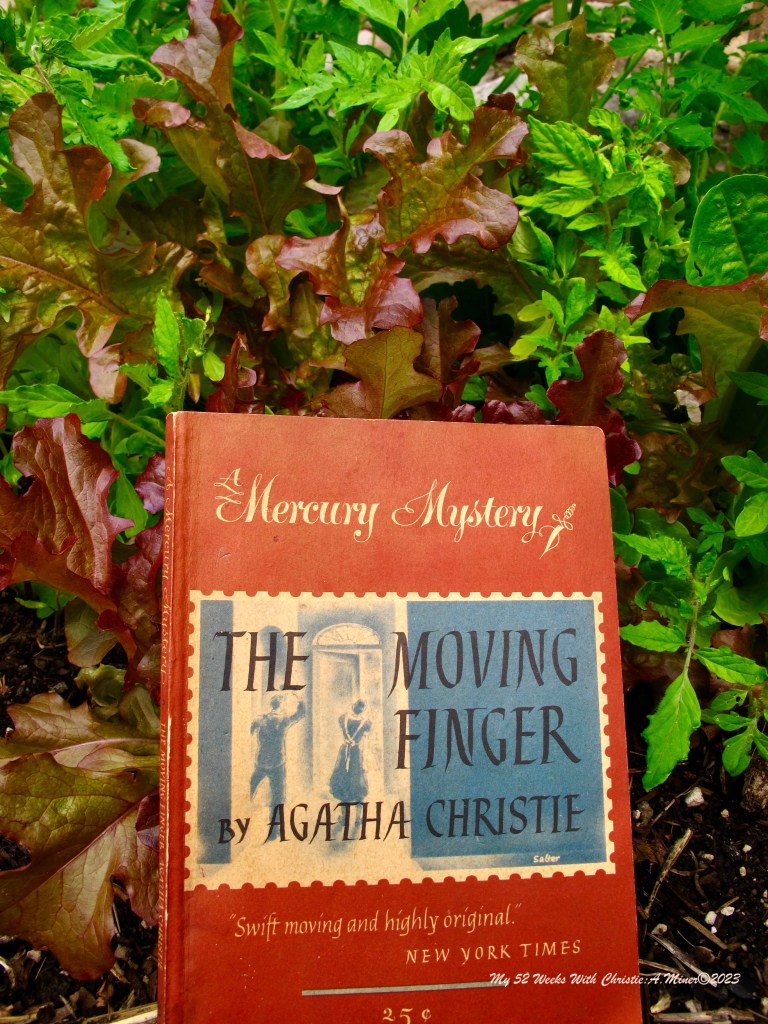
Chapter 1: The Moving Finger & A Real Life Poison Pen Case
Recently I found myself stuck in a mental fog bank with an overwhelming urge to read something more involved than the instructions on a jug of laundry detergent. So I turned to my bookshelves for help. Knowing from past experiences that new stories are a no-go, I ran my finger along the spines until my eyes and index digit landed on The Moving Finger. At which point my brain sat up and bellowed YAHTZEE! Not a new read, but one I hadn’t cracked the covers of since 2014.
Stoked, I sat down and devoured it whole.
Discovering, much to my surprise, my perspective on this classic mystery shifted since I’d last read it nine years ago. (Amusingly, I’d also forgotten the malefactor’s identity and was fooled all over again by the Grand Dame of Misdirection.) Rather than impatiently waiting for Miss Marple’s entrance from stage left or touching the cherished memory of howling with laughter at Victor Borge’s bit on inflationary language with my grandfather in the basement of his house one summer afternoon — my mind caught on the McGuffin of The Moving Finger: the poison pen letters.
Since the villain in The Moving Finger used these letters to mask his true intent, which didn’t seem to fit with what I knew of the phenomenon, it made me wonder what actually drives a true poison pen writer to pick up their quill, so to speak.* Moreover, I wondered why the police and residents of Lymstock so readily accepted the idea that Mrs. Mona Symmington committed suicide over a single letter. So, on a day when the mental fog receded to the outer banks of my brain, I began looking for answers….and fell down a veritable rabbit hole.
Turns out I should’ve had more faith in one of my all-time favorite authoresses.

An view of Tulle from back in the day!
Twenty years prior to the publication of The Moving Finger, a small city in France found itself a hotbed of this postal based crime. From 1917 to 1922, over one-hundred-and-ten poison pen letters were opened in the small provincial town of Tulle. (Where the epitomes fabric of the same name was originally invented and manufactured.) And by the time authorities finally stemmed the flow of these malicious missives — three people were dead, two were remanded to lunatic asylums, and at least one recipient suffered a nervous breakdown. Not to mention the countless broken marriages, shattered friendships, and ruined careers these slanderous communiques also caused.
And it all started over a boy.
Thanks to the overwhelming number of men called up to fight in WWI and her brother’s professional influence, Angele Laval secured a job within Tulle’s prefecture (police department) as a typist under the supervision of Jean-Baptise Mouray.

Jean-Baptise Mouray
Now it’s unclear how long the two worked together before Mouray became the object of Angele’s obsessive affections and due to conflicting contemporary newspaper reports it’s also unclear if: A) Angele loved Mouray from afar. B) Mouray rebuffed Angele’s romantic overtures due to lack of attraction on his part. C) Mouray and Angele dated for a period before he threw her over. However, we do know by 1917, Angele had hatched a plan to draw Mouray into her web.
By sending him an anonymous note abusing her own character.
Troubled by the unsigned slander aimed at his subordinate, Mouray stewed over the ill-natured intelligence for three days before bringing it to Angele. Who, upon laying eyes on the missive, produced one of her own. Only her’s was “left” on her desk at the prefecture and cast aspersions on Mouray’s character instead (calling him a seducer and such). Fearful the crude letters could harm her reputation and his career they decided to keep the contents a secret and consigned them to crackling flames found within a stove in the prefecture’s accounting office.
Unfortunately, this shared secret did not spark the love affair Angele presumably hoped the notes would ignite. Even worse? In 1918 Mouray hired a new typist for their department, Marie-Antoinette Fioux, whom Mouray soon developed an interested and in 1919 began dating.
Rather than giving up on her dream of romance or in a fit of “If he won’t love me, he can’t love anyone else” or both — Angele Laval turned to her inkwell once again. Churning out several crude letters to Mouray’s sister, denouncing Marie-Antoinette’s character. When that failed to produce the desired result, Angele directed another anonymous note to Mouray — this time taunting him with the knowledge of a child he’d fathered with his mistress.
This did the trick.
Apparently, at some point along the way Marie-Antoinette inadvertently witnesses Mouray leaving his mistress’s home. As he’d taken great care to conceal both said mistress and his illegitimate child from everyone in the prefecture and (more importantly) his mother — Mouray concluded Marie-Antoinette must be the author of these scurrilous notes and broke thing off.
This breakup slowed, but didn’t stop, the flow of the poison pen letters being posted. Cunningly, whilst trying to drive a wedge between her rival and her love, Angele camouflaged the true object of her obsession by mailing malicious missives to a number of people within or closely connected to the prefecture of Tulle (including its head) over the course 1918 & 1919. Not to say these catty pieces of correspondence were harmless, far from it, but they’d remained focused on the prefecture itself. Until 1920, after convincing her beloved of her innocence, Mouray married Marie-Antoinette — and — invited Angele to his wedding reception.
Prompting Angele to well and truly lose her nut.
*(BTW: Using a smokescreen of like crimes to hide a black hat’s true target is a well established mystery trope. One Christie used with great effect seven years prior in The A.B.C. Murders. But I digress.)
My 52 Weeks With Christie: A.Miner©2023
This Week’s Recipe: Lemon Buttermilk Sheet Cake
Inspiration: Recently, one of my husband’s coworkers left for greener pastures, and he asked if I could bake one or two things for their going away party.
The theme of the gathering: When life gives you lemons…
Not one to say no when given a chance to bake, I hit my cookbook library and found (amongst others) America’s Test Kitchen’s recipe for a Lemon Buttermilk Sheet Cake! What first drew me in is that it’s glazed — not frosted. Since I needed to complete another four bakes that day, I found this an attractive feature, and it turned out beautifully on the very first try!

One of the keys to baking a cake from scratch, I learned from the Great British Bakeoff and repeated in the instructions — you need to make sure your butter, buttermilk, and eggs are all at room temperature when you start assembling the batter….then recall you’ve set them aside. Since it takes A WHILE for them to reach the requested ambient temp.
Ask me how I know.
Fortunately, since I was whipping up all kinds of other stuff, this step didn’t prove a problem….for once.
As for the required cake flour, don’t let that intimidate you — if you sift 1 cup of regular all-purpose flour twice, then take out 1 Tablespoon, you’ve got one cup of cake flour.
Helpful Hint: You don’t need all the glaze the recipe calls for. If you halve this portion of the recipe, you’ll still have more than enough to thoroughly coat your cake top!
Christie: Tangy, lemony, and not overly sweet. I can see Tuppence baking this cake as a treat for Tommy and their kids on a random Saturday in Spring!
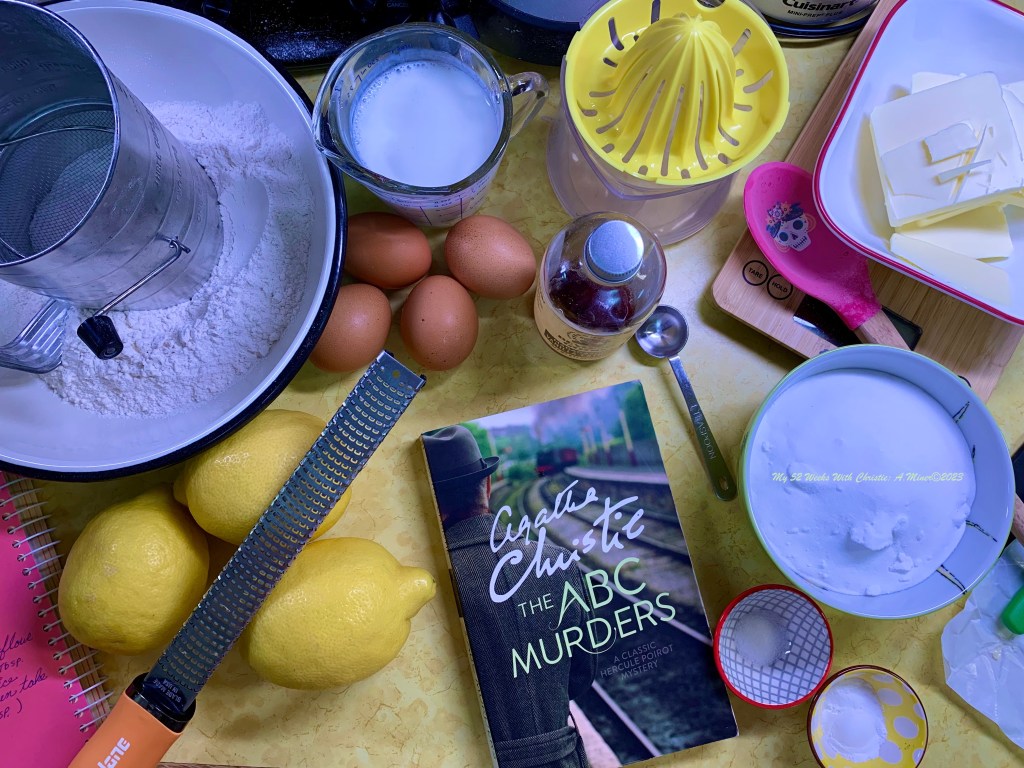
(Someday I’ll manage to consistently put the right book in my baking photos….But today’s not that day.)
First Published: Serialized in the US in Colliers Magazine 1942. New York, Dodd Mead, 1942. London, William Collins, 1943.
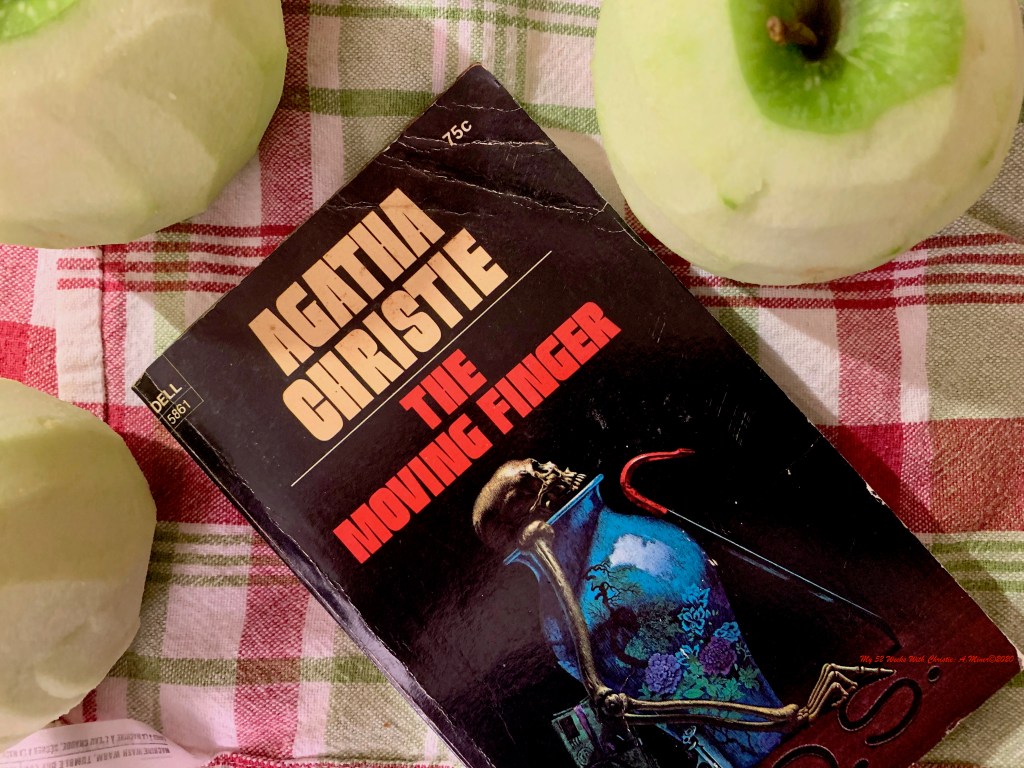
I Read: The Moving Finger (New York, Harper, 2011)
Series: Miss Marple
Summary: On the advice of his doctor, Jerry Burton and his sister Joanna decide to take a country home for several months, in order to help facilitate Jerry’s healing after his plane crash, “…go down to the country, take a house, get interested in local politics, in local scandal, in village gossip. Take an inquisitive and violent interest in your neighbors…” (chapt. 1, pg. 2). The local scandal comes to Jerry and Joanna, when they receive an anonymous poison pen letter accusing the siblings of a much less proper relationship. Laughing it off, they don’t think much of it, until they discover a number of their neighbors have received similar letters, accusing them of all sorts of preposterous activities. It’s not until a suicide and then a murder rocks the village of Lymstock, that Miss Marple arrives and works with Jerry to solve this mystery.
Review: I really liked this book, Jerry, who narrates the entire book, I found to be a very likable character who developed into a stronger and more confident character the more embroiled in the village’s mystery/gossip/scandal he became. The mystery itself is very clever, and Christie had me looking in the completely wrong direction for the entire book as I thought the completely wrong family member was responsible for the murder! I found, surprisingly enough, that I enjoyed being fooled for the better part of the novel. This is one which I plan on reading again, when I find a copy of the UK edition!
The Moving Finger I feel is a curious book. The main protagonist, the one which the series is named for, Miss Marple, does not appear in the story until chapter 10. The sticky wicket here is, there are only 15 chapters in the whole book and she doesn‘t appear in the 15th chapter. While I read the book, the more I started to wondered when she was going to appear and do her magic. I know this is blasphemous, but I am not sure how critical she was to the story, as Jerry was doing a good job of working towards the solution on his own. Miss Marple was almost more of a writing device – a deus ex machina (an ancient Greek term meaning, the only solution to the problems on stage, is to have the gods descend and provide the needed solution and explanation). While not a god, Miss Marple’s intervention is used by Christie as an efficient way to wrap the tangled set of problems; clarifying Jerry’s thoughts & deductions, then devising a clever plan to apprehend the real culprit. Which I maintain Jerry and the police would have been able to do on their own, given a few more pages. So while this book is included in the Marple series, in my heart of hearts, I think of it more as a stand-alone, with a cameo by a famous sleuth.
One entertaining thought which kept flitting through my head as I read The Moving Finger was Victor Borge’s comedy sketch about Inflationary Language. Inflationary Language, if you haven’t heard of it before, (if you have, you can skip to the next paragraph) is a bit inspired by a bout of inflation experienced by the Danish economy; all numbers go up, “Prices – anything to do with money goes up, except the language. See we have hidden numbers in the language…all these numbers can be inflated and meet the economy by rising to the occasion. I suggest we add one to each number…” (a passage I have done my best to write down from a youtube video). Then much hilarity ensues as he reads a passage from a book, seriously it is very funny. I have included the video below.
Several times in The Moving Finger, the phrase, “You’re a woman in a thousand.” (Chapt. 11, pg. 181) is uttered by a character. This, it seems to me, to be a precursor to the phase we now use: You’re one in a million! Same sentiment, different number, an inflated number…. Thus, making me chuckle each and every time I read the older phrase. Remembering how I giggled, in my grandparent’s basement one summer‘s day, to my grandfather’s record of Victor Borge and the Inflationary Language track (btw if you haven‘t heard his thoughts on Phonetic Punctuation, you really must!).
Favorite Quote:
“The human mind prefers to be spoon-fed with the thoughts of others, but deprived of such nourishment it will, reluctantly, begin to think for itself – and such thinking, remember, is original thinking and may have valuable results.” (Chapt. 6, pg. 78)
Interesting Notes: When Christie was writing Miss Marple’s The Moving Finger, she was also writing N Or M?, featuring Tuppence and Tommy Beresford. She alternated between the two manuscripts, she believed it kept her writing fresh and interesting. Christie also listed The Moving Finger as one of her all time favorites!
Another interesting fact: the US and UK versions of this book are evidently very different from each other. The reason behind this, it is widely theorized, is The Moving Finger was published serialized form in Colliers Magazine in the US almost a year before the book was released in the UK. It is thought that Penguin Books published the magazine edited version rather than the original manuscript which Christie wrote. What I find even more incredible is the fact this mistake on the publisher’s part to this day hasn’t been corrected, meaning the US audience is reading, from what I understand, a much different version than the one which Christie originally penned.
Cheating: No I did not cheat, I found it wasn’t as difficult as it has been with other books (perhaps because I read the bulk of the book while sitting next to my eagle-eyed husband). I did have a vague but controllable itch to know if I had guessed correctly who the culprit was!

 My 52 Weeks With Christie
You must be logged in to post a comment.