Caustic Candy: When a Frame Falls Apart

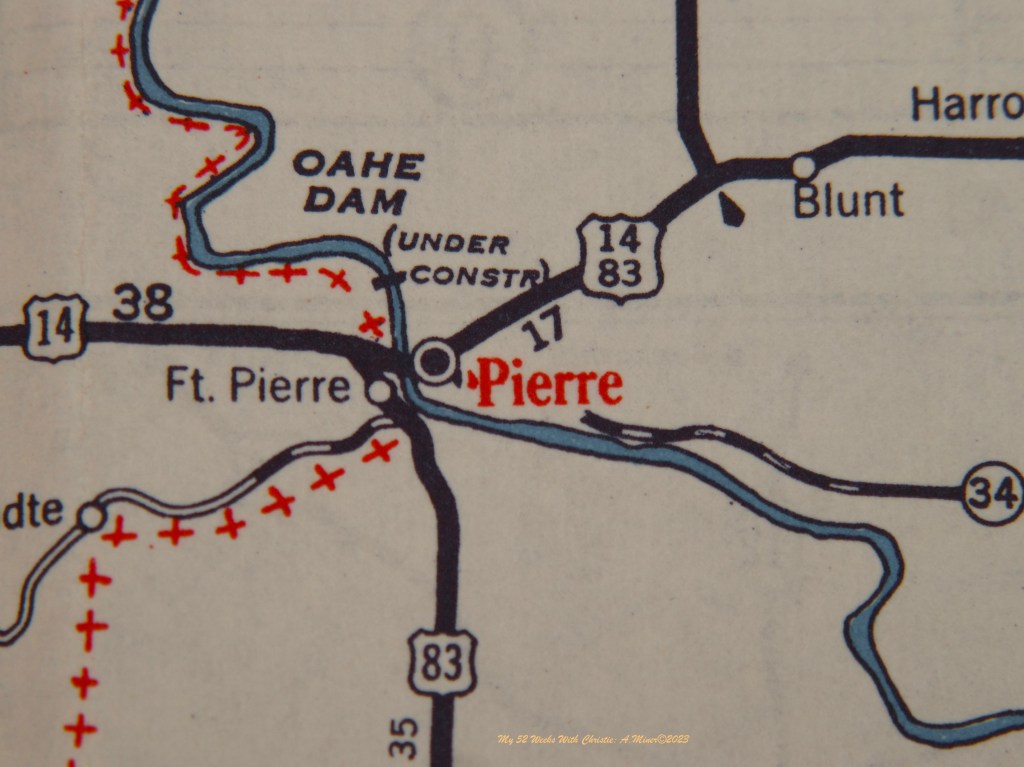
In an uncanny case of serendipity: While the curious citizens of Pierre, South Dakota, congregated outside the courthouse after the Coroner’s Inquest, someone linked to the investigation overheard a local confectioner remark that on Saturday, February 27, 1904, the day Rena Nelson said she received and ate a piece of poisoned candy — she’d come into his shop asking for an empty candy box. This tidbit marked the second inconsistency tallied that day. The first came during the testimony of one of the physicians, who noted That while a victim may linger in agony for upwards of fourteen days, the initial symptoms of an acute case of corrosive sublimate poisoning spring up within a few minutes or hours of ingestion. In other words, the science didn’t tally with Rena’s account of eating the tainted sweets on Saturday morning, feeling iffy on Sunday night, and then falling gravely ill on Monday morning. Compounding these two incongruities, Sheriff Laughlin admitted basing his pursuit of Belle Dye on Rena’s word — believing Rena’s sterling reputation provided the necessary veracity to establish his case.

So on March 10th (or perhaps 11th), authorities finally started corroborating the particulars of Rena’s accusation.

Pulling at the most straightforward thread first, investigators visited the shop of the confectioner whom they’d overheard earlier that day. Whereupon they learned that Rena did indeed stop by his shop looking for a candy box but left empty-handed as she said none that he stocked suited her purpose. Catching the scent, investigators visited a nearby drugstore, Dahoss & Company’s candy counter — and struck gold. Seems Rena bought a box and candy identical in every way to the ones submitted as evidence in the inquest.

Save for the white sweeties sprinkled amongst the chocolates. 

Similar in shape and size to peppermint pastilles, it turns out they were, in fact, corrosive sublimate tablets. 

With a sneaking suspicion starting to form, the lawmen returned to the beginning. Taking a closer look at the chocolate box’s wrappings, they found yet more discordant notes. While the package bore Rena’s name and address, they found it odd that someone would paste the front of an addressed envelope to the parcel rather than writing said details onto the paper wrapping itself. When the Special Agents from the Postal Service asked Pierre’s post office workers about this, they confirmed that Rena did receive a parcel on February 27th. However, they were nearly certain the box’s requisite information wasn’t listed on an envelope. When investigators rechecked the label again, using a strong magnifying glass, they detected writing beneath the pasted-down piece of paper (though they couldn’t read it). While back at square one, they also noticed a discrepancy in the cancellation marks. Seems the Boone Post Office cancels stamps using wavy lines, while this parcel’s stamps displayed a flag design. Even weirder, the box bore a January 23rd postmark. As a package doesn’t take a little shy of a month to travel the roughly four-hundred-and-seventy miles between Boone, Iowa, and Pierre, South Dakota, investigators re-interviewed Belle Dye.
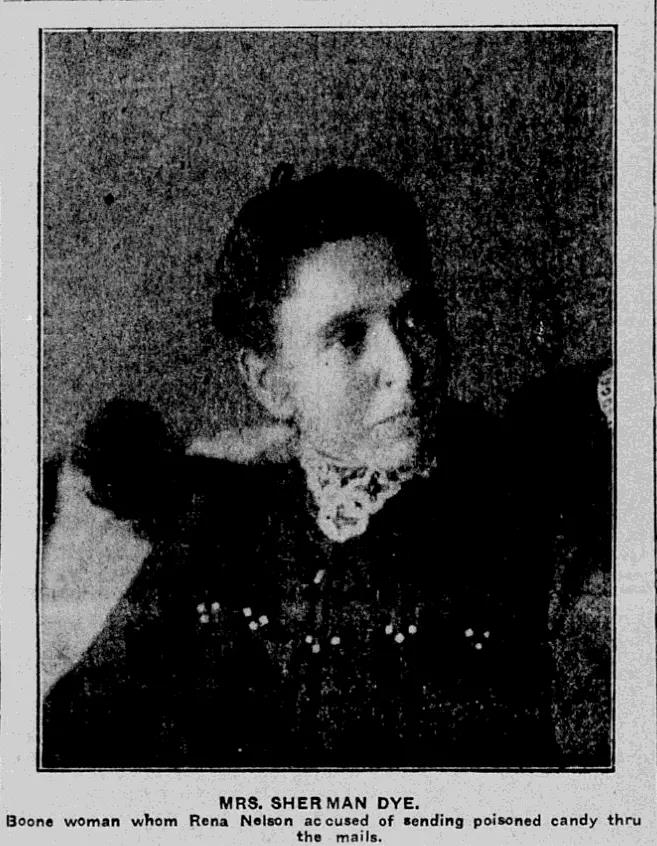
Who readily admitted that she wrote Rena a letter in January.

However, when Rena did not respect Belle’s wishes to leave her and Sherman alone, so they could work things out, Belle went to the Boone Police Department. Requesting they arrest Rena, should she enter Boone’s city limits again — citing her continued interference in her & Sherman’s marriage. Though it’s unclear if they could actually do anything, Belle apparently felt confident they could, as she made arrangements with a mutual friend to notify her if Rena ever returned. Whilst also ensuring word of Belle’s plan to press charges reached Rena’s Aunt. Hence, the letter Rena received on the same day as the sweets. It warned Rena against writing to Belle again. Otherwise, things could get ‘hot’ for her.

Why would Belle resort to poison if she already had a plan in place to deal with Rena?

Finally, a report submitted by Boone police hardened the sneaking suspicion into a rock-solid certainty. No shop in Boone, Iowa, used boxes or wrappings like those on the box Rena received. Moreover, they’d run the type of bonbons Rena received to ground and revealed to their South Dakota counterparts no shop in all of Boone sold chocolates manufactured in Mankato, Minnesota.

Since, thanks to all the legal wrangling over warrants earlier, the lawmen already established Belle defiantly hadn’t left Boone for some time prior to Rena’s poisoning. And they doubted she’d any reasonable way of obtaining those specific candies, wrapping, or box. Put these facts together with the incorrect cancelation on the package itself, the odd method of address, and the exorbitant amount of time it took to supposedly arrive…Sheriff Laughlin admitted he now believed Rena Nelson had fashioned a plan to slightly poison herself and frame Belle for the deed. 

While authorities never nailed down exactly where Rena obtained the corrosive sublimate tablets, though they suspected she swiped them whilst nursing the sick around the city (as the substance was used as a disinfectant in hospitals and sickrooms), they felt confident they’d finally arrived at the correct conclusion. (This time.)

Though they were less confident of Rena’s motivation.

Did Rena think if Belle went to jail, Sherman would be able to obtain a divorce from his wife, who, up until this point, had denied him one? Only to misjudge the amount of corrosive sublimate she could safely take (which, btw, is an infinitesimally small amount), destroying not only her chances of wedding Sherman but herself as well. Or did she sacrifice herself to ensure his freedom? Amongst the many articles I read, one claimed that Rena had shown her friends a letter from Sherman in November of 1903, in which he broke things off using the old saw — ‘he’d tired of her.’ This, of course, led to the report that Rena’s letter to her Aunt, the one she penned on Sunday, February, right before she became seriously ill, was tantamount to a suicide note. 

Whilst no one but Rena knows the truth, I lean towards the former explanation. 

Mainly because Rena wrote Belle asking her to grant Sherman a divorce — after — Belle had discovered the cache of Rena’s letters and photos in the family chicken coop in December. Implying Sherman told Rena they’d been found out. Information that wouldn’t need imparting if he’d broken up with Rena in November. On top of which, Belle herself was convinced Rena would return to Boone to visit either her or Sherman or both. Hence, Belle’s complaint to the police about Rena’s conduct.

It must’ve been a bitter blow to Rena when Sherman chose to comfort his wife in jail rather than running pell-mell to her side.

A choice Sherman repeated again…..eventually. 

Seventeen months after Rena Nelson’s death, in August of 1905, Belle Dye started divorce proceedings and obtained an injunction against Sherman from seeing her or coming to their house. The reason? Apparently, Sherman continued running around Boone with other women, and when he condescended to stay home, he treated Belle with ‘extreme cruelty.’ (The papers speculating he blamed Belle for Rena’s death). However, by April 1906, Sherman had secured a good job with a railroad company in Denver. At which point, he invited Belle and his daughter Dolly (a nickname) to join him in Colorado, which they did. Whilst I’ve no clue if they were happy together, from bits and pieces I found in newspapers and census records, they did indeed stay together after their do-over out west until his death in 1951.

My 52 Weeks With Christie: A.Miner©2023

Cooking With Christie: Pasta With Burst Cherry Tomato Sauce

Inspiration: From the end of August to the beginning of September, my husband’s tomato growing efforts reached fruition, and we possessed a veritable ton of cherry tomatoes! At about the same time, I purchased Cook’s Illustrated Magazine No. 184 (aka Sept/Nov 2023), which contained a bunch of great tomato based recipes — including Pasta With Burst Tomato Sauce.

And let me tell you, it’s outstanding! Even better, it’s easy to make.

Slightly trepidatious, as I’ve never used anchovies before, I set about making the dish…And due to my stupid, stupid allergies, I needed to eschew the garlic. But it turns out the anchovy fillets added more than enough flavor! (Without making it taste fishy.) I also increased the pepper flakes to a healthy teaspoon, as anything less, you get little if any, heat. I also switched the flakes from generic red pepper to gochugaru, which I prefer.

Then, watching the video, I realized I didn’t make the dish the way the recipe’s author intended…Rather than keeping them whole, I chopped the cherry tomatoes in half and had them as a single layer across a large shallow pot, which made a great creamy sauce without the whole cherry tomatoes. This unintentional goof worked out, as my husband likes tomatoes when manipulated in a dish, but not generally as a whole fruit.

A Bit of Household Controversy: In the pic above, I’ve used Fusilli Lunghi Col Buco noodles — they’re fun and I love the texture they add to the dish. My husband sides with Cook’s Illustrated and thinks a shorter pasta is best…So now, as a compromise, I prepare two separate pastas!

In any case, give this recipe a whirl. I don’t think you’ll be disappointed!

Christie: I can see Poirot or Mr. Satterthwaite tucking into this dish and eating it with relish as it possesses an elegant simplicity…Provided it was plated in a refined style!

My 52 Weeks With Christie: A.Miner©2023

Caustic Candy: The Woebegone Case of Rena Nelson

In our last case of Caustic Candy, we will travel roughly three-hundred-and-thirty-seven miles north and slightly west from Hastings, Nebraska, to Pierre, South Dakota, to meet a love-struck woman who nearly managed to send another to prison for a murder she didn’t commit.

In the years leading up to February 27, 1904 — Cordelia Botkin and her infamous cross-country murders continued to make headlines. (Due in no small part to the upcoming retrial Botkin managed to secure for herself — which would ultimately fail.) Despite the police catching and the prosecutors convicting Cordelia Botkin, her evil exploits still inspired/tempted people across the country into trying to rid themselves of an unwanted lover, rival, enemy, or annoying neighbor by sending said person a box of poisoned laced sweets through the mail.

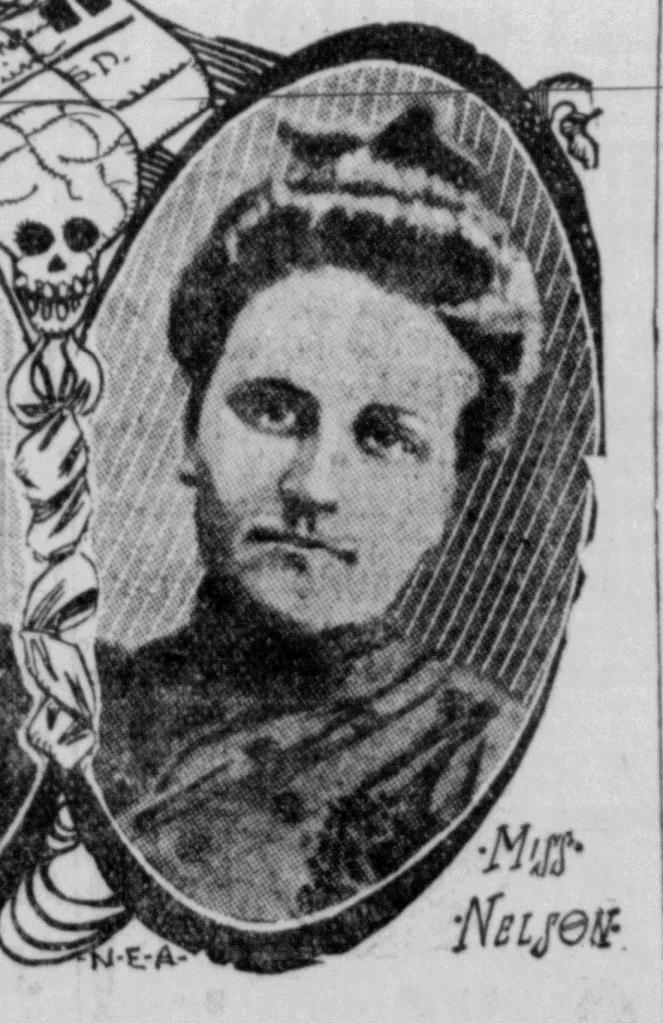
Enter Rena Nelson.

An unattached woman in her late twenties, Rena lived six miles north of Pierre, South Dakota, on a farm with her parents working as a nurse around the city. (Though, as she had no formal training, I think it’s more likely Rena acted as a nurse’s aide.) In any case, on Saturday, February 27, Rena and her father went into Pierre. One of the must-visit spots, whenever one visited town, was (of course) the post office. On this day, a parcel and a letter waited for Rena. Carefully slitting open the parcel’s wrappings, she discovered someone had sent her a box of chocolates. Popping one in her mouth, Rena stood at a counter chewing whilst reading a letter from her Aunt. By Sunday night, Rena was beginning to feel a little iffy, though still well enough to pen a return letter to her relation in Boone, Iowa. On Monday, Rena’s family sent for the doctor.

Who in turn sent for Sheriff Laughlin. 

Whilst slowly succumbing to a hitherto unknown poison her doctor suspected was delivered via bonbon, Sheriff Laughlin listened to Rena point the finger at her own murderer. Taking Rena’s hunch and the suspect box of confectionary with him, the Sheriff left the Nelson household. His first stop was the chemists, where he handed off the sweets for testing. His second was the telegraph office, where he wired his counterpart in Boone, Iowa, asking them to arrest his prime suspect.

By this point, it was Tuesday, March 1, 1904, and the local newspapers got wind of a possible Botkin copycat within their midsts. By the following day, regional papers had picked up the story, and by the next, the national press. 

On March 4, the State Chemist, Professor Whitehead, confirmed the local physician’s worst fears: Rena had ingested corrosive sublimate. Otherwise known as mercury chloride, this compound was used in developing photographs, preserving specimens collected by anthropologists & biologists, to treat syphilis, and as a disinfectant. In acute poisoning cases, like Rena’s, the chemical’s corrosive properties wreak havoc on internal organs. Causing ulcers in the mouth, throat, stomach, and intestines. Leading to a burning sensation in the mouth/throat, stomach pain, lethargy, vomiting blood, corrosive bronchitis, and kidney failure. Even today, doctors face an uphill battle in mercury chloride poisoning. Back in 1904, the only option available were iodine salts.  

Unfortunately, Rena’s organ damage proved too extensive for any hope of recovery.

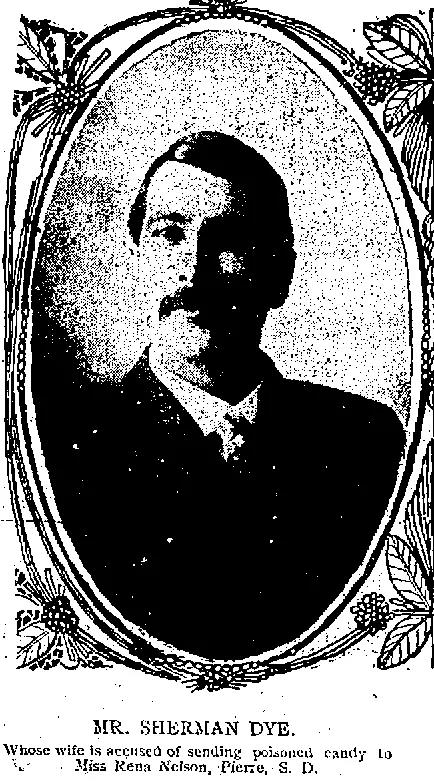
But who did Rena accuse of killing her, and why? This was the question the newspapers, public, and residents of Pierre clamored after Sheriff Laughlin to reveal. For that answer, we must travel back three years to Boone, Iowa. Where for a season, Rena worked at the Boone Telephone Exchange as an operator while living with her Aunt. During this time, Rena met Mr. Sherman Dye, who worked for the Northwestern Railroad as a clerk in one of their roundhouses. 

The two soon started dating. 

When Rena returned to Pierre, the pair continued their romance via pen & paper and carried on in this fashion for the next two-and-a-half years….Until November 1903, when Mrs. Belle Dye, Sherman’s wife and mother of his child, accidentally discovered Rena’s letters and photos stashed in the family’s chicken coop.

Mr. & Mrs. Dye separated on Christmas 1903.

Now, it’s unclear when Sherman told Rena he was married. However, thanks to the letter Rena penned to her Aunt on that Sunday when she started suffering from the effects of the corrosive sublimate, we do know that Sherman initially ‘misrepresented his marital status’. Telling Rena he’d obtained a divorce. However, when Sherman revealed he was, in fact, still married — for whatever reason — Rena chose to continue the relationship rather than giving him the old heave-ho. 

Rena even went so far as to write Belle several letters asking her to grant Sherman a divorce as he wanted to marry her. 

Finally, on January 23, 1904, Belle wrote back, asking Rena to leave them both alone — pointing out that she was ‘interfering with a husband and wife.’ And therein lies the crux of Rena’s deathbed accusation. She claimed Belle was jealous because Sherman transferred his affections from his wife onto herself. Rena also told the Sheriff she recognized the handwriting on the parcel’s wrapping as that of Mrs. Belle Dye’s — but only after ingesting the poison-laced chocolates.

On March 6, 1904, with a South Dakota issued arrest warrant in hand, Sheriff Laughlin arrested Belle Dye — in Boone, Iowa.

Unfortunately, for Sheriff Laughlin, returning to South Dakota with Belle in tow wasn’t as easy as simply catching a train. Facing the same conundrum his counterparts in California and Delaware found themselves in a few years prior with Cordelia Botkin — Sheriff Laughlin needed to navigate Iowa law, which had never faced a case where the (impending) murder took place in a separate state from where the instrument of destruction was mailed from. The first blow to the Sheriff’s extradition of Belle came when the Iowa Supreme Court quashed the North Dakota arrest warrant — which labeled Belle as a fugitive from justice. However, since Belle never entered South Dakota, it followed that she’d not fled back to Iowa afterwards. 

So, by definition of the law, Belle wasn’t a fugitive.

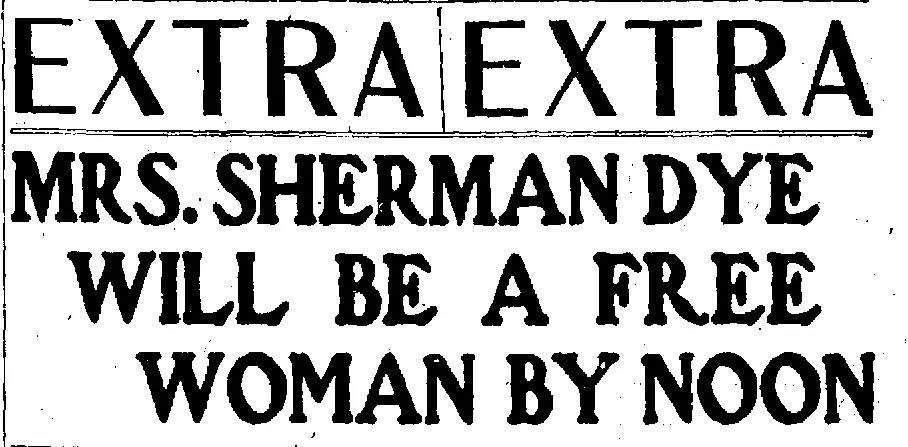
Not willing to let this woman get away with murder, Sheriff met with Iowa’s Governor Cummings on March 7, hoping he’d intervene. While he did, on advice from State Attorney General Mullan, Governor Cummings made a different call than his Californian counterpart. Not only did he free Belle on March 9 with a writ of habits corpus, he also let Sheriff Laughlin know that Belle could neither be extradited to South Dakota nor would she meet a murder charges in Iowa. 

Belle needed to be tried in South Dakota, where the deed took place, or not at all. 

Undoubtedly, seeing which way the wind was blowing before Governor Cumming made his announcement, Sheriff Laughlin made one last Hail Mary play to get Belle Dye back to South Dakota to face justice — he applied to the US Postal Inspection Service. As one of the only investigative federal bodies at the time (the precursor to the FBI wouldn’t be founded until four years later), the Sheriff hoped they’d charge Belle with misuse of the mail. (As sending poison thru the post was, and is still, illegal.) If the Special Agents found enough evidence to charge her, then Federal Marshals could cross state lines, arrest Belle without a warrant, and bring her back to South Dakota.

Whilst all this legal wrangling went on, Rena Nelson died on March 8, 1904. 

Noticeably absent from the side of Rena’s deathbed was Sherman Dye. Rather than comforting his dying lover, he chose to support his wife during her detention. Not only defending Belle in the press, Sherman also paid multiple visits to Belle in jail with their daughter Dolly.

On March 10, the same day Postal Service Special Agents arrived in Pierre — the Coroner’s Inquest into Rena’s death was held. The verdict from the jury was a foregone conclusion: “Miss Nelson came to her death through eating some tablets or chocolate candies contained in a box received through the United States Mail at Pierre, South Dakota and postmarked Boone, Iowa and contained corrosive sublimate in sufficient quantities to cause death.”

However, the most significant feature of the inquest, which would throw the whole case on its ear, occurred as the spectators congregated outside the courthouse discussing the case….

My 52 Weeks With Christie: A.Miner©2023
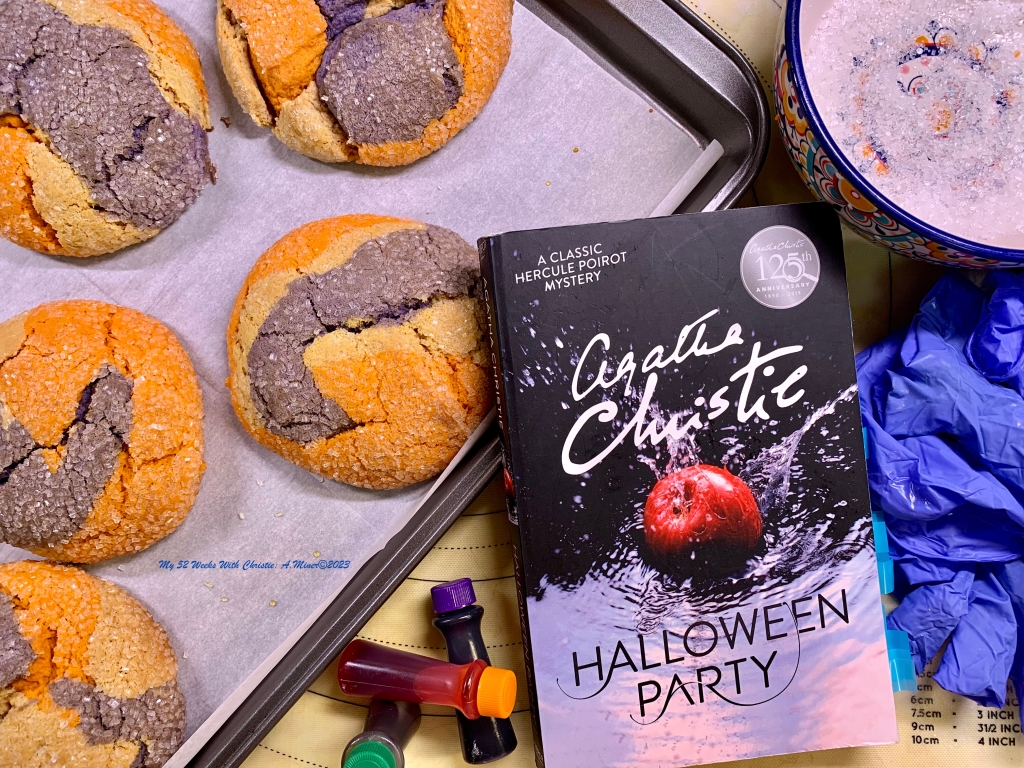
Cooking With Christie: Tie-Dye Cookies

Inspiration: On a random Saturday morning, whilst puttering around the house, I had The Food Network playing in the background and on popped the show Girl Meets Farm. Now, I must admit, I wasn’t paying particular attention to Molly Yeh….Until she started talking about making tie-dye cookies.

That perked my ears right up.

Watching her method, I decided they looked pretty easy, so I gave them a go.

From the Office of Me to You: Choose your food coloring gels with care. Otherwise, you’ll end up with a dull and potentially colorless bake!

Whereupon I learned not all gel food coloring brands are created equal. In the pic above, the basic cookie color was initially green. However, the organic dye I used disappeared entirely during the bake. An outcome the manufacturers failed to mention might happen on the back of the box.

I then discovered that the purple, produced by a different company, would fade a bit if the oven temperature exceeded 350 degrees. Prewarned, I added loads more food coloring than I usually would to counter the fading – as these cookies bake at 375 degrees.

(And usually is a relative term here, as this is the first time I’ve worked with food dyes in…..Well, the last time I can recall was in grade school for a rainbow cake for a carnival cake walk. I’m sure I’ve used it since then, but darned if I can remember when.)

The orange, the only non-natural dye of the lot, turned out perfectly.

In any case, as an eggless cookie, they turned out okay. I think these are better when eaten warm. And they are HUGE, which my taste testers found off-putting. So next time, rather than eyeballing the amount of dough in each cookie (as instructed), I will weigh each piece of colored dough and cut the size by half.

Christie: I can see these cookies being a popular holiday treat in the early days of Christie’s detectives’ careers. As eggs, amongst many other kitchen staples, were rationed during and after the Great Wars.

Caustic Candy: I Didn’t Do It, But If I Did It….

Until this point in Viola Horlocker’s trial, her defense team worked to establish doubt as to whether Viola actually entered the building where Anna and Charles Morey lived. Later, they’d call a witness, who’d known Viola for years, lived in the same hallway as the Morey’s, was home all day — who swore he never saw Viola on April 10, 1899. While all these details add up, Viola’s lawyers had yet to really address the heart of Viola’s insanity plea.

Until the prosecution called Charles Morey to the stand.

Faster than a fox falls on a fluffy-tailed rabbit, Viola’s defense team tipped their hand, showing the jury who they regarded as the real villain of the piece. 

Badgering and lambasting Charles at every turn, they relentlessly grilled him about the exact nature of his relationship with Viola: Charging him with ‘making love to an innocent young woman.’ Accusing him of encouraging Viola’s infatuation through the sheer volume of time spent together, confidences shared, and promises of marriage made. Blaming him for unhinging Viola’s mind — by forcing her to watch her rose-tinted dreams die when he unexpectedly severed all ties with her. Could anyone fault Viola for cracking under the pressure of watching the man she ‘loved not wisely, but too well’ carry on with his wife from afar, as if she never existed? 

(BTW: Apparently, Viola’s lawyer’s cross-examination of Charles was so merciless that when Charles left the stand, he said something very rude while passing by the defense counsel’s table. Unwilling to let the insult roll like so much water off a duck’s back, said lawyer immediately punched Charles in the nose. The next day, the bailiffs, who suspected the dust hadn’t quite settled from the previous day’s kerfuffle, kept a weather eye on the two men. The surveillance proved fortuitous as they foiled the pair of hotheads from drawing pistols and shooting one another in the middle of the courtroom.)

Viola herself took the stand sometime later in her own defense. Though, betwixt hiding her face in her hands, copious weeping, and periodic bouts of fainting, she didn’t provide much substance to aid her case….However….Considering the number of trials where the purported perpetrator put their own head in the noose by trying to defend themselves on the stand — you could call presenting a generally pathetic and remorseful figure a result.

Fortunately, her legal team had an ace up their sleeve.

Do you recall the friends who, from the very start, said Viola must’ve been out of her right mind if she tried to poison Anna Morey? Well, they’d stuck to their conviction and with her. Not only did they attend Viola’s trial en masse, much to Judge Adams’ consternation (who didn’t think it proper). At one point during the proceedings, they rained kisses all over Viola’s head to show their support. 

One of Viola’s particular friends, Miss Eva Stuart, took this show to the next level by providing information that Viola couldn’t or wouldn’t bring herself to say. 

In what the newspapers deemed a well-rehearsed testimony, Miss Eva Stuart divulged several pertinent secrets and private conversations she and Viola shared. Opening with the revelation that initially Viola hadn’t viewed Charles Morey as anything other than her boss….Until one afternoon in the office, he confided in her how sad and lonely he was and wondered if she would be his friend. 

(BTW: This was well before Anna left town for three months in the summer of 1898.)

However, Viola didn’t fall in love with Charles until the afternoon he hypnotized her headache away. While in the ‘altered’ state, Viola revealed she’d felt ‘a little door in her heart spring open and feelings she’d never felt for another friend poured out.’ Deepening their bond, Charles confided in Viola about his marital troubles whilst listening to her matriarchal woes. He came over to her house and listened to her sing. He started asking her to stay late after everyone else at work left — so he could give her a passionate kiss goodbye. Finally, while his wife was out of town, Charles invited Viola to his home. Just the two of them. Alone.

And she went.

At this point, Viola’s defense really started picking up steam. 

Her lawyers then called an array of witnesses who testified to Viola’s peculiar behavior in the months leading up to the poisoning of Anna Morey & friends. Behavior, which included: mood swings, crying jags, melancholy, depressed spirits, headaches, peculiar conduct, unhappiness, and general distress. On one occasion, Viola failed to recognize a friend whom she’d known for the better part of fifteen years. One of the Tibbets brothers testified that more often than not, after the summer of 1898, he’d find Viola on the office floor in a dead faint. 

Next, Viola’s elder sister, Luella, took the stand. First, disclosing what many already knew, that as children, they’d often witnessed the savage fights between their mother and George Horlocker. Bouts, which led to Viola’s nervous disposition as a child. However, the coup de grace of her testimony was the confession of a dark family secret: Just before Viola’s birth, their mother had tried to kill herself.

Next came the medical experts from Oak Lawn Sanatorium. Dr. Cromwell, the superintendent of said sanatorium, testified that Viola had indeed been insane on April 10th. Gradually, between August 1898 and April 1899, the irresistible impulse to poison Anna Morey seized Viola. The last straw, which snapped what little reason Viola still possessed, came that day in the dining room of the Boswick Hotel. When Charles called Anna ‘darling’ — a term of affection he’d never applied to her. 

Dr. Cromwell and his colleagues then explained that when Viola first entered the sanatorium, she’d been subject to extreme attacks of hysteria and nervousness. However, thanks to their care and treatments, Viola was well on the road to recovering her reason.

Dr. Cromwell also went on to say, I’m paraphrasing the pure hokum doctors often spouted about women during this era, that the true root of Viola’s crazy lay in her lady bits, which puberty magnified, and Charles’s wicked conduct together with his abrupt rejection exacerbated. The cumulative effect of all these factors turned Viola into a degenerate.

It took less than an hour for the jury to find Viola ‘not guilty by reason of insanity.’

The question is, was she? Was Viola really insane at the time she poisoned Anna Morey? He was her boss, and if what Viola’s friend Eva said is true, it sounds like Charles groomed her. Thereby making his sudden break-up all the more callous and cruel. And if, in the heat of the moment, she set his desk ablaze, stabbed him with a letter opener, or poisoned his favorite bottle of bourbon — I’d get it.

However, Viola waited just shy of eight months before acting, and she had that box of candied cherries and walnuts prepared before stepping into that hotel dining room on April 10, 1899. Making me wonder if coincidence or premeditation fueled Viola’s choice to dine at the same establishment on the same afternoon as Charles and Anna’s standing lunch date…..But as the papers noted from the beginning, Viola’s reputation, popularity, and well known family drama made a conviction highly unlikely — especially after her lawyers gave the jury an alternate person to blame.

In any case, after the reading of the verdict, Viola stood up, gave one long piercing shriek, and fainted. Upon being revived by her sister Luella, both women thanked the jury profusely. When the press asked Viola about her next life steps, she told them she planned to return to Oak Lawn Sanitarium for a few months before traveling to New York City to stay with Luella and her husband — for a fresh start.

And it seems she did. 

In the few lines in which her name appeared in the papers over the years after her acquittal, Viola Horlocker did indeed travel to New York. Where, for a few years at least, she performed music professionally. She married a man with the surname of Adams, moved to Tujunga, California, and was alive, if not well, as of February 16, 1939. 

My 52 Weeks With Christie: A.Miner©2023