
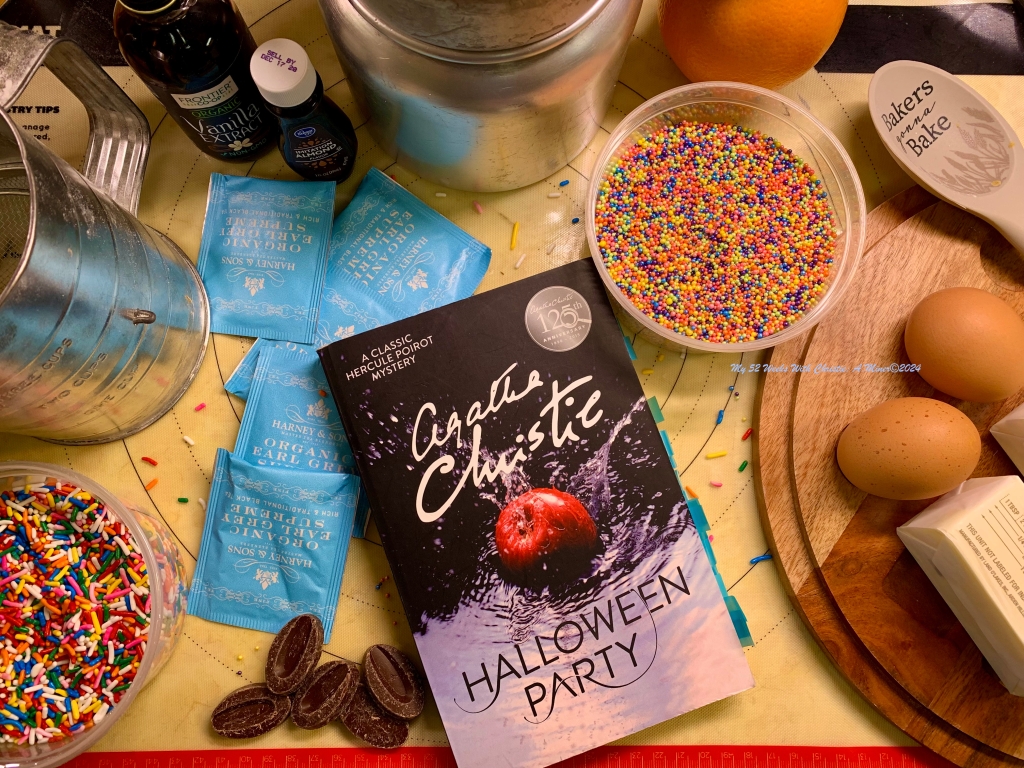
Part of the ingredient set up for baking the Orange & Earl Grey Madeleines! I also baked a batch of the Birthday Cake variety, just in case my experiment didn’t work….

It wouldn’t be late, late November unless service techs found something catastrophically wrong with our house….This time, our favorite plumber, Daniel, informed us: “Dude, your heating ducts are all messed up.” Which was great for him, as he could crawl around the bowls of our house and stay toasty, but for us? Not so much. When the HVAC tech shimmied into our crawlspace later the next week, he concurred with Daniel’s diagnosis. Apparently, nearly every one of the heat registers our furnace furnished with hot air wasn’t correctly connected and, in a couple of cases, not attached at all.
Sigh.
Of course, this meant the rapid dwindling of our savings and a couple days of strangers wandering around the house, thereby making it impossible for me to work on my other blog, which meant I could research a true crime or crime fiction topics to my heart’s content!
This year’s home repair inspired topic? Absinthe!
More specifically, if this green-hued spirit contained the power to corrupt the morals of anyone who drank it, erode entire cultures, and create fiends capable of committing grisly crimes (according to newspapers around the turn of the twentieth century). Then why haven’t I ever read a mystery where someone confesses ‘Absinthe made me do it!’ during the penultimate summing up? Variations of this basic defense, with supporting medical expert testimony, reached real-life courtrooms. So why not the page?
It turns out the answer to this question was far more circuitous than I had ever imagined. And to understand why ‘Absinthe made me do it!’ never caught on as a trope in mystery novels — I needed to unravel how absinthe came to be glorified then vilified in the first place.
Apparently, it all started with a bug named Phylloxera.

A pic of the different stages and sexes of Phylloxera from Le Monde Illustre
Unlike the indiscriminate palate of their aphid cousins, these native North American pests dine exclusively on grapevines. Targeting not only the plant’s leaves, Phylloxera loves chomping on roots as well, causing significant damage and deformation. If that wasn’t bad enough, these sapsuckers’ ceaseless chewing opens the plants up to a lethal secondary fungal infection. Worse still, even today, there’s no known cure for the louse or the fungus. While American vines evolved defenses to discourage this pest, nineteenth-century European vines (and those from the rest of the world, for that matter) were uniquely susceptible.


Part of the damage these bugs do to the grapevine roots & the bug. 1, 2, & 3
You don’t need to be The Amazing Kreskin to see where this is going.
It’s unclear exactly how Phylloxera managed to arrive across the pond. Some blame Victorian-era botanists for bringing tainted plant matter to England (as the bug devastated UK vines first). Others think European growers brought the pox down upon themselves through unregulated importation and experimentation with American grapevines. Still others believe the advent of the steamship, which allowed for quicker trips across the Atlantic, allowed the bug to hitch a ride and survive the crossing. Regardless of whichever explanation is true, in 1863, grape growers in France started reporting Phylloxera infestations — and in the blink of an eye, vineyards across France (and Europe) started failing.
While pockets of land inexplicably remained free from Phylloxera’s incessant hunger, it’s estimated that in fifteen short years, France lost anywhere between forty to sixty percent of its vines and vintners (the rest of Europe did not fare any better). To say this loss dramatically reduced the output of French wineries is an understatement — from 1875 to 1889, production fell by a staggering seventy-two percent. Of course, this led to skyrocketing wine and brandy prices which fewer and fewer people could afford to pay — thanks to the unemployment and resulting economic slump caused by the mass closures of farms, winemakers, and merchants.
Whilst mourning the loss of merlots, chardonnays, and rieslings — the French public was already primed with an alternative tipple.

A Pernod advertising poster.
During the 1830 French invasion and colonization of Algeria, troops were given absinthe to help prevent malaria. Not unlike the British officers in India, who found the taste of quinine-laced tonic water so off-puttingly bitter that they invented the gin & tonic cocktail to make it palatable, French soldiers started mixing absinthe with their wine rations for the same reason. When soldiers began returning home from the front lines, they brought a taste for absinthe with them. When France captured Algeria in 1834, the public keen on celebrating said ‘victory’ adopted the official hooch of the military campaign.
So, whilst grape growers scrabbled around trying to find a solution to the havoc wreaking root louse (which included pesticides, chickens, and burying dead toads), the French public turned to absinthe to quench their thirst.
My 52 Weeks With Christie: A.Miner©2024
This Week’s Recipe: Orange & Earl Grey Madeleines
Inspiration: Do you have a bake you’ve tried and tried — but it never turns out as it should? Well, if you haven’t, you’re one lucky duck!
In my case, my nemesis is madeleines.
No matter how many times I tried, I just could never make them turn out. Sometimes, they didn’t rise correctly; other times, they turned out tough as old boots, and on more than one occasion, I singed them….Yet, I persevered.
Why? Because I love those tiny little cakes!
Then I found this recipe by Think Fruitful and the Great British Bake Off set them as a challenge….and between these two sources and finding a pan that worked for me, I FINALLY made a successful batch after several years of trying!
Were they perfect? No. Were they good enough? Yes.
Over the last several years, I’ve gotten better at baking these tricky little treats, but I’ve still, on occasion, failed. So, let me tell you about the DREAD that filled my heart when one of my husband’s coworkers humbly requested Earl Grey Madeleines for her birthday…..Not only because these tasty tidbits and I share a complicated history — but also because I’ve never really managed to get a tea to infuse its full flavor into a bake.
Despite all this, I decided to give them a go.
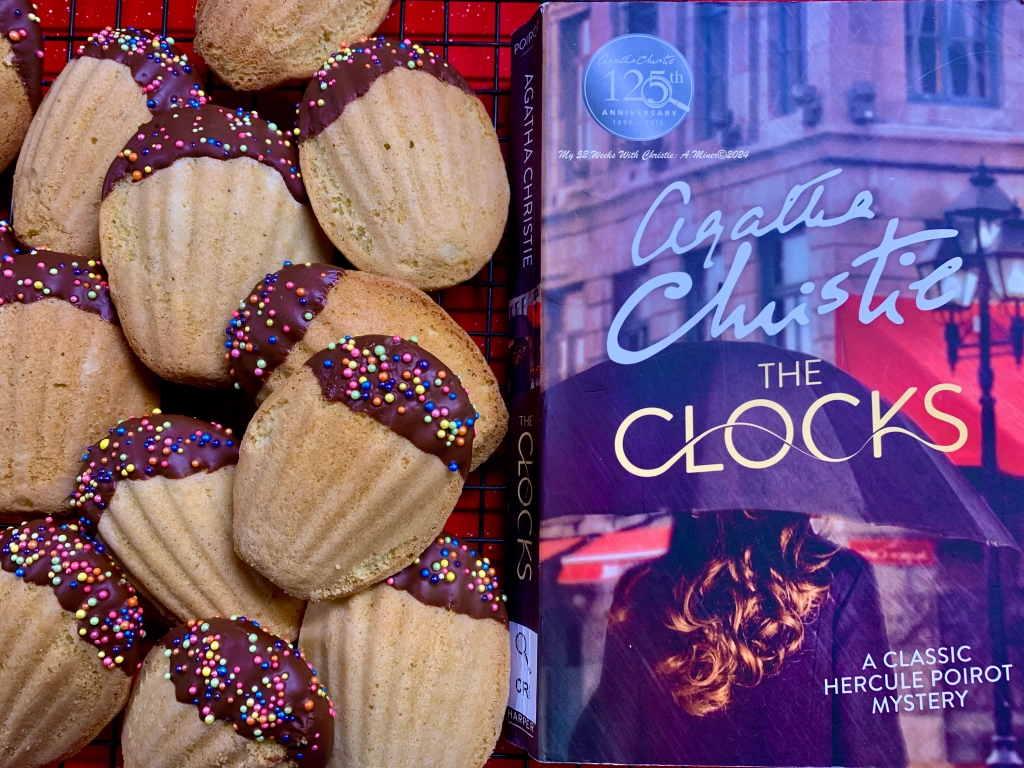
Eschewing all other recipes for the singular one that works for me, I adapted the Birthday Cake Madeleine recipe. First, I swapped out the vanilla and almond extracts for Earl Grey tea and the zest of one medium sized orange. The orange zest, plays well with the bergamot in the tea and adds an extra layer of flavor. (Plus, I still was not confident I could get a strong tea flavor into the cakes.)
Second, I cut open six tea bags and steeped the leaves directly in the butter for one minute whilst the butter was over the heat, then another five after I took it off the stove. Next, I strained the tea leaves through a fine mesh sieve lined with cheesecloth. Finally, I remeasured the butter and added a few grams back in — as not all of the butter made it through the transfer.
And….drumroll, please…..they turned out magnificent!
To make them extra special, I dipped them in 64% dark chocolate chocolate and sprinkled some pearlescent nonpareils onto the chocolate while it was still melty. The nonpareils added a bit of texture, whilst the 64% dark Madagascar chocolate, which the producers blended to have some citrusy notes, added a bit more texture and added yet another layer of flavor to the cake!
Christie: I finally made something I think Poirot would eat! Not only did these Madeleines taste great, they actually looked pretty as well!
Huzza!


Here’s the set up for a homemade potato au gratin recipe…it turned out okay….but a couple days later it was inedible….bleh!
 My 52 Weeks With Christie
You must be logged in to post a comment.