Golden Age Gals: Iris Little, A Real Life Mystery & Tangential Crime

About the time Constance and Gwenyth fade from sight, their youngest sibling comes into view. 

While included in a couple of U.S. censuses and passenger records in various ports of call, the youngest of the Little’s brood, Iris, doesn’t really come into focus until becoming the 1934 Women’s Table Tennis Champion. At this tournament, or perhaps the one the year before, Iris met her future husband Sydney Heitner (who’d won the men’s single division in 1933 and the mixed doubles in 1935). The two would marry sometime around 1935 (and definitely before 1938, as her father’s obituary uses her married name). 

Fast forward to 1950. 

Iris and Sydney are living at 32 Stephen Oval in Glen Cove, NY, with their two daughters — Jessie (age 9) and Sheryl (age 7), with a third baby (a boy later named Robert) on the way. Now 39 and an insurance broker, Sydney still participated in table tennis tournaments. One such contest drew him to New York City on March 30, 1950.

He never came home.

Detective John Quinn (of the Nassau County Missing Persons Squad), who’d been assigned the case, pinned down Sydney’s last confirmed sighting to a bar on 15th Street and Fifth in NYC. At first, Detective Quinn thought foul play of one kind or another occurred; however, as days passed, he found no evidence one way to the other. With all the available clues rapidly run to ground and the case growing colder by the day, the detective turned to the public for help.

On May 19, nearly three weeks after Sydney vanished into thin air, newspapers started running pieces citing the bare bones of the case and Sydney’s vital statistics. 

Iris, undoubtedly warned of the impending publicity, “prostrate” at the disappearance of her husband, and pregnant — took herself and her daughters to Maplewood (New Jersey) to stay with one of her brothers. A move which not only spared Iris from answering the standard battery of intrusive questions from reporters — it also protected her from addressing the gossip her next-door neighbors were more than willing to dish about the couple. 

Seems they told reporters Sydney and Iris recently “had a falling out”. Though the papers didn’t report what the pair argued over, Max Heitner (Sydney’s brother) refuted their claims by going on the record: “They have been married for 15 years and always appeared very happy.”

Speaking of Max, with Iris out of reach in New Jersey, her brother-in-law stepped into the informational breach. Supplying one reporter with Sydney’s photo and quote defending his sister-in-law in one breath…..…..And in the next, he provided the possible reason for such a marital clash to a different reporter. 

According to the Brooklynn resident, he was the last friend or family member to see Sydney in the flesh. Admitting Sydney asked him to drop himself and a “beautiful tall” lady-friend off at the 69th Regiment Armory to watch a roller derby bout. Though he couldn’t recall her name, Max did say this unknown woman disclosed a love of rollerskating and the ownership of a black four-door Oldsmobile. 

(BTW: From what I can suss out, the building hosting the roller derby is within walking distance from the bar where Detective Quinn said Sydney was last seen. So Max’s story could be true.)

Odder still, this wasn’t Max’s only conflicting account. 

After declaring his brother without a single enemy in the world….Max admitted he could not entirely brush aside the notion Sydney was kidnapped. Nor could Max discount the idea of murder, theorizing some hitherto unknown professional rival could’ve done away with his brother over a deal Sydney was due to broker (the day after he melted into the ether) that would’ve netted him a million-and-a-half-dollar commission.

The only explanation Max summarily dismissed was the suggestion Sydney was off somewhere suffering from amnesia, saying, “…it had never occurred in his family.”

From the Office of Fairness: It’s more than likely Max was beside himself with worry over his brother’s unknown fate. I know I would be if a sibling of mine vanished with only the clothes on their back and the change in their pockets. Moreover, I could totally see myself struck with a case of verbal diarrhea, which inevitably would lead me to spout off every theory and bit of info, no matter how trivial, to reporters, hoping it would lead to a breakthrough in the case…..Even the stuff which might place an unflattering light upon them.

However, the Miss Marple living within my brain wonders if the variety pack of mismatched details Max flung like confetti at reporters was really meant to muddy the waters while his brother fled to a new life, possibly in Austria, where Max and Sydney’s family originally hailed from — or — according to a rumor printed in Table Tennis Magazine 45 years later, to Florida “…to risk being a freedom-minded cab driver. Later he died under strange circumstances. Or someone had heard.” (BTW: I have not been able to verify a word of this rumor.)
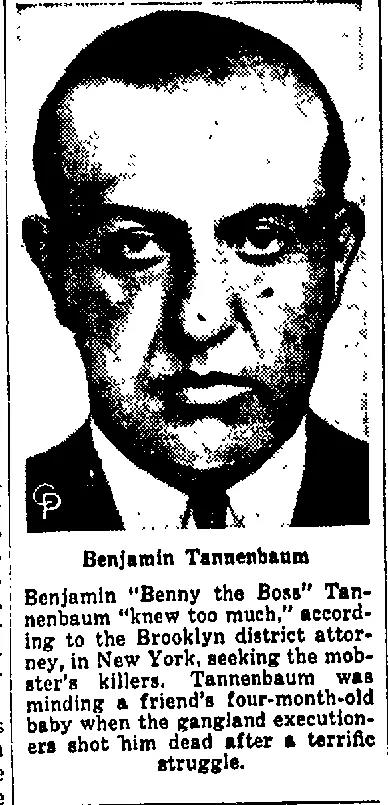
In any case, while not probable, it is just possible Max Heitner possessed the correct connections to hook Sydney up with forged documents, which allowed him to vanish without a trace……Seems, in the summer of 1940, Max Heitner and his wife met one Benjamin Tannenbaum while on vacation. Apparently, Benjamin and Max hit it off so well that by the time winter of 1941 rolled around, Tannenbaum was renting a room in Max’s apartment when he wasn’t on the road for work. Even better, Tannenbaum was an accountant and helped Max with the books for the apartment building he managed (and lived in) for his brother-in-law.

Everything was hunky-dory until 9:30pm on February 6, 1941.

That’s when Bertha Lipzitz heard a commotion coming from the Heitner’s apartment….followed by five gunshots. Waiting until she heard footsteps receding down the hallway, Bertha scurried down to the building’s super, who in turn called the police. 

Entering Heitner’s home through an open window on the fire escape, police discovered signs of a struggle, a discarded blackjack, and Benjamin Tannenbaum’s dead body (with two bullet holes) in the apartment’s hallway and four-month-old Paulette Heitner, who Tannenbaum had been babysitting, asleep in her crib. 

Police detectives thought the baby, who remained sound asleep under the watchful eye of a detective for the majority of their crime scene search, was the biggest surprise the night would hold….until the fingerprints of the dead man came back.

It turns out the nice, polite, and respectable accountant was none other than Benjamin “Benny The Boss” Tannenbaum — the notorious strong-arm man and accountant for Louis “Lepke” Buchalter and Jacob “Gurrah” Shapiro. A duo responsible for all kinds of crimes — including prostitution, racketeering, and the creation of Murder, Inc. (An enterprise that insulated organized crime families from the murders they wanted done by providing a fleet of unconnected contract killers, and zero paper trail.)

On the other side of the law at this point in time was Thomas E. Dewy. A special prosecutor for New York County whose sole job was to pursue, prosecute, and convict every member of the organized crime families operating in New York. 

Apparently, Dewey was very good at his job.

Of course, this led to no small amount of paranoia amongst the upper echelons of these crime syndicates. Anyone whom the bosses even suspected might’ve spoken to Dewey (or a member of his crew) or was targetted by the lawyer for grooming as an informant was summarily executed.

Hence the fatal visit to Heitner’s apartment. (It’s unclear if any of the aforementioned particulars applied to Tannenbaum, but apparently, no one wanted to take the chance.)

By the time Max Heitner and his wife returned home to 40 Featherbed Lane in the Bronx, shortly before 2am (she from a visit with a friend and Max from the movies), their apartment, the building, and the surrounding neighborhood were crawling with police. 

Unfortunately for Max, he’d been convicted on September 10, 1936, for “possession of policy slips” (basically, he was caught gambling and was given a $50 fine for it). This conviction allowed the police to arrest Max after they found two loaded revolvers in his apartment. An arrest that feels more than a little like a pretext so Dewey’s task force could tighten the screws on Max over his relationship with Tannenbaum, whom they thought “…had never been known to engage in any legitimate business unconnected with racketeering.” 

And whilst I believe Max’s courtroom denial of being clueless about the loaded firearms in his home. I am highly skeptical of Max’s claim he’d no inkling of Tannenbaum’s employment or employers. (BTW: I don’t know if Max Heitner was convicted on the weapon’s charge or not. After reporting he made it out of police custody on February 9th or 10th on $2,500 bail, there’s nothing. At least that I could find.)

Hence, I think it’s possible but not probable Max had the connections to secure the fake papers Sydney would need to vanish without a trace nine years later.

Or maybe Sydney just walked out on his life — without anyone’s assistance. He wouldn’t be the first husband to abandon his family for a fresh start. Or maybe this unidentified “beautiful tall” woman overheard Sydney speaking to Max about the massive lumpsum he was coming into, missed the part where he said the deal was on the morrow, and lured Sydney away from the bar on 15th and 5th to a location where some less-than-savory confederates jumped him and, in the scuffle, accidentally killed him.

Ultimately, Sydney Heitner’s fate remains unknown. 
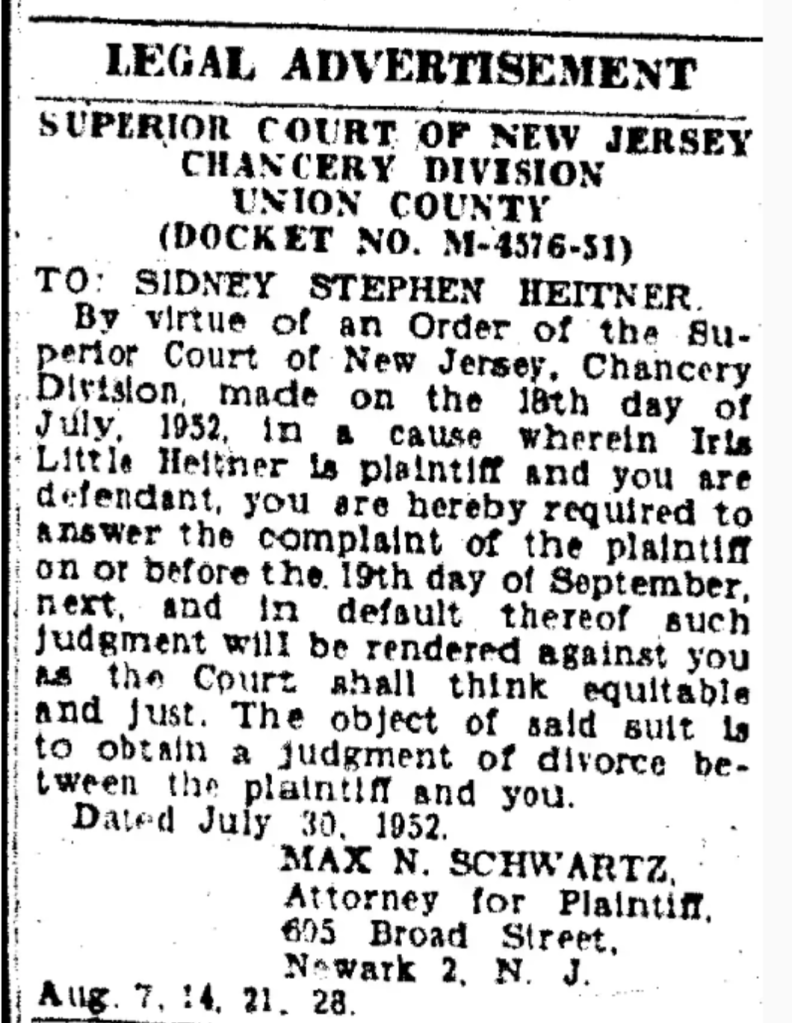
At least to the public at large. Interestingly, on July 30, 1952 — Iris Heitner started divorce proceedings against Sydney, which suggests she believed Sydney was still alive somewhere since she didn’t simply wait a bit longer and have him declared legally dead. (Though that could’ve been due to family politics.) 

And it’s within this unsettling interim period (1951 & 1952), Iris published her only two mysteries, Board Stiff and Death Wears Pink Shoes

And just like that — Iris Little Heitner, Constance & Gwenyth Little, and all their mysteries faded from the public eye.

My 52 weeks With Christie: A.Miner©2024
Golden Age Gals: The Little Sisters

The Little Sisters:

  • Constance B: September 18, 1899 Australia  D: 1980
  • Gwenyth    B: May 19, 1903 Australia                D: 1985
  • Iris M.         B: November 18, 1910 England      D: 2003

Lives:

Okay, so here’s the dealio: Whilst doing research for this piece, I fell into a deep genealogical rabbit hole which, in a weird way, fired up my competitive streak…Since I, apparently, took the lack of information on the sisters Little as a personal challenge, which I had a very, very difficult time letting go of once I started! Moreover, I still feel a vague sense of frustration at my inability to locate their graves, obituaries, or, in fact, much of any info beyond 1950.

Be that as it may, here’s what I’ve been able to piece together.

One line I kept reading over and over again when researching the sisters Little was: “How little is known about their lives.” Two huge factors contributed to this informational vacuum: A. All three sisters wrote under pseudo-pseudonyms. & B. Their father’s (and later their own) predilection for globe-trotting.

First of all, researching any female early on in the twentieth century is challenging because when women married back then, they lost their names. In this case, Gwenyth Little became Mrs. Bernard Hemming-Jones after her marriage in August 1930, and Constance Little became Mrs. Lawrence Baker sometime after August 1938. (We know this because, in her father’s obituary published in the same month and year, Constance is referred to as Miss Constance Little whilst her sisters were listed by their ‘Mrs.’ names. A fine yet important distinction.) 

Taking the name game to another level…Not only did the duo publish their mysteries under their “maiden” name Little — they swapped their given names for their middle ones! Legally, they were Jessie Constance and Norma Gwenyth. Now, in all likelihood, Constance probably went by her middle name for the majority of her life since she and her mother shared the same first name (Jessie). As for Gwenyth, your guess is as good as mine as to which name she favored outside her role as author.

(BTW: For the sake of clarity in this post, I’m going to stick to the names printed on their books — Constance & Gwenyth.)

We’ll get to Iris next week.

Armed with this info, I started verifying the facts in Carol Hetherington’s 2007 paper (Little Australians? Some Questions about national identity and the national literature) and the info included in the Rue Morgue Press’s reprints of the Constance & Gwenyth’s books. Scouring several vintage newspaper sites and genealogical sites, I started building a picture. 

Their claim to have circumnavigated the globe three times does not appear to be an idle boast. 

Born in Sydney, Australia, to James F. Little and Jessie Gilchrist. Constance and Gwenyth also had two brothers, James A. and Robert. Sometime between 1906 and 1909, their dad announced he’d “…grown tired of Australia…” packed up his family and sailed for London, where he found work as a consulting actuary, and his last child, Iris, was born in 1910. From London, James F. took a job with the Mexican government and moved everyone to Mexico City. By the time 1911 rolled around, he’d accepted a position with Prudential in New York City and set sail once again.

Finally, by 1915, the Little family settled in Maplewood, New Jersey. (Though in 1924 James F., Jessie, Constance, Gwenyth, and Iris returned to Australia for a visit — and whilst on the way back and forth they visited Wellington (NZ), Rarotonga, Pago-Pago, Honolulu, and Los Angeles.)

Then, sometime prior to 1926 (as that’s when they returned home), both Constance and Gwenyth were sent to England for an education. This is where Gwenyth undoubtedly met her husband, Captain Bernard Hemming-Jones — and in 1930, both sisters would again hop onto a steamer and set sail for London, with one returning as a Mrs. Bernard Hemming-Jones.

In January 1930, Constance petitioned for her naturalization papers (which is where I found her photo) and became a US citizen in 1932. Norma would petition for her papers in 1938 (though there’s no photo with her application). 

At this point, I lost track of Constance and Gwenyth in the genealogical records. However, this is when they started writing their ‘Black’ series.

Writing:

Unlike many mysteries, these do not share the same detective. Instead, these stand-alone books share similar features: 

  • All fall within the screwball genre of detective fiction. 
  • All the sleuths are female, with tangential male figures involved. 
  • All minor and major plot points are wrapped up in a neat bow at the end of the book.
  • All have a great sense of humor to counterbalance the somewhat bloody murders happening off-stage. 
  • All, other than The Grey Mist Murders, use the color ‘black’ in the title and have a corresponding ‘black’ clue.

According to one interview, all the books Constance and Gwenyth wrote were written in bed as “Chairs give one backaches.” Their writing partnership, whilst constantly evolving as things do, started with Constance giving Gwenyth detailed plot outlines and Gwenyth fleshing out the final drafts.

Books:

Published under the Pseudonyms: Constance & Gwenyth Little and Conyth Little (in some UK versions)

  • 1st Books: Grey Mist Murders &The Black-Head Pins (1938)  
  • Last: The Black Iris (1953)
  • No. of Books In Series: 21 novels & at least 1 short story   Setting: U.S. & Australia

Iris Published Under the Pseudonym:  Robert James (An amalgamation of her two brothers’ first names.)

  • Board Stiff (1951) & Death Wears Pink Shoes (1952)

My 52 Weeks With Christie: A.Miner©2024

Cooking With Christie: Outtake

Buttermilk Catfish Fry — This didn’t turn out flawlessly, mainly because this was the first time in over two decades I’ve fried anything in oil unsupervised by another adult. So once I get this down pat, I’ll post a more comprehensive recipe!

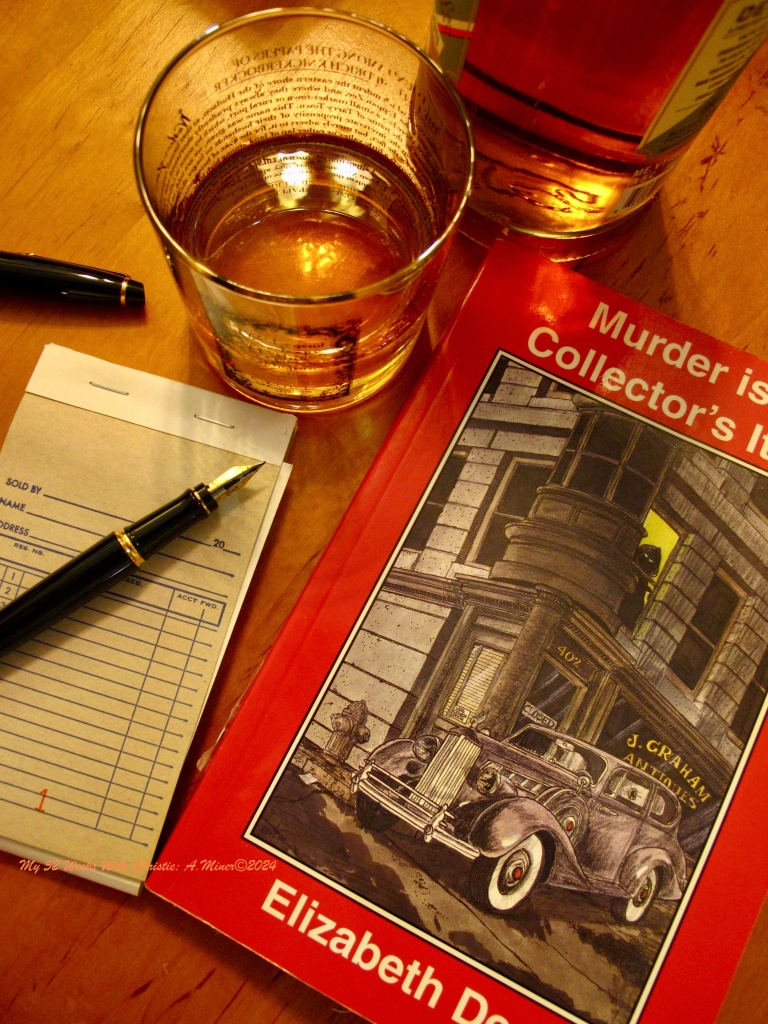
Mystery Review: Murder is a Collector’s Item

For the last few months, I’ve been in a reading drought. 

Nothing I’ve picked up since Tress Of The Emerald Sea really hit home in the same way as Tress, her quest, and her collection of teacups. This immediate attention grab, for which Brandon Sanderson is adept at creating, rendered other books pale and uninteresting by comparison…or I’m tired of having to wear reading glasses every time I pick up a book these days.

It could be two things, I suppose.

In any case, when writing about a Golden Age Gals, I always secure at least one book by said author in order to form my own opinion on their writing. 

And let me tell you, this book — finally — burst my funk!

Murder is a Collector’s Item is an outstanding read! Not only does it hold up well against today’s eye, the humorous (though not screwball) mystery is engaging and believable.

What I appreciate, above and beyond the well-placed zingers, dry humor, and a mystery that Plays Fair, is Elizabeth Dean’s conscious effort to put Emma Marsh front and center. The majority of the mystery is told from Emma’s perspective. Even better, Dean doesn’t gloss over the foibles of a twenty-something female living on her own. The science experiments growing in the back of the icebox, clothes strewn across the bedroom floor, a habitually unmade bed, and dusty dishes sitting in a cupboard — are all things I understand. (And grown out of. Mostly. Though, that fridge science is a tough one to beat.) However, with my twenty-sixth birthday well and truly in the review mirror, this glimpse back into the past made me laugh.

I delighted in watching three separate investigation threads, whose ultimate goals varied slightly from one another, all propelled the mystery forward. Emma’s pure logic and luck (both bad and good) balanced well against her boyfriend’s application of the psychology angle, which was tempered by the Boston cop’s practical and pragmatic approach to the crimes. 

Moreover, I enjoyed watching Emma balance the stresses of her job. The battle of wits when trying to pitch the possible perfect (for them) item to a dithering customer, dealing with the foibles of a temperamental boss who you love (platonically) to bits but occasionally want to strangle with your bare hands, and the competative thrill of unearthing a gem from a rubbish heap you can sell for an order of magnitude more than what you paid for it. These are just some of the things I miss about my time at the book and record shops I once worked in. Plus, it’s fun to imagine how I’d balance my job duties against trying to suss out a murderer — something I never found myself needing to do.

I would happily recommend reading Murder is a Collector’s Item to anyone looking for a mystery on the lighter side. It’s not a cozy, but the murder(s) do take place off-stage, and the dry wit is precisely measured, so it only adds to the story without distracting. 

Seriously, it is worth the few extra clicks to find a used copy hanging out in the corners of the interwebs — I don’t think you’ll be sorry!

My 52 Weeks With Christie: A.Miner©2024
Cooking With Christie: Dispelling A Chill

This Week’s Recipe: Throw Together Chicken Soup

Inspiration: Recently, a cold snap hit where we live, and in response, I decided to make some soup. However, I’ve made a lot of tomato soup this winter, so I decided to switch things up a bit and make chicken soup instead. 

First, I roasted a whole chicken. Next, after the bird finished cooking, I separated the meat from the bones and then made soup stock (setting the meat aside for later). Finally, after the stock finished cooking and I strained the spices, veggies, and such from the liquid (tossing the solid bits into the compost bin), I added frozen peas, a cup of frozen corn, a cup of fresh carrots, a cup of minced celery, a couple of cups of chopped up chicken, salt, pepper, turmeric, chili flakes, and rosemary (to taste) to the pot of stock. Then let the whole thing simmer until the carrots soften up!

Now, if you don’t have time or don’t want to take eight hours making soup (which sounds way more intense than it is, as there are hours of hands-off time whilst things simmer or bake away), you can achieve a similar effect by using a rotisserie chicken and store-bought soup stock. However, due to my stupid, stupid allergies, I didn’t want an end product that would invoke my body’s uncomfortable reaction to prohibited foods — hence the longer process.

Slight Controversial Issue: As I made a large batch intended to span several lunches, I omitted the noodles. Now, hear me out before you start yelling. Noodles absorb the liquid as they sit, making the soup either overly thick or the texture off as they become mushy. Also, because I intended to eat toasty-cheese sandwiches dipped in the soup’s broth, I figured the bread more than made up for the missing noodle carbs.

Christie: I can see Miss Marple making a version of this staple with whatever leftovers she had lying around in the fridge during the colder months in St. Mary Mead!

Cooking With Christie: Outtake

This Creamy Orzo with Parmesan & Green Peas is relegated to the outtakes as it’s made with all kids of stuff I’m allergic too (and therefore poisoned myself slightly when I tried a bite) like white wine, onions and garlic. However my husband enjoyed it, so if you want to try the recipe, it’s in the book below (which is full of plenty non-allergy inducing dishes, I just possess the brains of a gnat when I decided to take a bite). It’s a good dish to make if you’re wanting to make something nutritious but your brain is a bit foggy — as it a good set and forget dish.