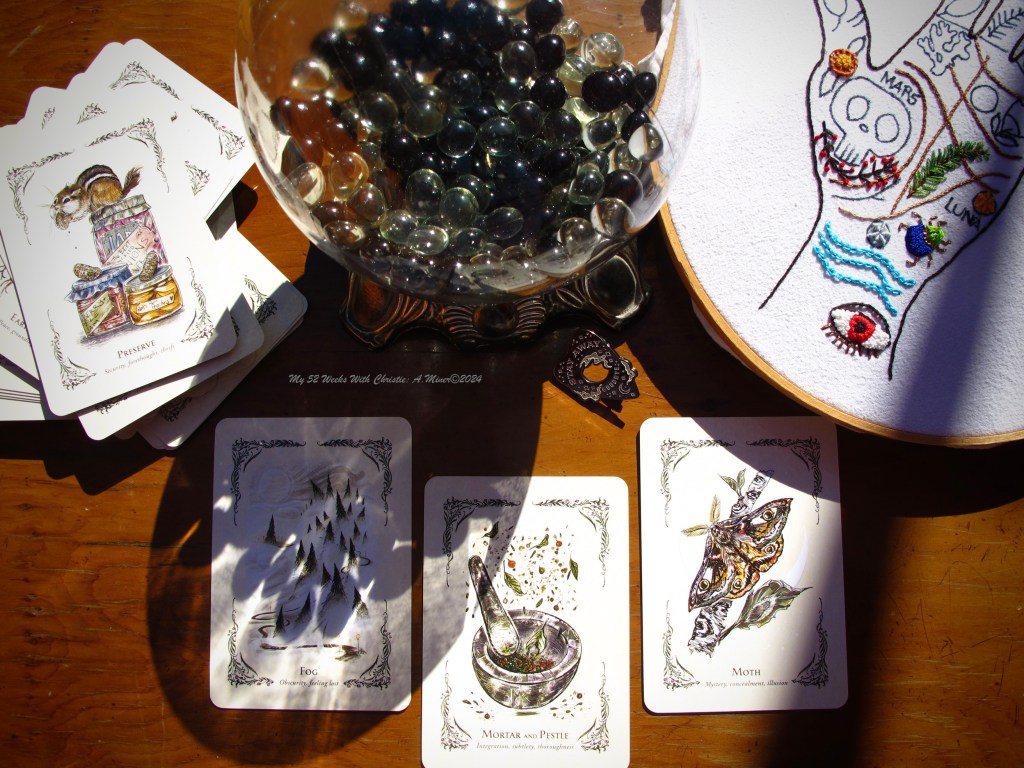
Possible tools of Louisa’s trade.
Now that Louisa Lindloff’s lawyer, George Remus, dealt with the arsenic hued elephant in the (court)room, it was time to address a far more problematic aspect of the case — Louisa’s pinpoint prophesies of death. Obviously, correctly predicting the exact expiration date for (at least) seven separate people is a tough mountain for any defense to climb. Yet, this peak wasn’t insurmountable, thanks to the mercurial nature of Chicago juries and the well-established Murderess Acquittal Formula.
However, the climb did prove far more treacherous than first anticipated after Judge Thomas G. Windes allowed Assistant State’s Attorneys Smith & Lowe to introduce the deaths of Julius Graunke, John Otto Lindloff, William Lindloff, Frieda Graunke, and Alma Graunke as well as, the corresponding life insurance payouts into evidence. These deaths, when taken in conjunction with Arthur’s (the only family member Louisa was actually on trial for murdering) and the ledger found secreted away beneath a floorboard in Louisa’s wardrobe (which demonstrated the correlation between Louisa’s dipping bank balance and the alleged murders) made the pattern crystal clear.
Though this judicial decision was problematic, it didn’t seem to alter the razzle-dazzle strategy Louisa and her legal team set in motion in the run-up to her trial in November 1912.
Now, you need to understand that by the time Louisa’s alleged crimes came to light, Spiritualism was simultaneously flourishing and floundering in the United States. Spurred on by grieving families who lost fathers, husbands, brothers, and other relatives in brutal battles during the Civil War (forty-seven years before), this idea that the spirit remained intact after death and could be contacted brought genuine solace to those in mourning. (Spiritualism saw a similar uptick in popularity after WWI as well. Hence its inclusion in so many golden age mystery stories, including a Miss Marple short story, Motive v. Opportunity.)
Unfortunately, it didn’t take long for those with an eye for the main chance to start taking advantage. Now, to be fair, some spiritualists sincerely wanted to help the bereaved and those searching for answers. However, a far greater number chose to twist Spiritualism for their own gain.
Like Chicago’s own Bangs Sisters.
Operating out of their parlor, May and Lizzie conducted seances during which the spirits sometimes “created” either writings or portraits for their still-living loved ones — for a hefty fee.
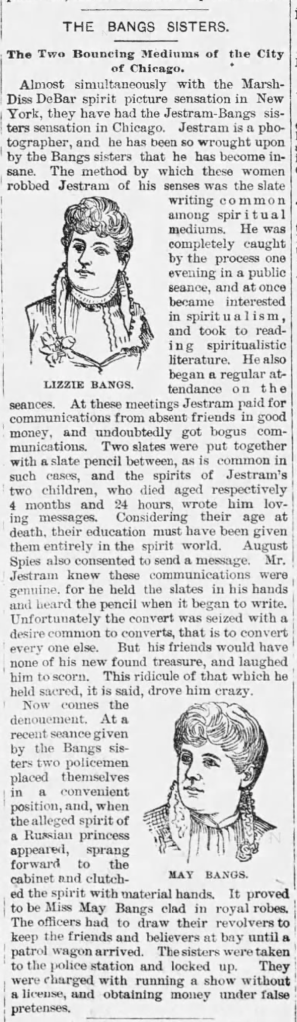
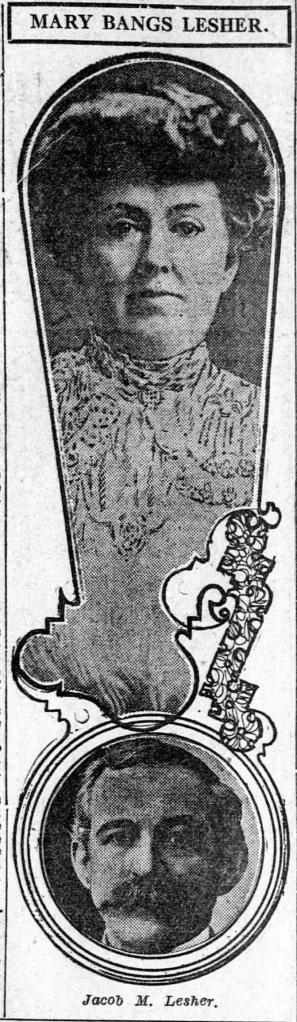
The first article about how the Bangs Sisters drove a prominent Chicago photographer, Henry Jestram, insane with messages from the dead. Many in Chicago blamed the pair for Jestram’s commitment and subsequent death inside an insane asylum. The second photo is (obviously) of Mary “May” Bangs and her ex-husband – who married her because his dead mother “told” him to do so.
However, by the time Louisa’s trial came around in 1912, a massive number of mediums, fortunetellers, and their ilk had been publicly unmasked as frauds. (Including the Bangs Sisters, who had their deceit exposed once in 1901, again in 1909, and finally sometime before 1913.)
Yet, despite the growing body of evidence compiled by scientists, magicians, and authorities demonstrating the literal tricks of the trade — people still wanted to believe.
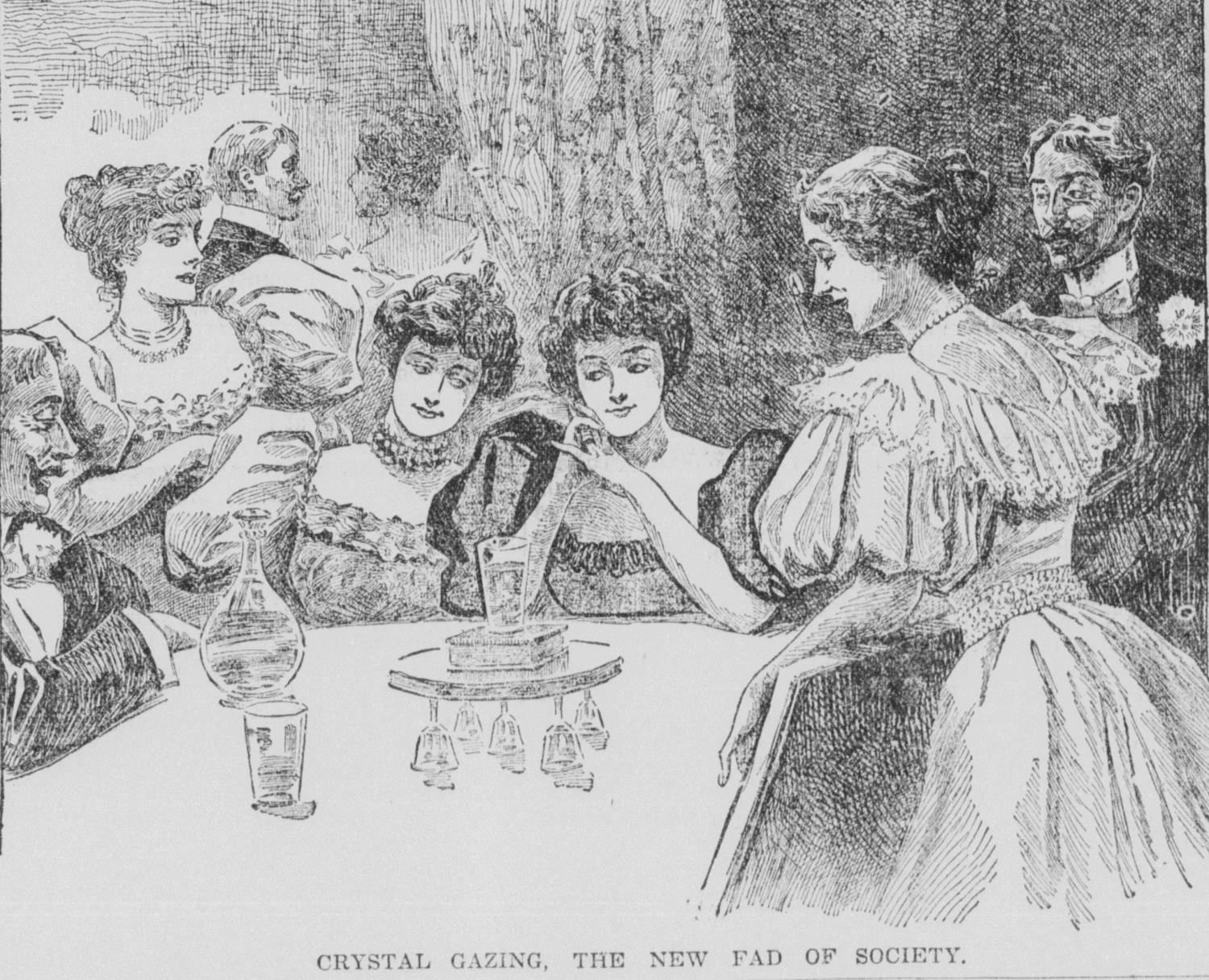

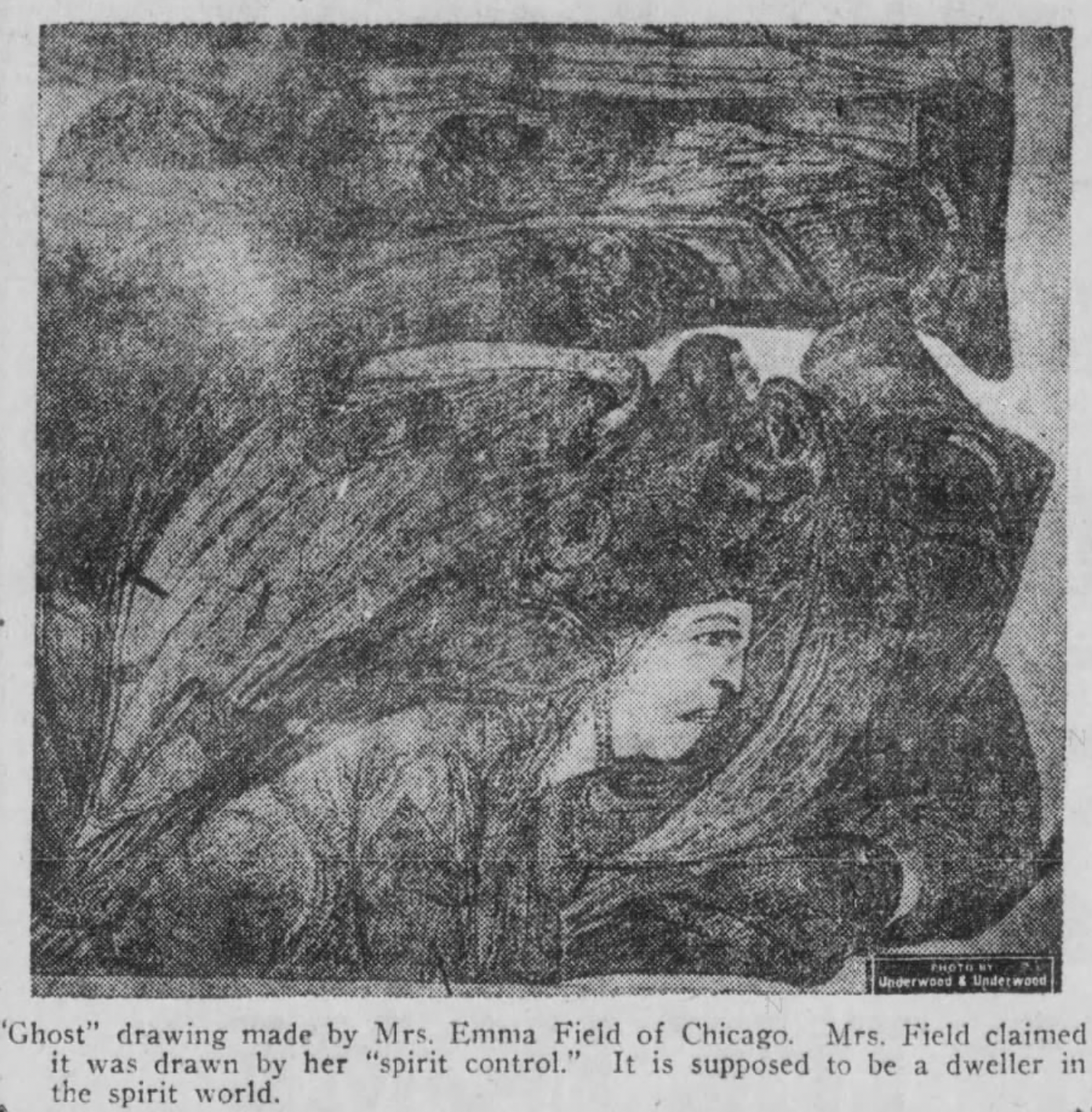


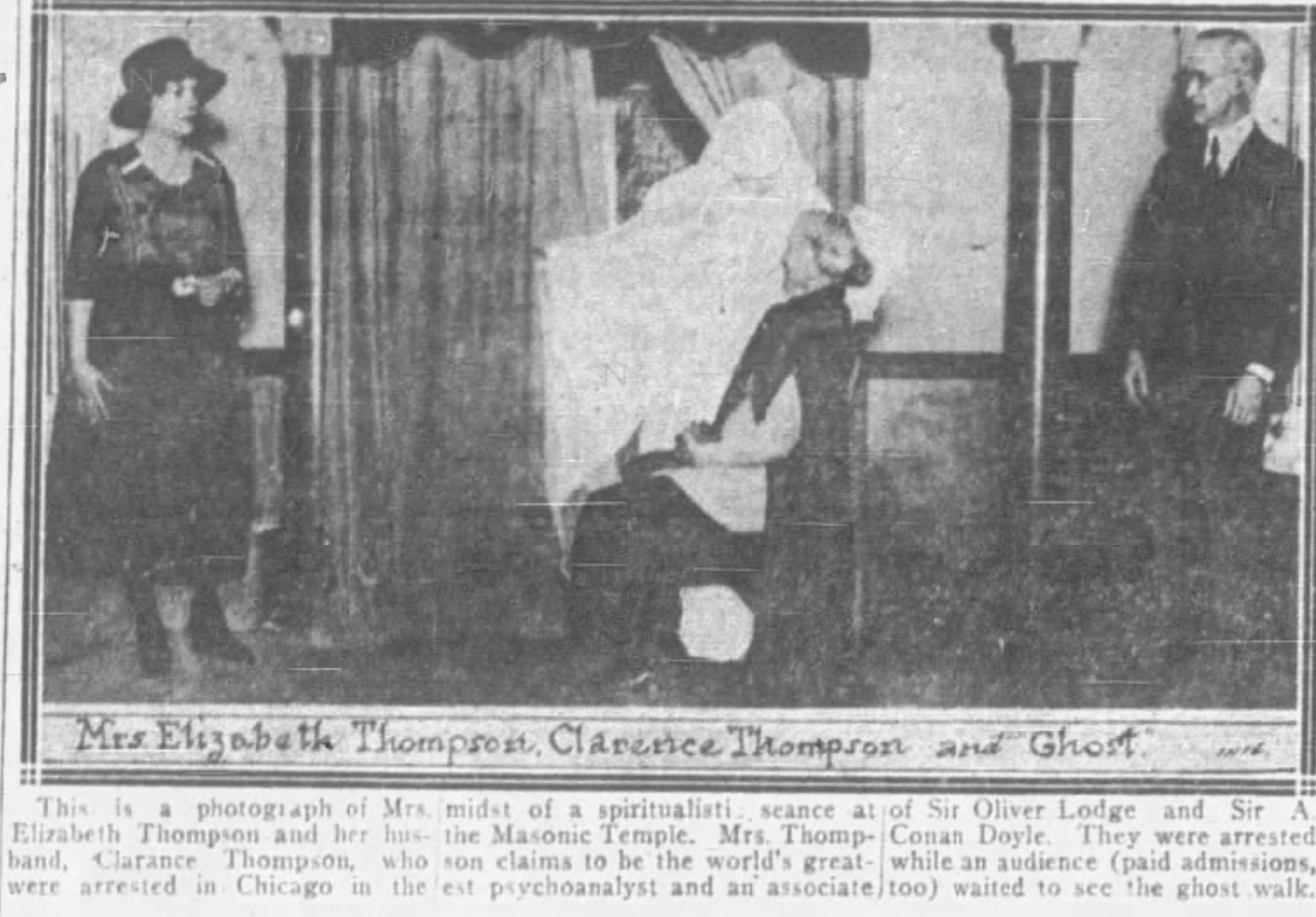
Just some of the coverage Spiritualism received back in the day. From L to R: A) When one did not own a crystal ball, a glass of water would work equally well for seeing into the future. B) Spirit boards were often employed by mediums. C) An “authentic” spirit drawing. D) Sir Arthur Conan Doyle being photo bombed by fairies, now debunked. E) An advertisement/bio of a clairvoyant. E) A “ghost” appearing during a seance.
Whether Louisa counted herself as a true believer or amongst the double dealers hardly matters.
What does signify is the fact that within short order upon arriving at Cook County’s Murderess Row, Louisa leaned heavily into her advertised occupation of spiritualist medium. To this end, Louisa installed her favorite crystal ball within her jail cell. When reporters asked about the clear sphere, Louisa proudly boasted she’d paid $500 for the instrument, which contained a single tear shed by Cleopatra over Marc Anthony’s resting place within its heart. When used with her own second sight, this extraordinarily powerful reagent would swell and stretch beneath her gaze until images from the future filled her vision and/or she contacted someone across the River Styx.
Unsurprisingly, Louisa used the crystalline orb to contact the son she was accused of murdering: “She says that she has communicated thus with Arthur, and that he tells her she will be exonerated, but that she is unable to get in touch with her late husband Wm. Lindloff. However, she is assured that Arthur will look him up.” This prediction, made just eleven days after Arthur’s death, was one of the first in a lengthy string of prophesies Louisa would deliver to anyone and everyone in earshot.
And many were listening.
Amongst Louisa’s most vocal supporters were her fellow mediums, necromancers, and the like. During Louisa’s many and varied court appearances, these spiritualists routinely relayed their visions and spirit guide messages to reporters — all of which confirmed Louisa’s gifts, innocence, and imminent acquittal. Moreover, they and sympathetic members of the public contributed to Louisa’s defense fund, raising well over $1,800.

The close ups of her mouth and nose were trying to show the paper’s readers how Louisa’s features identified her as a murderer.
Although the state’s tests and investigation of Louisa’s crystal ball revealed it to be nothing more than a fifty-cent orb of glass, this information did not (seemingly) affect Louisa’s clients’ faith. Although ASA Smith & Lowe compelled a few to corroborate that Louisa had predicted the exact dates of several familial deaths (which Louisa later denied doing). They also testified to numerous predictions Louisa made that came about, which she couldn’t possibly have influenced the outcome of. (Louisa also made similar death day prophecies to Dr. Warner for Alma and Arthur’s death and predicted Arthur’s death at Alma’s funeral to her favorite Undertaker.)
(BTW: The loss of access to said sphere for police testing did not stem the tide of Louisa’s predictions. Instead, she would perform long, complicated divination rituals before an altar constructed from a framed photograph of Arthur and gifts he’d given her to achieve the same results.)
To the jaded eye, this spiritualist angle appears to be nothing but a bunch of balderdash meant to feed the press and distract the public from the correlation between death and benefits. If it also happened to plant the idea Louisa was far too silly to commit such ruthless acts, so much the better.
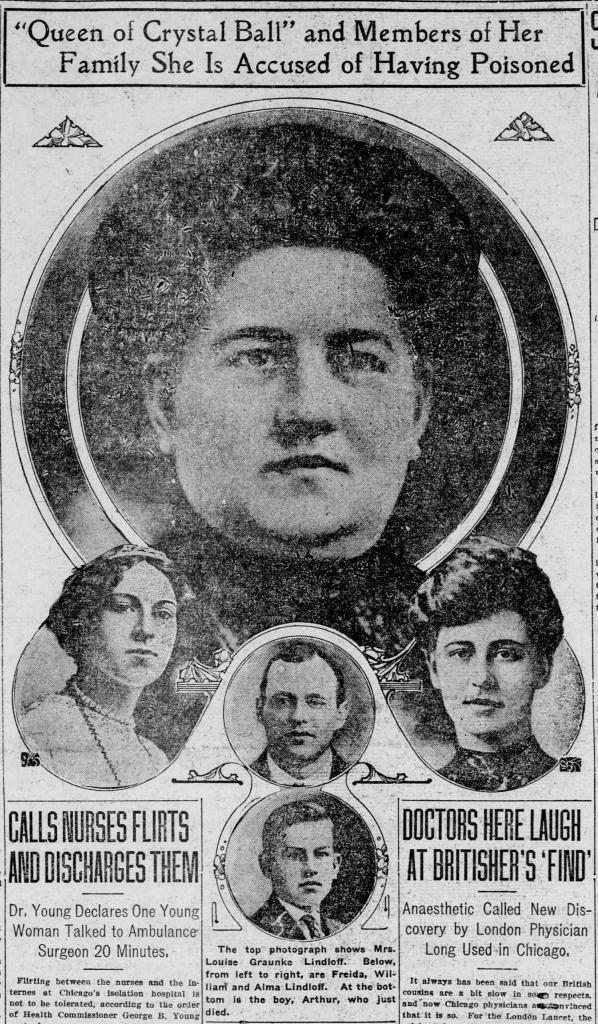
Another headline of Louisa’s alleged crimes.
Next, George Remus attempted to fashion Louisa into a sympathetic figure caught in a web of circumstances far beyond her control.
To this end, and to the complete surprise of everyone, Louisa included a hitherto unmentioned death while testifying in her own defense. Fourteen years before Julius’s death in 1905, Louisa and Julius’s infant son, Erick Graunke, died unexpectedly in 1891. In the article I read, there wasn’t a clear reason why Louisa brought Erick and his death up….Other than trying to garner sympathy from the jury? And/or hoping to get remains tested for arsenic, knowing none would be found, thereby breaking the pattern? I know it sounds unkind to intimate Louisa used her baby’s death for her own ends, but up until this point, he’d not come up once. So why now? It just seems…..well…..slightly shady that she would bring up his death at this point in time when no one in either Wisconsin or Illinois had once questioned it.
(And this wasn’t the only time Louisa might’ve used an infant for her own ends. According to Captain Baer and Milwaukee prosecutors, there was a fair chance Louisa experimented with arsenic or other substances on a five-month-old infant she helped care for, leading to their death in 1907.)
Next, during her nearly two hours on the stand, Louisa elaborated on several tidbits she had shared with the press earlier in her incarceration. First, she painted her first husband, Julius Graunke, as a serial adulterer. Who passed a STD to her, and she unsuspectingly gave her children and second husband. Moreover, after mustering the courage to leave him, Julius tricked her into a reconciliation three months later. (BTW: While her neighbors in Milwaukee neither confirmed nor denied Louisa’s account in the articles I read, MANY testified to the fact they suspected she was carrying on with another man before, during, and after Julius’s last illness.)
Following her harsh account of Julius, Louisa portrayed John Otto Lindloff as a drunk whom neither she nor his brother/her future husband wanted marrying Frieda (Louisa’s eldest daughter).
At this point, Louisa donned the mantle of a long-suffering mother whose other daughter (Alma) routinely stayed out all night drinking and dancing. Utterly undeterred by Louisa’s warnings about her frail health or “whippings” she received, Alma continued to do as she pleased until her fast lifestyle caught up with her. (Whether these “whippings” were physical or verbal is unclear). Finally, Louisa painted herself and Arthur as victims. He, being a “good boy”, was forced to endure an STD he’d done nothing to earn. While she helplessly watched everyone she loved fall like dominoes due to the unexpected consequences of the arsenic laced medicines they all were compelled to take due to Julius’s infidelity.
Now, with the arsenic accounted for, circumstances sufficiently muddied, and a sympathetic tale on record, George Remus turned his sights on the last problem sticking in the proverbial craw of his defense — a one Miss Sadie Ray.
My 52 Weeks With Christie: A.Miner©2024
 My 52 Weeks With Christie