Cooking With Christie: Sussing out a mystery with sprinkles?

“He doctored the hundreds and thousands…” 

Upon encountering this solution for the first time in the Miss Marple short story, The Tuesday Night Club, I was left baffled. Why? Because up until that moment, I’d never encountered hundred-and-thousands before.

Or so I thought.

Turns out I knew exactly what they were only by a different name: Sprinkles. 

Since that day, I’ve learned these tiny confections are much like Shakespearian roses — tasting just as sweet whether they are called hundreds-and-thousands, jimmies, jazzies, vermicelli, nonpareils, pearls, shots, or snowies. Though there are minor variations amongst them, to my mind, they all fall under the broad umbrella of sprinkles. 

Okay, fine. 

Satisfied with finding the answer to my question, I moved on to the next Miss Marple mystery. Yet, upon subsequent reads, beyond making me giggle at my younger self, something about “He doctored the hundreds and thousands…” still nagged me. Something I couldn’t quite put my finger on until I started baking cookies every Thursday to share with Seattle Mystery Bookshop patrons on Fridays. 

How did this nefarious fictional husband manage to “doctor” those hundreds-and-thousands? 

At first, I theorized he shook them in a jar with the poisonous powder. The only problem? The baddie intended to do away with his wife straightaway, and I’m not so sure this dusting would impart enough arsenic to achieve his hideous objective. (Nor is this something I am going to fiddle around with to find out. There’s a limit to my dedication to this blog.) 

Moreover, simply tossing the sprinkles around in an arsenic based powder (like so much lettuce in dressing) would leave behind a visual clue. Which could be mistaken for some sort of spoilage. Leading the victim to leave her desert uneaten and her husband’s wicked plan unfulfilled. 

Neither could this villain simply soak the sprinkles in an arsenic solution to impart the element’s death-dealing properties. As sprinkles, being composed primarily of sugar, would melt. Knowledge my much shorter self acquired by watching a generous measure of nonpareils melt into my ice cream nearly every Saturday evening at my grandparents’ house.

So, how did the murderer do it?

Since I’ve never lived in a world where sprinkles, snowies, hundreds-and-thousands, jimmies, jazzies, and nonpareils haven’t been available on grocery store shelves in tubs, tubes, and cartons. It took me far longer than it should’ve to arrive at a solution. 

Or, at least, an answer that makes sense to me

Then, a few months back, during a commercial break in The Great Canadian Baking Show, several of the former popular/winning contestants popped back onto the screen, extolling the virtues of a particular food product by demonstrating its versatility. Witnessing one of the former bakers piping tidy rows of raw sprinkles onto baking sheets caused my little grey cells to sit up and sing.

This was how the foul spouse “…doctored the hundreds and thousands…” 

He made his own.

Theory firmly lodged amongst the folds of my brain, I did a bit of sleuthing to see if this idea was even remotely possible. Whereupon I learned the machine-made sprinkles I love to put on anything, and everything are just over one hundred years old. 

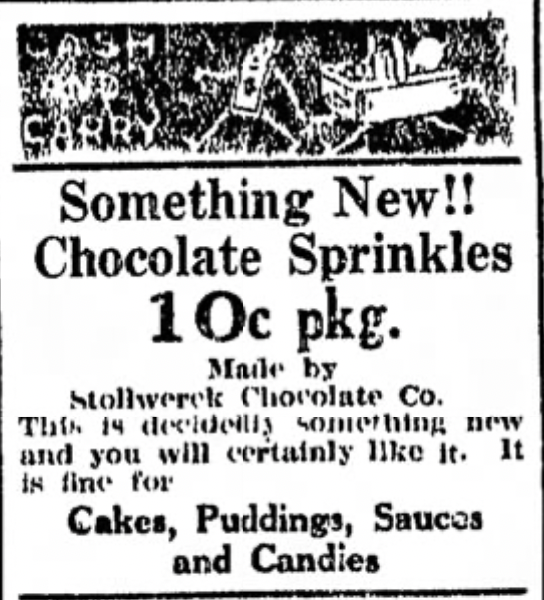
According to Wikipedia and corroborated by advertisements I located, chocolate sprinkles started becoming commercially available across the U.S. around 1921. Seven years after, a pair of Dutch candy companies pioneered a similar product. Which, unlike many of their American counterparts, actually contained real chocolate. (Though how fast these manufactured petite sweets traveled across the English Channel and into the UK, I don’t know.)

Although this technological advent is fairly new (in geologic terms), homemade sprinkles date back several centuries. Apparently, there’s several French pastry recipe going back to the seventeenth century which gives bakers the option of topping their treats with nonpareils or sanding sugar. Even more exciting, thanks to Michigan State University’s Feeding America: The Historic American Cookbook Project, there’s an indexable cookbook with a recipe for nonpareils dating back to 1864!

This quick and dirty timeline, when paired with the fact that Agatha Christie published The Tuesday Night Club in 1927, shows us that Agatha Christie, Miss Marple, and the killer all inhabited a world before mass-produced sprinkles stepped into the limelight. More importantly, the knowledge of how to make snowies at home hadn’t been shunted off to the periphery of baking — yet. (Where these recipes lingered for nearly a century until Covid lockdowns gave people time to explore the margins of baking again.)

Okay, fine, he made his own sprinkles. 

But how did this villain ensure his unsuspecting wife would eat a lethal amount of arsenic via these crunchy bits of formed sugar? Mind you, this is only an educated guess, but I suspect he substituted rat poison for a portion of the powdered sugar and swapped the clean water for some he’d adulterated with flypaper. Then, he instructed his accomplice to use a heavy hand when applying the poisoned pearls to the top of the trifle. 

(Please, don’t do this.)

Remember, this murder took place in 1926-1927 when manufacturers of rodenticides and insecticides happily embraced arsenic as their active ingredient. Despite the colorants producers added to their products, endeavoring to dissuade people from administering rat poison to their nearest and dearest, this fail-safe often fell short. In this fictional instance, so long as this diabolical husband stuck to making chocolate sprinkles, this “safety feature” was easily circumvented. 

Above and beyond ensuring his wife’s untimely death, this murder-minded spouse accomplished several other feats by making his own hundreds-and-thousands. Recall that aforementioned accomplice? The effort this man took to “doctor” these sprinkles, more than likely, allowed him to manipulate his desperate (according to the text) younger lover/accomplice into carrying his heinous plan over the finish line. 

In a — I did my part, now it’s your turn — kind of scenario.

Though I wonder: Did his female accomplice realize he was setting her up to take the fall? Because I bet dollars to doughnuts, this crooked husband could prove he never set foot in the kitchen the day that terrible trifle was served (and probably most others). Why would he? He had both a wife and a maid to take care of the canning, candy-making, and meals for him.

Next, by partaking of the tainted treat with his wife, he misdirected attention away from the nefariously designed arsenic ladened sprinkles and himself. A calculated risk that bought him a breath of deniability should his wife’s murder and its method come to light: 

OMG, if I hadn’t scraped those hundreds-and-thousands of my portion, I would’ve followed my wife to the grave!/ I don’t care for their texture./ They were contaminated with arsenic, you say? How can that be? My wife always bought XYZ brand. Oh no! Has someone else died?/ They were handmade? You don’t say./ She said what? She‘s crazy! I never did anything to encourage her affections. I was a happily married man./ She says I made those hundred-and-thousands? How? I can’t even boil water!

And so on and so forth. Until…

It wasn’t I who sprinkled the hundreds-and-thousands on that damned trifle.

At least that’s how I imagine the murderer might have used the era’s everyday sexism as a smokescreen, why I believe he made chocolate sprinkles to complete his evil deed, and the method he used to “doctor” the hundreds and thousands in this classic Miss Marple mystery.

My 52 weeks With Christie: A.Miner©2025

Caustic Candy: When a Frame Falls Apart

In an uncanny case of serendipity: While the curious citizens of Pierre, South Dakota, congregated outside the courthouse after the Coroner’s Inquest, someone linked to the investigation overheard a local confectioner remark that on Saturday, February 27, 1904, the day Rena Nelson said she received and ate a piece of poisoned candy — she’d come into his shop asking for an empty candy box. This tidbit marked the second inconsistency tallied that day. The first came during the testimony of one of the physicians, who noted That while a victim may linger in agony for upwards of fourteen days, the initial symptoms of an acute case of corrosive sublimate poisoning spring up within a few minutes or hours of ingestion. In other words, the science didn’t tally with Rena’s account of eating the tainted sweets on Saturday morning, feeling iffy on Sunday night, and then falling gravely ill on Monday morning. Compounding these two incongruities, Sheriff Laughlin admitted basing his pursuit of Belle Dye on Rena’s word — believing Rena’s sterling reputation provided the necessary veracity to establish his case.

So on March 10th (or perhaps 11th), authorities finally started corroborating the particulars of Rena’s accusation.

Pulling at the most straightforward thread first, investigators visited the shop of the confectioner whom they’d overheard earlier that day. Whereupon they learned that Rena did indeed stop by his shop looking for a candy box but left empty-handed as she said none that he stocked suited her purpose. Catching the scent, investigators visited a nearby drugstore, Dahoss & Company’s candy counter — and struck gold. Seems Rena bought a box and candy identical in every way to the ones submitted as evidence in the inquest.

Save for the white sweeties sprinkled amongst the chocolates. 

Similar in shape and size to peppermint pastilles, it turns out they were, in fact, corrosive sublimate tablets. 

With a sneaking suspicion starting to form, the lawmen returned to the beginning. Taking a closer look at the chocolate box’s wrappings, they found yet more discordant notes. While the package bore Rena’s name and address, they found it odd that someone would paste the front of an addressed envelope to the parcel rather than writing said details onto the paper wrapping itself. When the Special Agents from the Postal Service asked Pierre’s post office workers about this, they confirmed that Rena did receive a parcel on February 27th. However, they were nearly certain the box’s requisite information wasn’t listed on an envelope. When investigators rechecked the label again, using a strong magnifying glass, they detected writing beneath the pasted-down piece of paper (though they couldn’t read it). While back at square one, they also noticed a discrepancy in the cancellation marks. Seems the Boone Post Office cancels stamps using wavy lines, while this parcel’s stamps displayed a flag design. Even weirder, the box bore a January 23rd postmark. As a package doesn’t take a little shy of a month to travel the roughly four-hundred-and-seventy miles between Boone, Iowa, and Pierre, South Dakota, investigators re-interviewed Belle Dye.

Who readily admitted that she wrote Rena a letter in January.

However, when Rena did not respect Belle’s wishes to leave her and Sherman alone, so they could work things out, Belle went to the Boone Police Department. Requesting they arrest Rena, should she enter Boone’s city limits again — citing her continued interference in her & Sherman’s marriage. Though it’s unclear if they could actually do anything, Belle apparently felt confident they could, as she made arrangements with a mutual friend to notify her if Rena ever returned. Whilst also ensuring word of Belle’s plan to press charges reached Rena’s Aunt. Hence, the letter Rena received on the same day as the sweets. It warned Rena against writing to Belle again. Otherwise, things could get ‘hot’ for her.

Why would Belle resort to poison if she already had a plan in place to deal with Rena?

Finally, a report submitted by Boone police hardened the sneaking suspicion into a rock-solid certainty. No shop in Boone, Iowa, used boxes or wrappings like those on the box Rena received. Moreover, they’d run the type of bonbons Rena received to ground and revealed to their South Dakota counterparts no shop in all of Boone sold chocolates manufactured in Mankato, Minnesota.

Since, thanks to all the legal wrangling over warrants earlier, the lawmen already established Belle defiantly hadn’t left Boone for some time prior to Rena’s poisoning. And they doubted she’d any reasonable way of obtaining those specific candies, wrapping, or box. Put these facts together with the incorrect cancelation on the package itself, the odd method of address, and the exorbitant amount of time it took to supposedly arrive…Sheriff Laughlin admitted he now believed Rena Nelson had fashioned a plan to slightly poison herself and frame Belle for the deed. 

While authorities never nailed down exactly where Rena obtained the corrosive sublimate tablets, though they suspected she swiped them whilst nursing the sick around the city (as the substance was used as a disinfectant in hospitals and sickrooms), they felt confident they’d finally arrived at the correct conclusion. (This time.)

Though they were less confident of Rena’s motivation.

Did Rena think if Belle went to jail, Sherman would be able to obtain a divorce from his wife, who, up until this point, had denied him one? Only to misjudge the amount of corrosive sublimate she could safely take (which, btw, is an infinitesimally small amount), destroying not only her chances of wedding Sherman but herself as well. Or did she sacrifice herself to ensure his freedom? Amongst the many articles I read, one claimed that Rena had shown her friends a letter from Sherman in November of 1903, in which he broke things off using the old saw — ‘he’d tired of her.’ This, of course, led to the report that Rena’s letter to her Aunt, the one she penned on Sunday, February, right before she became seriously ill, was tantamount to a suicide note. 

Whilst no one but Rena knows the truth, I lean towards the former explanation. 

Mainly because Rena wrote Belle asking her to grant Sherman a divorce — after — Belle had discovered the cache of Rena’s letters and photos in the family chicken coop in December. Implying Sherman told Rena they’d been found out. Information that wouldn’t need imparting if he’d broken up with Rena in November. On top of which, Belle herself was convinced Rena would return to Boone to visit either her or Sherman or both. Hence, Belle’s complaint to the police about Rena’s conduct.

It must’ve been a bitter blow to Rena when Sherman chose to comfort his wife in jail rather than running pell-mell to her side.

A choice Sherman repeated again…..eventually. 

Seventeen months after Rena Nelson’s death, in August of 1905, Belle Dye started divorce proceedings and obtained an injunction against Sherman from seeing her or coming to their house. The reason? Apparently, Sherman continued running around Boone with other women, and when he condescended to stay home, he treated Belle with ‘extreme cruelty.’ (The papers speculating he blamed Belle for Rena’s death). However, by April 1906, Sherman had secured a good job with a railroad company in Denver. At which point, he invited Belle and his daughter Dolly (a nickname) to join him in Colorado, which they did. Whilst I’ve no clue if they were happy together, from bits and pieces I found in newspapers and census records, they did indeed stay together after their do-over out west until his death in 1951.

My 52 Weeks With Christie: A.Miner©2023

Caustic Candy: The Woebegone Case of Rena Nelson

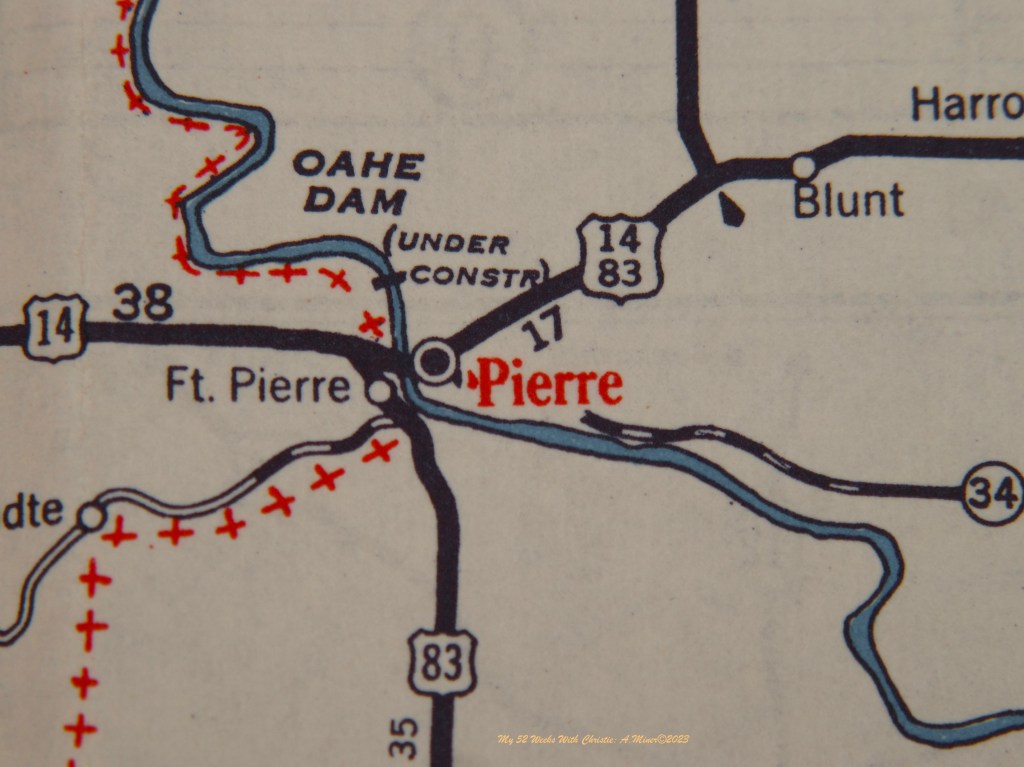
In our last case of Caustic Candy, we will travel roughly three-hundred-and-thirty-seven miles north and slightly west from Hastings, Nebraska, to Pierre, South Dakota, to meet a love-struck woman who nearly managed to send another to prison for a murder she didn’t commit.

In the years leading up to February 27, 1904 — Cordelia Botkin and her infamous cross-country murders continued to make headlines. (Due in no small part to the upcoming retrial Botkin managed to secure for herself — which would ultimately fail.) Despite the police catching and the prosecutors convicting Cordelia Botkin, her evil exploits still inspired/tempted people across the country into trying to rid themselves of an unwanted lover, rival, enemy, or annoying neighbor by sending said person a box of poisoned laced sweets through the mail.

Enter Rena Nelson.

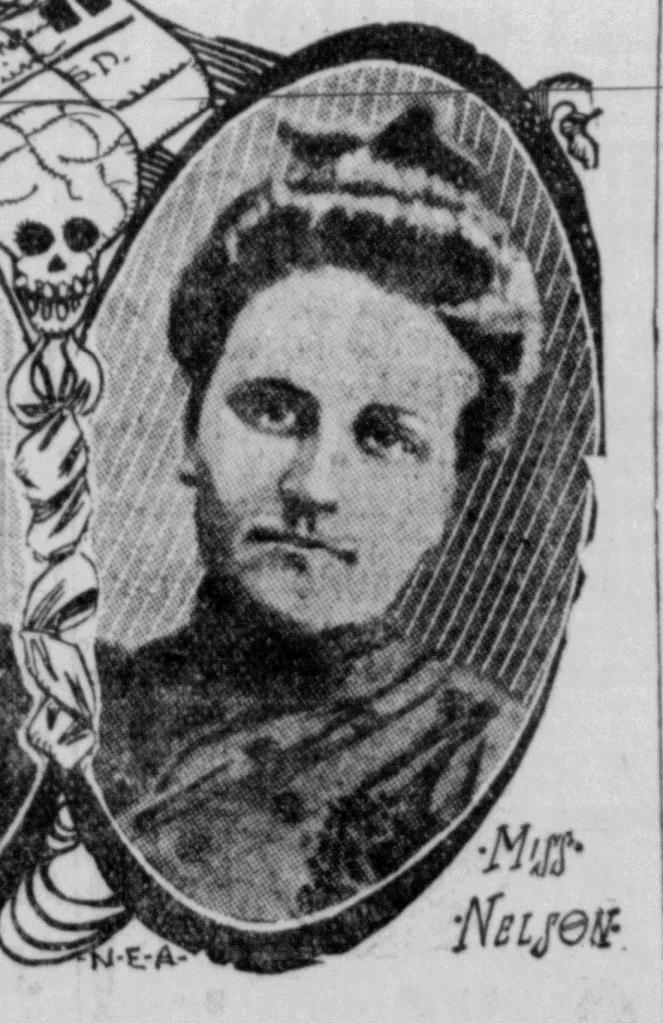
An unattached woman in her late twenties, Rena lived six miles north of Pierre, South Dakota, on a farm with her parents working as a nurse around the city. (Though, as she had no formal training, I think it’s more likely Rena acted as a nurse’s aide.) In any case, on Saturday, February 27, Rena and her father went into Pierre. One of the must-visit spots, whenever one visited town, was (of course) the post office. On this day, a parcel and a letter waited for Rena. Carefully slitting open the parcel’s wrappings, she discovered someone had sent her a box of chocolates. Popping one in her mouth, Rena stood at a counter chewing whilst reading a letter from her Aunt. By Sunday night, Rena was beginning to feel a little iffy, though still well enough to pen a return letter to her relation in Boone, Iowa. On Monday, Rena’s family sent for the doctor.

Who in turn sent for Sheriff Laughlin. 

Whilst slowly succumbing to a hitherto unknown poison her doctor suspected was delivered via bonbon, Sheriff Laughlin listened to Rena point the finger at her own murderer. Taking Rena’s hunch and the suspect box of confectionary with him, the Sheriff left the Nelson household. His first stop was the chemists, where he handed off the sweets for testing. His second was the telegraph office, where he wired his counterpart in Boone, Iowa, asking them to arrest his prime suspect.

By this point, it was Tuesday, March 1, 1904, and the local newspapers got wind of a possible Botkin copycat within their midsts. By the following day, regional papers had picked up the story, and by the next, the national press. 

On March 4, the State Chemist, Professor Whitehead, confirmed the local physician’s worst fears: Rena had ingested corrosive sublimate. Otherwise known as mercury chloride, this compound was used in developing photographs, preserving specimens collected by anthropologists & biologists, to treat syphilis, and as a disinfectant. In acute poisoning cases, like Rena’s, the chemical’s corrosive properties wreak havoc on internal organs. Causing ulcers in the mouth, throat, stomach, and intestines. Leading to a burning sensation in the mouth/throat, stomach pain, lethargy, vomiting blood, corrosive bronchitis, and kidney failure. Even today, doctors face an uphill battle in mercury chloride poisoning. Back in 1904, the only option available were iodine salts.  

Unfortunately, Rena’s organ damage proved too extensive for any hope of recovery.

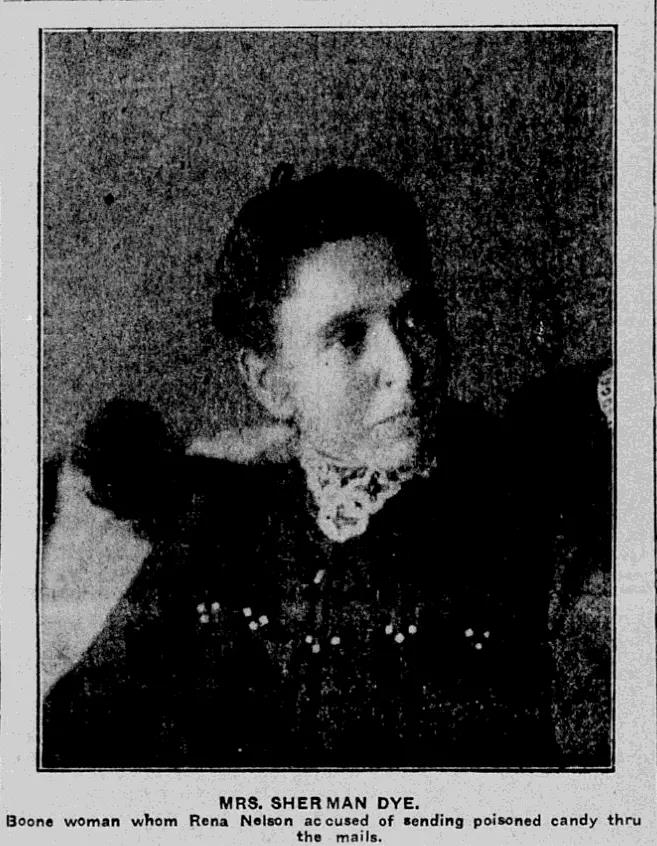
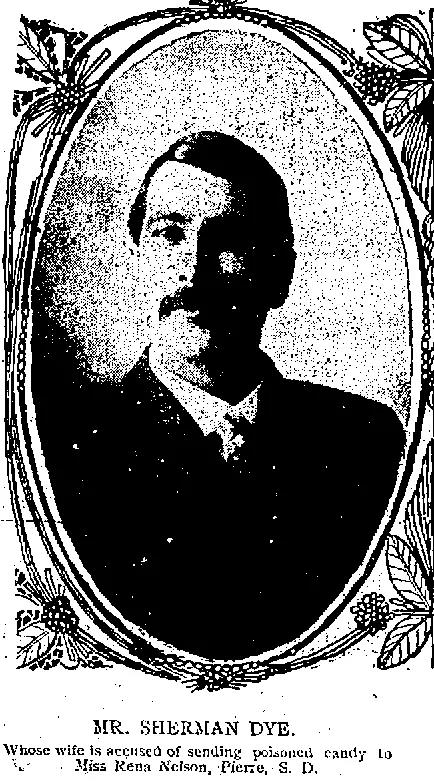
But who did Rena accuse of killing her, and why? This was the question the newspapers, public, and residents of Pierre clamored after Sheriff Laughlin to reveal. For that answer, we must travel back three years to Boone, Iowa. Where for a season, Rena worked at the Boone Telephone Exchange as an operator while living with her Aunt. During this time, Rena met Mr. Sherman Dye, who worked for the Northwestern Railroad as a clerk in one of their roundhouses. 

The two soon started dating. 

When Rena returned to Pierre, the pair continued their romance via pen & paper and carried on in this fashion for the next two-and-a-half years….Until November 1903, when Mrs. Belle Dye, Sherman’s wife and mother of his child, accidentally discovered Rena’s letters and photos stashed in the family’s chicken coop.

Mr. & Mrs. Dye separated on Christmas 1903.

Now, it’s unclear when Sherman told Rena he was married. However, thanks to the letter Rena penned to her Aunt on that Sunday when she started suffering from the effects of the corrosive sublimate, we do know that Sherman initially ‘misrepresented his marital status’. Telling Rena he’d obtained a divorce. However, when Sherman revealed he was, in fact, still married — for whatever reason — Rena chose to continue the relationship rather than giving him the old heave-ho. 

Rena even went so far as to write Belle several letters asking her to grant Sherman a divorce as he wanted to marry her. 

Finally, on January 23, 1904, Belle wrote back, asking Rena to leave them both alone — pointing out that she was ‘interfering with a husband and wife.’ And therein lies the crux of Rena’s deathbed accusation. She claimed Belle was jealous because Sherman transferred his affections from his wife onto herself. Rena also told the Sheriff she recognized the handwriting on the parcel’s wrapping as that of Mrs. Belle Dye’s — but only after ingesting the poison-laced chocolates.

On March 6, 1904, with a South Dakota issued arrest warrant in hand, Sheriff Laughlin arrested Belle Dye — in Boone, Iowa.

Unfortunately, for Sheriff Laughlin, returning to South Dakota with Belle in tow wasn’t as easy as simply catching a train. Facing the same conundrum his counterparts in California and Delaware found themselves in a few years prior with Cordelia Botkin — Sheriff Laughlin needed to navigate Iowa law, which had never faced a case where the (impending) murder took place in a separate state from where the instrument of destruction was mailed from. The first blow to the Sheriff’s extradition of Belle came when the Iowa Supreme Court quashed the North Dakota arrest warrant — which labeled Belle as a fugitive from justice. However, since Belle never entered South Dakota, it followed that she’d not fled back to Iowa afterwards. 

So, by definition of the law, Belle wasn’t a fugitive.

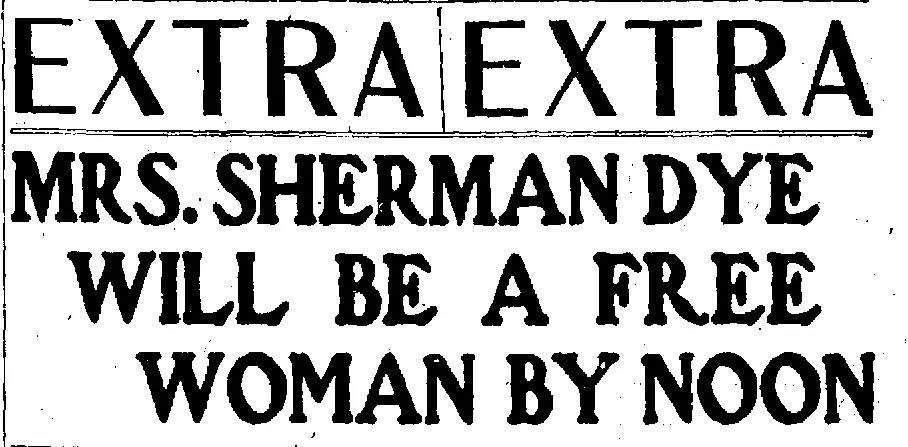
Not willing to let this woman get away with murder, Sheriff met with Iowa’s Governor Cummings on March 7, hoping he’d intervene. While he did, on advice from State Attorney General Mullan, Governor Cummings made a different call than his Californian counterpart. Not only did he free Belle on March 9 with a writ of habits corpus, he also let Sheriff Laughlin know that Belle could neither be extradited to South Dakota nor would she meet a murder charges in Iowa. 

Belle needed to be tried in South Dakota, where the deed took place, or not at all. 

Undoubtedly, seeing which way the wind was blowing before Governor Cumming made his announcement, Sheriff Laughlin made one last Hail Mary play to get Belle Dye back to South Dakota to face justice — he applied to the US Postal Inspection Service. As one of the only investigative federal bodies at the time (the precursor to the FBI wouldn’t be founded until four years later), the Sheriff hoped they’d charge Belle with misuse of the mail. (As sending poison thru the post was, and is still, illegal.) If the Special Agents found enough evidence to charge her, then Federal Marshals could cross state lines, arrest Belle without a warrant, and bring her back to South Dakota.

Whilst all this legal wrangling went on, Rena Nelson died on March 8, 1904. 

Noticeably absent from the side of Rena’s deathbed was Sherman Dye. Rather than comforting his dying lover, he chose to support his wife during her detention. Not only defending Belle in the press, Sherman also paid multiple visits to Belle in jail with their daughter Dolly.

On March 10, the same day Postal Service Special Agents arrived in Pierre — the Coroner’s Inquest into Rena’s death was held. The verdict from the jury was a foregone conclusion: “Miss Nelson came to her death through eating some tablets or chocolate candies contained in a box received through the United States Mail at Pierre, South Dakota and postmarked Boone, Iowa and contained corrosive sublimate in sufficient quantities to cause death.”

However, the most significant feature of the inquest, which would throw the whole case on its ear, occurred as the spectators congregated outside the courthouse discussing the case….

My 52 Weeks With Christie: A.Miner©2023

Caustic Candy: I Didn’t Do It, But If I Did It….

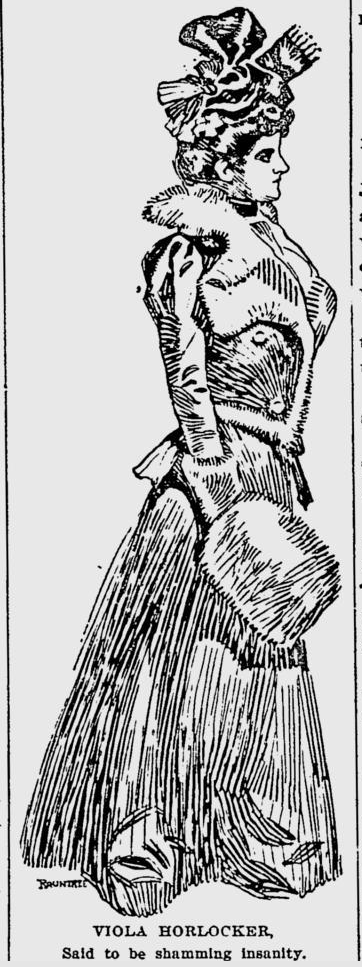
Until this point in Viola Horlocker’s trial, her defense team worked to establish doubt as to whether Viola actually entered the building where Anna and Charles Morey lived. Later, they’d call a witness, who’d known Viola for years, lived in the same hallway as the Morey’s, was home all day — who swore he never saw Viola on April 10, 1899. While all these details add up, Viola’s lawyers had yet to really address the heart of Viola’s insanity plea.

Until the prosecution called Charles Morey to the stand.

Faster than a fox falls on a fluffy-tailed rabbit, Viola’s defense team tipped their hand, showing the jury who they regarded as the real villain of the piece. 

Badgering and lambasting Charles at every turn, they relentlessly grilled him about the exact nature of his relationship with Viola: Charging him with ‘making love to an innocent young woman.’ Accusing him of encouraging Viola’s infatuation through the sheer volume of time spent together, confidences shared, and promises of marriage made. Blaming him for unhinging Viola’s mind — by forcing her to watch her rose-tinted dreams die when he unexpectedly severed all ties with her. Could anyone fault Viola for cracking under the pressure of watching the man she ‘loved not wisely, but too well’ carry on with his wife from afar, as if she never existed? 

(BTW: Apparently, Viola’s lawyer’s cross-examination of Charles was so merciless that when Charles left the stand, he said something very rude while passing by the defense counsel’s table. Unwilling to let the insult roll like so much water off a duck’s back, said lawyer immediately punched Charles in the nose. The next day, the bailiffs, who suspected the dust hadn’t quite settled from the previous day’s kerfuffle, kept a weather eye on the two men. The surveillance proved fortuitous as they foiled the pair of hotheads from drawing pistols and shooting one another in the middle of the courtroom.)

Viola herself took the stand sometime later in her own defense. Though, betwixt hiding her face in her hands, copious weeping, and periodic bouts of fainting, she didn’t provide much substance to aid her case….However….Considering the number of trials where the purported perpetrator put their own head in the noose by trying to defend themselves on the stand — you could call presenting a generally pathetic and remorseful figure a result.

Fortunately, her legal team had an ace up their sleeve.

Do you recall the friends who, from the very start, said Viola must’ve been out of her right mind if she tried to poison Anna Morey? Well, they’d stuck to their conviction and with her. Not only did they attend Viola’s trial en masse, much to Judge Adams’ consternation (who didn’t think it proper). At one point during the proceedings, they rained kisses all over Viola’s head to show their support. 

One of Viola’s particular friends, Miss Eva Stuart, took this show to the next level by providing information that Viola couldn’t or wouldn’t bring herself to say. 

In what the newspapers deemed a well-rehearsed testimony, Miss Eva Stuart divulged several pertinent secrets and private conversations she and Viola shared. Opening with the revelation that initially Viola hadn’t viewed Charles Morey as anything other than her boss….Until one afternoon in the office, he confided in her how sad and lonely he was and wondered if she would be his friend. 

(BTW: This was well before Anna left town for three months in the summer of 1898.)

However, Viola didn’t fall in love with Charles until the afternoon he hypnotized her headache away. While in the ‘altered’ state, Viola revealed she’d felt ‘a little door in her heart spring open and feelings she’d never felt for another friend poured out.’ Deepening their bond, Charles confided in Viola about his marital troubles whilst listening to her matriarchal woes. He came over to her house and listened to her sing. He started asking her to stay late after everyone else at work left — so he could give her a passionate kiss goodbye. Finally, while his wife was out of town, Charles invited Viola to his home. Just the two of them. Alone.

And she went.

At this point, Viola’s defense really started picking up steam. 

Her lawyers then called an array of witnesses who testified to Viola’s peculiar behavior in the months leading up to the poisoning of Anna Morey & friends. Behavior, which included: mood swings, crying jags, melancholy, depressed spirits, headaches, peculiar conduct, unhappiness, and general distress. On one occasion, Viola failed to recognize a friend whom she’d known for the better part of fifteen years. One of the Tibbets brothers testified that more often than not, after the summer of 1898, he’d find Viola on the office floor in a dead faint. 

Next, Viola’s elder sister, Luella, took the stand. First, disclosing what many already knew, that as children, they’d often witnessed the savage fights between their mother and George Horlocker. Bouts, which led to Viola’s nervous disposition as a child. However, the coup de grace of her testimony was the confession of a dark family secret: Just before Viola’s birth, their mother had tried to kill herself.

Next came the medical experts from Oak Lawn Sanatorium. Dr. Cromwell, the superintendent of said sanatorium, testified that Viola had indeed been insane on April 10th. Gradually, between August 1898 and April 1899, the irresistible impulse to poison Anna Morey seized Viola. The last straw, which snapped what little reason Viola still possessed, came that day in the dining room of the Boswick Hotel. When Charles called Anna ‘darling’ — a term of affection he’d never applied to her. 

Dr. Cromwell and his colleagues then explained that when Viola first entered the sanatorium, she’d been subject to extreme attacks of hysteria and nervousness. However, thanks to their care and treatments, Viola was well on the road to recovering her reason.

Dr. Cromwell also went on to say, I’m paraphrasing the pure hokum doctors often spouted about women during this era, that the true root of Viola’s crazy lay in her lady bits, which puberty magnified, and Charles’s wicked conduct together with his abrupt rejection exacerbated. The cumulative effect of all these factors turned Viola into a degenerate.

It took less than an hour for the jury to find Viola ‘not guilty by reason of insanity.’

The question is, was she? Was Viola really insane at the time she poisoned Anna Morey? He was her boss, and if what Viola’s friend Eva said is true, it sounds like Charles groomed her. Thereby making his sudden break-up all the more callous and cruel. And if, in the heat of the moment, she set his desk ablaze, stabbed him with a letter opener, or poisoned his favorite bottle of bourbon — I’d get it.

However, Viola waited just shy of eight months before acting, and she had that box of candied cherries and walnuts prepared before stepping into that hotel dining room on April 10, 1899. Making me wonder if coincidence or premeditation fueled Viola’s choice to dine at the same establishment on the same afternoon as Charles and Anna’s standing lunch date…..But as the papers noted from the beginning, Viola’s reputation, popularity, and well known family drama made a conviction highly unlikely — especially after her lawyers gave the jury an alternate person to blame.

In any case, after the reading of the verdict, Viola stood up, gave one long piercing shriek, and fainted. Upon being revived by her sister Luella, both women thanked the jury profusely. When the press asked Viola about her next life steps, she told them she planned to return to Oak Lawn Sanitarium for a few months before traveling to New York City to stay with Luella and her husband — for a fresh start.

And it seems she did. 

In the few lines in which her name appeared in the papers over the years after her acquittal, Viola Horlocker did indeed travel to New York. Where, for a few years at least, she performed music professionally. She married a man with the surname of Adams, moved to Tujunga, California, and was alive, if not well, as of February 16, 1939. 

My 52 Weeks With Christie: A.Miner©2023

Caustic Candy: Planting Doubt

Undoubtedly aware of the scandal Charles Morey narrowly managed to dodge the summer before, Dr. Cook didn’t need to strain any mental muscles persuading Sheriff Simmering to take a closer look at Viola Horlocker for the attempted murder of Mrs. Anna Morey and her friends. When the lawman learned Viola and her mother hightailed it out of town a few hours after Dr. Cook’s accusation? The twenty-five-year-old law clerk became suspect numero uno. Viola’s sister, who was visiting Hastings, tried to explain to the Sheriff that the hastily taken trip was due to the disquiet caused by Dr. Cook’s unanticipated accusation — not because it possessed any merit. 

The explanation failed to hold water for the Sheriff Simmering.

Knowing when and what train Viola departed on, it didn’t take the Sheriff’s men much time to locate the wayward Viola and her mother in Sheldon, Iowa. Due to Viola’s crossing of state lines and lack of an arrest warrant, the Sheriff issued a statement to the press. Warning the Horlocker family that if Viola didn’t return to Hastings, Nebraska forthwith, he’d fetch her back to town himself. 

A threat he followed through with a week later, arrest warrant in hand.

Arriving back in Hastings, Viola (apparently) created quite a spectacle when authorities tried to usher her from the train platform to a waiting cab. Sobbing, moaning, and fainting — Viola needed support to traverse the fifty or so yards to the waiting vehicle. Whilst her mother looked on, giving an unhelpful statement to the eager reporters, “Even as a child, she’s always had these funny turns.” After finally making it to the courthouse, Viola pleaded ‘not guilty’, placed under a $5,000 bond, and sent home.

While in court, her brilliant legal team, John Stevens and William R. Burton, also asked Judge Adams for a continuance to prepare Viola’s defense. 

The request was granted.

The newspapers labeled their delay a sound strategy: Noting that Viola’s previously spotless reputation of a hardworking, churchgoing, and long-suffering daughter would delay the trial until autumn 1899 and would allow time for minds & memories to mellow. 

As coverage of Viola’s case continued, it became readily apparent she and her lawyers needed all the help they could get.

A little over a week prior to Anna finding the box of arsenic tainted candy on her doorstep, Viola purchased one full ounce (or 900 grains) of the deadly metalloid. She then returned to the chemists on April 3rd & 10th for another two half-ounce packets of the poisonous powder (or 218 grains each). Viola’s reason for the purchase? Rats.

(Though, unless a massive rabble of rats decided to take up residence in the house’s walls, attic, crawl space, garden shed, root cellar, and garage  — the purchase of two full ounces doesn’t exactly align with Viola’s explanation.)

Supplementing the prosecution’s case were various eyewitnesses who placed Viola in the Boswick Hotel at the same time as the Morey’s lunch date, on the street near their apartment, in their building, and in the hallway leading to their apartment. Together with the tried and true motive, jealousy, I’m sure Hasting’s prosecutors thought Viola’s case a slam dunk.

Despite the damning evidence mounting against her, Viola’s lawyers proved more than equal to the task. 

The first order of business, they convinced Viola’s mother to commit her daughter to the Oak Lawn Sanatorium in Jacksonville, Illinois, for treatment. (From the Office of Full Disclosure: I don’t actually have documentation that her lawyers persuaded Viola to enter the sanatorium. However, this surmise feels probable with the subsequent turn of events.) Next, they asked Judge Adams for another continuance in September of 1899. Stating they needed extra time to explore their defense strategy — hypnotism. Whilst not admitting to committing the crime, her lawyers said Viola had no recollection of perpetrating the deed and claimed she was subjugated to a will stronger than her own. It was this unnamed person who instructed Viola to kill Anna Morey, and it was they who wanted her dead. Making Viola an instrument, not the guilty party.

Whilst Viola’s lawyers did not directly point the finger at Charles Morey, the newspapers did. 

Digging into this sensational claim, they (rather quickly) found the kernel of truth fueling Viola’s defense. Seems Charles did indeed hypnotize Viola at least once in an effort to help rid Viola of headaches that had plagued her on and off for years. (Even back then, hypnotism stood on very, very shaky ground. However, I don’t think Viola’s lawyers ever seriously considered using it. I believe this was another means of A) buying more time and B) casting further doubt in the minds of potential jurors.) 

At this point, the papers uncovered another curious detail. 

During the period when the prosecution needed to charge Viola with attempted murder, the victim herself lay bedbound, recovering from arsenic poisoning. Hence, the task of pressing charges fell to Charles. Only he didn’t. The County Prosecutor did. This lack of action on Charles’s part was considered highly irregular. Perhaps Charles didn’t want to leave his wife’s side or was paralyzed by the fear of losing Anna. Either way, the newspapers didn’t report this so benevolently. Especially when editors know innuendo increases circulation, so speculation ran rampant: Because if everything between Charles and Viola in the summer of 1898 was on the up and up, it follows that the investigation into and the trial of Viola Horlocker wouldn’t uncover anything untoward. So why didn’t Charles press charges? Did he have something to hide? 

There’s no smoke without fire.

Planting yet another seed of doubt in the minds of the potential jury pool.

In the spring of 1900, Viola’s lawyers asked for a third continuance. Only this time, Judge Adams denied their request. Summoning Viola home from Oak Lawn Sanatorium, where she’d spent nearly a year receiving treatment, the trial commenced on March 20, 1900 with jury selection. After two days, the lawyers finally agreed on a group of all male, well-to-do, local farmers. At which point, Judge Adams instructed the jury that the prosecution didn’t need to prove Viola was sane when she poisoned Anna Morey & friends — just that the murder attempt was made.

Unsurprisingly, Viola’s lawyers abandoned hypnotism and switched to a straight not-guilty by reason of insanity defense. 

The first five witnesses called by the prosecution established that Viola was seen at the Boswick, walking towards the Morey’s building, and outside their flat’s door. 

Until their cross-examination, whereupon: Mr. Dillon, the proprietor of the Boswick, admitted he wasn’t totally sure Viola lunched in the hotel on April 10. The second witness, a Mr. Barnes, was equally uncertain if April 10th was the exact date he’d seen Viola walking towards the Morey’s flats. The third, C. E. Cox, owned that he hadn’t actually seen Viola climb the stairs towards the Moray’s flat. He only heard a female foot tread up them. Cox’s wife testified that a veritable bevy of women ascended and descended those stairs all that day. The flat’s housekeeper, Mrs. Pottinger, testified she’d seen Viola in the Morey’s hallway, but said she’d asked after a different tenant. Viola held a similar conversation with Belle Rand a minute or two later on the Morey’s doorstep. Unfortunately for the prosecution, neither woman recalled Viola holding a fancy candy box. 

Mrs. Anna Morey took the stand, confirming her sighting and hasty retreat of Viola from the hotel’s dining room. Plus her recollection of the circumstances surrounding the receipt of the poisoned box of candy.

Finally, the prosecution summoned Charles Morey to the stand.

*Cue the fireworks.*

My 52 Weeks With Christie: A.Miner©2023

Caustic Candy: The Alleged Crimes of Viola Horlocker

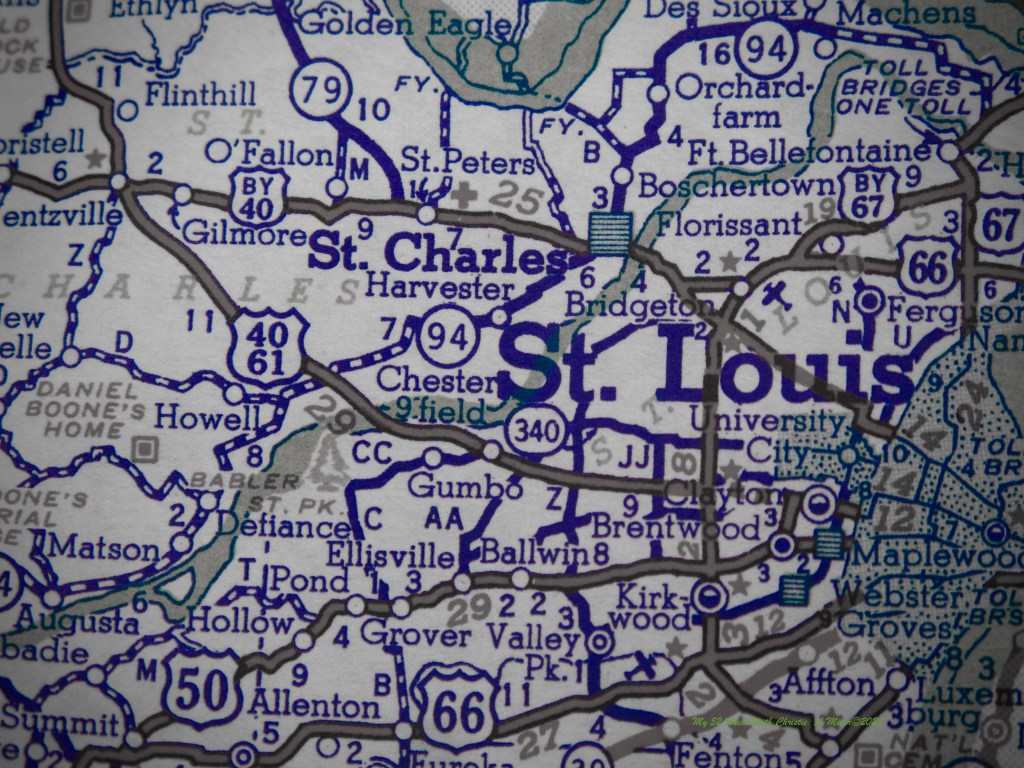
Continuing on our theme of unexpected deliveries, tainted sweets, and copycats of Cordelia Botkin (who murdered two women by sending poisoned chocolates through the mail), we are going to put St. Louis (Mo.), Florence McVean, and her sister Mary McGraw in our review mirrors and travel roughly five-hundred-and-twenty-six miles northwest to Hastings, Nebraska to meet Viola Horlocker.

Known as Ollie, though I will continue to refer to her as Viola for constancy’s sake, she was the second oldest of four sisters. By the spring of 1898, all save Viola had left home. The oldest, Luella, became a highly regarded painter of porcelain china. Lita went on to become an accomplished artist in the field of flower painting and arranging. Whilst Zora made a name for herself as a professional singer. Like her sisters, Viola also possessed a musical streak, which she showed to full advantage by singing and arranging music for the church’s choir. Though not considered a beauty, Hasting’s society did find Viola attractive, fashionable, and “well above mediocrity in every way”. 

However, things weren’t as rosy as they appeared at first blush.

Viola’s father, George, not only made and lost a vast fortune, he also abandoned his entire family when Viola was a teenager. An event that surprised no one in the community, as next-door neighbors were often treated to the auditory splendor of knock-down-drag-out fights between the Mr. and Mrs. of the Horlocker household. (At one point, during one of these vicious rows, said neighbors felt the need to intervene. Upon locating the source of the commotion, they found Mrs. Horlocker beating George with a pot about the head and shoulders in the kitchen. Noting the number of dents in the cookware, neighbors surmised this wasn’t the first time something along these lines happened.) After her husband’s hasty exit stage left, Mrs. Horlocker turned her capricious temper, bitter disposition, and sour tongue on her daughters. Driving each and every one to seek out respectable employment in cities hundreds of miles away from their mother.

Save Viola. 

Viola stayed behind to cope with a maternal figure, who was not mellowing with age, alone. Again, this turn of events wasn’t wholly unexpected. Viola’s sense of duty to her family found her stepping up to provide for her mother and two younger sisters (as Luella was already out of the house and state by this point) after their father departed. Educating herself in the law, Viola worked as the deputy county clerk for four years until she accepted a position at Tibbets Bros. & Morey. Where her work was considered exemplary. (There is a bit of discrepancy regarding her exact role in the firm. The newspapers labeled her a stenographer. However, during the trial, the Tibbets brothers said Viola drew up flawless legal documents for them….Which sounds more involved than what a stenographer normally does? I’m not really sure. Though, it wouldn’t be the first time newspapers of this era chose a dumbed down a woman’s job title to avoid confusing their readers.)

Enter Charles F. Morey. 

Prior to joining the prestigious firm as a junior partner, he’d held the office of City Attorney for years. Now, it’s unclear if Viola and Charles knew each other before joining the same firm, but either way, they soon became acquainted — as Viola was assigned to assist him. By the time spring rolled around in 1898, the two were friendly enough that Charles introduced Viola to his wife and tried to encourage a friendship between the two women. He also invited Viola to join his cycling club….Naturally, Charles accompanied Viola home after each meeting or tour — to make sure she arrived safely. 

Fast forward a few months to the summer of 1898: Anna, Charels’s wife, left Hastings for a few months.  

Almost immediately, Charles and Viola started spending ever increasing amounts of time together. They’d go for long, winding rides in the country, where Charles confided in Viola about his work, career aims, and struggles at home. Viola, in turn, vented to Charles about her troubled home life and mercurial mother. Charles then began asking Viola to stay on after everyone else in the office left for the day, for more long talks, which more often than not spilled over into dinner at one restaurant or another. If Viola felt she couldn’t leave her mother alone on a particular evening, Charles would accompany her home, and they’d sit out on her porch for hours talking.

After three months of this constant association, the local newspaper’s gossip column weighed in on what the Hasting’s busybodies had already started whispering about: What would Anna say if she knew her husband was spending such copious amounts of time with his young female law clerk? As they say: While the cat’s away, the mice will play. Though the paper didn’t print their names, everyone in Hastings knew (or was subsequently informed of) who the couple in question was. This potentially embarrassing situation prompted one of the Tibbets brothers to pull Morey aside and advise him to cool it with Viola. 

Counsel Charles willingly complied with as his wife was due home in days.

To say Viola took Charles’s news badly would be an understatement. However, she soon learned no amount of protestation or pleading would alter Charles’s mind. He even went so far as to have Viola reassigned to one of the Tibbets, further limiting Viola’s opportunities to spend time with him. And whilst her work didn’t suffer, after Charles dropped her like a hot stone, her manner did. Over the subsequent fall and winter months, Viola’s demeanor turned increasingly irritable, nervous, and depressed….

Until everything came to a head on April 10, 1899. 

According to the newspapers, the bare bones of the “incident” went something like this: Whilst Charles occupied his days with lawyering. His wife Anna added to the household coffers by teaching art, drawing, and painting to the well-to-do women (and their daughters) of Hastings. And by all accounts, both Anna and her classes were remarkably popular. Due to the duo’s demanding professional calendars, Charles and Anna chose to consciously carve out time to spend together.

One such hewn event was a standing Monday lunch date at the Boswick Hotel.

On this particular April day, after finishing their meal and parting ways until quitting time, Anna rushed home to prepare for a class. When she arrived at their apartment’s door, Anna found a box of candy sitting on the mat. The attached card identified the gift giver as one of Anna’s good friends, Miss Kirby. Still needing to zoom, Anna Morey set the box aside and started prepping her studio for the impending art class. A short while later, with everything sorted and five out of six students on hand, Anna opened the box of homemade candy. Passing the sugared walnuts and cherries around, the group partook while they waited for the last class member.

Who, in an odd case of serendipity, just happened to be Miss Kirby.

Upon Anna’s thanks for the unexpected box of sweets, Miss Kirby denied making or sending Anna the candy. Unsurprisingly, this contradiction frightened everyone: The notorious trial of Cordelia Botkin had only wrapped up five months prior and copycat crimes, like Florence McVean’s, had proliferated on newspaper’s front pages across the country ever since.

Compounding this disquiet, everyone who’d nibbled on a piece or two or three — started feeling queasy. Uncertain whether the power of suggestion or something more diabolical was causing their gastric distress, the group of budding artists sent for a doctor….Who, after arriving, rapidly determined he’d a genuine case of poisoning on his hands. After treating/stabilizing the group of women, the doctor sent the remaining candied fruit and nuts out for testing.

The very first piece tested came back as containing four grains of arsenic. 

Now, if I understand how this largely defunct unit of measurement works (please correct me, nicely, if I’m wrong), one grain equals just a smidge under 65mg. Experts consider a lethal dose of arsenic between 100-300mg (depending on things like body mass, tolerance, and overall health). So if each piece of the tainted candy contained four grains or about 258mg of arsenic…..That sextet of women should thank the gods above and below for escaping the afternoon of April 10th with their lives. Anna Morey, in particular, should light a candle. The only reason the tainted sweets didn’t kill her outright was that she threw up a large measure of the arsenic she’d eaten. As it was, Anna was bed-bound for weeks afterward as the toxic substance worked its way out of her system — her husband continuously by her side.

News of Anna’s mysterious poisoning spread like wildfire through Hastings.

Two days after the ‘incident’ Viola, who’d continued to work diligently at the firm whilst gossiping with everyone else over nearly fatal turn of events, ran into a family friend at the drugstore. Well acquainted with the gossipworthy happenings betwixt Charles and Viola the summer before Dr. Cook voiced his growing suspicion: “Ollie, how could you do this?”* To say this brought their conversation to an abrupt end is an understatment, as Viola apparently fainted then staggered away from the good doctor as fast as humanly possible after regaining her senses….Then, later that same evening, she and her mother boarded an eastbound Burlington Train and left town.

Because running away after someone accuses you of attempted murder ALWAYS makes you appear innocent.

*(There’s a variant of this story where one of the Tibbets Brothers accuses Viola. However, the majority of the newspapers printed the Dr. Cook version.) 

My 52 Weeks With Christie: A.Miner©2023

Caustic Candy: Florence McVean — A Victim Once Again?

Now, on with the post.

Sometime between seven and eight o’clock on March 14, 1899, the doorbell rang at No. 4015 Cook Avenue. 

Despite the hour, Florence McVean answered the summons and found a heavily veiled woman in black standing on her doorstep. Not recognizing said woman through her costume and in no way aided by a streetlamp’s distant glow, Florence asked, “Is there anything I can do for you?” The beveiled woman moved forward and answered, “Damn you, I have you now!” Whereupon, the mystery woman lifted the lower edge of several layers of concealing lace and revealed the presence of a pint glass full of liquid — which she then flung onto Florence’s face, neck, and bosom. Collapsing into a heap, screaming in pain, Florence watched helplessly as her attacker dashed down the front steps, up the street, and into the night.

Florence’s younger sister, Miss Mary McGraw, who’d run to the drugstore for some medicine, returned home from her errand a short while later and found Florence lying prone across the threshold, crying in pain. Not knowing what happened, only that her sister said her face was burning, Miss McGraw and her mother sent for Dr. Lyda. 

Doctor Lyda rapidly diagnosed the substance splashed onto Florence’s face as Carbolic Acid. 

Also known as Phenol, this organic compound is used as an antiseptic, disinfectant, and local anesthetic to treat sunburns & hives. (This last application once gave Agatha Christie a “nervous horror” as a hospital pharmacy dispenser — as Christie feared she’d mis-prepared a carbolic acid ointment for a patient.) Carbolic Acid presents a threefold danger. Not only will the liquid rapidly generate second and third-degree burns, your skin absorbs the organic compound poisoning your heart and central nervous system, while the sweet-smelling vapor will do additional damage to your eyes and lungs.

Hence why, Dr. Lyda reported to the papers that Florence hovered near death whilst putting her chance of recovery at one in a hundred. And if Florence did manage to rally, he predicted she would bear heavy scars at best and lose her eyesight (and perhaps the organs themselves) at worst.

The newspapers, which had all but forgotten Florence, lept all over this unexpected turn of events. Speculating as to whether or not Florence’s original claims, that a jealous rival tried to poison her, were true….Because who would intentionally throw acid in their own face?

Which brings us to August 30, 2010 and the case of Bethany Storro. 

Suffering from a then undiagnosed mental disorder, Storro attempted to take her own life by smearing her face with drain cleaner. Initially, she’d planned to drink the caustic chemical as well, but in light of the searing pain burning her face, Storro couldn’t bring herself to take a sip. Panicked at the thought of explaining her actions, Storro left her house and went to a nearby park. According to an eyewitness statement, she dropped to the ground and began screaming that a black woman with a ponytail threw acid in her face.

This was curious as said eyewitness swore he’d not seen anyone approaching or anywhere near Storro when she began screaming for help. 

Storro’s story unraveled further when doctors eventually discovered something odd. Storro’s chemical burns, which roughly correspond to the areas where you’d apply a mud mask, failed to follow the splash pattern consistent with this style of violent crime. Not a single drop of the caustic liquid broke her hairline, ran under her chin, or spattered onto her ears, lips, neck, chest, or back. Storro’s claims that a pair of sunglasses saved her eyes and brows fell short with police — because why would you need to wear shades thirty-eight minutes before sunset?

Suspicions raised, it didn’t take law enforcement long to trace the purchase of the drain cleaner and gloves back to Storro herself, at which point she confessed to everything. (BTW — After paying back the small amount of money she’d spent from funds donated by the community, authorities decided not to press charges. Storro would spend little over a year in a mental health facility that diagnosed and treated the underlying mental health issues that led to her suicide attempt.)

Casting aside, but not forgetting his earlier conclusions about the veracity of Florence’s claims of harassment, Chief Campbell took this new threat on Florence’s life seriously. Not only did he assign Chief of Detectives Desmond to the case, he also allocated another half-dozen detectives to hunt down the perpetrator. 

With so many resources dedicated to a single case, it didn’t take long for irregularities to start surfacing.

Florence’s explanation as to why she answered the door at such a late hour (for the 1890s) was totally reasonable — she thought it was her sister at returning home. The police could just about understand why it took until the next morning for someone in the household to alert them to the brutal assault. More difficult to fathom was Miss Mary McGraw’s fluctuating and contradictory timelines (yes, plural) she gave authorities about her movements on the night in question. However, what truly stuck in the detective’s collective craws was motive: During the first investigation Doctor Glasgow made it crystal clear to authorities, newspapers, and the public alike that he held zero affection for Florence. Surely these profuse and forthright negative declarations would render any lingering jealousy inert? Therefore the barbarity of the attack didn’t align with the wafer thin motive.

Then there’s the evidence the cadre of detectives didn’t find.

No one, other than Florence herself, witnessed the attack. No one, other than Florence, saw a veiled woman running from the scene. In fact, Chief Detective Desmond couldn’t find a single trace of this mystery woman anywhere. Nor could he locate a single one of Florence’s neighbors who heard her screams. And the one and only suspect in the case, Zoe Graham, possessed a rock-solid alibi for the night of the attack.

So, who flung carbolic acid in Florence’s face? 

Chief Campbell once again pointed the finger at Florence herself: “As I study the case from beginning to end, I confess I turn to the idea I first advanced that Mrs. McVean has been persecuting herself. What for cannot be clearly seen but it may be one of those manias sometimes seized upon by woman, which, when once adopted, carry them way past where they thought when they began.” Newspapers expanded on this new wrinkle, theorizing Florence used the acid attack to acquit herself of Chief Campbell’s initial accusations of self-persecution.

Despite the Sheriff’s moderately sexist thoughts, did she really do it?

Though it galls me to disbelieve the victim of a violent crime, the most damning part of the carbolic acid episode (for me) was Florence’s miraculous recovery. While I understand carbolic acid (by comparison to its bigger and badder cousins nitric, sulfuric, and hydrochloric) is considered a weak acid — it can still wreak some serious havoc. So for doctors to announce, a mere four days after the attack, that other than some peeling skin, Florence’s eyesight would remain unchanged, her skin unscarred, and her overall health unaffected? It feels a tad, well, suspicious and calls to mind the Bethany Storro case.

On top of which, the urge to inflict further damage to “prove your innocence” reminds me of Christiana Edmunds — who, twenty-nine years earlier, engineered two separate poisoning plots (which resulted in one murder and earned her the nickname The Chocolate Cream Killer) to prove to her crush, Dr. Beard, she didn’t try murdering his wife (without success). 

Only in this case, Florence flung acid at herself instead. 

And while Doctor Glasgow, Mrs. Graham, and Sheriff Campbell all thought this self-persecution conclusion was correct — I find it difficult to reconcile the poison pen letters, arsenic laced chocolates, and acid-throwing incidences with a thirty-five-year-old widow. They seem to me like acts perpetrated by a naive young woman.

Someone like a single, younger sister, perhaps?

As the news articles focused on Florence, we don’t know the state of Mary and Florence’s relationship. However, experts have established that Poison Pen Letters are often written by those nearest and dearest to the recipient. Since the abuse contained within the correspondence aimed the majority of its vitriol towards Florence rather than the doctor, it could point in Miss McGraw’s direction. 

Do the abusive letters point to some hitherto unknown well of resentment within the younger woman? Did Miss McGraw write them to help her big sister find happiness with another man before Florence was ready? Or did she want Doctor Glasgow for herself? Did these good (or bad) intentions spiral out of control and the resulting violence snapped her out of the grip of whatever illogical thought process she’d fashioned to justify her actions?

I’ve no clue.

However, I do know Miss McGraw repeatedly insinuated herself into the case. Not only did she, not Florence, initially take the case to Sheriff Campbell. Miss McGraw also reported to the newspapers she’d taken control of the household’s mail before the arrival of the tainted candy. Virtually ensuring the arsenic ladened chocolates wouldn’t pose a threat to anyone in the house. Next, she vocally supported Florence’s claim that she’d not set foot downtown in the months prior to the bonbon’s arrival. Finally, she handled all the interactions with the press as her sister recovered from the acid-throwing incident.

Speaking of the night of March 14th, if Mary threw the acid on her sister it would explain the confusing and contradictory accounts of her errand to the drugstore. The veils and the rest of her costume could’ve been secreted away until Dr. Lyda stabilized Florence, then burnt or otherwise discreetly discarded later that night. Thereby explaining the time gap between the attack and when someone notified the authorities.

As to the clerk from the Busy Bee Candy Store, eyewitness identifications are notoriously unreliable, and we don’t know how closely the two sisters resembled one another. Miss Mary McGraw could’ve used Florence’s calling card, styled her hair like her sister’s, worn her clothes, and led authorities down the garden path. 

While my theory about Miss McGraw doesn’t conform as well with Occam’s Razor, as does the one put forth by Sheriff Campbell, it’s within the realm of possibility. Unfortunately, due to the doctor’s pronouncement of Florence’s impending full recovery, the newspapers quickly lost interest in the story and Florence and Mary faded back into their lives in St. Louis.

My 52 Weeks With Christie: A.Miner©2023

Caustic Candy: Copycats of Cordelia Botkin

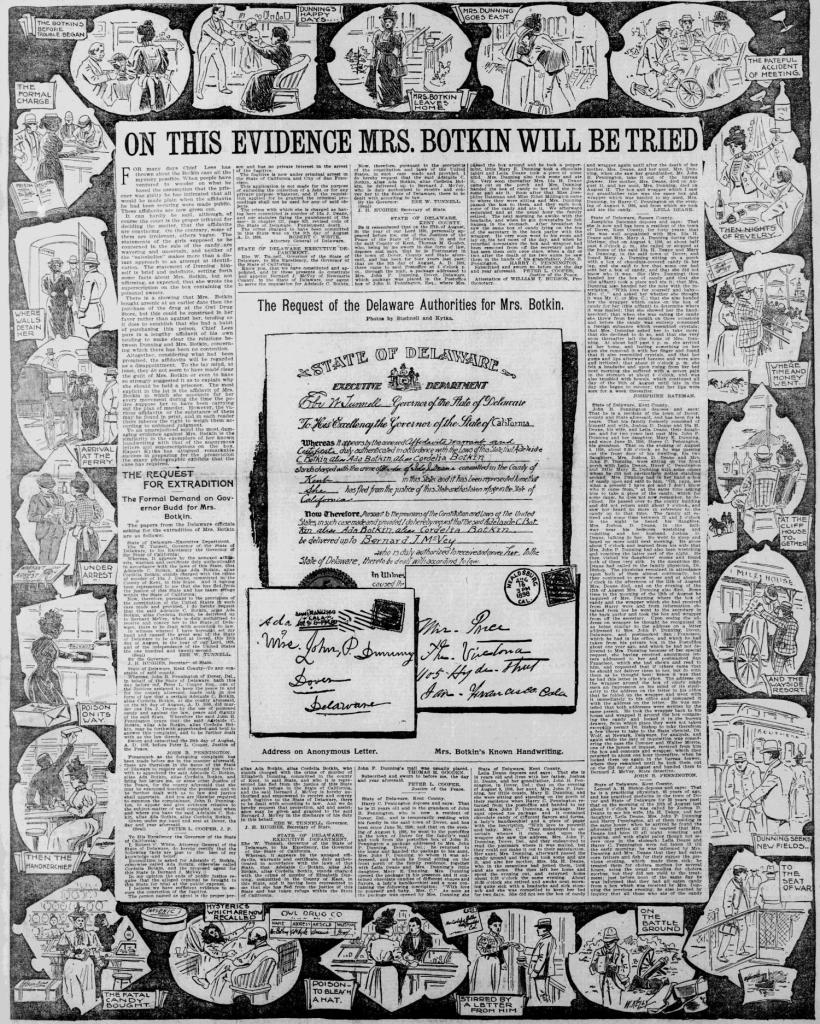
Last week I touched briefly on the true-crime case of Cordelia Botkin. As it happens, she’s the lynchpin in the spat of turn-of-the-century poisoned candy cases in the US, and let me tell you, her case had it all: A talented reporter who fell from grace, an adulterous affair conducted by an older woman with a younger man (which was far more whisper worthy back in 1898), a US Senator, anonymous letters, and a cross country murder plot which paired arsenic tainted chocolates with the postal system to complete the dastardly deed. (If you want a more comprehensive account of Cordelia Botkin’s misdeeds, check out episode #134 of the Poisoner’s Cabinet podcast.) 

Unsurprisingly, newspapers across the country splashed Cordelia’s crimes across their pages for years — and the public lapped up every single word. 

However, as we now know, this highly publicized poisoning case wasn’t exactly good news for law enforcement. Whilst Cordelia was by no means the first poisoner to mail a box of toxic sweets in the hopes of dispatching a rival, a wealthy relative, or the perpetrator of past slights — she was by far the most (in)famous. Convicted twice, first in 1898 and again in 1904 (after winning an appeal for a retrial), forces of law and order knew it was only a matter of time before copycats began creeping out of the woodwork.

They didn’t need to wait long.

In January of 1899, mere weeks after Cordelia Botkin’s first trial concluded, Florence McVean began suffering from an acute case of nerves. The thirty-five-year-old widow of a prominent doctor, Florence, lived with her mother and younger sister at No. 4015 Cook Avenue in St. Louis, Missouri. After a couple weeks, Florence confided in her sister, Miss McGraw*, the source of her troubles: Poison Pen Letters. Being a good sister, Miss McGraw began intercepting the caustic communiques before her sister could see them, helping restore some of Francis’s peace of mind. 

Fast forward a few more weeks, to around February 7, 1899 (the newspapers weren’t clear on the exact date), when an anonymous box of bonbons arrived at the house without a note and addressed to Florence. 

Instantly suspicious of the unrequested sweets, Miss McGraw took both the box of chocolates and the stack of malicious missives to Police Chief Campbell and told her sister’s tale. During said recitation, she aimed authorities at one Miss Zoe Graham — to whom Miss McGraw, Florence, and their mother firmly believed was the author of all. The question was, why? Why would the twenty-two-year-old daughter of a prominent St. Louis plumbing contractor stoop to such crimes and misdemeanors? The answer, of course (sigh), was a man. Doctor Glasgow, a well-respected physician & eligible bachelor, had been calling on both Zoe and Florence.

Obviously, Zoe wanted to keep Florence from nabbing the catch of the county.

Knowing from which side his bread was buttered, Sheriff Campbell wisely chose to test the candy prior to tackling the well-to-do Graham family. Submitting the box of chocolates to the City Chemist for testing, the Sheriff quickly learned that each chocolate had been rolled in a powder containing arsenic, imbuing each piece with lethal levels of the metalloid. 

Now possessing definite proof of murderous intent, Chief Campbell began looking into the finer points of Miss McGraw’s story. Which inevitably brought him to Doctor Frank A. Glasgow’s doorstep, whereupon, the distinguished young doctor informed him of a massive flaw in Miss McGraw’s theory: His interest in Florence was purely professional. He’d only looked in on Mrs. McVean to treat her for one malady or another — simple as that. Doctor Glasgow further complicated and confused proceedings by producing a sheaf of Poison Pen Letters, which he’d received over the course of a few weeks, all of which warned him to stay away from Florence — as she had “designs” on him.

Taking possession of the second set of noxious notes, determined to compare them to the first, Chief Campbell turned his eyes slowly toward his prime suspect. However, in a surprising twist of fate, the Chief didn’t need to bother pussyfooting around Zoe Graham and her parents. As both she and her mother showed up, unannounced and madder than a pair of wet hens, at the police station to see him. Evidently, Florence and her female relations had been broadcasting hither, thither, and yon to anyone and everyone (including several veiled references printed in multiple newspapers across the region) their suspicions about Zoe. The indignant Mrs. Graham wanted to press charges against Florence for dragging her innocent daughter into the whole affair and their insistence on throwing mud at Zoe’s good name. Whilst the Prosecuting Attorney refused to issue a warrant for Florence’s arrest, Miss & Mrs. Graham’s visit provided Sheriff Campbell with another critical clue — the younger woman’s alibi, which, according to his subsequent investigation and statements on the subject, was cast iron.

This development might’ve thrown a spanner into investigation had Sheriff Campbell’s detectives not run down the source of the tainted bonbons. Enter Miss Henley of the Busy Bee Candy Store: Who could not only describe the woman who purchased the box of sweet treats, she could put a name to the face — as she’d kept the mystery woman’s calling card so the store could ship her her purchase. Though Miss Henley’s true coup de grace was her positive identification of the chocolate’s purchaser……

A one Mrs. Florence McVean!

Rolling with this unforeseen twist, Chief Campbell returned to Doctor Glasgow’s doormat and asked if he had any correspondence, notes, or even a grocery list in Florence’s hand. The only scrap the good doctor could share with authorities was an envelope Florence had addressed to him. Upon comparing the exemplar to the handwritten noxious notes, the handwriting appeared similar but wasn’t a conclusive match. Seems the letter writer had taken steps to disguise themselves. Of the countermeasures employed, all are classics: writing in all capital letters, failing to sign the missive itself, and using commonly available stationary (in this case, cheap ruled paper). Piling onto this circumstantial evidence were the postmarks stamped onto the envelopes. Apparently, every postmark indicated the letters were mailed from a postal territory only a stone’s throw away from Florence’s home.

Thoroughly convinced Florence was the architect of her own misery Sheriff Campbell immediately dropped his investigation and turned the case over to the Federal Authorities. (They didn’t say which branch, but I’m reasonably certain it was the US Postal Inspection Service.) Who, in turn, dropped the case as well due to the lack of direct evidence linking Florence to the Poison Pen Letters or the Chocolates. Sheriff Campbell also, to reassure the public there wasn’t a mad poisoner stalking the citizens of St. Louis, presented his findings to the press — who were more than willing to take the story and run.

After the story broke, Florence went into hiding for a few days, leaving her mother and sister Mary to defend her in her absence. When she returned, Florence vehemently denied the allegations against her. Contending to anyone willing to listen, she’d not set foot in downtown St. Louis, where the Busy Bee Candy Shop was located, for several months. Secondly, Florence claimed that poison pen letters continued to arrive in the mail. And why on earth would she continue to write them if authorities didn’t believe her? Miss Mary McGraw corroborated both claims….to no avail. Neither the papers, police, nor the populace of St. Louis were swallowing Florence’s defense.

Then came the night of March 14, 1899.

*(I’ve read no less than four wildly different variations of Florence’s sister’s name in the newspaper articles I referenced for these posts — I’m sticking with Miss McGraw as it was the most legible of the lot.)

My 52 Weeks With Christie: A.Miner©2023

Caustic Candy: How NutraSweet Got Me Into Hot Water

Back in 1984, NutraSweet introduced themselves to the world via a gumball campaign, where the company sent out a handful of spherical sweets to prove to the public it “tasted just as good as sugar”. Knowing they couldn’t send out the chewing gum and expect people to eat it — they preceded the mass mailing with an ad campaign letting everyone know what their mailers and gumballs looked like. Catching a couple of the commercials, I shrugged and returned to reading my Nancy Drews.

We never got anything that interesting in the mail.

Fast forward a few weeks to the day I opened our mailbox and spotted a familiar envelope lying inside — my heart skipped a beat. Lacking the means to buy candy on my own, as I was still in grade school at the time, I tore that envelope open in two shakes of a lamb’s tail. Popping the bright red gumball in my mouth, I began happily chewing away. Since checking the mail doesn’t generally include snacks, my mom immediately spotted my repetitive mastication when I walked back into the house and handed her the stack of correspondence. After a brief inquisition, in which my television defense was found wanting, the remaining gumballs were confiscated, and the piece I was happily snapping was consigned to the trash………….and my mom was MAD. 

Yes, capital letters are necessary.

As a kid, I thought her reaction was blown way out of proportion. The tv commercial showed the envelope, the envelope we received was a match, and the sleeve of gumballs was unopened (I did possess some common sense) — so what’s the big deal? And let me tell you, that’s the exact wrong thing to say under your breath around an already irate mom. (I swear that woman possesses the hearing of a bat.) It wasn’t until recently, when I started reading and writing about true crime, that I finally understood the root of my mom’s eruption of MAD.

In point of fact, my mom wasn’t mad — she was scared.

What sparked her poorly expressed fear? Less than two years before the artificial sweetener’s spectacular introduction to American consumers, seven people died in Chicago via cyanide polluted pain pills. The first victim in the 1982 Chicago Tylenol Murders, which remain unsolved to this day, was only a couple of years older than myself when those gumballs landed in our letterbox. My mom, an avid mystery and true-crime reader (proving I come by my reading inclinations naturally), followed the case and knew of the rash of copycat killings it inspired — hence her fright at finding me chewing gum of “uncertain” origins. (BTW — I called her up and apologized a couple weeks ago for this long ago eye rolling transgression — she laughed and accepted it.)

Now what exactly does this have to do with the price of shortbread in Scotland?

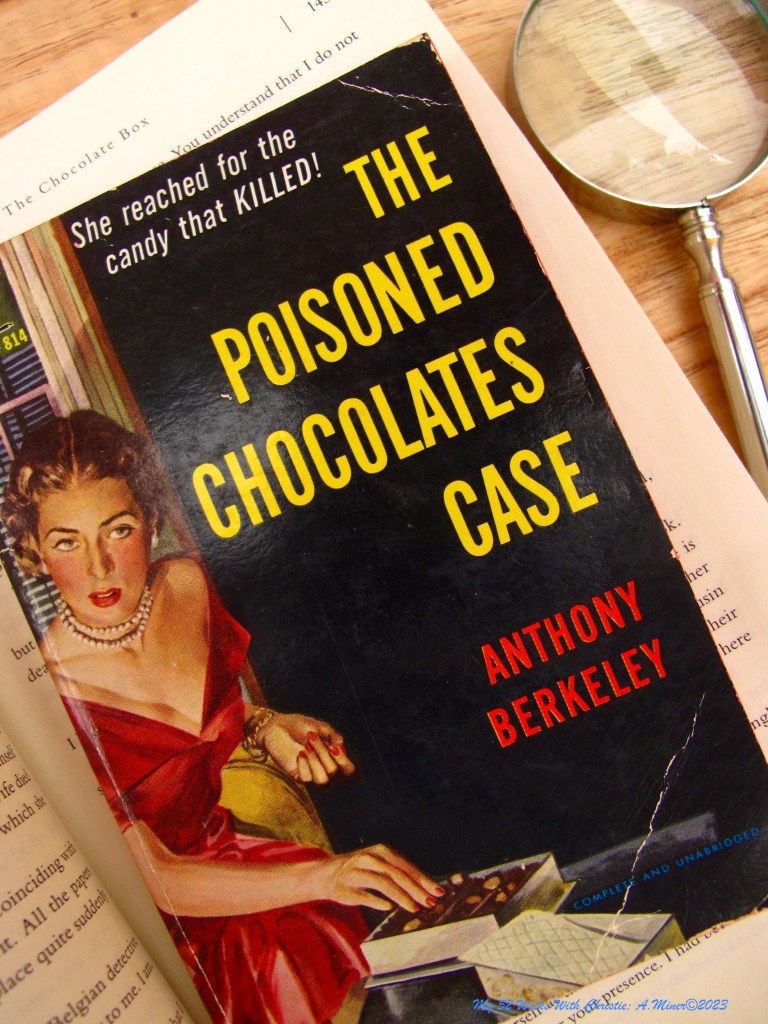
Over the past few months, I’ve unconsciously gravitated towards books that, in one way or another, feature chocolates and mail. Sometimes together, sometimes separate, these two elements kept creeping into the narrative…..A box of chocolates laced with cocaine appears in Peril At End House (1932). In the short story The Chocolate Box (1923), Poirot figures out the murder weapon was a singe trinitrine (aka nitroglycerine) stuffed chocolate. Author Anthony Berkley injected nitrobenzene into the soft centers of an entire box of chocolates, sent thru the mail to an unwitting puppet, to complete the deed in The Poisoned Chocolate Case (1929). 

Following the heels of Berkley’s aforementioned mystery, I listened to Poisoner’s Cabinet’s (a brilliant podcast) take on the case of Christiana Edmunds (year of crimes: 1870 -1871). The Chocolate Cream Killer, as Christiana was later known, laced her favorite chocolate coated confections with strychnine, then left bags of the contaminated sweets all over Brighton in the hopes someone would eat a piece of uncredited candy and sicken. Thereby convincing her crush that the candy maker was responsible for poisoning his wife and not her (it was definitely Christiana, btw). Later in her career as an adulterationist, Christiana sent anonymous boxes of sweets, chalked full of her preferred poison, to prominent citizens of the same city.

(This last feature of Christiana’s crimes, of course, brought Angele Laval and her infamous letter writing campaign to mind. Thank the gods above and below that Umberto Eco’s book, The Name of the Rose, wouldn’t be published for another sixty-three years — otherwise, it might have inspired her to post literally poisonous, poison pen letters….But I digress.)

Hot on Christiana’s heels, though not actually, as there are several episodes betwixt the two explorations, I re-listened the Poisoner’s Cabinet’s alcohol tinged study of Cordelia Botkin (year of crime: 1898). Who first tried to dissuade her love rival with an anonymous note. When that foray fell flat, Cordelia sent her a box of chocolates overflowing with arsenic to permanently deal with her opponent.

Talking with my husband about these cases, I idly wondered: What on earth possessed people to eat candy they neither ordered nor expected to receive in the mail? Didn’t they see the danger? Indeed common sense and penny dreadfuls would warn people away from such behavior….That’s when I recalled the whole gumball debacle of my childhood, which made me curious. Since mysteries often reflect reality, and all the fictional crimes I listed above came well after my true-crime exemplars….How often (really) did candy get turned into a weapon before 1923?

Turns out a lot, and I will explore three true-crime cases linked by candy, poison, the postal service, and love-rivals over the next few weeks.

My 52 Weeks With Christie: A.Miner©2023