Absinthe: Why “Absinthe made me do it!” Never Caught On, IMHO

Amongst the treasure trove of Golden Age mysteries, we find Sherlock Holmes enjoying his seven percent solution, Philip Marlowe’s prodigious drinking makes the characters in Mad Men look like teetotalers, Elizabeth Daly pitted Henry Gamadge against a heroin addict in Somewhere In The House, and Dorothy L. Sayers engineered a plot where Lord Peter Wimsey broke up a cocaine ring in Murder Must Advertise…These and a title wave of like-minded plots prove Golden Age mystery writers (and those from the surrounding decades) didn’t shy away from including alcohol and/or illicit substances in their works. 

Yet absinthe, the purported creator of fiends and madmen, rarely gets mentioned. 

Above and beyond the fact that the “Absinthe Defense” repeatedly fell short in courtrooms, thereby making it less appealing as a McGuffin for writers, I think there are a couple of other factors as to why “Absinthe made me do it!” never became a trope in mysteries. (Or at least not among the tomes I’ve helped collectors locate or in the reprints I’ve cracked the covers of.)

First and foremost, UK scientists and physicians gave Magnan’s 1869 paper detailing his flawed test findings, the stink eye. Pointing out the same problem I saw when first encountering Magnan’s experiment — i.e., using wormwood oil rather than absinthe effectively negates the test as the essential oil contains significantly higher thujone levels than absinthe. So while France, Switzerland, and the USA (amongst others) lost their shirt over absinthism (which Magnan believed his test conclusively proved as a separate and worse disease than standard alcoholism) and the fiends the green fairy purportedly created.…This scientific side-eye damped the alarm over absinthism in the UK and is considered one of the main reasons Parliament dismissed the idea of banning the Green Fairy out of hand.

It also doesn’t hurt that absinthe never came anywhere close to supplanting Gin, Irish Whiskey, Single Malt, or Welsh Whisky in the hearts of British Isles imbibers. Otherwise, British distillers might have found themselves tempted to join forces with French vintners in their smear campaign against absinthe.

In any case, while the UK never banned absinthe, it doesn’t mean those who enjoyed the odd Frappe or Corpse Reviver at their local pub could do so. Unfortunately, when the Swiss and French bans landed, distilleries in both countries either switched production to a less contentious product or closed up shop. So, whilst the UK patrons could order a Sazerac or a Death in the Afternoon, most bartenders couldn’t shake or stir one up due to the lack of the key imported ingredient (according to the sources I read). 

(Unless said pub owner, or their supplier, navigated the red tape around importing absinthe directly from Pernod’s distillery in Catalonia, Spain (where the liquor was never prohibited) until it closed in the 1960s. Or someone working in this theoretical pub somehow cultivated a connection to a Swiss home brewer. Despite the ban, Swiss fans with home distilling skills still produced it — though many switched their recipes to the clear version so they could pass their homemade efforts off as some other liquor if lawmen came a knocking.)

Then came WWI and WWII.

Under the hail of bombs, bullets, fear, and rationing, together with battlefield atrocities grabbing headlines and bans stymieing absinthe sales — news stories focused on crimes committed by “absinthe fiends” by and large fell away and without new fuel, the hullaballoo around absinthe slowly extinguished. Moreover, with people focusing on just surviving the day, for so many years, absinthe & its sinister reputation largely passed into urban legend.

In my estimation, this exit from the public’s day-to-day consciousness further rendered the “Absinthe made me do it!” solution unappealing to mystery writers. Since younger authors and audiences probably never tasted the anise flavored liquor or knew much about the brouhaha it caused. While mature authors and their readers could recall the attached lousy science and the ineffectualness of the absinthe defense in courts across Europe and the Americas. 
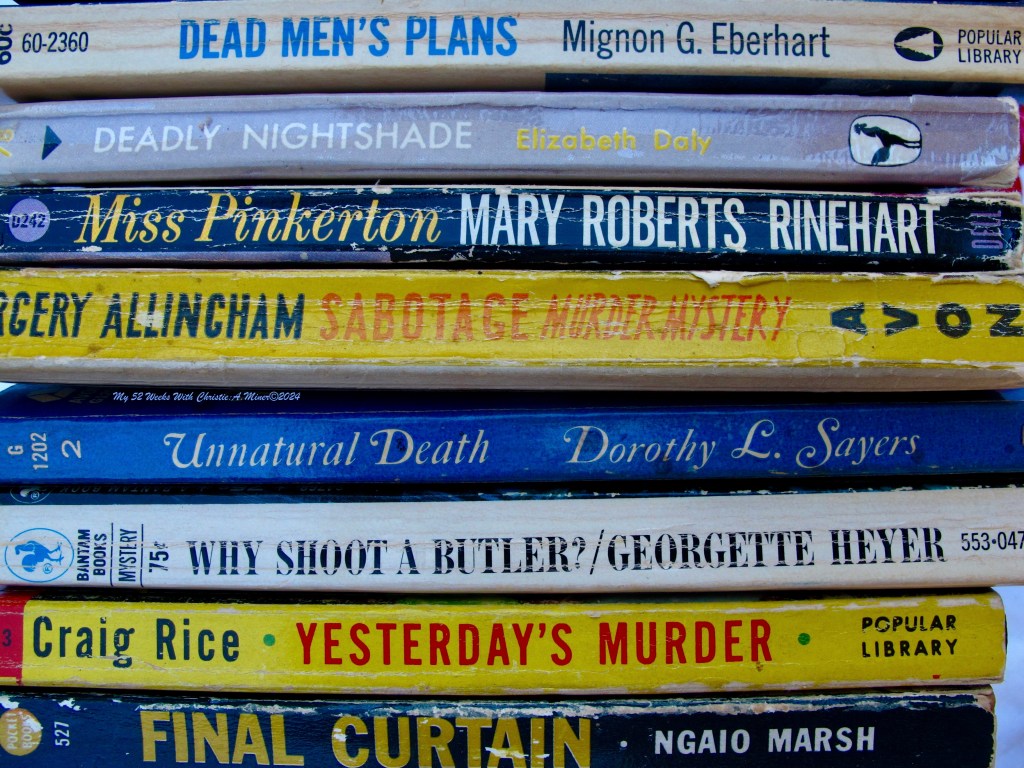
Perhaps all these aforementioned reasons account for the general absence of absinthe in mysteries penned by the Queens of Crime: Agatha Christie, Margery Allingham, Ngaio Marsh, and Dorothy L. Sayers; The American Queens of Crime: Elizabeth Daly, Craig Rice, Mary Roberts Rinehart, and Phoebe Atwood Taylor; Plus: Georgette Heyer, Josephine Tey, and Patricia Wentworth. In this pantheon of titans, only three (I can recall off the top of my head) chose to employ absinthe in any of their stories. 

Agatha Christie used absinthe in the 1926 Mr. Harley Quin short story The Soul of the Croupier to quickly flesh out the deterioration of a promising future due in part to absinthe’s influence. Similarly, Georgette Heyer employed absinthe in her 1934 novel The Unfinished Clue. Evoking the memory of the hedonistic existence and excess of turn-of-the-century artists to quickly sketch out a similar sort of character. And Craig Rice mentions the liquor in Headed For A Hearse as one of her characters is battling an absinthe inspired hangover with a plate of eggs (I believe).*

The relegation of absinthe to a piffling plot device by these Mistresses of Mystery, I think, struck the death knell of the “Absinthe made me do it!” solution before it ever had a chance to take off as a trope. Furthermore, the sheer dominance of these women’s works during the Golden Age of Detective Fiction (together with the lasting influence they still enjoy within the genre) played a significant role in perpetuating absinthe’s role as a bit player in plots.

And with heat now wafting from each vent of our house, repairmen on their way, and our cash reserves depleted — I bid adieu to another home repair inspired question until next November.

(But hopefully not.)

*If I failed to mention a reference (as I am not infallible, nor have I read the complete bibliography of each authoress — yet), please be nice if you wish to point out an omission.

My 52 Weeks With Christie: A.Miner©2024
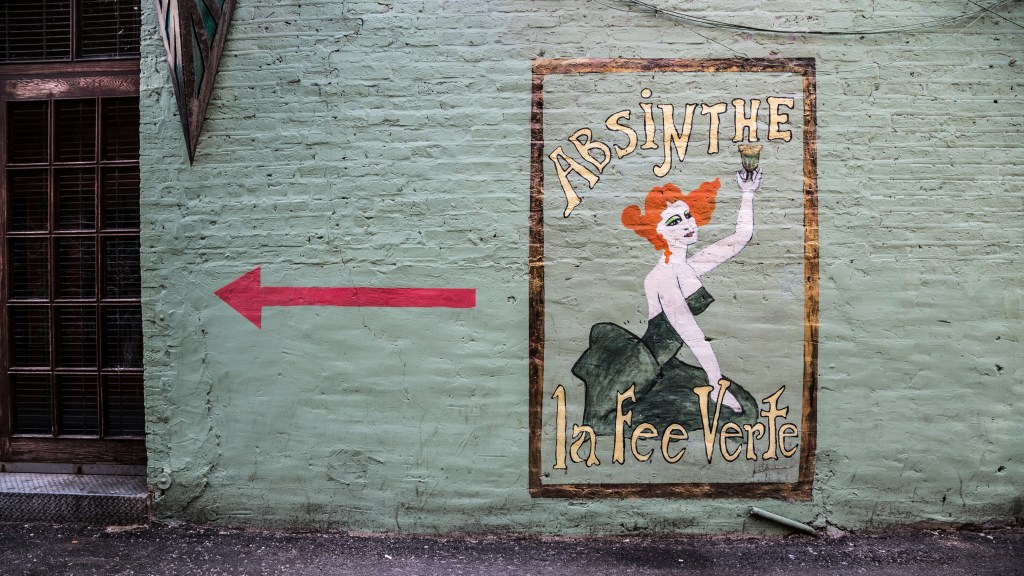
Absinthe: People have killed for less…But not by much.

Now that we’ve established absinthe’s meteoric rise and even faster fall in the realm of public opinion, we can now focus on my original question: Why haven’t I read mysteries where, during the summing up, the malefactor yells, “Absinthe made me murder/rob/eat Uncle Singin McBuzzleworth!”

One Unscientific Opinion/Answer: The “Absinthe made me do it!” defense didn’t hold up in real-life courtrooms. 

When examining classic mystery and real-life motives like avarice, revenge, envy, and sex — the “Absinthe made me do it!” defense appears weak by comparison. Moreover, despite large swaths of the population (within many countries) purportedly believing absinthe poisoned the minds and hearts of any who partook of the Green Fairy’s potion — defense councils were still hard-pressed to engender enough sympathy in jury members to make this justification stick. 

Take the case of Auguste-Leon Thabuis. 

Near the township of Dole in the department of Jura in France sits Saint-Ylie Hospital (or Asylum; the French translator app I used was not flawless). Back in 1909, the 1,500 people (or so) residing within Saint-Ylie were separated into different pavilions by age and gender then sub-divided further based on their ailment — those possessing some sort of paralysis lived in one ward, those with mental health issues in another, and the “incurables” (their word, not mine) lived in their own wing. 

In April 1909, the hospital director hired Auguste-Leon Thabuis to work in the men’s paralysis ward. Besides discovering he owned a terrific thirst, which he quenched at a nearby tavern, hospital administrators found no problem with Thabuis’s work.

Fast forward seven months.

On Friday, November 19, 1909, Thabuis reported to his supervisor that Justin Garneret (age 61) had died. Busy with one thing or another, Thabuis’s superior didn’t take the time to look the body over, instead they told Thabuis to get on with it. Which he did — leaving Justin Garnet’s body in his room, Thabuis went to prepare the earth for her newest resident — as he also moonlighted as a gravedigger and amphitheater boy for the hospital when needed.

Now it’s unclear precisely what roused the other nurses’ suspicions, perhaps because Justin Garneret’s death came completely out-of-the-blue or the curious piece of serendipity which found four other patients passing away, about one every other day, on Thabuis’s watch starting on November 10, 1909. Either way, they snuck a peek at Mr. Garneret’s body whilst Thabuis was away….And were rewarded with the sight of darkening fingermarks encircling Mr. Garneret’s neck. 

Fetching Hospital Director Bierry and Chief Physician Santenoise, the nurses explained their misgivings and subsequent discovery. 

At about this point, Thabuis returned to Mr. Garneret’s room with a coffin. In the ensuing conversation, during which I imagine Thabuis sweating more than a few bullets, Dr. Santenoise questioned the nurse about the undeniable signs of strangulation. Unfortunately (for Thabuis), the Chief Physician didn’t buy the story he spun: That one of the lunatics must’ve snuck out of their ward, into his, strangled Mr. Garneret, then crept back to their room — their absence and presence remaining undetected by everyone the entire time.

When the public prosecutor, examining magistrate, their clerk, and two trained forensic examiners answered Dr. Santenoise’s summons, Thabuis told them that Mr. Garneret attacked him and he’d been forced to defend himself. This explanation, which went over about as well as his first, prompted Thabuis’s immediate arrest — during which he cried out, “I’m innocent! I’m innocent!” Mr. Garneret’s autopsy, carried the same night around eight pm, confirmed the nurses’ worst fears — he was indeed murdered.

The Question Was: Did the other four patients who died under Thabuis’s care over the past eight days meet the same fate? 

Performing a quadruple exhumation and autopsy the following Friday, authorities found some answers. Sadly, the bodies of the first two possible victims decomposed to the point where murder couldn’t be conclusively proven. The third victim, Francoise-Emile Menefere (age 54), bore bruises in the outline of two hands around his neck and a bruise on his chest. The fourth victim, Xavier Guinez (age 54), sported a similar bruising pattern as well as a row of four broken ribs and other defensive injuries. (It seems in addition to using his hands, the murderer used his knees to compress his victim’s chest to hasten the deed.)

With cause of death now established and confident they had their man, investigators turned to motive…..which proved troubling. Not because they found its establishment difficult but because the only dependable benefit Thabuis received from any of the deaths was the single extra franc he earned for each grave he dug. This veritable pittance was hastily spent at the neighborhood tavern. Where, when “flush” with cash, Thabuis reputedly drank up to four liters of wine and twenty-two glasses of absinthe.

All these facts & theories, together with the unsavory intelligence Thabuis sent notes to grieving families asking if they’d like him to maintain their loved ones’ graves in exchange for a small donation, emerged during his trial, which commenced in July of 1910. (It’s unclear if Thabuis wrote the families of the men he murdered.) This seedy behavior, coupled with a job history that included terminations due to theft, insolence towards a nun, coming to work while inebriated, and serving a three-month prison sentence for insulting a Swiss police officer — didn’t help his case. 

However, his public defender, Milleret, was up to the task.

Amongst the sixteen witnesses called by the prosecution, Milleret determined that while all the nurses, who’d first raised the alarm, believed Thabuis culpable in the murder of Mr. Garneret (based on his and their movements that day), none could confidently assign his hand to the deaths of Mr. Menefere or Mr. Guinez. While the prosecution argued that Mr. Garneret’s murder proved the pattern. Milleret countered this by pointing out that the prosecution could not call a single “reliable” eyewitness to the crimes.

(Now, here comes the cream, at least for the question I’m trying to answer.)

In a Classic Scenario of ‘I didn’t do it. But if I did it.’: Milleret attempted to establish that Thabuis suffered from a classic case of hereditary degeneration and, therefore, shouldn’t be held accountable for his actions. (Yes, this case explicitly put absinthism to the test.) Not only did Thabuis prefer the embrace of the green fairy above all others — Milleret argued this devotion/addiction decayed Thabuis’s moral fiber to the point where taking another man’s life in pursuit of another glass felt justifiable. Moreover, due to weak genes he’d inherited from his father, whose excessive drinking sent him to an early grave six years prior, Thabuis’s ethical putrefaction was all but guaranteed.

It’s unclear if the alienist the prosecutor brought in successfully refuted Thabuis’s defense or (more likely in my estimation due to the slant of the newspaper reports) the members of the jury couldn’t overcome the repugnance of Thabuis killing a man for a single franc. Either way, it only took the jury three-quarters of an hour to find Thabuis guilty of Mr. Garneret’s murder and sentence him to seven years in prison and a ten-year ban of stay. (I’ve no clue what that last bit means. Maybe it banned him from working in another hospital for ten years after his release?)

In any case, the regular rejection of Magnan and Legrain’s absinthism defense by juries presents a fascinating counterpoint to the anti-absinthe campaign, which embraced these theories and was, at that moment in time, gaining momentum across several continents. Perhaps if women, the backbone of the temperance movement, were allowed to serve on juries during this period, acquittals based on the “Absinthe made me do it!” wouldn’t have been rarer than hen’s teeth.

Moreover, the lack of acquittals based solely on “Absinthe made me do it!” may have signaled to Golden Age mystery writers the inherent weakness in this particular solution. Since their livelihoods were based on fashioning viable and (generally) believable solutions for their readers, placing the blame solely on absinthe for the unfortunate fate befalling Uncle Singin McBuzzleworth could place a lackluster ending on an otherwise strong story — which might cause an author to lose readers. 

An idea I imagine any pro would find insupportable.

My 52 Weeks With Christie: A.Miner©2024

Absinthe: Let’s All Panic!

While increased availability and/or Magnan and Legrain’s theories swayed some back towards wine (which most experts considered harmless), a far greater number now viewed the absinthe as a guilty pleasure — which only enhanced its protracted pizzaz. This not-so-subtle brush-off made teetotalers, doctors, and winemakers despaired over the idea that they may never rid themselves of the glittering Green Fairy. 

Then Jean Lanfray came along.

Originally a Frenchman, Jean Lanfray lived and worked in Switzerland. Arriving home on the afternoon of August 28, 1905, Lanfray promptly picked a fight with his wife over the state of his boots. Seems she hadn’t gotten around to waxing them as he’d requested and, in short order, both spouses were seething. When Lanfray told his wife to shut up….She said, “I’d like to see you make me!” Whereupon he fetched his Vetterli rifle — shot his wife in the head, turned the gun on his two daughters (both under five), then attempted to kill himself.

After his arrest, the reeling residents of Commugny (the town in which Lanfray and his family lived) attended a townhall meeting on September 3, 1905, where they learned Lanfray ingested two ounces of absinthe and that his wife was about four months pregnant with their son at the time of her murder. Horrified at the latter revelation and feeling powerless in the wake of this senseless violence, townsfolk needed someone or something to blame. Unable to put Lanfray immediately on trial, as he lay in a nearby hospital recovering from his suicide attempt, they chose absinthe as their scapegoat. Within days of the assembly, the citizenry sent a petition with 82,000 signatures to their state capital, asking legislators to ban the “Green Monster”.

The unintended consequence of the community’s appeal? They set a clear defense strategy for Lanfray’s lawyers — absinthe made him do it. An assertion medical experts supported during Lanfray’s brief trial. Absinthe notwithstanding, the fact Lanfray also quaffed seven glasses of wine, six glasses of cognac, two coffees laced with brandy, and two creme de menthes on that fateful Monday diluted the effectiveness of this defense. And while this prodigious intake prior to the murders and his very obvious remorse kept his neck out of the noose, on February 23, 1906 a jury found Lanfray guilty of murder. 

Three days after being sentenced to thirty years imprisonment Lanfray, haunted by his own actions,  would hang himself in his jail cell.

Despite the clear flaw in the blame game being played (i.e. the liters of other alcohol Lanfray consumed), on May 15, 1906, the Canton of Vaud (the state where Commugny is located) banned absinthe. Shortly thereafter, Geneva followed suit in response to their own absinthe-drinking husband named Sallez, who murdered his wife about a month after Lanfray’s crimes. (Brazil and Belgium beat both to the punch by banning absinthe outright in 1905.)

Temperance unions extracted an entirely different lesson from this series of tragic events. 

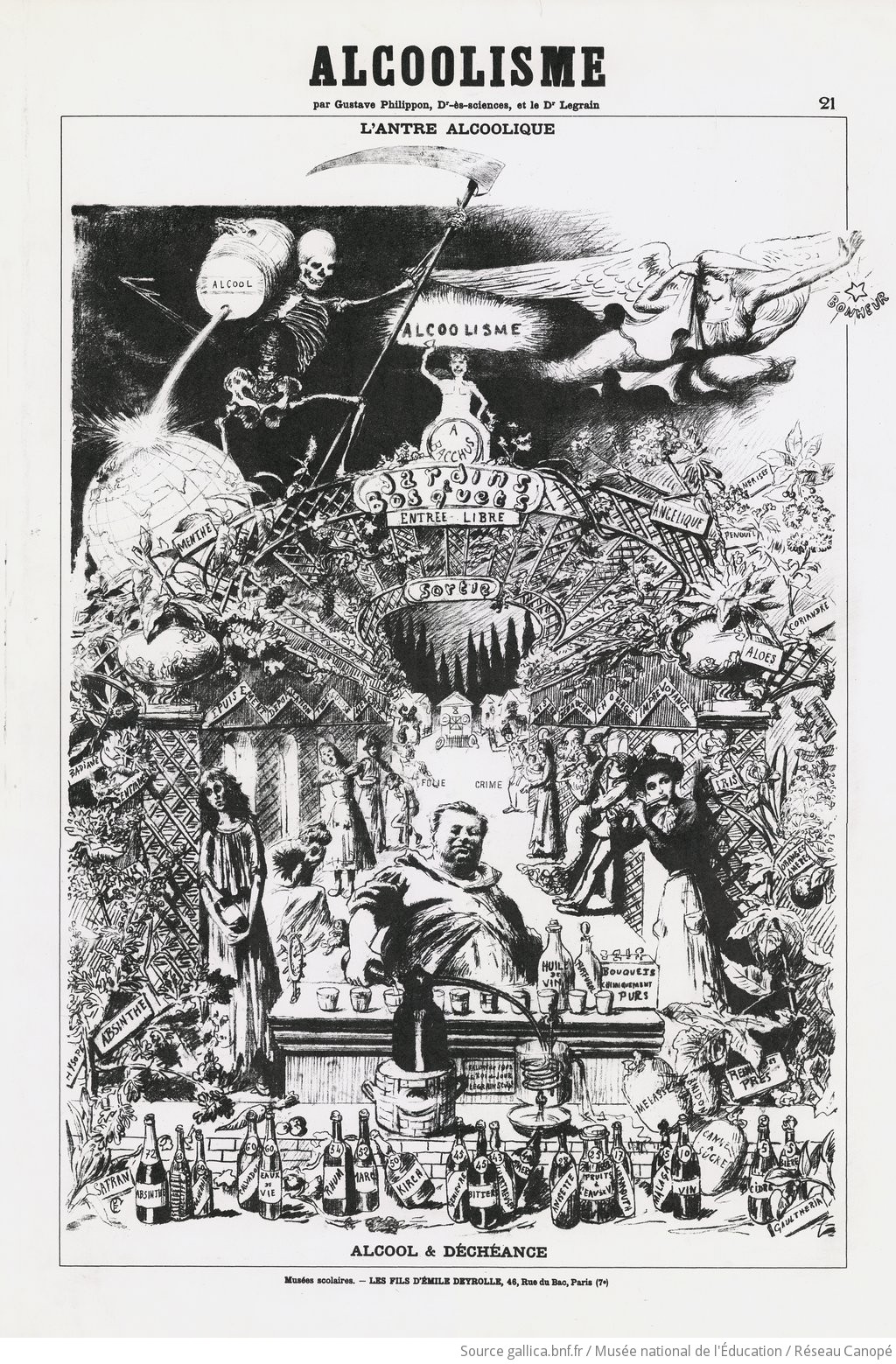
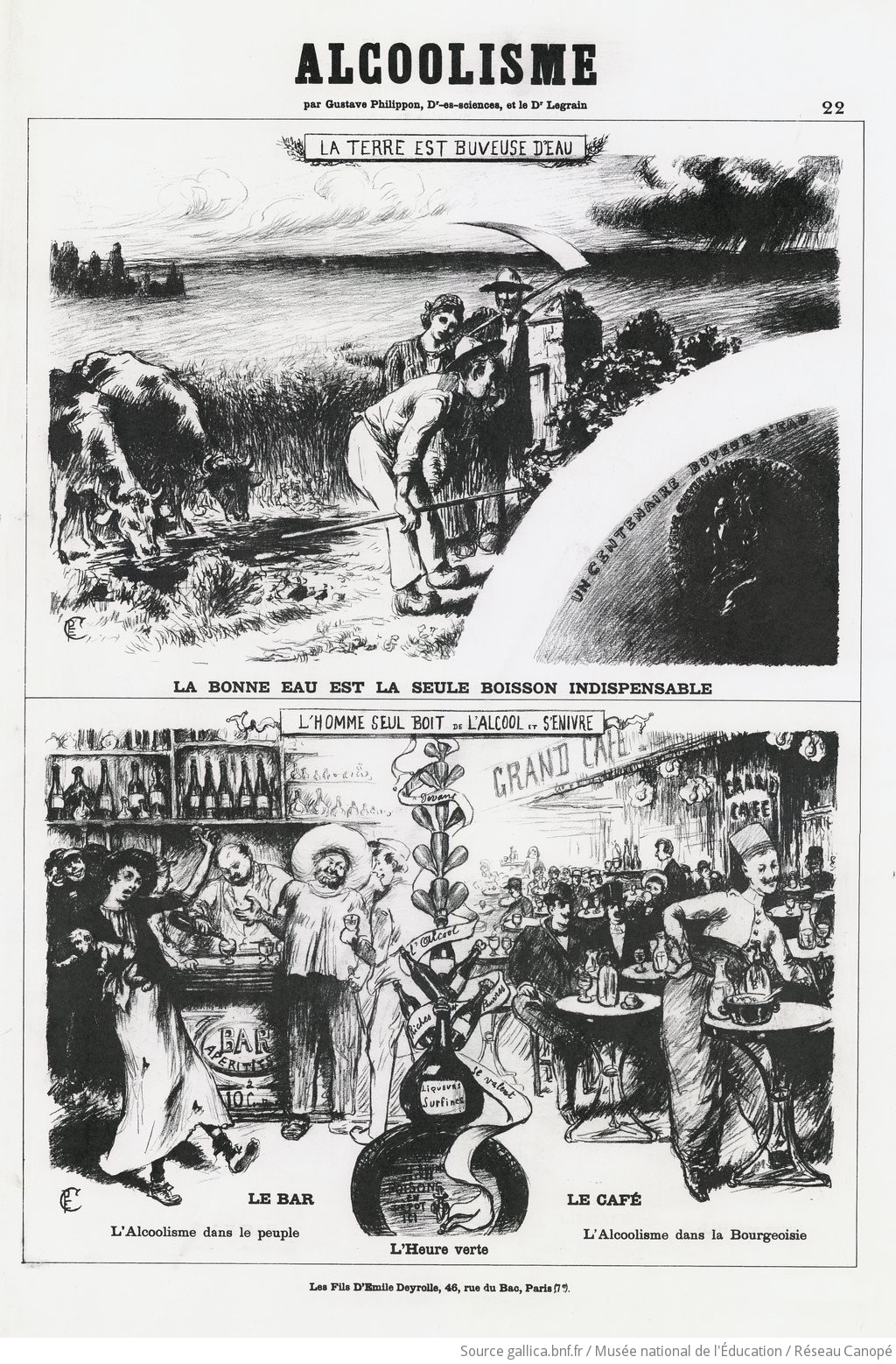
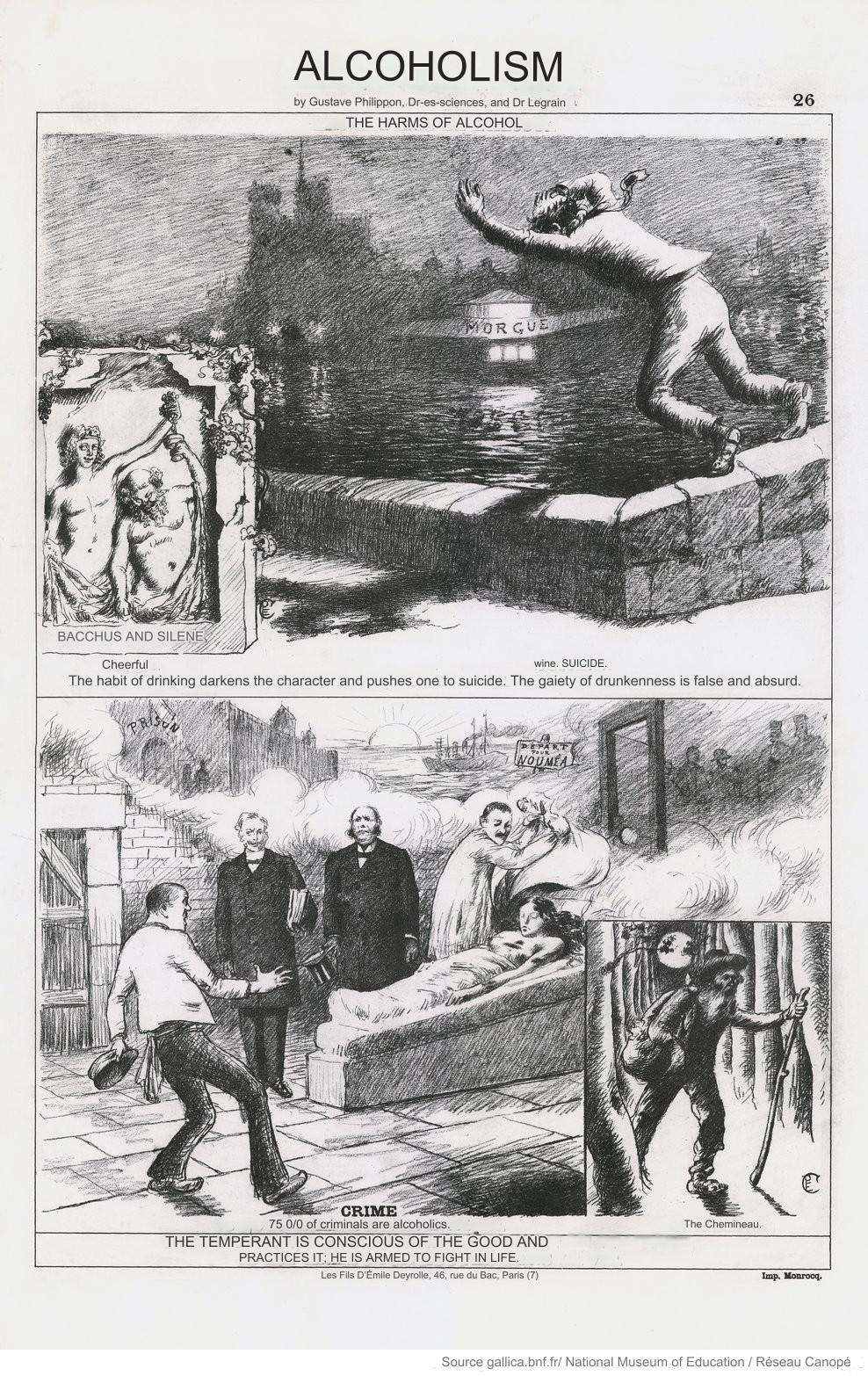
They discovered a potent weapon in their fight — moral panic. By spotlighting every crime where absinthe played a role, even a minor one, they could catastrophize the “threat” absinthe posed to society’s safety and wellness. To this end, not only were Magnan’s skewed scientific experiments widely reprinted along with his theories on absinthism, Legrain lent his time, reputation, and words: “….after three years’ absinthe drinking a man becomes weak minded…moody, taciturn, suspicious, eccentric, untrustworthy and apt to quarrel without cause. If he continues to take the deadly liquor his body becomes an automaton, and he obeys without hesitation the auto-suggestions of his mind often killing, maiming and destroying with savage glee those nearest and dearest to him.” 

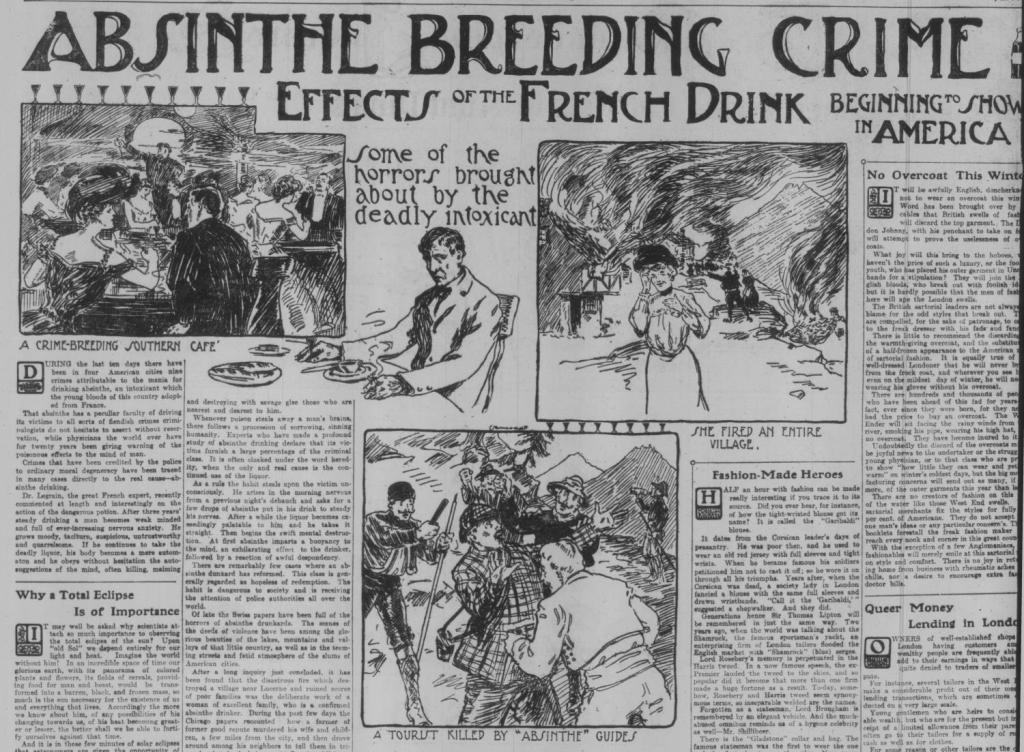
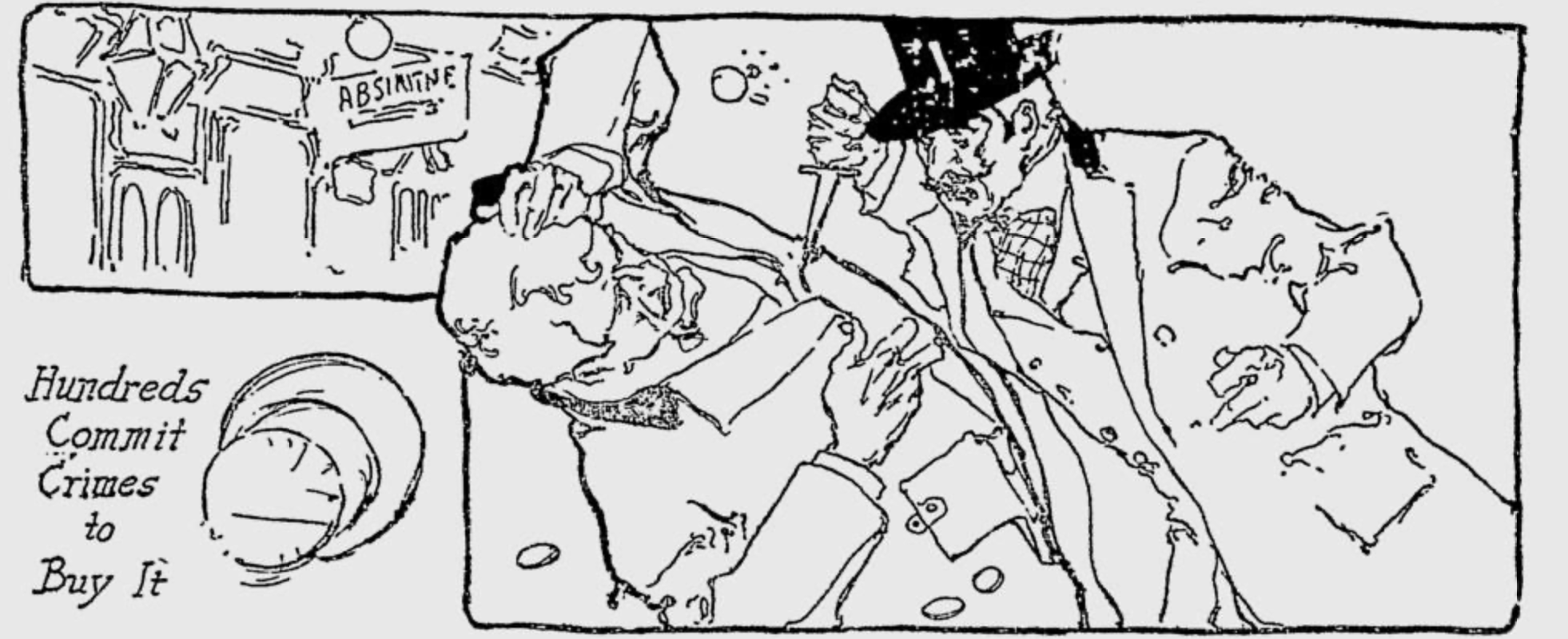
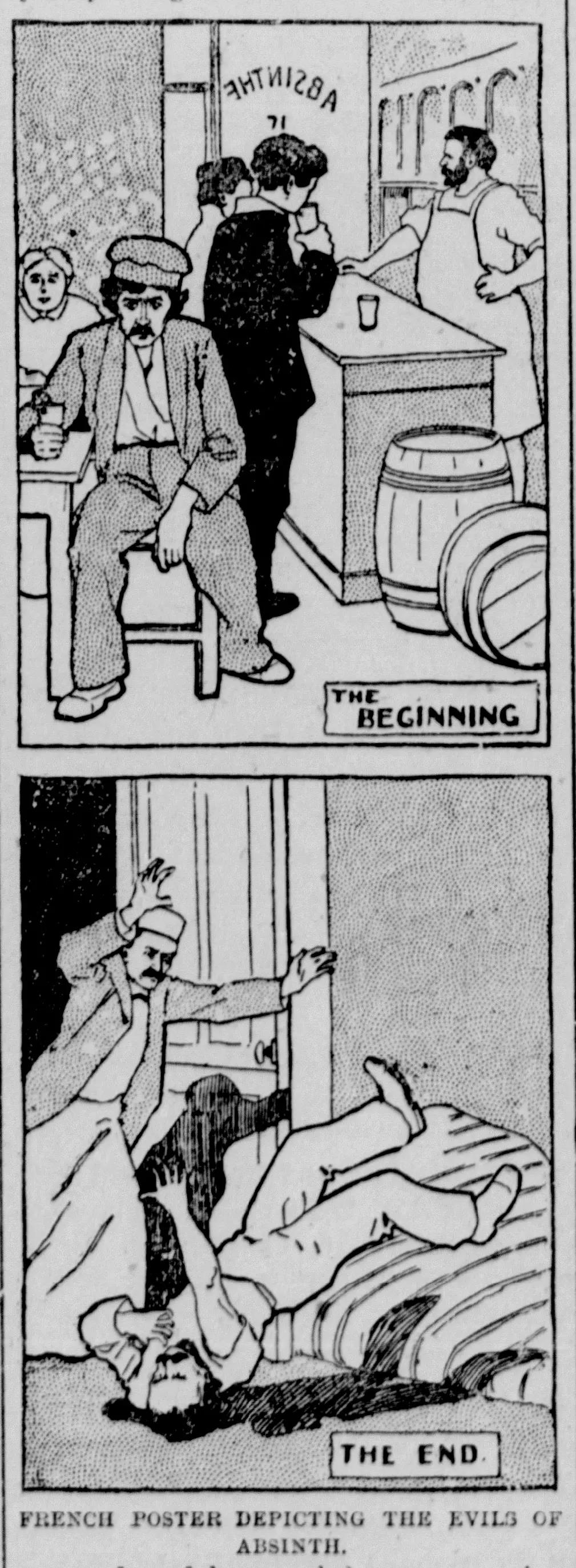
Fanning the anti-absinthe flames further, temperance unions and their members began churning out art, movies, and pamphlets corroborating these scientific findings. The most effective arrow in their quiver? Syndicated newspaper articles, in which the author detailed the alarming or violent behavior of absinthe drinkers. Amongst the many offenses attributed to “absinthe fiends” were: A) A man named Valentin Boyer, who was convinced that his enemies were persecuting him via electricity. When circumstances forced him to enter Paris, he donned a 385-pound coat made of copper and a hat made of lead with a visor covering his face. He was promptly arrested for his odd appearance. B) A man attending a national fete set fire to 37 dresses as he couldn’t resist applying his cigar to every blue dress he saw. C) A woman of good standing was arrested and imprisoned for setting fire to a village near Lucerne and destroying several houses owned by “the poor.” D) Near Nyon, an absinthe addict maimed cattle and set a series of fires. E) A 12-year-old girl was stabbed to death near Thorwaldensen’s Lion of Lucerne by a man employed at a match factory in Geneva. F) A man decapitated a young girl in Lausanne. G) Six Valois guides murdered a tourist and hacked him to pieces. H) Whilst in police psychiatric care, it was noted absinthe addicts would often try to bite off and eat pieces of their friends and family’s faces when they leaned in for a kiss. 

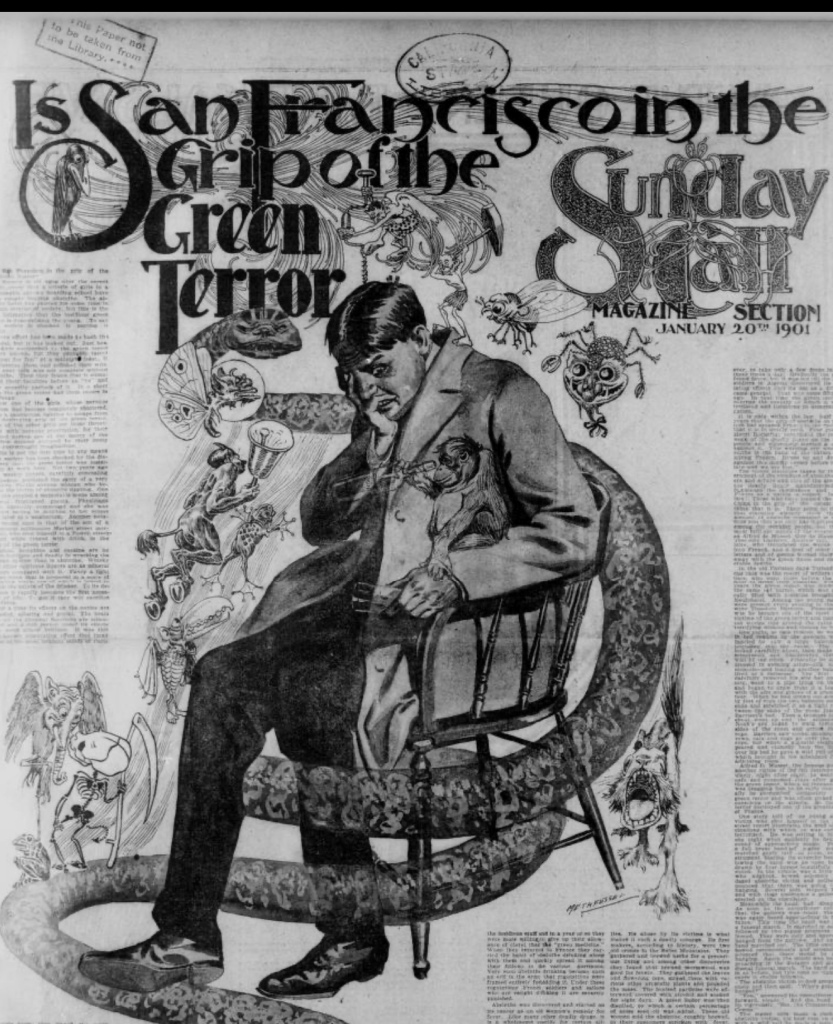
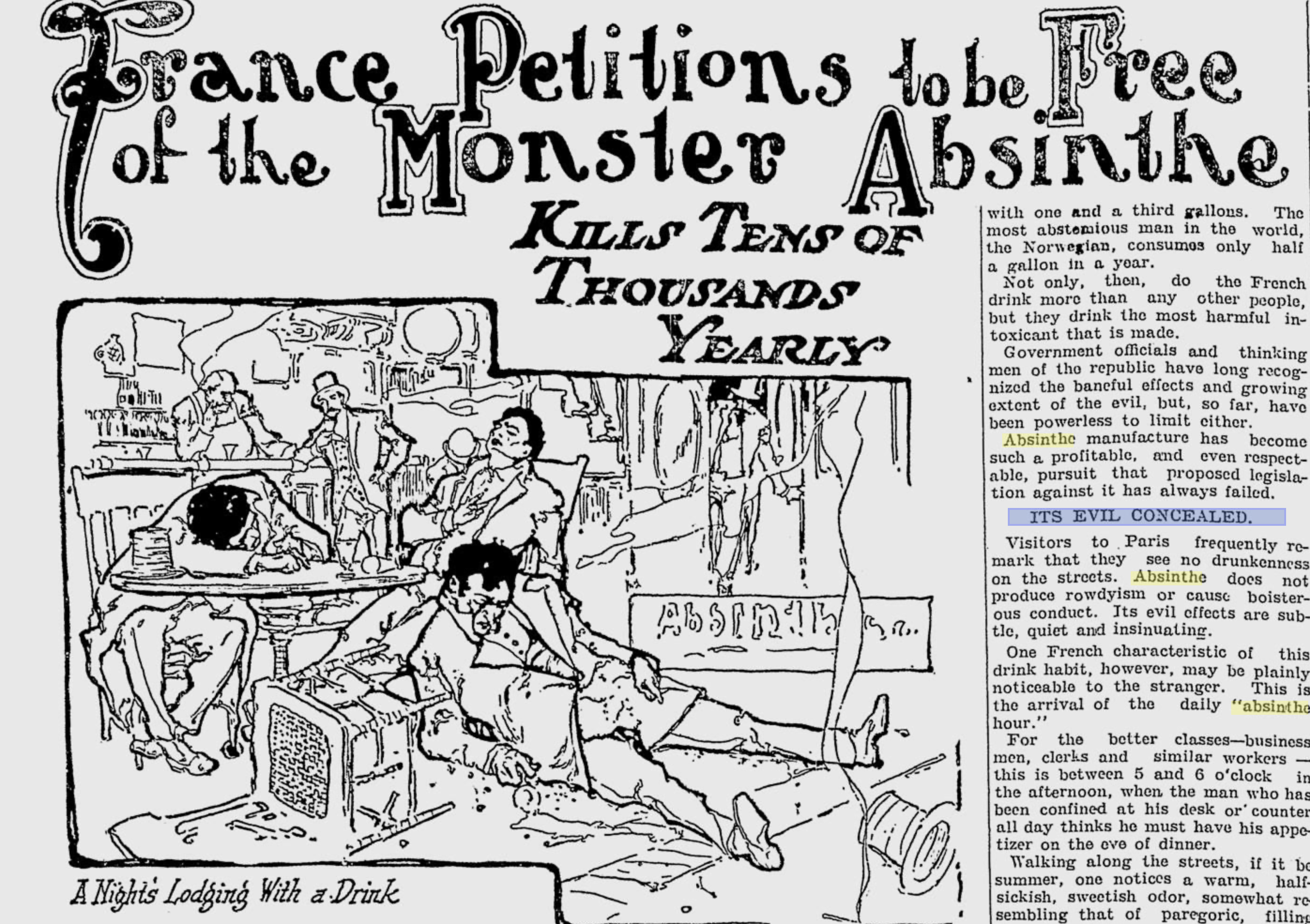
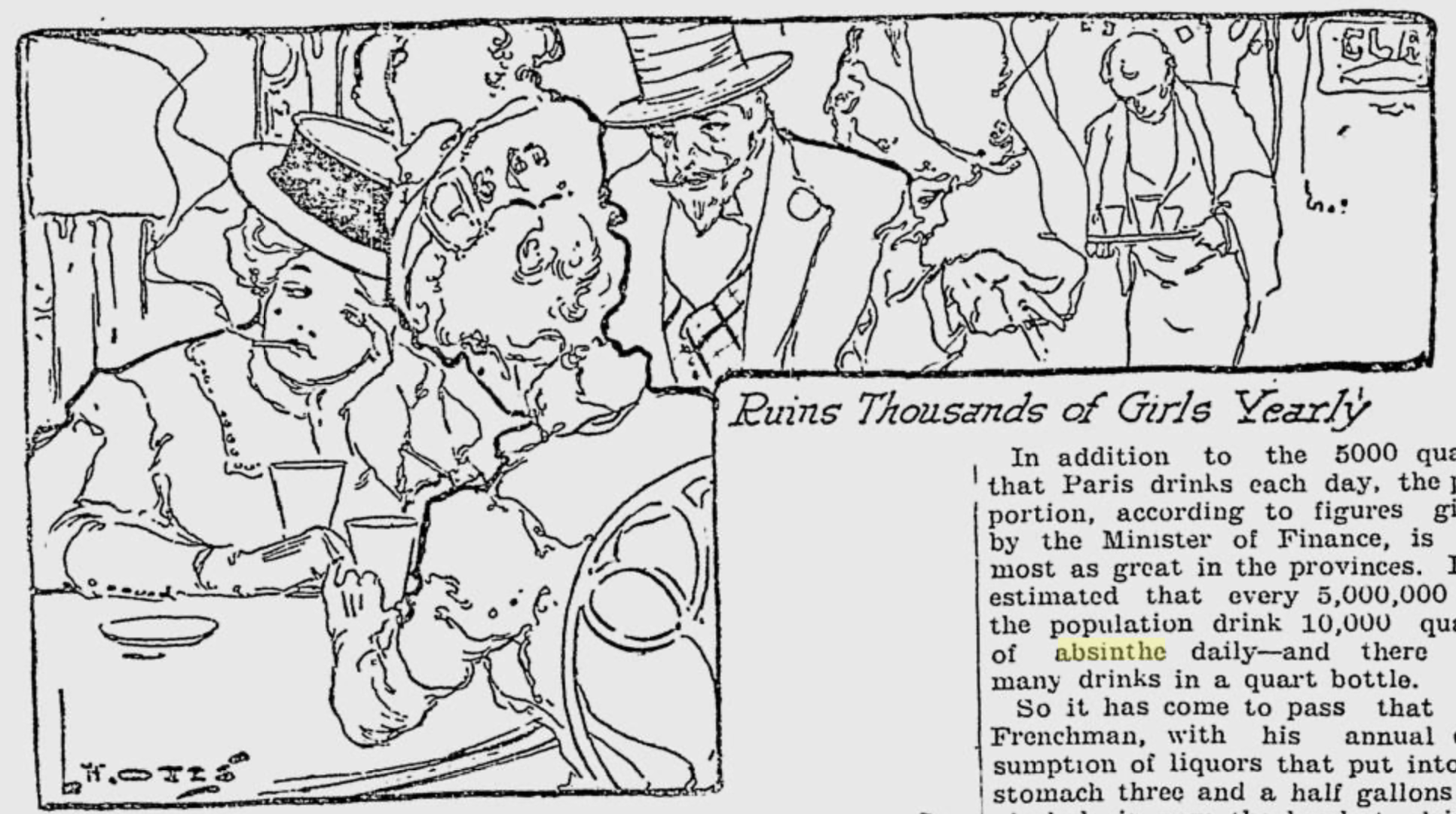
Unsurprisingly, these tales of arson, murder, and cannibalism snowballed as editors keen on increasing their readership (and/or were part of the temperance movement themselves) lept onto the anti-absinthe bandwagon. Not only did they feature any local/regional cases that even tangentially intersected with the “green monster.” They also published their own exposes on the dangers absinthe posed to their communities. Some linked the drink to the same dangers posed by opium or morphine. Others warned husbands to watch their wives lest they be lured into absinthe dens and robbed of their pin money and jewelry while they lay in an absinthe-induced stupor. Still others advised parents to keep a weather eye on their daughters lest absinthe tempt them into a wickedness and ruin.

At some point, one bright bulb took this fear-mongering to another level by linking Magnan and Legrain’s theories of social degeneration due to absinthe drinking to the bitter loss of Alsace-Lorraine during the Franco-Prussian War in 1871. Doubling down newspapers across the world started questioning France’s fighting fitness (and, by extension, every other country that allowed absinthe within its borders). Thereby creating a green-tinted scapegoat for the growing anxiety and helplessness people felt as they watched Germany, the Austro-Hungarian Monarchy, and the Ottoman Empire growing stronger as the world hurtled towards 1914 and the start of World War One. (Though they didn’t know it yet.)

Unsurprisingly, this relentless pressure and constant fear bore fruit in 1909 when the Netherlands banned the spirit. Switzerland amended its constitution to add an absinthe prohibition in 1910, the USA’s Pure Food and Drug Act barred its import in 1912, and France banned the spirit in 1914. 

From the Office of Cynical Speculation: When reading these “reports” of absinthe induced crimes cracks start to appear when they inevitably reference the Lanfray case. Rarely do any of these “news stories” cite Lanfray by name; none mention the date of his offenses or conviction, nor the specific town where the murders took place. They generally refer to him as a farmer living near Coppet who murdered his young wife and children. 

Why so vague? Not only with Lanfray but in the description of the other cases? Other than the rare mention of Lanfray by name, only the first of my examples ever mentioned one of these “absinthe fiends” by name — few gave a specific location and none contained a firm date.

Playing Devil’s Advocate Here: They could have omitted these details to keep the newspaper column under a specific word count. Or perhaps the authors thought these examples were so famous everyone would instantly get the reference. I know the Lanfray case became the cause célèbre in Europe for a time thanks to the anti-absinthe movement. So, it’s not out of the realm of possibility.

However, the doubting Thomas living in the back of my brain wonders if the lack of detail stems from the desire to obfuscate the particulars of their examples…..In order to make it difficult for the public or their opponents (of which there were more than a few, though they were far less organized and funded) to suss out details which didn’t align with the thrust of the anti-absinthe campaigner’s aims. Again, take the Lanfray case as an example. If those unfamiliar with the murders learned of the liters of wine and wine-based beverages he consumed and compared it to the two ounces of absinthe….Well, people might draw a different conclusion and blame the wrong kind of alcohol — which flies in the faces of winemakers’ self-interest. Hence why it may’ve been left out.

So what about the other examples of absinthe-induced crimes? Do they own similar inconsistencies? 

I don’t know. I attempted to verify the finer points of the other cautionary tales and came up with bupkis. I couldn’t find a single newspaper piece aligning with the criminal information outlined in these syndicated articles. In fairness, these purported transgressions are well over a century old, and my French (while improving) is still lackluster at best. 

While, I do not believe the authors made this anecdotal evidence up….…I am not sure they were above exaggeration either.

My 52 Weeks With Christie: A.Miner©2024

Absinthe: Mary Poppins, Bad Science, & Teetotalers

‘A spoonful of sugar helps the medicine go down. The medicine go down. The medicine go down…’ Originally, this ditty sung by MaryPoppins meant to teach her charges how changing their perspective could make any task fun — and as a kid, I lapped Ms. Poppins’ lesson right up. Not long after, my folks skewed the song’s meaning to a more literal interpretation, i.e., taking actual medicine. (Without giving me an actual spoonful of sugar or some other substitute — much to my younger self’s disappointment.) This ever-so-slight adjustment introduced the idea that songs, art, and books could take on new meanings separate from the creator’s original intent. 

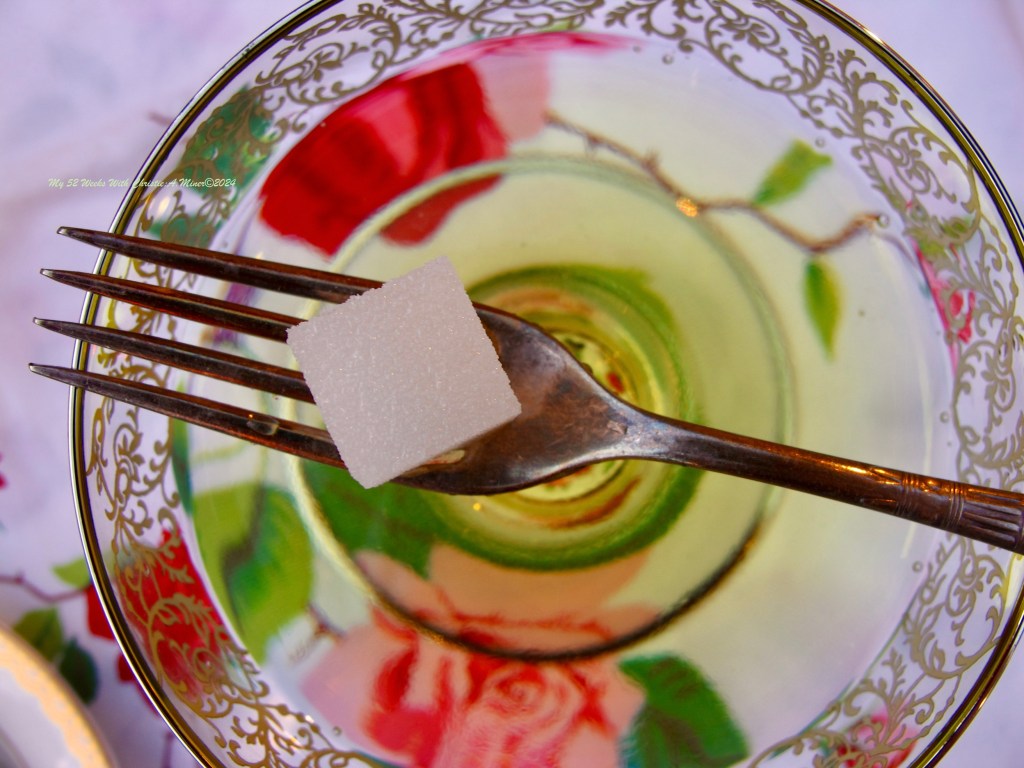
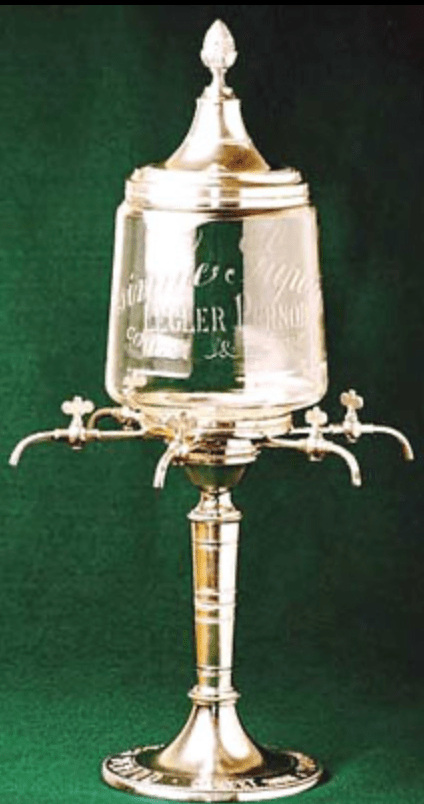
Fast forward a few decades to the day my brain took this ditty’s refrain one step further by wondering if A Spoonful of Sugar shouldn’t be absinthe’s unofficial anthem. After all, absinthe did originally start out as a medicine (whether or not it was effective treatment is a different story), and the ritual around consuming the notorious spirit does often include a sugar cube…..Set on a slotted spoon which rests upon the rim of a glass which contains absinthe. When all the elements are assembled in the correct order the water dripper is turned on and the sugar cube is gradually dissolved — one water droplet at a time. 

(Fun Fact: A Spoonful of Sugar owes its origins to the songwriter’s son, who inspired his father with how he received his polio vaccine.)

What’s the point of waiting ages for the sugar cube to completely dissolve? 

Not only does the sugar sweeten and round out the taste of absinthe (according to experts) — you’re rewarded with the pageantry of the ouzo effect. Otherwise known as louching, as each drop of water falls into the absinthe, the ice cold drip steadily transforms the crystal clear green liquid into cloudy opalescence. This unhurried ceremony forces the imbiber to slow down, be patient, and present in the moment. Lessons which I think Mary Poppins, who herself enjoys the odd glass of rum punch, would approve.

Interestingly enough, this pomp & circumstance around drinking a dram of absinthe was perfected by the French during decades spanning the mid to late nineteenth century. Culminating l’heure verte or the green hour, where people would flock to their favorite drinking joint from five to seven pm and partake in absinthe’s relaxed razzle-dazzle. 

(Fun Fact: L’heure verte is the precursor to what we now call Happy Hour.)

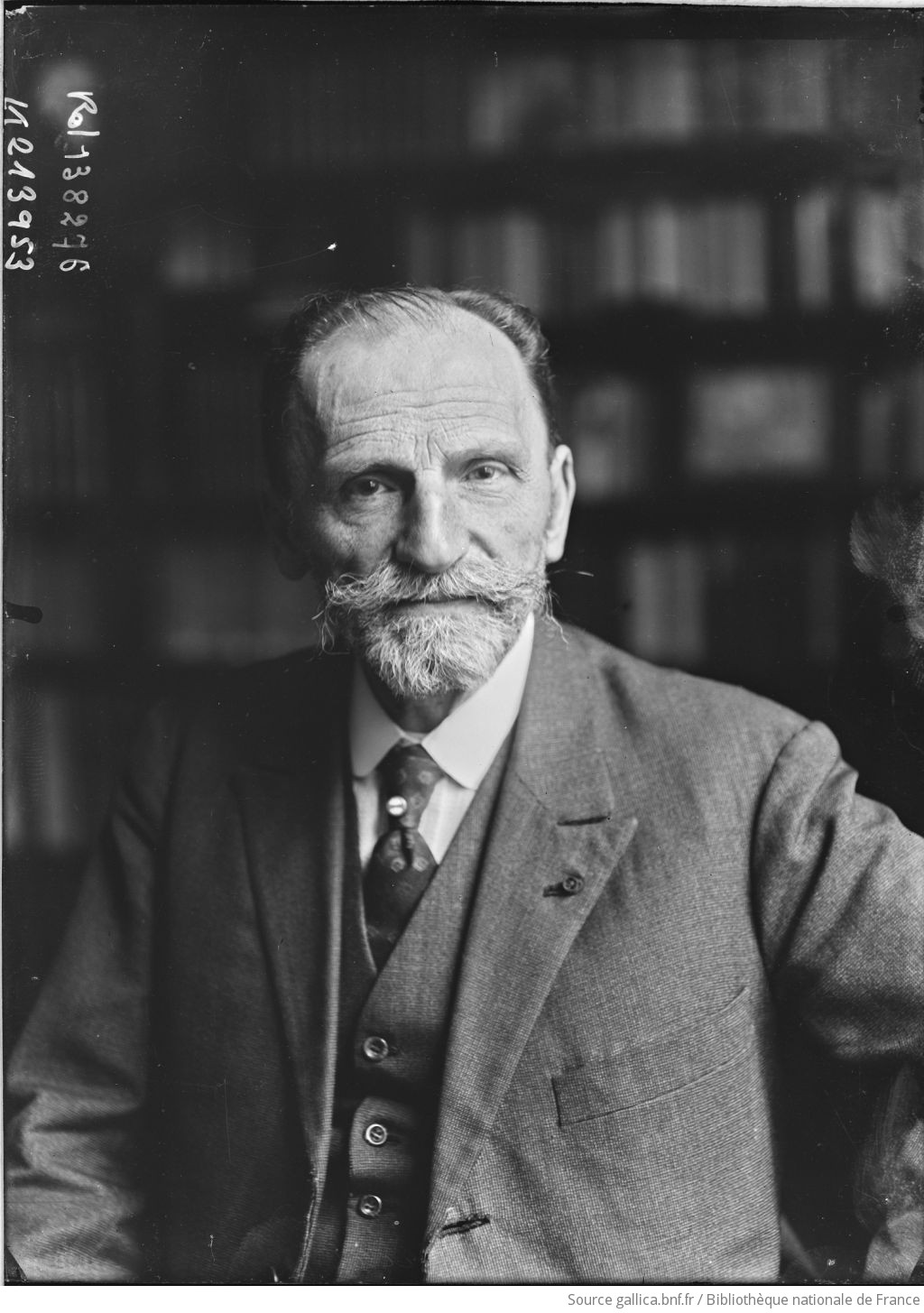
Yet not everyone in France was spellbound by absinthe’s sedate charm. The man considered the foremost authority on mental illness (upon his appointment to the post of physician and chief of Sainte-Anns asylum in 1867), Valentin Magnan, held absinthe responsible for the overall decline of the French people. He also believed this degeneration via absinthe (and alcohol in general) was passed on genetically from one generation to another — and was inevitable. He came to this conclusion due to the uptick in those admitted to his asylum and the study of over two hundred and fifty alcoholics under his care. Magnan’s research convinced him that those addicted to absinthe suffered far worse and from distinct symptoms than those who drunk pretty much anything else. 

(BTW: Other doctors and newspapers criticized Magnan for giving cold comfort to those “afflicted” by this absinthe/alcohol induced degeneration theory and robbing those genetically related to them of all hope of avoiding a similar fate.)

So, of course, Magnan coined a term.

Absinthism, he believed, was characterized by hallucinations, delirium, bouts of amnesia, tremors, sleeplessness, seizures, and violent fits brought on by one of absinthe’s key ingredients — wormwood. A man of science, Magnan sought to prove his absinthism theory by conducting a series of tests. Procuring two guinea pigs, he placed each under their own glass domes. In one enclosure, Magnan placed a saucer of pure alcohol; in the other, he set a saucer of wormwood oil and then watched the animals inhale the vapors. Whilst the guinea pig with alcohol merely grew inebriated, the one exposed to wormwood oil grew highly excited, then collapsed into seizures and died. 

You see the problem with his experiment, don’t you? Magnan didn’t use absinthe. He used wormwood oil. 

This concentrated form of Artemisia Absinthium owns significantly more thujone (the chemical compound responsible for the animal’s seizures) than the common wormwood plant or absinthe. Hence, Magnan did some spectacularly bad science by performing an experiment guaranteed to prove his theory.

(From the Office of Fairness: It’s unclear if Magnan made this error in good faith, i.e., just an ordinary cockup — or — if he tested absinthe on the animals and switched to wormwood oil when they failed to prove his theory.) 

Magnan also didn’t take into account the adulterated versions of absinthe floating around France by this time, either. Unlike wine or brandy, absinthe had no governmental oversight keeping distillers honest. So as absinthe’s popularity grew, unscrupulous manufacturers would contaminate poor quality absinthe or create fraudulent versions by adding things like parsley, turmeric & indigo or copper sulfate to enhance or attain absinthe’s trademark green hue and antimony trichloride to achieve the spirit’s signature ouzo effect. Whilst parsley and turmeric aren’t a problem, the other substances aren’t particularly good for you when ingested and could account for the array of symptoms Magnan attributed to absinthism. Moreover, the people most likely to partake of the polluted versions, the desperately poor and alcoholics who’ve hit rock bottom, were more likely to wind up institutionalized than their wealthier counterparts — thereby skewing Magnan’s theory from the outset.

Flawed as Magnan’s methodology was, he felt confident enough to publish a paper on the perils of absinthe, its chronic use, and absinthism in 1869. (And its flawed conclusions have bedeviled absinthe ever since).

The bohemian artists of France embraced a slice of Magnan’s findings. Loudly extolling the virtues of absinthe’s purported psychedelic properties, they claimed brought a clarity of mind, which in turn enhanced their creativity. Naming absinthe’s muse like qualities the Green Fairy, artists like Manet, Henri de Toulouse-Lautrec, Alfred Jarry, Oscar Wilde, and Vincent Van Gough all sought out absinthe’s warm embrace and some even put her into their works. 

(Fun Fact?: Critics of absinthe are forever pointing at the generally early deaths of these aforementioned artists as proof of absinthe’s toxic qualities. However, what these fault finding individuals generally ignore is this group of artists also enjoyed a host of other ailments like syphilis, TB, and mental illnesses which alcohol of any variety would’ve exacerbate.)

In any case, these wholehearted endorsements of absinthe’s spectacular effects cut little ice with the growing conservativeness in France, including a student of Magnan’s, Dr. Paul Maurice Legrain. Like his mentor, Legrain too was a chief physician of an insane asylum, only he specialized in the treatment of alcoholics. While his mentor viewed absinthe as the sole author of France’s decline, Legrain widened this stance, considering alcohol and alcoholism as the root of France’s social evils. However, rather than doing medical research into how to successfully treat the disease, Legrain threw himself into France’s growing temperance movement. In 1897 he founded the French Anti-Alcoholic Union then grew its membership numbers from 40,000 in 1903 to 125,000 in 1914.

At about this point, the late 1890s, French grapevines and vintners had bounced back (which took about thirty years), thanks to grafting and hybridization with louse-resistant American vines….Only to discover they’d a formidable rival. Even worse, a substantial number of drinkers were uninterested in abandoning absinthe’s leisurely glitz & glam or its lower price point. Leaving French wine producers flailing about for ideas on how to rid themselves of this brash green upstart.

Then came the afternoon of August 28, 1905.

My 52 Weeks With Christie: A.Miner©2024

Absinthe: Home Repairs, A Questionable Mystery Trope, & Bugs

It wouldn’t be late, late November unless service techs found something catastrophically wrong with our house….This time, our favorite plumber, Daniel, informed us: “Dude, your heating ducts are all messed up.” Which was great for him, as he could crawl around the bowls of our house and stay toasty, but for us? Not so much. When the HVAC tech shimmied into our crawlspace later the next week, he concurred with Daniel’s diagnosis. Apparently, nearly every one of the heat registers our furnace furnished with hot air wasn’t correctly connected and, in a couple of cases, not attached at all.

Sigh.

Of course, this meant the rapid dwindling of our savings and a couple days of strangers wandering around the house, thereby making it impossible for me to work on my other blog, which meant I could research a true crime or crime fiction topics to my heart’s content! 

This year’s home repair inspired topic? Absinthe!

More specifically, if this green-hued spirit contained the power to corrupt the morals of anyone who drank it, erode entire cultures, and create fiends capable of committing grisly crimes (according to newspapers around the turn of the twentieth century). Then why haven’t I ever read a mystery where someone confesses ‘Absinthe made me do it!’ during the penultimate summing up? Variations of this basic defense, with supporting medical expert testimony, reached real-life courtrooms. So why not the page?

It turns out the answer to this question was far more circuitous than I had ever imagined. And to understand why ‘Absinthe made me do it!’ never caught on as a trope in mystery novels — I needed to unravel how absinthe came to be glorified then vilified in the first place. 

Apparently, it all started with a bug named Phylloxera.

Unlike the indiscriminate palate of their aphid cousins, these native North American pests dine exclusively on grapevines. Targeting not only the plant’s leaves, Phylloxera loves chomping on roots as well, causing significant damage and deformation. If that wasn’t bad enough, these sapsuckers’ ceaseless chewing opens the plants up to a lethal secondary fungal infection. Worse still, even today, there’s no known cure for the louse or the fungus. While American vines evolved defenses to discourage this pest, nineteenth-century European vines (and those from the rest of the world, for that matter) were uniquely susceptible.

You don’t need to be The Amazing Kreskin to see where this is going.

It’s unclear exactly how Phylloxera managed to arrive across the pond. Some blame Victorian-era botanists for bringing tainted plant matter to England (as the bug devastated UK vines first). Others think European growers brought the pox down upon themselves through unregulated importation and experimentation with American grapevines. Still others believe the advent of the steamship, which allowed for quicker trips across the Atlantic, allowed the bug to hitch a ride and survive the crossing. Regardless of whichever explanation is true, in 1863, grape growers in France started reporting Phylloxera infestations — and in the blink of an eye, vineyards across France (and Europe) started failing. 

While pockets of land inexplicably remained free from Phylloxera’s incessant hunger, it’s estimated that in fifteen short years, France lost anywhere between forty to sixty percent of its vines and vintners (the rest of Europe did not fare any better). To say this loss dramatically reduced the output of French wineries is an understatement — from 1875 to 1889, production fell by a staggering seventy-two percent. Of course, this led to skyrocketing wine and brandy prices which fewer and fewer people could afford to pay — thanks to the unemployment and resulting economic slump caused by the mass closures of farms, winemakers, and merchants.

Whilst mourning the loss of merlots, chardonnays, and rieslings — the French public was already primed with an alternative tipple.

During the 1830 French invasion and colonization of Algeria, troops were given absinthe to help prevent malaria. Not unlike the British officers in India, who found the taste of quinine-laced tonic water so off-puttingly bitter that they invented the gin & tonic cocktail to make it palatable, French soldiers started mixing absinthe with their wine rations for the same reason. When soldiers began returning home from the front lines, they brought a taste for absinthe with them. When France captured Algeria in 1834, the public keen on celebrating said ‘victory’ adopted the official hooch of the military campaign.

So, whilst grape growers scrabbled around trying to find a solution to the havoc wreaking root louse (which included pesticides, chickens, and burying dead toads), the French public turned to absinthe to quench their thirst. 

My 52 Weeks With Christie: A.Miner©2024