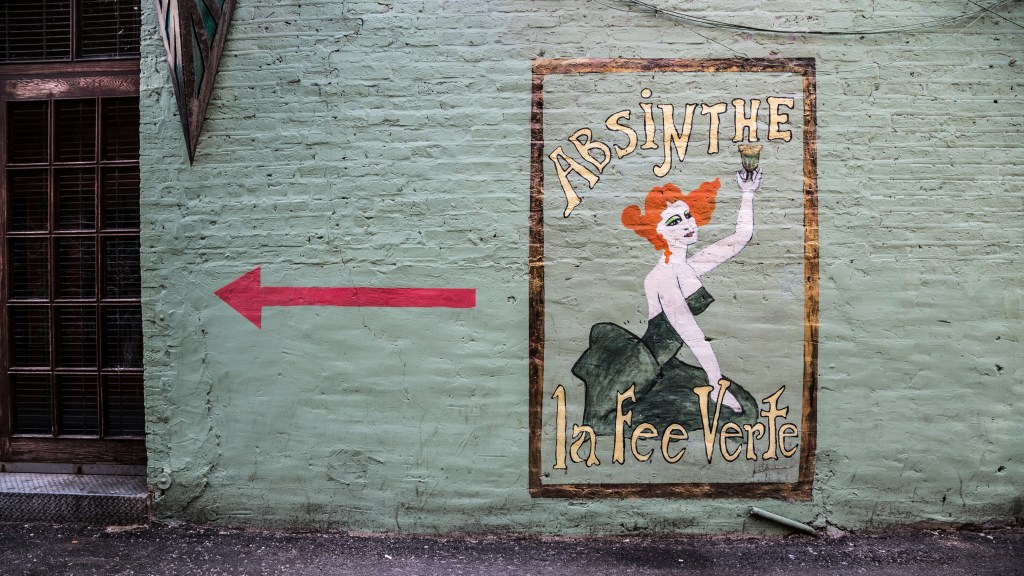
This photo is by Timon Studler.
Now that we’ve established absinthe’s meteoric rise and even faster fall in the realm of public opinion, we can now focus on my original question: Why haven’t I read mysteries where, during the summing up, the malefactor yells, “Absinthe made me murder/rob/eat Uncle Singin McBuzzleworth!”
One Unscientific Opinion/Answer: The “Absinthe made me do it!” defense didn’t hold up in real-life courtrooms.
When examining classic mystery and real-life motives like avarice, revenge, envy, and sex — the “Absinthe made me do it!” defense appears weak by comparison. Moreover, despite large swaths of the population (within many countries) purportedly believing absinthe poisoned the minds and hearts of any who partook of the Green Fairy’s potion — defense councils were still hard-pressed to engender enough sympathy in jury members to make this justification stick.
Take the case of Auguste-Leon Thabuis.
Near the township of Dole in the department of Jura in France sits Saint-Ylie Hospital (or Asylum; the French translator app I used was not flawless). Back in 1909, the 1,500 people (or so) residing within Saint-Ylie were separated into different pavilions by age and gender then sub-divided further based on their ailment — those possessing some sort of paralysis lived in one ward, those with mental health issues in another, and the “incurables” (their word, not mine) lived in their own wing.

In April 1909, the hospital director hired Auguste-Leon Thabuis to work in the men’s paralysis ward. Besides discovering he owned a terrific thirst, which he quenched at a nearby tavern, hospital administrators found no problem with Thabuis’s work.
Fast forward seven months.
On Friday, November 19, 1909, Thabuis reported to his supervisor that Justin Garneret (age 61) had died. Busy with one thing or another, Thabuis’s superior didn’t take the time to look the body over, instead they told Thabuis to get on with it. Which he did — leaving Justin Garnet’s body in his room, Thabuis went to prepare the earth for her newest resident — as he also moonlighted as a gravedigger and amphitheater boy for the hospital when needed.
Now it’s unclear precisely what roused the other nurses’ suspicions, perhaps because Justin Garneret’s death came completely out-of-the-blue or the curious piece of serendipity which found four other patients passing away, about one every other day, on Thabuis’s watch starting on November 10, 1909. Either way, they snuck a peek at Mr. Garneret’s body whilst Thabuis was away….And were rewarded with the sight of darkening fingermarks encircling Mr. Garneret’s neck.
Fetching Hospital Director Bierry and Chief Physician Santenoise, the nurses explained their misgivings and subsequent discovery.
At about this point, Thabuis returned to Mr. Garneret’s room with a coffin. In the ensuing conversation, during which I imagine Thabuis sweating more than a few bullets, Dr. Santenoise questioned the nurse about the undeniable signs of strangulation. Unfortunately (for Thabuis), the Chief Physician didn’t buy the story he spun: That one of the lunatics must’ve snuck out of their ward, into his, strangled Mr. Garneret, then crept back to their room — their absence and presence remaining undetected by everyone the entire time.

Thabuis is (obviously) the gentleman on the left.
When the public prosecutor, examining magistrate, their clerk, and two trained forensic examiners answered Dr. Santenoise’s summons, Thabuis told them that Mr. Garneret attacked him and he’d been forced to defend himself. This explanation, which went over about as well as his first, prompted Thabuis’s immediate arrest — during which he cried out, “I’m innocent! I’m innocent!” Mr. Garneret’s autopsy, carried the same night around eight pm, confirmed the nurses’ worst fears — he was indeed murdered.
The Question Was: Did the other four patients who died under Thabuis’s care over the past eight days meet the same fate?
Performing a quadruple exhumation and autopsy the following Friday, authorities found some answers. Sadly, the bodies of the first two possible victims decomposed to the point where murder couldn’t be conclusively proven. The third victim, Francoise-Emile Menefere (age 54), bore bruises in the outline of two hands around his neck and a bruise on his chest. The fourth victim, Xavier Guinez (age 54), sported a similar bruising pattern as well as a row of four broken ribs and other defensive injuries. (It seems in addition to using his hands, the murderer used his knees to compress his victim’s chest to hasten the deed.)

My photo of a glass of absinthe!
With cause of death now established and confident they had their man, investigators turned to motive…..which proved troubling. Not because they found its establishment difficult but because the only dependable benefit Thabuis received from any of the deaths was the single extra franc he earned for each grave he dug. This veritable pittance was hastily spent at the neighborhood tavern. Where, when “flush” with cash, Thabuis reputedly drank up to four liters of wine and twenty-two glasses of absinthe.
All these facts & theories, together with the unsavory intelligence Thabuis sent notes to grieving families asking if they’d like him to maintain their loved ones’ graves in exchange for a small donation, emerged during his trial, which commenced in July of 1910. (It’s unclear if Thabuis wrote the families of the men he murdered.) This seedy behavior, coupled with a job history that included terminations due to theft, insolence towards a nun, coming to work while inebriated, and serving a three-month prison sentence for insulting a Swiss police officer — didn’t help his case.
However, his public defender, Milleret, was up to the task.
Amongst the sixteen witnesses called by the prosecution, Milleret determined that while all the nurses, who’d first raised the alarm, believed Thabuis culpable in the murder of Mr. Garneret (based on his and their movements that day), none could confidently assign his hand to the deaths of Mr. Menefere or Mr. Guinez. While the prosecution argued that Mr. Garneret’s murder proved the pattern. Milleret countered this by pointing out that the prosecution could not call a single “reliable” eyewitness to the crimes.
(Now, here comes the cream, at least for the question I’m trying to answer.)
In a Classic Scenario of ‘I didn’t do it. But if I did it.’: Milleret attempted to establish that Thabuis suffered from a classic case of hereditary degeneration and, therefore, shouldn’t be held accountable for his actions. (Yes, this case explicitly put absinthism to the test.) Not only did Thabuis prefer the embrace of the green fairy above all others — Milleret argued this devotion/addiction decayed Thabuis’s moral fiber to the point where taking another man’s life in pursuit of another glass felt justifiable. Moreover, due to weak genes he’d inherited from his father, whose excessive drinking sent him to an early grave six years prior, Thabuis’s ethical putrefaction was all but guaranteed.
It’s unclear if the alienist the prosecutor brought in successfully refuted Thabuis’s defense or (more likely in my estimation due to the slant of the newspaper reports) the members of the jury couldn’t overcome the repugnance of Thabuis killing a man for a single franc. Either way, it only took the jury three-quarters of an hour to find Thabuis guilty of Mr. Garneret’s murder and sentence him to seven years in prison and a ten-year ban of stay. (I’ve no clue what that last bit means. Maybe it banned him from working in another hospital for ten years after his release?)
In any case, the regular rejection of Magnan and Legrain’s absinthism defense by juries presents a fascinating counterpoint to the anti-absinthe campaign, which embraced these theories and was, at that moment in time, gaining momentum across several continents. Perhaps if women, the backbone of the temperance movement, were allowed to serve on juries during this period, acquittals based on the “Absinthe made me do it!” wouldn’t have been rarer than hen’s teeth.
Moreover, the lack of acquittals based solely on “Absinthe made me do it!” may have signaled to Golden Age mystery writers the inherent weakness in this particular solution. Since their livelihoods were based on fashioning viable and (generally) believable solutions for their readers, placing the blame solely on absinthe for the unfortunate fate befalling Uncle Singin McBuzzleworth could place a lackluster ending on an otherwise strong story — which might cause an author to lose readers.
An idea I imagine any pro would find insupportable.
My 52 Weeks With Christie: A.Miner©2024


 My 52 Weeks With Christie
You must be logged in to post a comment.