
Arsenic: The secret spice no one wants in their food!
Despite science finally running arsenic to ground, the cultural memory of the “good old days” when arsenic was fondly known as ‘inheritance powder’ (as it helped part inconveniently living relatives from their fortunes/properties/titles in an expeditious fashion) remained. Egging on those tempted to employ arsenic for their nefarious deeds was the fact that it was available practically everywhere. Above and beyond being able to purchase the uncut stuff from druggists — products like fly paper, rat poison, and Scheele’s & Paris green pigments needed little to no refinement in order to kill.
Speaking of druggists, at some point between 1889 and 1906, whilst living in Milwaukee, Louisa worked at Herman L. Emerich’s drugstore located at 1603 3rd Street. According to her fellow clerks, Louisa showed a marked thirst for knowledge about all the lethal substances stocked on the store’s shelves. On top of her unofficial education, Louisa’s position also granted her access to said substances. This could’ve allowed her to obtain any number of them without worrying about someone tracing, say, a purchase of pure arsenic or its slightly adulterated cousins, back to her.
On the topic of employment, above and beyond the insurance payments Louisa collected and her new husband’s wages, by the time 1907/1908 rolled around, Louisa was earning an undisclosed amount of coin via her purported skills as a “spiritualist, medium, and seeress”. Amongst her unknown number of clients was a woman named Mrs. Eugenie Clavett.

Louisa’s advert in The Inter Ocean newspaper which ran for a few weeks in the spring of 1911.
How Louisa entered Eugenie’s orbit or how long she performed for her is unknown. What we do know, thanks to her sister Mrs. Mary C. Nelson, was Eugenie was either already sick or became sick shortly after meeting Louisa. An illness Louisa exacerbated, Mary firmly believed, by coaxing Eugenie into rebuffing the prescription provided by her doctor in favor of one or more nostrums concocted by Louisa herself — only a few days before her death.
From the Office of Fairness: Eugenie’s case only came to light after Louisa was caught. When more often than not, people try to assign every death occurring around a poisoner to said poisoner. Nevertheless, there are four reasons why Mrs. Nelson’s accusation rings true in my mind.
First, this was not the first time Louisa switched out a doctor’s prescribed medicine for a homemade “remedy”. According to later testimony, young Frieda and Alma both told Milwaukeean neighbors how their mother exchanged the doctor’s prescription for a concoction of her own design during their father’s final illness.
Second, Louisa accurately “predicted” the day of Eugenie’s expiration — just as she had with Julius, John, and Frieda.
Moreover, right after Eugenie’s passing, Louisa started pressuring her teenage daughter, Mabel, to move from her Auntie Mary’s abode and in with herself. The fact young Mabel inherited $7,000 upon her mother’s death undoubtedly spurred on Louisa’s increasingly pushy demands to relocate. (Happily, the teen declined and lived.)
Lastly, Eugenie’s probable murder coincides with a lull in familial deaths.

William Lindloff
Deaths that resumed on August 3, 1910. When William Lindloff, Louisa’s second husband, died in Chicago’s Denton Hospital from a brain aneurysm. Oddly enough, after being admitted to the hospital, Louisa barred Dr. Augustus S. Warner, who’d been treating William for a rapidly worsening heart ailment up until this point, from her husband’s bedside. A decision that may or may not have been due to him asking some uncomfortable questions about an inexplicable rash that started spreading all over William’s face and body just before his untimely demise. (Which is one of the symptoms of arsenic poisoning.)
It will amaze absolutely no one that Louisa promptly collected $600 from a mutual aid fund provided by William’s employer, McCormick Harvester Company, and a $1,000 life insurance policy underwritten by the Modern Woodmen of America.
Now, with six possible murders at her door, five of which netted her approximately $7,950, you’d think Louisa would quit while she was ahead. However, money ran like so much dry sand through her fingers, and by 1911, Louisa was again in desperate need of cash. Whereupon her gaze turned to her second eldest daughter, Alma.
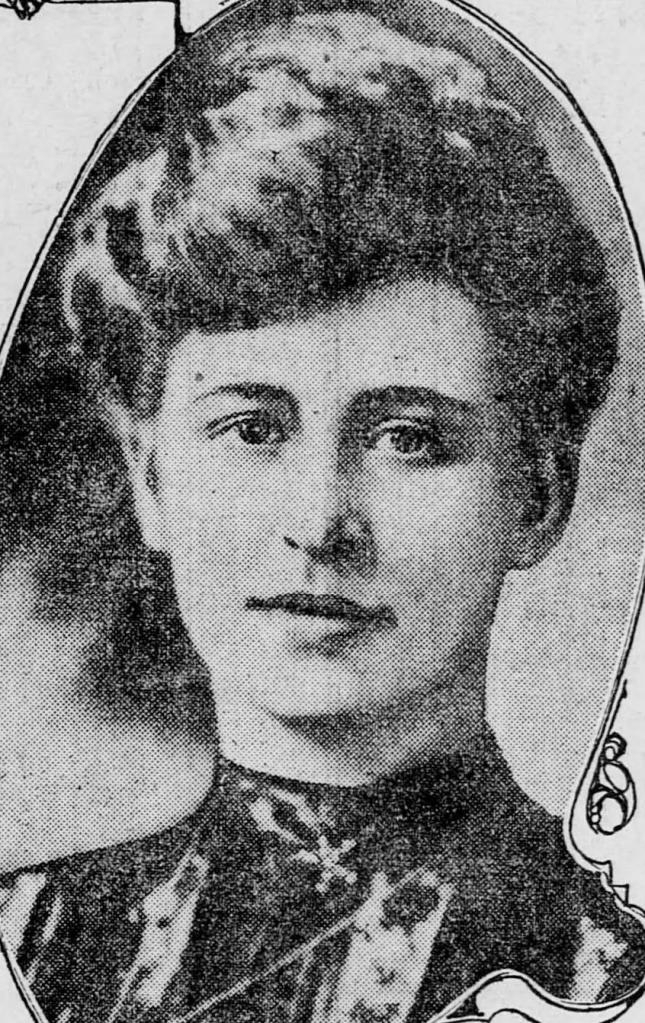
Alma Graunke
Whether it was sheer laziness, cockiness over hoodwinking people on six separate occasions, or at Alma’s insistence — Louisa made the mistake of employing the services of Dr. Warner a second time. Diagnosing Alma’s symptoms, which included tiredness and lack of appetite, as stemming from a weak heart, Dr. Warner treated her for eight months. According to Alma’s suitor, Stewart Hall, Alma’s health took a turn for the worse: “On the night of July 29, 1911, when I called to take Alma to a theater she was feeling ill. She told me that she became ill immediately after eating a supper that her mother had prepared.”
Six days after ingesting said meal, Alma was dead.
According to Louisa, her daughter fell ill after overheating while dancing, which Dr. Warner thought enlarged the nineteen-year-old’s heart and, in turn, led to Alma’s death on August 4, 1911. Designating natural causes as cause of death, Alma’s death certificate was duly signed, and Louisa collected her daughter’s $1,300 insurance policy.
Leaving Louisa’s son, fifteen-year-old Arthur, as her only immediate family member above ground.
My 52 Weeks With Christie: A.Miner©2024
 My 52 Weeks With Christie
You must be logged in to post a comment.