Murder by Mail: The Cankor in the Hedge

The Final Chapter: The Elephant in the Room

Much like Agatha Christie’s mysteries, I’m not going to give a play-by-play of Angele’s trial. Not only because it would take at least another four posts to do it justice (pun intended). But on account of the language ap I used to translate French newspapers, at one point, attempted to convince me an avocado played a critical role in Angele’s case.

An avocado. 

I feel completely confident in stating Angele Laval’s case never hinged on a large green berry.

The alligator pear notwithstanding, I do know Mr. Victor Filliol, Angele’s lawyer, did his level best by her. Quickly realizing that Angele’s chances of receiving a fair trial in Tulle were narrower than the width of a hair, he looked into changing the trial’s venue. Unfortunately, there wasn’t a city, town, or hamlet in France untouched by the coverage of Tulle’s plague of poison pen letters. However, since she wouldn’t be facing a jury of Tulle citizens, he quietly abandoned this idea. Next, Mr. Filliol sought to bar the residents of Tulle from the courtroom, citing the fact the trial would necessitate the airing of sensitive material contained within the poison pen letters. The side benefits of this request are obvious: Not only would it mitigate, even if only slightly, the influence Tulle’s populace would enjoy on the officials deciding Angele’s fate. It would also spare Angele from facing a sea of openly hostile faces, day in and day out.

His request was denied.

On the opening day of her trial, December 4, 1922, the citizenry of Tulle demonstrated the wisdom of Mr. Filliol’s request. Masses of people gathered outside the courthouse. They packed staircases. Crowded the courtroom’s gallery. While generally making their belief in Angele’s guilt crystal clear. 

For her part, Angele did her best to ignore the seething courtroom. The fact Angle wore the trappings of deep mourning — an ensemble of unrelieved black she augmented with a matching mantilla covering her hair and a dark fur muff that hid her hands — cut zero ice with the vocal throng scrutinizing her every move.

Angele Laval is the woman closest to the pic, her Aunt is next to her and sat with her throughout the trial. The other photos are of: The Courtroom, Tulle’s courthouse, and the people waiting outside.

This habit of grief, which Angele wore for the whole of her trial, led a reporter from Le Matin (a newspaper) to describe Angele as — “….a poor bird that has folded its wings.” The reporter continued reinforcing this avian imagery throughout his coverage of Angele’s trial. His impression, repeated periodically in subsequent accounts, laid relatively dormant until 1943 — when Henri-Georges Clouzot’s movie Le Corbeau hit cinemas. Very loosely based on Tulle’s poison pen campaign twenty years earlier, the filmmaker expanded on the avian imagery by changing Angele’s nom de plume from Tiger’s Eye to The Raven — a purported harbinger of ill-tidings. 

Now this association of ravens with poison pen letters & writers might have died on the vine if: A) The film wasn’t excellent. B) Experts didn’t consider Le Corbeau the first film noir film before film noir was actually a thing. And C) The film and its director didn’t cause such a lasting stir.
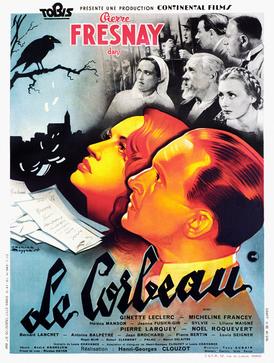
Apparently, Clouzot secured financing for Le Corbeau from a Nazi funded film company…….during WWII……while France was occupied by the Third Reich. Adding fuel to the fire, during France’s occupation, (apparently) it was common for people to write anonymous letters denouncing their neighbors (generally for helping or siding with the Nazis). So rather than seeing Le Corbeau as a true-crime-inspired story, the French Resistance saw it as a cautionary tale meant to frighten French citizens. Others saw the stark noir portrayal of a provincial town in the grips of hysteria as an unflattering portrait. Unsurprisingly, Le Corbeau was banned soon after its release (in point of fact, the film was officially suppressed until 1969) for “vilifying the French people”. 

Despite this, the film was a hit. 

After the liberation of France in 1944-1945, Clouzot was tried as a German collaborator — whereupon the courts imposed a lifetime ban from film sets and from owning a motion picture camera. However, thanks to several notable artists who spoke on his behalf (one of whom was Jean-Paul Sartre), his lifetime ban was reduced to two years (until 1947). 

Fun Fact: Otto Preminger remade Le Corbeau for American audiences in 1951 and renamed the film The 13th Letter.

All of the above is a long-winded explanation of how, in France, poison pen writers came to be known as ravens, including Angele — who’s now referred to as The Raven of Tulle rather than by her chosen pen name, Tiger’s Eye.

Speaking of Angele, let’s get back to her trial. 

Amongst the twenty-three witnesses called to testify — several were people who received, found, or saw the poison pen letters around Tulle. Whilst establishing that no one person could’ve left all the noxious notes all over Tulle — they also made it clear no one ever witnessed Angele delivering a single poison pen letter. As for the partially written letter the priest espied on a table during a visit with Angele and her mother Marie-Louise — Mr. Filliol didn’t deny what he saw. Instead, they claimed Angele occasionally drew wildly unflattering caricatures of her neighbors for her own enjoyment.

An explanation that sounds so ridiculous it might be true, but it’s hard to swallow.

Top Row: The comparison of letters from the Poison Pen Letters to Angele’s writing.

Bottom Row: The experts & Mr. Filliol debating if Angele wrote the letters.

The main event of Angele’s trial came when Mr. Filliol locked horns with Dr. Locard. The defense found not one but two graphologists willing to contradict Dr. Locard’s findings. Mr. Filliol then accused Dr. Locard of allowing the highly charged atmosphere of Tulle and Angele’s strange behavior at the time of her assessment to influence his conclusions. Angele’s defense contended that rather than carrying out a rigorous examination, using techniques he helped pioneer, Dr. Locard merely eyeballed Angele’s handwriting exemplar next to a Tiger’s Eye letter — then declared her guilt. 

As tactics go, this was a sound strategy. Unfortunately, Mr. Filliol couldn’t present a convincing alternative explanation to account for Angele’s bizarre behavior during her handwriting examination.

A Feature of Interest: Thirty years after testifying in Angele Laval’s case, Dr. Locard abandoned graphology, citing its inexactness as a science. Apparently, in 1945 he attributed a series of anonymous letters to a woman, who was subsequently sentenced to a lifetime of hard labor, only to discover (in 1956) she was not the author. 

Despite Mr. Filliol’s hard work, on December 20, 1922, the Judge delivered a sixty-page, scathing judgment against Angele….Though she wasn’t present to hear her fate firsthand. Someone sagely convinced Angele to stay away from the courthouse on the day of her sentencing. The move proved sound as a mob, several hundred strong, stood outside the building feverishly anticipating Angele’s trip to the guillotine for her role in August Gilbert’s death. 

Sorta Fun Fact?: Before abolishing the death penalty in 1981, France was the last country to use a guillotine for a state-sanctioned murder. When in 1977, convicted murderer Hamida Djandoubi was executed in Marseille.

Whilst the residents of Tulle were ready to sentence her to death, those with the power to send Angele to meet her maker had other ideas. 

Recall Angele’s enforced visit to Limoges’s lunatic asylum? During her eight months inside, alienists (an outdated term for psychiatrists) evaluated her mental health. They concluded that while Angele knew right from wrong and could be held responsible for her actions, she teetered on the brink of madness.

In point of fact, the alienists did not wish to release Angele from the asylum at all — citing, amongst other things, her frequently expressed desire to kill herself, the censure she suffered at the hands of Tulle citizens, and the resulting isolation. However, after Angele’s general practitioner testified that she’d never been prone to ‘hysterical’ behavior and Angele described the alienist’s multiple attempts to extract a confession via hypnotism as well as the numerous occasions they’d forced her to wear a straitjacket — the Judge ordered Angele’s immediate release (just a few days prior to the official start of her trial).

Though they lost that battle, the alienists won the war.

During their testimony, in which an alienist presented what he thought was tantamount to a confession from Angele (though to be clear, it was not an actual confession) — he also advocated treatment over incarceration in Angele’s case. The recommendation, when combined with the sentencing guidelines for public defamation and the first offender act — resulted in Angele receiving a suspended sentence of one month in prison, plus a one-hundred franc fine for defamation and another two hundred francs in compensation to her victims. Angele, who’d maintained her innocence before, during, and after her trial, paid little heed to the lenient sentence. She appealed the next year…..and lost. 

The citizenry of Tulle, deprived of the justice and spectacle they thought they deserved, imposed their own life sentence on Angele. Not only did they continue to shun and shout curses at her whenever she dared to leave the house — they made it impossible for her to find work, marry, or make friends. Her notoriety, thanks to the press who splashed her face all over the papers, made it equally impossible for her to start over somewhere else in France. Angele spent the rest of her life as a recluse with the only people who believed in her — her brother Jean and his family. 

Angele Laval died forty-four years after her appeal on November 16, 1967.

What of the other Poison Pen writers who rode Tiger’s Eye’s coattails? Despite delivering 100 to 200 noxious notes above and beyond the 110 attributed to Angele — no one else (so far as I can tell) was ever brought to account. The last known anonymous letter of this caustic campaign was delivered to Mr. Filliol. Slipped into his briefcase during Angele’s trial, he reported it immediately to the court — as most eyes were riveted on Angele and she sat in front of Mr. Filliol’s desk — he swore (and I believe him) that Angele never had the opportunity to place it inside.

Perhaps this factored into Angele’s overall light sentence.

The question is: Did everyone get it wrong? Was Angele really innocent? 

Angele’s brother Jean is the gentleman with the x below his shoes.

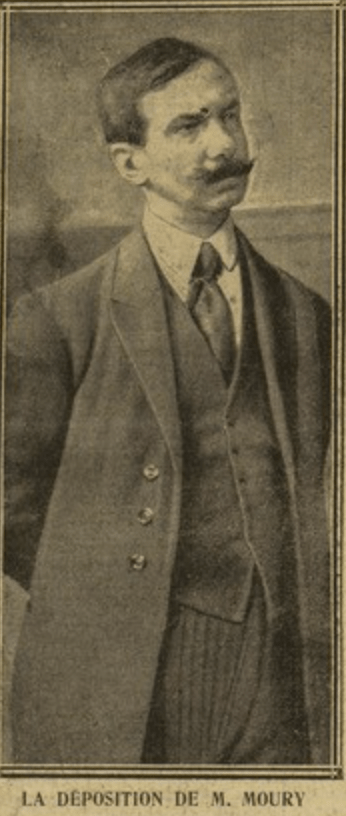
Not only were there multiple other poison pen writers who got away scot-free. There was one person connected to the prefecture, Mouray, Angele, and Marie-Louise, who owned a genuine motive for starting a poison pen campaign — Angele’s brother Jean. According to all accounts, his professional envy of Mouray was well known within the prefecture, and if Dr. Locard’s report correctly attributed an undisclosed number of Tiger’s Eye letters to Marie-Louise….Could the two have worked together? 

Did they start writing poison pen letters together, hoping to crush Angele’s infatuation with Mouray? Did they continue with the intention of pinning the blame on Marie-Antoinette and forcing Mouray to resign in disgrace? There was no love lost between the two men. Jean was perfectly positioned to hear salacious bits of gossip about the great and good of Tulle. As a Captain in the prefecture, Jean could’ve easily planted the early letters inside the prefecture, and his mother had plenty of time to sprinkle the later letters all around Tulle.

Did Dr. Locard mistake Marie- Louise’s hand for Angele’s?

When she realized Angele would shoulder the blame instead of her, did Marie-Louise convince Angele to commit suicide rather than admit to what she’d done? Is that why Jean supported and sheltered his sister for the rest of her life? Guilt?

Convoluted as it sounds, it’s possible — just not probable. Like everyone else one hundred years ago, I cannot overlook Angele’s peculiar behavior during Dr. Locard’s writing examination. Why take so much time writing one line? Why repeatedly retouch them if you don’t have something to hide? 

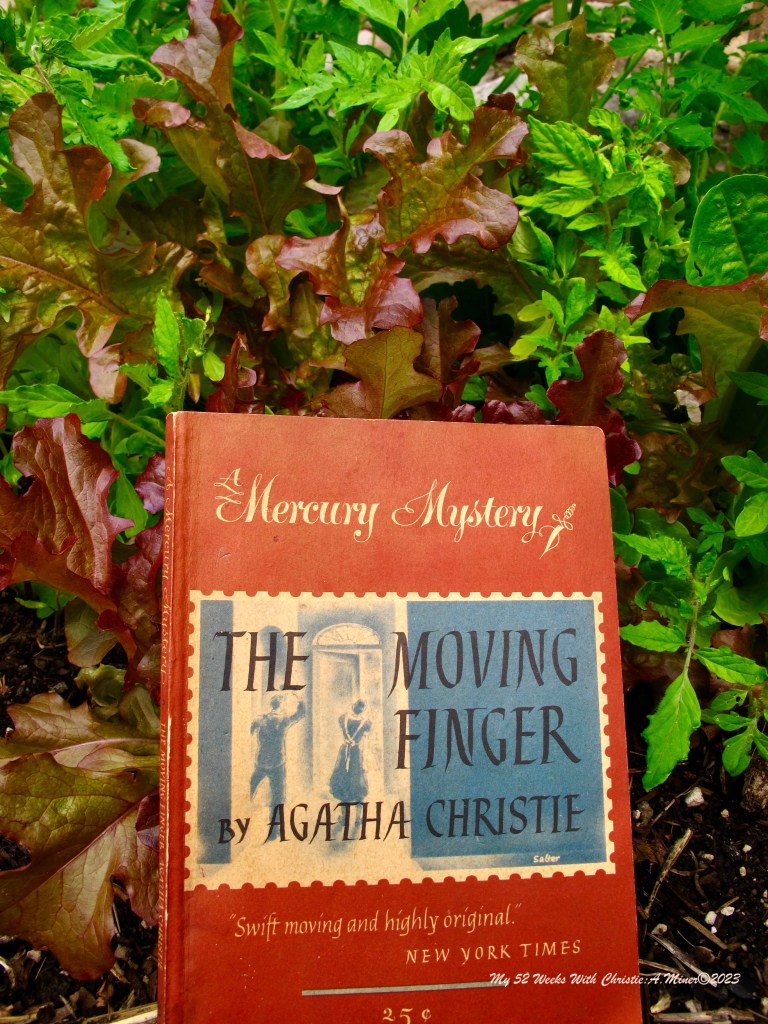
Plus, much like Miss Marple in The Moving Finger — I find love, even frustrated love, a much stronger motive than envy.

My 52 Weeks With Christie: A.Miner©2023

Murder by Mail: When Everyone Knows Your Name

Chapter Five: Copycats

One of the red herrings Christie cunningly employed in The Moving Finger was a copycat. Inspired by the outbreak of poison pen letters landing in mailboxes all over Lymstock, Christie’s Copycat rode the coattails of the original writer in the hopes of thwarting a potential romance, and when said hurdle was cleared, and should the stars and planets align, they hoped to secure the affections of the object of their desire for themselves. (Sound familiar?) However, the only thing the Copycat actually managed to accomplish was muddying the waters, which nearly allowed the genuine Black Hat of the book to get away with murder. (Thank goodness for Miss Marple.)

Seems, much like their fictional counterparts, the residents of Tulle weren’t above a bit of copycatting either. 

Whilst it’s generally accepted that Angele Laval wrote around one-hundred-and-ten of the known malicious missives — another hundred to two hundred (depending on the source) of these noxious notes bedeviled the citizenry of Tulle. Meaning there was at least one, but probably many more, copycats at work….including Marie-Louise Laval. 

Angele’s mother.

It’s unclear if Marie-Louise knowingly provided fodder for her daughter’s letters, if she wrote letters to help disguise her daughter’s objectives, or if she owned her own fair share of spleen in need of venting and independently took advantage of the situation. Equally uncertain is how these copycats affected Angele, did her escalation occur in response to the evolution of Mouray & Marie-Antoinette’s relationship, because she needed to find newer & bigger ways to feed her addiction, or to differentiate her caustic correspondence from those riding her coattails?

Either way, Tulle’s copycats were put on notice when newspapers named Tiger’s Eyes on January 22, 1922. 

Dr. Locard’s final report, the source of their scoop, proved divisive. A small minority of townspeople could not reconcile the Laval’s upright reputations with the venomous, lewd, and repugnant ideas and images filling the letters they’d received or seen. The majority of Tulle’s citizenry, either ecstatic at finally having someone to blame or hiding a guilty copycat conscience, immediately turned on Angele and Marie-Louise. Overnight the pair became social pariahs — newspapers splashed their names across their front pages, friends and neighbors shunned them, people hissed and spat on them in the street, urchins threw mud at them whenever they dared to walk through town, and their chosen pew in church would immediately empty when they sat down. 

Compounding their woes, and despite Dr. Locard corroborating Magistrate Richard’s occultists’ prediction, the French Minister of Justice sacked Richard on January 28, 1922 (according to the NY Times). Leaving Angele and her mother to live under a heavy cloud of condemnation while anticipating the appointment of a new Magistrate who’d level official charges against them.

Sadly, this constant state of anxiety proved unbearable for the pair.

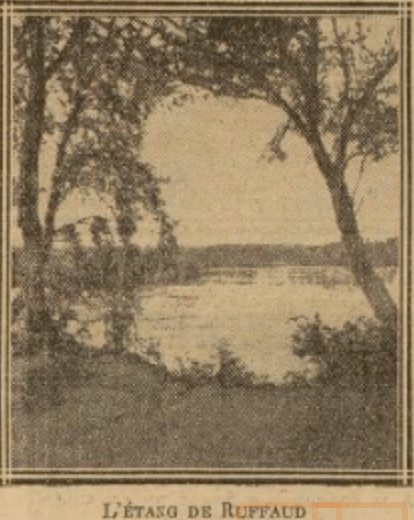
Ruffaud Pond

On March 13, 1922, Angele and her mother set out in their Sunday best. Sticking to scantly populated country lanes, they walked to Ruffaud Pond. Where they bound each other’s hands (or legs, as reported in some papers) with reeds & vines and jumped into the deep. Again there’s some discrepancies in the reports of whether woodcutters noticed a wet, shivering woman sitting alone under a tree. Who, upon spotting them, popped up and threw herself back into the pond. Whereupon the woodcutters fished her and her mother’s body from the water. — OR — The woodcutters alerted by Angele’s cries and thrashing raced to the pond and saved her. The authorities, once alerted to the events at said pond, recovered Marie-Louise’s body the next morning.

The first photo of Angele, taken paparazzi style from a hidden photographer on a nearby roof, while she took a walk.

Whichever way this tragedy unfolded, the outcome was the same Marie-Louise was dead.

Owing to the fact Angele lived whilst her mother died, the newspapers proclaimed Marie-Louise Tiger’s Eye’s latest victim. Theorizing that either: A) Angele and her mother slowly came to realize suicide was the only way for them to avoid the humiliation of a public trial — but when push came to shove Angele couldn’t follow through. B) Angele manipulated Marie-Louise into a suicide pact, then chickened out. C) Angele tricked her mother into committing suicide, without ever intending to follow through — to garner Tulle’s sympathy. 

Whether Marie-Louise fought off Angele’s attempts to save her life or Angele left her to drown — there’s little doubt the daughter watched her mother die. A scene that undoubtedly left an indelible mark on Angele and rather than attempting suicide for a second or third time (some sources suggest she tried to end her own life prior to the attempt that claimed her mother’s), she fled Tulle. 

Marie-Louise’s funeral procession lead by her son (and Angele’s brother) Jean.

In her absence, Angele was formally indicted. 

When authorities located and arrested her in a nearby town a few weeks later, in April of 1922, Angele’s quoted as saying she’d run because, “…she simply could not endure the shame of facing the people of Tulle after the charges against her.” (Washington Times, April 22, 1922) Obviously viewing her as both a suicide and a flight risk, Angele was remanded to Limoges’s lunatic asylum. (However, there is some evidence to suggest Angele’s brother Jean, upon learning the prefecture had located his sister, may’ve asked that she be admitted to the asylum.)

Whilst inside, prosecutors scrabbled through lengthy law tomes trying to find something to charge Angele with. 

Even though the papers loudly proclaimed Angele engineered her mother’s death, there were no witnesses or evidence to support her purported villainy. Adding insult to injury, since the act of composing or sending poison pen letters wasn’t a crime — authorities couldn’t prosecuted for Angele for murder. As she never raised a weapon, other than her pen, against Auguste Gilbert. Nor could they do anything about the marriages, friendships, and careers the malevolent messages destroyed by revealing the truth.

But what of the lives fractured by Angele’s lies? 

Turns out, that bone still possessed a bit of meat.

Prosecutors determined they could charge Angele with public defamation. However, thanks to the statute of limitations, they could only mine the last fifteen of her poison pen letters for evidence. Despite needing to ignore the majority of her falsehoods Angele’s trial started on December 4, 1922.

My 52 Weeks With Christie: A.Miner©2023
Murder by Mail: Science to the Rescue!

Chapter 4: Dr. Edmond Locard vs. Tiger’s Eye

Whilst an amateur such as Miss Marple can gather evidence from wherever she chooses, including the dreams of Jerry Burton, even she knows such hazy evidence won’t hold water in court. Hence she, along with Megan Hunter and the police, engineered a sting operation to catch Mrs. Symmington’s killer red-handed. 

Now if an amateur sleuth, albeit a gifted one, knows the musings of one’s subconscious won’t satisfy the court, then why on earth did Magistrate Richard think hiring a sorcerer, a hypnotist, and a medium was a good idea? Especially since, just ten years earlier, France’s first forensics laboratory was founded in Lyon. Needless to say, after the papers gleefully reported Magistrate Richard’s unorthodox investigative methods, he was summoned before his superiors to explain.

As this internal brouhaha played out in the press, a priest visited Angele Laval and her mother. At some point during his visit, he spied a half-finished letter sitting on a table. Familiar with Tiger’s Eye style, as he’d received at least one cankerous communique himself, he took this observation to the prefecture. Keen on ending the whole nasty affair, Commissioner Walter (who I think is the head of Tulle’s prefecture) confronted Angele with this information and attempted to cajole a confession from her — without success.

Meanwhile, as the case stalled due to Magistrate Richard’s absence, the great and the good of Tulle took matters into their own hands.

Contributing money to a fund, they hired the best forensics expert in France and the founder of the aforementioned forensics laboratory, Dr. Edmond Locard. (Whose principle is still used today — every contact leaves a trace.) Dr. Locard, at this point in his career, showed considerable enthusiasm for graphology — the study and interpretation of handwriting to build a psychological portrait of the writer. (Not to be confused with Questioned Document Examination, which focuses solely on the words on the page.) Interestingly, after his employment was secured, Dr. Locard found himself on the receiving end of about twenty anonymous letters accusing one person or another in Tulle of being Tiger’s Eye and one purportedly from Tiger’s Eye themselves asking if he could arrive in Tulle on any other day than Sunday, as they’d made plans. 

Dr. Locard

With Dr. Locard’s recruitment, things were about to go south for Angele.

As it happens, modern experts agree with their fictional counterpart in The Moving Finger, “I can tell you gentlemen, I’d like to see something new sometimes, instead of the same old treadmill.” (pg. 88) It seems poison pen writers invariably employ the same tired mechanisms to disguise their handwriting: using all capital letters, writing with their off-hand, changing the slant or size of words, misshaped or deformed letters, employing different writing instruments within the same letter, altering how they dot their ‘i’ and cross their ’t’, pretending to be illiterate, or using cut out letters from magazines/books.

These techniques can successfully camouflage one’s handwriting, provided the author keeps their malice tinged missives short and sweet — so to speak. However, as a poison pen writer sinks further and further into their addiction, brevity generally isn’t within their reach.

Examples of Tulle’s Poison Pen Letters

Just look at Angele’s letters, overflowing margins, cramped lines — even the postcards are covered on both sides with words. Clearly illustrating what experts already know: poison pen writers are their own worst enemy. The longer the letter, the more likely it is that a lifetime of handwriting habits will start creeping onto the page — and — the longer they remain unnamed, the more confident they become, the more letters they send. Substantially increasing the odds, they’ll leave telltale signs of themselves somewhere in the script for an expert (and occasionally a motivated amateur) to find.

And let me tell you, Dr. Locard was given more than enough material to work with.

On January 16, 1922, after analyzing all the known letters, Dr. Locard summoned eight women to Tulle’s courthouse. Amongst the octette, all of whom were related to men present at the prefecture’s secret meeting, were Marie-Antoinette, Angele Laval, Angele’s Mother, Auntie, and Sister-in-Law.

Dr. Locard’s plan was simple. 

First, he dictated select words and passages from Tiger’s Eyes letters while instructing the women to write them with both their dominant and off-hand. Then, after finishing these specimens, Dr. Locard asked the all female assembly to write four pages of capital letters. Although accounts vary slightly on how this writing exhibition went down, they all agree that during Dr. Locard’s initial short passage dictation, Angele didn’t falter. However, when asked to pen four pages of capital letters? Angele’s facade cracked, and it took her twelve minutes to write one line. Dr. Locard, a trained forensic scientist and keen observer, watched Angele repeatedly go over the string of letters, adjusting, augmenting, and adding little flourishes to her original hand. 

Needless to say, Dr. Locard found this behavior highly suspicious. 

Again it’s unclear if Dr. Locard let Angele go after finishing her lines and recalled her to the courthouse later that same day or whether he kept her behind at the end of the session — either way, the results are the same. Dr. Locard, determined to secure a genuine sample of Angele’s handwriting, relentlessly dictated the same passages at her over and over again. He purposely upset her by intermittently berating, shouting, and generally getting in her face. For hours he pushed her to write faster and faster, all the while ignoring her protestations of innocence, bouts of weeping, and occasional fainting spells. Eventually, by dint of sheer exhaustion, Dr. Locard procured several sheets of Angele’s genuine hand —thereby stripping her protective layer of anonymity away.

My 52 Weeks With Christie: A.Miner©2023

Murder by Mail: Truth is Stranger than Fiction

Chapter 3: I Wish I Was Kidding.

Ahead of widening her pool of potential victims, which forced her to switch how she delivered her poison pen letters and work out a way of keeping Tulle’s grapevine robust — Angele Laval made her most significant tactical change. After three-ish years of peppering the prefecture with anonymous notes which ultimately failed to secure her Mouray’s love or prevent his marriage to her rival Marie-Antoinette (and perhaps seeking a way to take credit for her work) — Angele started signing her malice filled missives. 

Obviously, she didn’t use her real name. 

An Example of Tiger’s Eye signature. It’s on the second page, one line above the ‘BRAVO’.

Instead, she assumed the pseudonym Tiger’s Eye. (Or Eye of the Tiger, depending on how you translate the French. I’m sticking with Tiger’s Eye as it’s how I first read it, and, more importantly, it doesn’t make me want to sing the 1980s anthem Eye of the Tiger by Survivor or make my mind’s eye play snippets of Rocky III every time I write the nom de plume.) At first blush, this change appears only mildly important compared to the others. However, as Angele descended deeper into her addiction, she needed to increase both the frequency and cruelty of her jaundice correspondence to feel the same rush — and this simple stylistic evolution of adding a signature inspired a genuinely evil idea.

First Pic: Auguste Gilbert

Second Pic: The line that sent Gilbert over the edge.

Late in December of 1921, Angele Laval sent at least two letters to the Bailiff of the Prefecture’s Council, Auguste Gilbert. At least one accused Gilbert’s wife of having an affair. Another purportedly written by Mrs. Gilbert, though obviously not really, confessed her secret identity to her husband.

Somehow the false confession managed to convince Auguste his wife was the notorious Tiger’s Eye. Horrified by this revelation and frantic to keep his wife’s name from being dragged through the mud: he either confessed to being Tiger’s Eye and committed suicide — or — he suffered a mental breakdown, which caused a stroke, which killed him a few days later. (I’m pretty sure he, unfortunately, committed suicide.) Although the accounts of Auguste Gilbert’s death are muddled they all agree Angele Laval’s letters led Gilbert to his grave. 

Transforming her from a slanderous semi-stalker type into a killer overnight. 

(Unlike the malefactor in The Moving Finger, who, from the outset of his campaign, had murder on his mind.) 

Gilbert’s death heralded two critical changes in the case. 

Firstly, between the sheer volume of victims, blood being spilled, and the rapidly approaching end to Henri Landru’s trial (swindler, murderer, and generally a nasty piece of work — who was executed by guillotine in February 1922), the French newspapers needed a new case to captivate their readers with….So French editors sent their reporters, en masse, to Tulle.

Followed, in short order, by the rest of the world.

With the spotlight firmly fixed on and feeding the ego of Tiger’s Eye, there was little hope that Auguste’s death would shock Angele into ceasing her caustic campaign. Indeed, she continued to single out individuals for similarly executed deceptions as those perpetrated against Auguste. Though no one else died, Angele’s pernicious notes did manage to usher one woman into a nervous breakdown and at least three more men into permanent insanity or mental derangement.

(Though my sources didn’t specifically say Auguste Gilbert and the others suffered from shell-shock (what we now call PTSD) from fighting in WWI, they did say the affected men: “…were subject to terrible mental strain during the war and were in a condition which made them susceptible to mental injury.” (Washington Times April 23, 1922) Thereby graduating Angele’s campaign from the category of contemptible into the realm of the truly despicable.) 

Secondly, prompted by the death of one of their own and the humiliation caused by a list Tiger’s Eye nailed to the municipal theater (where Angele linked seven high-profile married men or their wives — with the names of their extramarital lovers), Tulle’s top officials finally abandoned their laissez-faire attitude towards the deluge of poison pen letters plaguing the city. 

The first order of business? Calling a top-secret meeting, of course! Assembling behind shuttered windows and locked doors, said officials made two critical decisions: A) The Police Prefect would send a plea to Paris for help. Since no one wanted to inadvertently put Tiger’s Eyes in charge of finding themselves. B) The Postmaster would start fingerprinting all known correspondence from Tiger’s Eyes.

These clandestine resolutions prodded Angele into her first major mistake.

Perhaps feeling bulletproof in her anonymity or, in the throws of her addiction, needed to impress the press with her reach. Angele couldn’t resist leaving two taunting letters for the aforementioned officials — less than 24 hours after their classified confab. The former was told his decision to send for outside help was futile, and the latter was informed that Tiger’s Eyes always wore rubber gloves when composing their pernicious missives. (A claim they tested and found truthful.)

However, this reckless revelation did more to help than hinder the incoming investigator, Magistrate Francois Richard. By showing off her inside knowledge, Angele narrowed the pool of suspects from all of Tulle to one of the members of the secret meeting or their closest relations.

A mistake she unintentionally compounded by inadvertently eliminating their prime suspect.

Unwilling, and undoubtedly unable, to cease her cruel campaign Angele continued planting her noxious notes around town — whilst Marie-Antoinette lay in hospital for seven to ten days after giving birth. Undoubtedly abreast of this event, Angele might have successfully shifted all the blame onto Marie-Antoinette had she been able to stop herself. As it was, Angele’s need to feed her addiction handed Marie-Antoinette a nearly cast-iron alibi. Seems all the doctors, nurses, and other patients, aware of her unearned reputation, kept a weather eye on the purported poison pen. Upon learning this Magistrate Richard concluded it was highly improbable Marie-Antoinette could’ve traipsed all over Tulle without someone noticing her suspiciously empty bed. 

With the elimination of Tulle’s prime suspect, Magistrate Richard called Mouray to his office. Again accounts vary on what happened during this meeting — either way the end result is the same — Mouray pointed the finger at his former subordinate. Above thirty, a respectable spinster who still lived with her mother, Angele fit the conventional image of a poison pen far better than Marie-Antoinette ever did. With Angele firmly in his sights, Magistrate Richard’s set out to secure the evidence needed to prove Angele Laval and Tiger’s Eyes were one and the same. 

Magistrate Francois Richard

Though instead of using tried and true methods to secure said proof, Magistrate Richard employed a sorcerer, a hypnotist, and a medium. 

The sorcerer produced a pendulum which he claimed could locate hidden wells, mineral veins, buried treasure, and detect when people lied. How? When held said pendulum above a person’s head during questioning, a luminous spot would appear on their temple if they told a falsehood. The only fly in the ointment? He’d only perform the test if representatives from the French Institute were present and the French government bought the pendulum for 20,000 francs. Needless to say, he left empty-handed.

Next, the hypnotist, several reporters, three suspects (one of whom sounds a lot like Marie-Antoinette), and Magistrate Richard sequestered themselves within Richard’s office, pulled the curtains, locked the doors, and posted guards outside. Once they felt safe from Tiger’s Eye’s prying orbs, the hypnotist put the first woman to sleep…..and learned nothing as the woman never uttered a single word. The second woman proved immune to the hypnotist’s influence. The last woman fell easily into a trance, however, she started screaming the building down after the first question. Which, unsurprisingly, brought people sprinting into the office, thereby ending that avenue of inquiry.

Lastly, Magistrate Richard brought in a famous medium from Paris. Who, after entering a deep trance, eventually revealed that the letters were written by the sister of an officer in the prefecture.

Proof at last?

Magistrate Richard thought so…Until the papers, who’d not been sworn to secrecy, publicized the methods Magistrate Richard was employing to suss out the notorious Tiger’s Eyes.

The French Minister of Justice was not best pleased.

My 52 Weeks With Christie: A.Miner©2023

Murder by Mail: Catch Me if You Can

Chapter 2: Addiction & Expansion

Robbed of her rose-colored dreams and furious her rival managed to get Mouray to the alter, despite her best efforts, you’d think Angele would set aside her stationary. But here’s the thing: Poison Pen Letters can become addictive to the sender. Every close call, near miss, and narrow escape from someone catching them in the act and possibly unmasking their identity is an adrenaline rush. Then there’s the pure exhilaration of owning a secret. The thrill of saying all the mean-spirited, vindictive, and spiteful things to people who’ve, in your eyes, slighted you. Not to mention the pleasure of watching your victim/victims react to your words and knowing you hold the power to destroy their happiness — should you choose.

This explains why this type of malevolent missive rarely ends with only a single letter being sent.

Even worse, for both sender and receiver, this addiction (like any other) starts requiring bigger and bigger hits in order to recreate the same rush the writer felt upon delivering their very first venomous letter. And this is where The Moving Finger and Angele’s case diverge. Our fictional malefactor either never got hooked on sending poison pen letters in the first place. Or, more likely, due to their definite endgame and the fact Miss Marple engineered their capture prior to the Black Hat reaching their last pre-written poisonous note, Christie’s bad guy never faced the decision of continuing their caustic campaign or stopping cold turkey. Hence, unlike Angele, they never need to adapt their strategy to avoid detection or feel the need to feed the monkey on their back. 

All of which possibly explains why Angele decided to double down rather than quit while she was ahead. 

The Prefecture of Tulle.

No longer satisfied with tormenting just the prefecture, Angele expanded her toxic campaign to include any man, woman, or child living within the borders of Tulle. And unlike Agatha Christie’s fictional ne’er-do-well in The Moving Finger, whose evil epistles failed to contain even the smallest kernel of truth. (According to the Vicar’s wife, who knew more than her fair share of Lymstock’s salacious secrets.) Angele raked up every scandal, revealed every overheard family secret, and repeated every morsel of gossip she came across — and through sheer volume, managed to sprinkle just enough truth amongst the lies contained in the lines of her noxious notes that shadows of doubt proliferated within the minds of Tulle.

The townsfolk, now aware en masse of the existence of a poison pen, unsurprisingly began casting sidelong glances at each other. This wholesale loss of trust translated into a mass cancellation of social engagements, entertainment, and gatherings across the city. The only upside? The lack of dances, dinners, and friendly chats over tea gave people more than enough spare time to monitor the post office’s mailboxes.

And what’s a girl to do when 13,000 pairs of unblinking eyes are dying to catch you red-handed at the public letterbox?

Angele simply stopped using them. 

Opting for the direct approach, she began leaving her malignant messages on her victim’s windowsills, doorsteps, on church pews, and within the confessional. She shoved them through letter slots, dropped them on sidewalks, apartment hallways, and office corridors. For an extra surge of excitement, Angele would occasionally slip one of her splenetic letters into someone’s shopping basket while they did their marketing. Whilst this change in delivery method removed the postman from the list of least-liked people in Tulle — by leaving no haven safe from her vicious attacks Angele, through either careful planning or pure happenstance, successfully managed to foster a state of mass anxiety. 

Can you imagine Angele’s dark delight when walking down deserted streets, past nearly empty taverns, and through the all-but-abandoned town square — which, only a few months prior, positively bustled with activity?

This wholesale avoidance of other people (which in some households included your spouse, older children, siblings, parents, or in-laws — depending on what despicable rumor you’d read about them or they you) might’ve ground the corrosive campaign to a halt. However, people still needed to work, children still required schooling, and larders filling…Meaning there was still a bit of foot traffic, and by tapping her evil genius gene, Angele found a way of exploiting those few brave souls who ventured outdoors — by creating a variation on a chain letter.

For example: Angele would address and leave a noxious note for Mr. X to find. Upon reading the obscenity ladened piece of paper, Mr. X would discover the contents actually concerned a Mr. Z — to whom the note would instruct Mr. X to deliver it too. Thereby giving her slanders a chance of spreading, with the added bonus of possibly causing an awkward conversation between two people and potentially straining a friendship, professional relationship, or marriage in the process. 

Speaking of marriage.

Despite her busy schedule of tormenting an entire town, Angele never forgot her roots. 

Again it’s unclear if, in Angele’s heart of hearts, hoped Mouray would abandon his newly minted marriage to Marie-Antoinette for her or if she wanted to punish her perceived rival Marie-Antoinette for stealing her chance at happiness and Mouray for not loving her.* Either way, Angele cleverly found a way to ratchet the pressure on the couple into the stratosphere — by singing the praises of the happy couple in the majority of her despicable epistles.

Despite the fact this style of harassment was considered the domain of sexually repressed spinsters (by newspapers, experts, and authors alike), these anomalous complements eventually led the stressed-out populace of Tulle to draw the same conclusion — that Marie-Antoinette must be the author of their misery. 

However, because French law did not consider it a crime to write or send poison pen letters, the prefecture couldn’t legally do anything about it. Especially since no one ever witnessed Marie-Antoinette placing, dropping, or leaving a bilious letter anywhere around town. So the court of public opinion sentenced her to ugly confrontations, muttered epithets, and general ostracization.

A punishment that might have become permanent had Angele’s addiction not spiraled out of control.

*(BTW: Mouray, at this point, had nullified Angele’s most effective weapon against him — by not only publicly acknowledging his illegitimate child and providing for them. He also broke things off with his mistress before marrying Marie-Antoinette.)

My 52 Weeks With Christie: A.Miner©2023

Murder by Mail: Art Imitating Life

Chapter 1: The Moving Finger & A Real Life Poison Pen Case

Recently I found myself stuck in a mental fog bank with an overwhelming urge to read something more involved than the instructions on a jug of laundry detergent. So I turned to my bookshelves for help. Knowing from past experiences that new stories are a no-go, I ran my finger along the spines until my eyes and index digit landed on The Moving Finger. At which point my brain sat up and bellowed YAHTZEE! Not a new read, but one I hadn’t cracked the covers of since 2014. 

Stoked, I sat down and devoured it whole. 

Discovering, much to my surprise, my perspective on this classic mystery shifted since I’d last read it nine years ago. (Amusingly, I’d also forgotten the malefactor’s identity and was fooled all over again by the Grand Dame of Misdirection.) Rather than impatiently waiting for Miss Marple’s entrance from stage left or touching the cherished memory of howling with laughter at Victor Borge’s bit on inflationary language with my grandfather in the basement of his house one summer afternoon — my mind caught on the McGuffin of The Moving Finger: the poison pen letters. 

Since the villain in The Moving Finger used these letters to mask his true intent, which didn’t seem to fit with what I knew of the phenomenon, it made me wonder what actually drives a true poison pen writer to pick up their quill, so to speak.* Moreover, I wondered why the police and residents of Lymstock so readily accepted the idea that Mrs. Mona Symmington committed suicide over a single letter. So, on a day when the mental fog receded to the outer banks of my brain, I began looking for answers….and fell down a veritable rabbit hole.

Turns out I should’ve had more faith in one of my all-time favorite authoresses.

An view of Tulle from back in the day!

Twenty years prior to the publication of The Moving Finger, a small city in France found itself a hotbed of this postal based crime. From 1917 to 1922, over one-hundred-and-ten poison pen letters were opened in the small provincial town of Tulle. (Where the epitomes fabric of the same name was originally invented and manufactured.) And by the time authorities finally stemmed the flow of these malicious missives — three people were dead, two were remanded to lunatic asylums, and at least one recipient suffered a nervous breakdown. Not to mention the countless broken marriages, shattered friendships, and ruined careers these slanderous communiques also caused.

And it all started over a boy.

Thanks to the overwhelming number of men called up to fight in WWI and her brother’s professional influence, Angele Laval secured a job within Tulle’s prefecture (police department) as a typist under the supervision of Jean-Baptise Mouray.

Jean-Baptise Mouray

Now it’s unclear how long the two worked together before Mouray became the object of Angele’s obsessive affections and due to conflicting contemporary newspaper reports it’s also unclear if: A) Angele loved Mouray from afar. B) Mouray rebuffed Angele’s romantic overtures due to lack of attraction on his part. C) Mouray and Angele dated for a period before he threw her over. However, we do know by 1917, Angele had hatched a plan to draw Mouray into her web.

By sending him an anonymous note abusing her own character.

Troubled by the unsigned slander aimed at his subordinate, Mouray stewed over the ill-natured intelligence for three days before bringing it to Angele. Who, upon laying eyes on the missive, produced one of her own. Only her’s was “left” on her desk at the prefecture and cast aspersions on Mouray’s character instead (calling him a seducer and such). Fearful the crude letters could harm her reputation and his career they decided to keep the contents a secret and consigned them to crackling flames found within a stove in the prefecture’s accounting office.

Unfortunately, this shared secret did not spark the love affair Angele presumably hoped the notes would ignite. Even worse? In 1918 Mouray hired a new typist for their department, Marie-Antoinette Fioux, whom Mouray soon developed an interested and in 1919 began dating.

Rather than giving up on her dream of romance or in a fit of “If he won’t love me, he can’t love anyone else” or both — Angele Laval turned to her inkwell once again. Churning out several crude letters to Mouray’s sister, denouncing Marie-Antoinette’s character. When that failed to produce the desired result, Angele directed another anonymous note to Mouray —  this time taunting him with the knowledge of a child he’d fathered with his mistress.

This did the trick.

Apparently, at some point along the way Marie-Antoinette inadvertently witnesses Mouray leaving his mistress’s home. As he’d taken great care to conceal both said mistress and his illegitimate child from everyone in the prefecture and (more importantly) his mother — Mouray concluded Marie-Antoinette must be the author of these scurrilous notes and broke thing off. 

This breakup slowed, but didn’t stop, the flow of the poison pen letters being posted. Cunningly, whilst trying to drive a wedge between her rival and her love, Angele camouflaged the true object of her obsession by mailing malicious missives to a number of people within or closely connected to the prefecture of Tulle (including its head) over the course 1918 & 1919. Not to say these catty pieces of correspondence were harmless, far from it, but they’d remained focused on the prefecture itself. Until 1920, after convincing her beloved of her innocence, Mouray married Marie-Antoinette — and — invited Angele to his wedding reception. 

Prompting Angele to well and truly lose her nut.

*(BTW: Using a smokescreen of like crimes to hide a black hat’s true target is a well established mystery trope. One Christie used with great effect seven years prior in The A.B.C. Murders. But I digress.) 

My 52 Weeks With Christie: A.Miner©2023