
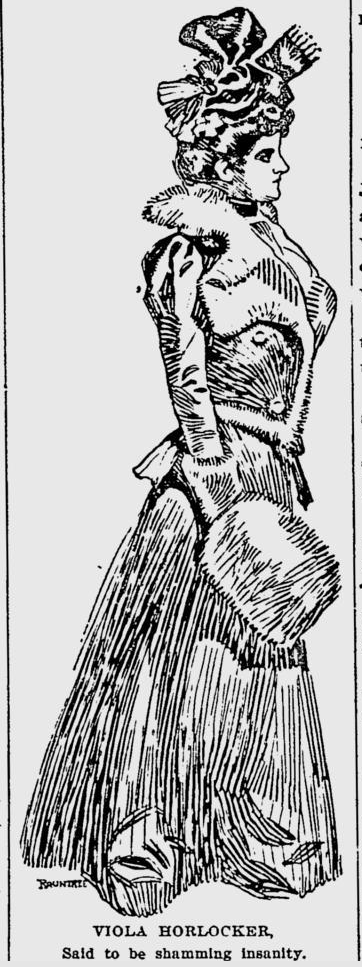
(From the Boston Sunday Post on March 25, 1900)
Until this point in Viola Horlocker’s trial, her defense team worked to establish doubt as to whether Viola actually entered the building where Anna and Charles Morey lived. Later, they’d call a witness, who’d known Viola for years, lived in the same hallway as the Morey’s, was home all day — who swore he never saw Viola on April 10, 1899. While all these details add up, Viola’s lawyers had yet to really address the heart of Viola’s insanity plea.
Until the prosecution called Charles Morey to the stand.
Faster than a fox falls on a fluffy-tailed rabbit, Viola’s defense team tipped their hand, showing the jury who they regarded as the real villain of the piece.
Badgering and lambasting Charles at every turn, they relentlessly grilled him about the exact nature of his relationship with Viola: Charging him with ‘making love to an innocent young woman.’ Accusing him of encouraging Viola’s infatuation through the sheer volume of time spent together, confidences shared, and promises of marriage made. Blaming him for unhinging Viola’s mind — by forcing her to watch her rose-tinted dreams die when he unexpectedly severed all ties with her. Could anyone fault Viola for cracking under the pressure of watching the man she ‘loved not wisely, but too well’ carry on with his wife from afar, as if she never existed?
(BTW: Apparently, Viola’s lawyer’s cross-examination of Charles was so merciless that when Charles left the stand, he said something very rude while passing by the defense counsel’s table. Unwilling to let the insult roll like so much water off a duck’s back, said lawyer immediately punched Charles in the nose. The next day, the bailiffs, who suspected the dust hadn’t quite settled from the previous day’s kerfuffle, kept a weather eye on the two men. The surveillance proved fortuitous as they foiled the pair of hotheads from drawing pistols and shooting one another in the middle of the courtroom.)
Viola herself took the stand sometime later in her own defense. Though, betwixt hiding her face in her hands, copious weeping, and periodic bouts of fainting, she didn’t provide much substance to aid her case….However….Considering the number of trials where the purported perpetrator put their own head in the noose by trying to defend themselves on the stand — you could call presenting a generally pathetic and remorseful figure a result.
Fortunately, her legal team had an ace up their sleeve.
Do you recall the friends who, from the very start, said Viola must’ve been out of her right mind if she tried to poison Anna Morey? Well, they’d stuck to their conviction and with her. Not only did they attend Viola’s trial en masse, much to Judge Adams’ consternation (who didn’t think it proper). At one point during the proceedings, they rained kisses all over Viola’s head to show their support.
One of Viola’s particular friends, Miss Eva Stuart, took this show to the next level by providing information that Viola couldn’t or wouldn’t bring herself to say.
In what the newspapers deemed a well-rehearsed testimony, Miss Eva Stuart divulged several pertinent secrets and private conversations she and Viola shared. Opening with the revelation that initially Viola hadn’t viewed Charles Morey as anything other than her boss….Until one afternoon in the office, he confided in her how sad and lonely he was and wondered if she would be his friend.
(BTW: This was well before Anna left town for three months in the summer of 1898.)
However, Viola didn’t fall in love with Charles until the afternoon he hypnotized her headache away. While in the ‘altered’ state, Viola revealed she’d felt ‘a little door in her heart spring open and feelings she’d never felt for another friend poured out.’ Deepening their bond, Charles confided in Viola about his marital troubles whilst listening to her matriarchal woes. He came over to her house and listened to her sing. He started asking her to stay late after everyone else at work left — so he could give her a passionate kiss goodbye. Finally, while his wife was out of town, Charles invited Viola to his home. Just the two of them. Alone.
And she went.
(This was a bigger deal back in the day – as women back then were suppose to remain chaste until marriage.)
At this point, Viola’s defense really started picking up steam.
Her lawyers then called an array of witnesses who testified to Viola’s peculiar behavior in the months leading up to the poisoning of Anna Morey & friends. Behavior, which included: mood swings, crying jags, melancholy, depressed spirits, headaches, peculiar conduct, unhappiness, and general distress. On one occasion, Viola failed to recognize a friend whom she’d known for the better part of fifteen years. One of the Tibbets brothers testified that more often than not, after the summer of 1898, he’d find Viola on the office floor in a dead faint.
Next, Viola’s elder sister, Luella, took the stand. First, disclosing what many already knew, that as children, they’d often witnessed the savage fights between their mother and George Horlocker. Bouts, which led to Viola’s nervous disposition as a child. However, the coup de grace of her testimony was the confession of a dark family secret: Just before Viola’s birth, their mother had tried to kill herself.
Next came the medical experts from Oak Lawn Sanatorium. Dr. Cromwell, the superintendent of said sanatorium, testified that Viola had indeed been insane on April 10th. Gradually, between August 1898 and April 1899, the irresistible impulse to poison Anna Morey seized Viola. The last straw, which snapped what little reason Viola still possessed, came that day in the dining room of the Boswick Hotel. When Charles called Anna ‘darling’ — a term of affection he’d never applied to her.
Dr. Cromwell and his colleagues then explained that when Viola first entered the sanatorium, she’d been subject to extreme attacks of hysteria and nervousness. However, thanks to their care and treatments, Viola was well on the road to recovering her reason.

(From the Columbus Journal April 4, 1900. And one of my favorite lines of the entire case calling Viola ‘crazy as a bedbug’….)
Dr. Cromwell also went on to say, I’m paraphrasing the pure hokum doctors often spouted about women during this era, that the true root of Viola’s crazy lay in her lady bits, which puberty magnified, and Charles’s wicked conduct together with his abrupt rejection exacerbated. The cumulative effect of all these factors turned Viola into a degenerate.
It took less than an hour for the jury to find Viola ‘not guilty by reason of insanity.’
The question is, was she? Was Viola really insane at the time she poisoned Anna Morey? He was her boss, and if what Viola’s friend Eva said is true, it sounds like Charles groomed her. Thereby making his sudden break-up all the more callous and cruel. And if, in the heat of the moment, she set his desk ablaze, stabbed him with a letter opener, or poisoned his favorite bottle of bourbon — I’d get it.
However, Viola waited just shy of eight months before acting, and she had that box of candied cherries and walnuts prepared before stepping into that hotel dining room on April 10, 1899. Making me wonder if coincidence or premeditation fueled Viola’s choice to dine at the same establishment on the same afternoon as Charles and Anna’s standing lunch date…..But as the papers noted from the beginning, Viola’s reputation, popularity, and well known family drama made a conviction highly unlikely — especially after her lawyers gave the jury an alternate person to blame.
In any case, after the reading of the verdict, Viola stood up, gave one long piercing shriek, and fainted. Upon being revived by her sister Luella, both women thanked the jury profusely. When the press asked Viola about her next life steps, she told them she planned to return to Oak Lawn Sanitarium for a few months before traveling to New York City to stay with Luella and her husband — for a fresh start.
And it seems she did.
In the few lines in which her name appeared in the papers over the years after her acquittal, Viola Horlocker did indeed travel to New York. Where, for a few years at least, she performed music professionally. She married a man with the surname of Adams, moved to Tujunga, California, and was alive, if not well, as of February 16, 1939.
My 52 Weeks With Christie: A.Miner©2023





 My 52 Weeks With Christie
You must be logged in to post a comment.