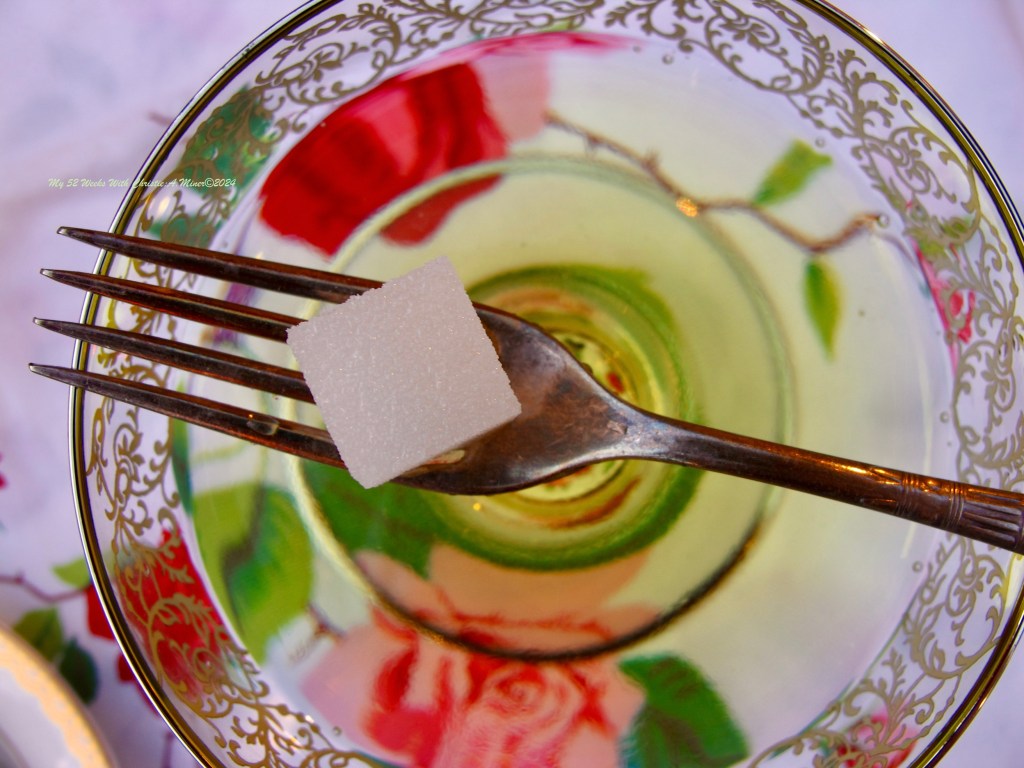
When you don’t have a fancy absinthe spoon, you can make due with a fork!
While increased availability and/or Magnan and Legrain’s theories swayed some back towards wine (which most experts considered harmless), a far greater number now viewed the absinthe as a guilty pleasure — which only enhanced its protracted pizzaz. This not-so-subtle brush-off made teetotalers, doctors, and winemakers despaired over the idea that they may never rid themselves of the glittering Green Fairy.
Then Jean Lanfray came along.
Originally a Frenchman, Jean Lanfray lived and worked in Switzerland. Arriving home on the afternoon of August 28, 1905, Lanfray promptly picked a fight with his wife over the state of his boots. Seems she hadn’t gotten around to waxing them as he’d requested and, in short order, both spouses were seething. When Lanfray told his wife to shut up….She said, “I’d like to see you make me!” Whereupon he fetched his Vetterli rifle — shot his wife in the head, turned the gun on his two daughters (both under five), then attempted to kill himself.
After his arrest, the reeling residents of Commugny (the town in which Lanfray and his family lived) attended a townhall meeting on September 3, 1905, where they learned Lanfray ingested two ounces of absinthe and that his wife was about four months pregnant with their son at the time of her murder. Horrified at the latter revelation and feeling powerless in the wake of this senseless violence, townsfolk needed someone or something to blame. Unable to put Lanfray immediately on trial, as he lay in a nearby hospital recovering from his suicide attempt, they chose absinthe as their scapegoat. Within days of the assembly, the citizenry sent a petition with 82,000 signatures to their state capital, asking legislators to ban the “Green Monster”.
The unintended consequence of the community’s appeal? They set a clear defense strategy for Lanfray’s lawyers — absinthe made him do it. An assertion medical experts supported during Lanfray’s brief trial. Absinthe notwithstanding, the fact Lanfray also quaffed seven glasses of wine, six glasses of cognac, two coffees laced with brandy, and two creme de menthes on that fateful Monday diluted the effectiveness of this defense. And while this prodigious intake prior to the murders and his very obvious remorse kept his neck out of the noose, on February 23, 1906 a jury found Lanfray guilty of murder.
Three days after being sentenced to thirty years imprisonment Lanfray, haunted by his own actions, would hang himself in his jail cell.

I apologize for the racial slur, which I will not repeat in English, at the start of this poster. The rest of the poster is by Swiss women begging legislators to ban absinthe in order to secure women’s safety in the home.
Despite the clear flaw in the blame game being played (i.e. the liters of other alcohol Lanfray consumed), on May 15, 1906, the Canton of Vaud (the state where Commugny is located) banned absinthe. Shortly thereafter, Geneva followed suit in response to their own absinthe-drinking husband named Sallez, who murdered his wife about a month after Lanfray’s crimes. (Brazil and Belgium beat both to the punch by banning absinthe outright in 1905.)
Temperance unions extracted an entirely different lesson from this series of tragic events.
They discovered a potent weapon in their fight — moral panic. By spotlighting every crime where absinthe played a role, even a minor one, they could catastrophize the “threat” absinthe posed to society’s safety and wellness. To this end, not only were Magnan’s skewed scientific experiments widely reprinted along with his theories on absinthism, Legrain lent his time, reputation, and words: “….after three years’ absinthe drinking a man becomes weak minded…moody, taciturn, suspicious, eccentric, untrustworthy and apt to quarrel without cause. If he continues to take the deadly liquor his body becomes an automaton, and he obeys without hesitation the auto-suggestions of his mind often killing, maiming and destroying with savage glee those nearest and dearest to him.”
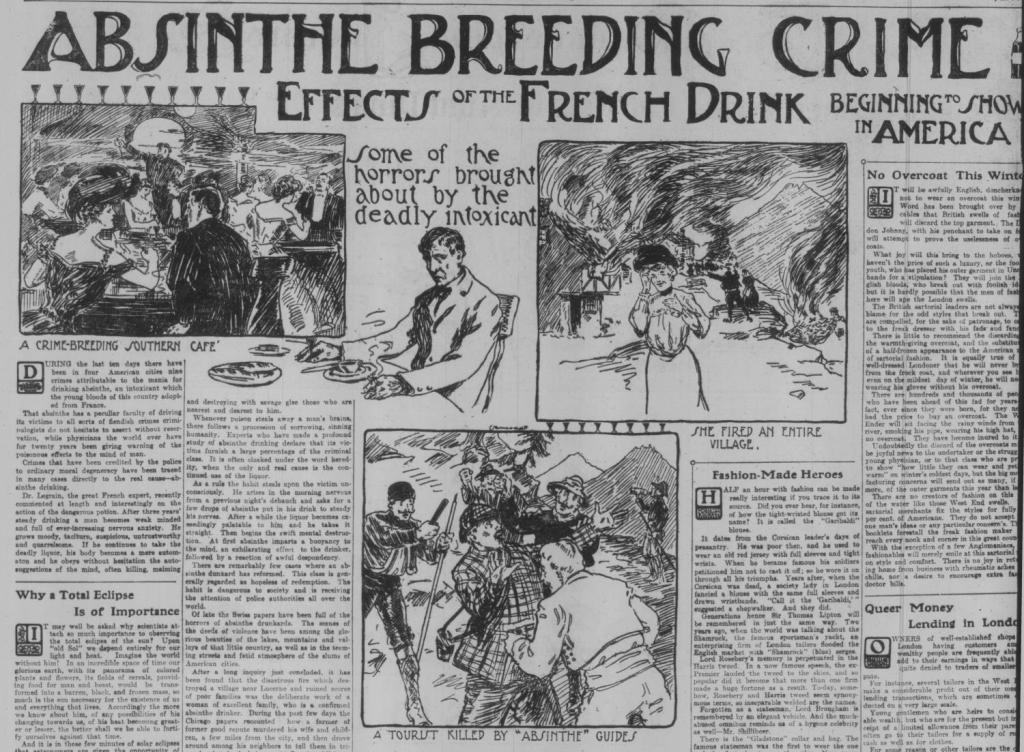
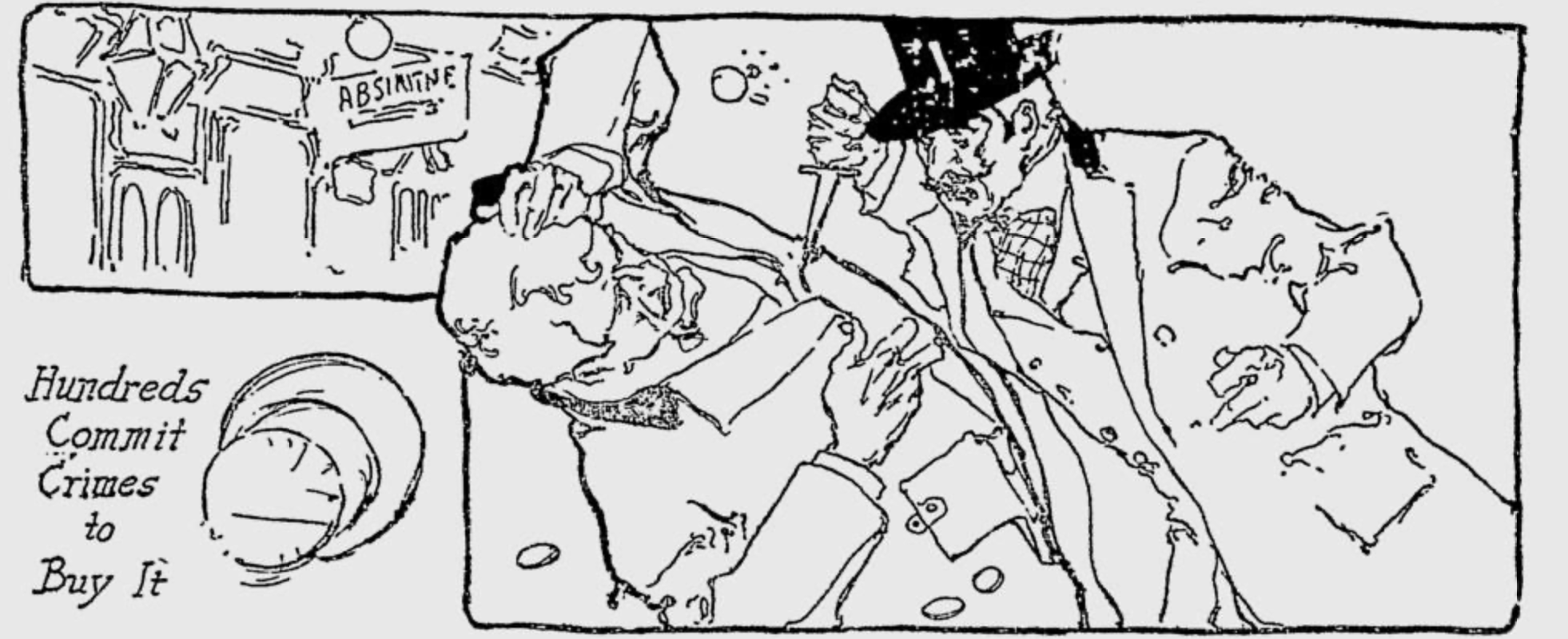
One of the many serialized pieces used to whip up fear in the U.S.
Fanning the anti-absinthe flames further, temperance unions and their members began churning out art, movies, and pamphlets corroborating these scientific findings. The most effective arrow in their quiver? Syndicated newspaper articles, in which the author detailed the alarming or violent behavior of absinthe drinkers. Amongst the many offenses attributed to “absinthe fiends” were: A) A man named Valentin Boyer, who was convinced that his enemies were persecuting him via electricity. When circumstances forced him to enter Paris, he donned a 385-pound coat made of copper and a hat made of lead with a visor covering his face. He was promptly arrested for his odd appearance. B) A man attending a national fete set fire to 37 dresses as he couldn’t resist applying his cigar to every blue dress he saw. C) A woman of good standing was arrested and imprisoned for setting fire to a village near Lucerne and destroying several houses owned by “the poor.” D) Near Nyon, an absinthe addict maimed cattle and set a series of fires. E) A 12-year-old girl was stabbed to death near Thorwaldensen’s Lion of Lucerne by a man employed at a match factory in Geneva. F) A man decapitated a young girl in Lausanne. G) Six Valois guides murdered a tourist and hacked him to pieces. H) Whilst in police psychiatric care, it was noted absinthe addicts would often try to bite off and eat pieces of their friends and family’s faces when they leaned in for a kiss.
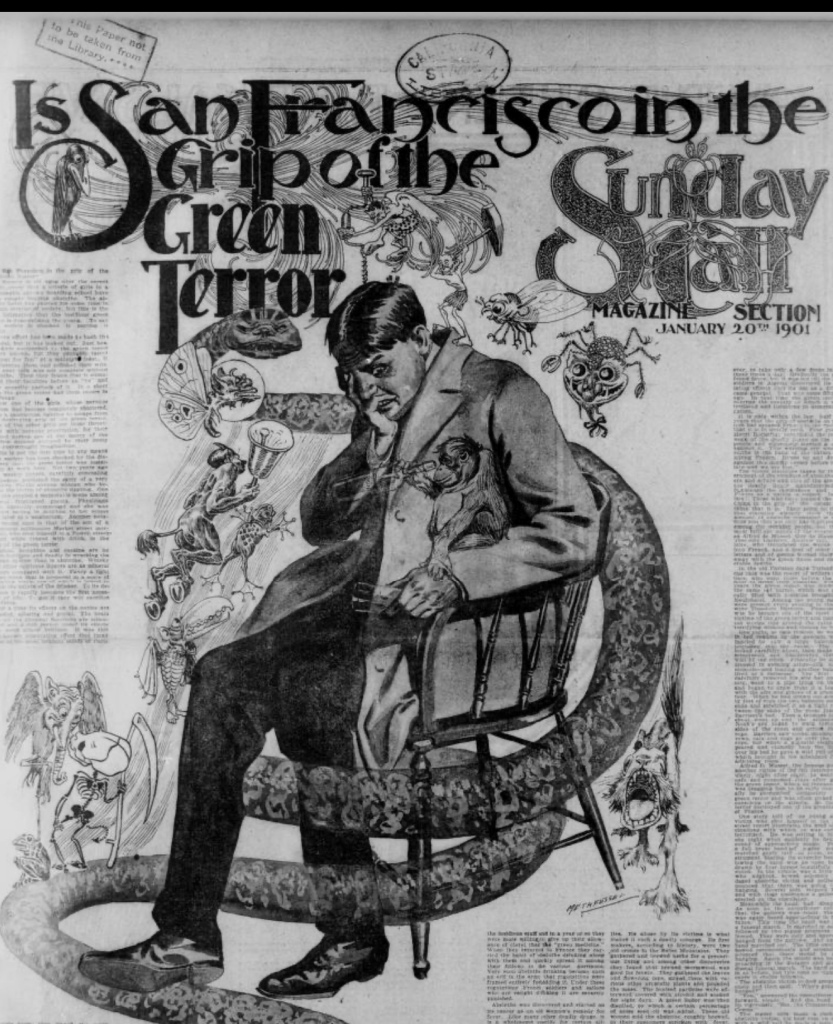
Unsurprisingly, these tales of arson, murder, and cannibalism snowballed as editors keen on increasing their readership (and/or were part of the temperance movement themselves) lept onto the anti-absinthe bandwagon. Not only did they feature any local/regional cases that even tangentially intersected with the “green monster.” They also published their own exposes on the dangers absinthe posed to their communities. Some linked the drink to the same dangers posed by opium or morphine. Others warned husbands to watch their wives lest they be lured into absinthe dens and robbed of their pin money and jewelry while they lay in an absinthe-induced stupor. Still others advised parents to keep a weather eye on their daughters lest absinthe tempt them into a wickedness and ruin.
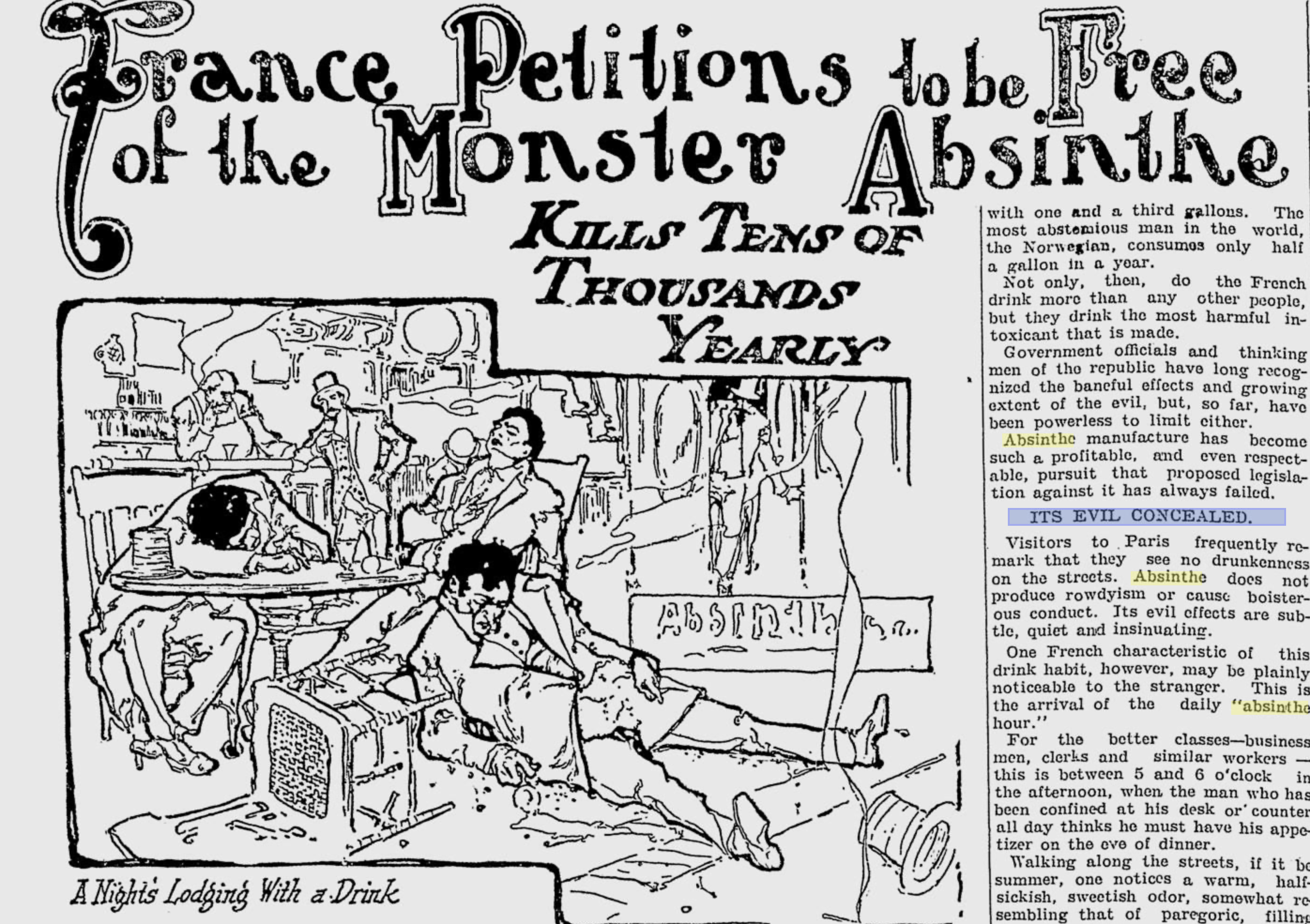
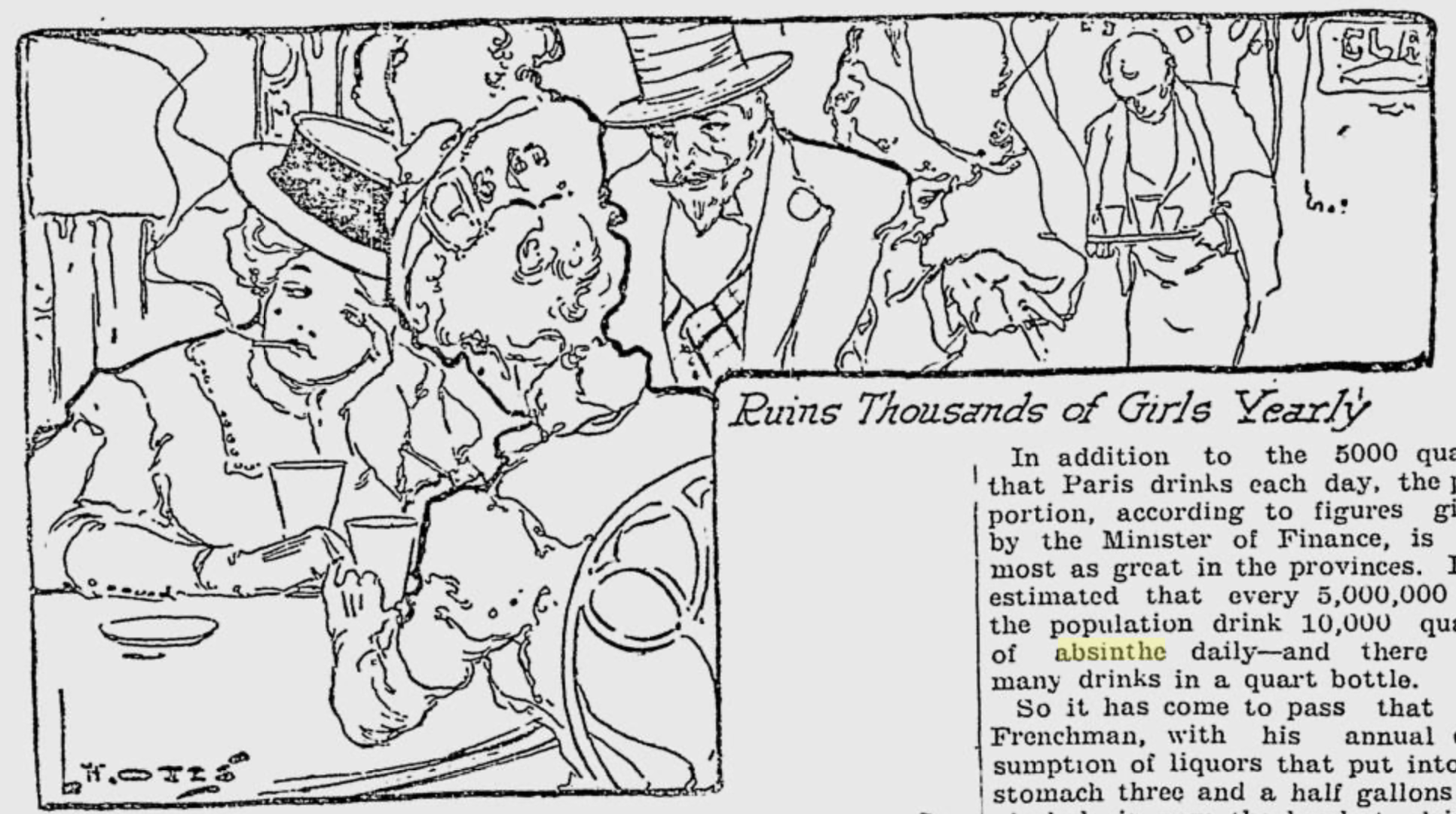

Another serialized pieces used to whip up fear in the U.S.
At some point, one bright bulb took this fear-mongering to another level by linking Magnan and Legrain’s theories of social degeneration due to absinthe drinking to the bitter loss of Alsace-Lorraine during the Franco-Prussian War in 1871. Doubling down newspapers across the world started questioning France’s fighting fitness (and, by extension, every other country that allowed absinthe within its borders). Thereby creating a green-tinted scapegoat for the growing anxiety and helplessness people felt as they watched Germany, the Austro-Hungarian Monarchy, and the Ottoman Empire growing stronger as the world hurtled towards 1914 and the start of World War One. (Though they didn’t know it yet.)
Unsurprisingly, this relentless pressure and constant fear bore fruit in 1909 when the Netherlands banned the spirit. Switzerland amended its constitution to add an absinthe prohibition in 1910, the USA’s Pure Food and Drug Act barred its import in 1912, and France banned the spirit in 1914.
From the Office of Cynical Speculation: When reading these “reports” of absinthe induced crimes cracks start to appear when they inevitably reference the Lanfray case. Rarely do any of these “news stories” cite Lanfray by name; none mention the date of his offenses or conviction, nor the specific town where the murders took place. They generally refer to him as a farmer living near Coppet who murdered his young wife and children.
Why so vague? Not only with Lanfray but in the description of the other cases? Other than the rare mention of Lanfray by name, only the first of my examples ever mentioned one of these “absinthe fiends” by name — few gave a specific location and none contained a firm date.
Playing Devil’s Advocate Here: They could have omitted these details to keep the newspaper column under a specific word count. Or perhaps the authors thought these examples were so famous everyone would instantly get the reference. I know the Lanfray case became the cause célèbre in Europe for a time thanks to the anti-absinthe movement. So, it’s not out of the realm of possibility.
However, the doubting Thomas living in the back of my brain wonders if the lack of detail stems from the desire to obfuscate the particulars of their examples…..In order to make it difficult for the public or their opponents (of which there were more than a few, though they were far less organized and funded) to suss out details which didn’t align with the thrust of the anti-absinthe campaigner’s aims. Again, take the Lanfray case as an example. If those unfamiliar with the murders learned of the liters of wine and wine-based beverages he consumed and compared it to the two ounces of absinthe….Well, people might draw a different conclusion and blame the wrong kind of alcohol — which flies in the faces of winemakers’ self-interest. Hence why it may’ve been left out.
So what about the other examples of absinthe-induced crimes? Do they own similar inconsistencies?
I don’t know. I attempted to verify the finer points of the other cautionary tales and came up with bupkis. I couldn’t find a single newspaper piece aligning with the criminal information outlined in these syndicated articles. In fairness, these purported transgressions are well over a century old, and my French (while improving) is still lackluster at best.
While, I do not believe the authors made this anecdotal evidence up….…I am not sure they were above exaggeration either.
My 52 Weeks With Christie: A.Miner©2024
 My 52 Weeks With Christie
You must be logged in to post a comment.