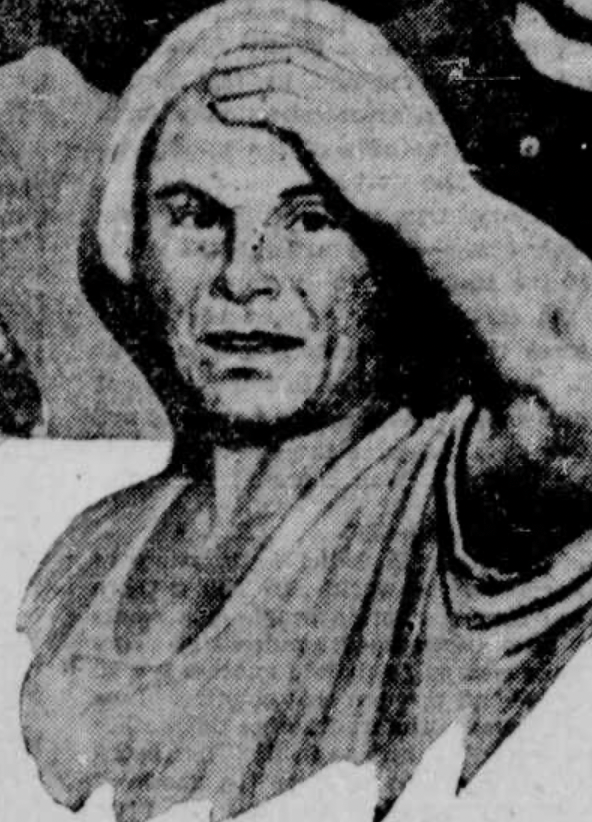
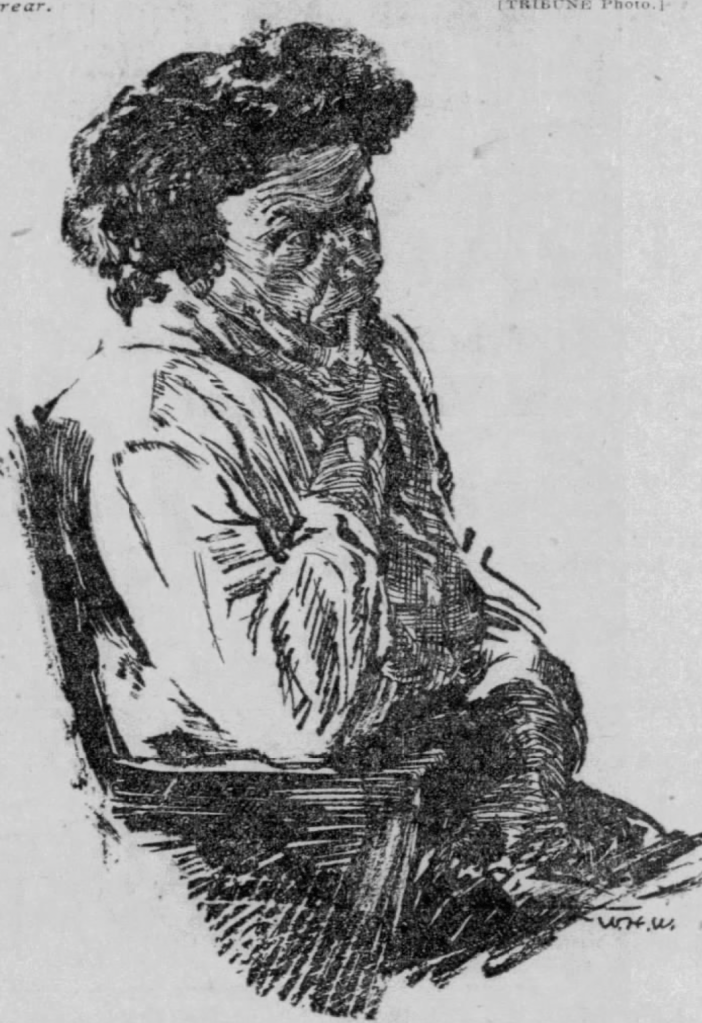
Crime & Christie: Louisa Lindloff’s Ultimate Fate

After the state recalled Dr. Miller and a Coroner’s physician to the stand, both of whom swore neither Alma nor Arthur suffered from any disease that would require treatment from an arsenic based medicine (endeavoring to rebut Sadie Ray and Louisa Lindloff’s insistence that the pair had), the state and defense made their closing arguments then rested their collective cases. 

At 3:45 pm, on November 5, 1912, the jury started deliberating Louisa Lindloff’s future.

Whilst they did so, Louisa laughed and gossiped with Sadie Ray and other friends in the vacated jury box. Reporters sat in the gallery and started writing yet more copy about how a woman, even a mass murderer, couldn’t get convicted by a Cook County jury. A sentiment most spectators still sitting in the courtroom echoed, much to the despair of the Assistant States Attorneys.

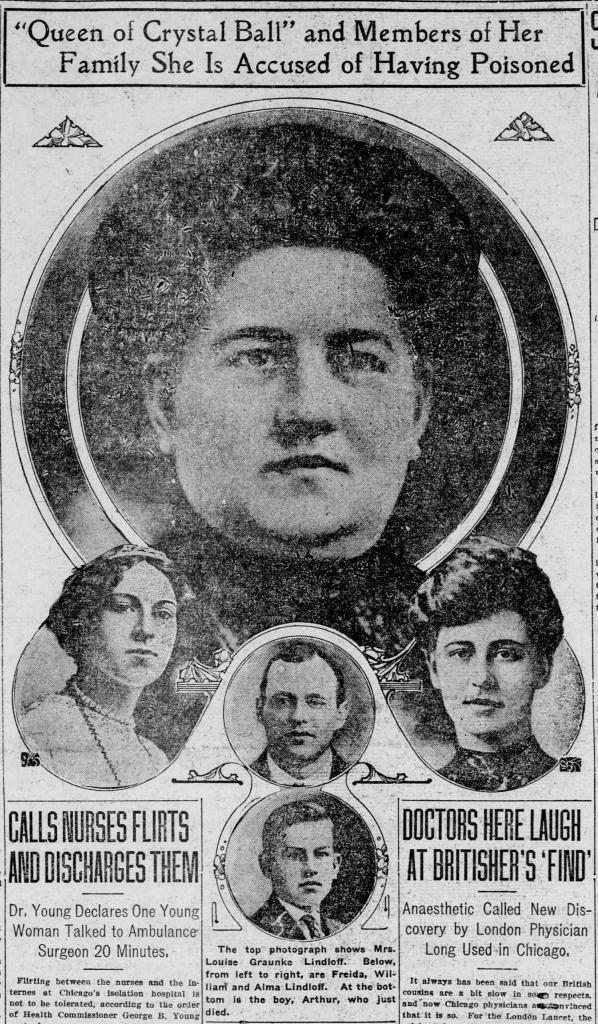
Though the jury created a stir when the bailiffs escorted them to dinner at the Alexandra Hotel and again when they returned at 7:30pm — it wasn’t until a knock sounded on the jury room door at 9:15pm that the butterflies in everyone’s stomachs took flight. After shuffling back into their seats, the jury foreman rose and declared Louisa Lindloff guilty of murdering her son, Arthur Graunke, and sentenced her to twenty-five years in prison.

Seems the jury unanimously agreed on Louisa’s guilt straight away. What took the next five-ish hours to settle was Louisa’s punishment: On the jury’s first ballot – 5 wanted life in prison and 7 wanted Louisa to hang. On the second ballot – 5 voted for life in prison and 7 switched to a term of 40 years. Finally, on the third ballot – the twelve men compromised and settled on 25 years.

The resulting headlines touted Louisa as the first woman convicted by a Cook County jury in three years.

A bulletin that highlights the casual racism of the day. 

For you see, only one month before, in the very same judge’s courtroom, Lulu Blackwell was sentenced to thirty-five years in prison for manslaughter. The only difference? Both the Lulu and the victim, Charles Vaughn, were black. A fact which apparently made a difference to the white newspaper editors of Chicago. As not only was there significantly less coverage of Lulu’s crime and trial (in the papers I’ve got access to), when her name was mentioned either during the scant trial coverage or on the lists of women arrested for murder, most papers felt the need to point out Lulu’s skin color, and none (I found) mentioned Lulu’s stretch inside Joliet Prison being longer than Louisa’s — for a lesser charge. 

Although there’s a distinct lack of copy on both the murders committed by black women and the subsequent acquittals they won during this stretch of time in Cook County, I did find a few — like Belle Beasley. Who, after five minutes of deliberation, was acquitted. Despite being found standing over her dead husband with a literal smoking gun in one hand and newspaper clippings of other women cleared of murder by Cook County juries clutched in the other. 

All that being said, one of the biggest issues for Lulu’s defense was she brought a gun with her to 3212 Dearborn Street. Beyond all the typical problems associated with shooting someone in a fit of jealousy, before their house, on a public sidewalk, in front of witnesses. (Charles was planning to marry another.) By lugging the firearm to the confrontation, Lulu gave the impression, real or not, that some level of plotting went into the act. Making it that much more challenging to convince a jury that Lulu acted in either ‘the heat of the moment,’ self-defense, or needed protection under Chicago’s ‘unwritten law.’ 
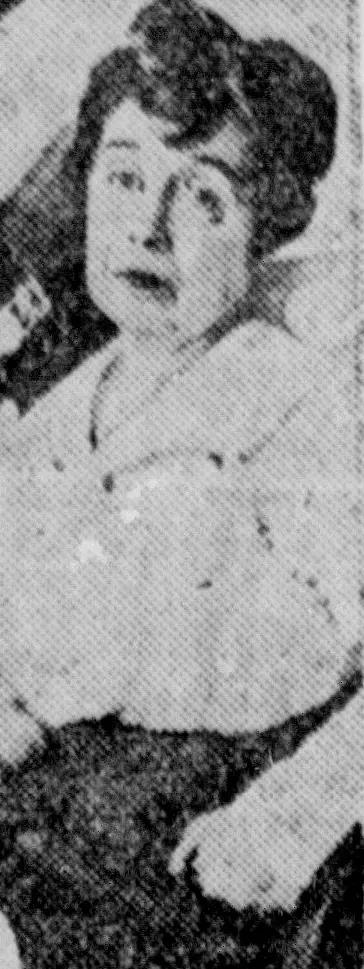
Then, there were the barks of laughter Lulu reportedly let loose during the testimony of the witnesses called against her. Remember, the men called to serve on Cook County juries only wanted to see overt displays of contrition, regret, and/or remorse on the faces of the women they were judging. Hence why, Billy Flynn became annoyed with Roxie (in the 2002 film adaptation of Chicago) when reporters asked during We Both Reached for the Gun if she was sorry for murdering her boyfriend and she replied, “Are you kidding?” Had Roxie continued to appear unrepentant, as she nearly did, until a state-sanctioned murder radically changed her tune — ten-to-one, she would’ve found herself facing a length of rope. 

Though the reasons behind the jury’s decision to find Lulu guilty are only educated guesses — what isn’t — is the utter shock she displayed upon hearing the word ‘guilty’ ring out in the courtroom. An emotion Louisa would mirror thirty days later after the same exact verdict reached her ears.

While George Remus lept to his feet and motioned for a new trial — Louisa sat stock still. Only after she was led from the courtroom did she break down. After recovering from a fainting spell, Louisa wept and gave reporters this quote: “There is no justice here…Those that are guilty are turned loose and those who are innocent get the worst of it. I will show my innocence before I am through. It will only be a question of time. I did not kill my boy or any others. I am innocent, as God is my witness.” 

Interestingly enough, unlike Isabella Nitti and Hilda Exlund, who blamed their conviction on their looks, Louisa didn’t. She blamed a different source: “The spirits lied to me—they lied—they told me I would be acquitted. They promised I should be free—and here I am, convicted. Why have I believed the spirits—they lie.” Though Louisa’s disillusionment in the spirit world quickly faded and new predictions of her imminent release followed — the press, her fellow spiritualists, and the public had already moved on.

A circumstance that may have changed if Louisa’s appeal for a new trial came to fruition. And thanks to Judge Windes’ decision to allow the introduction of Julius, John Otto, Frieda, William, and Alma’s deaths into evidence — there was an excellent chance the Illinois Supreme Court would’ve approved this appeal. 

Granted, the other deaths and their connected life insurance policies/payouts created a compelling pattern. However, Louisa was never formally accused of, arrested for, or tried for any death other than Arthur’s. Meaning they shouldn’t have been presented as evidence to the jury. An argument Chief Justice Carter of the Illinois Supreme Court seemed to nominally agree with, as on March 15, 1913, he issued a ‘writ of supersedeas.’ Allowing Louisa to move back to Cook County Jail’s Murderess Row while waiting for the Supreme Court to hear her appeal. 

However, we will never know how the Justices would’ve ultimately ruled.
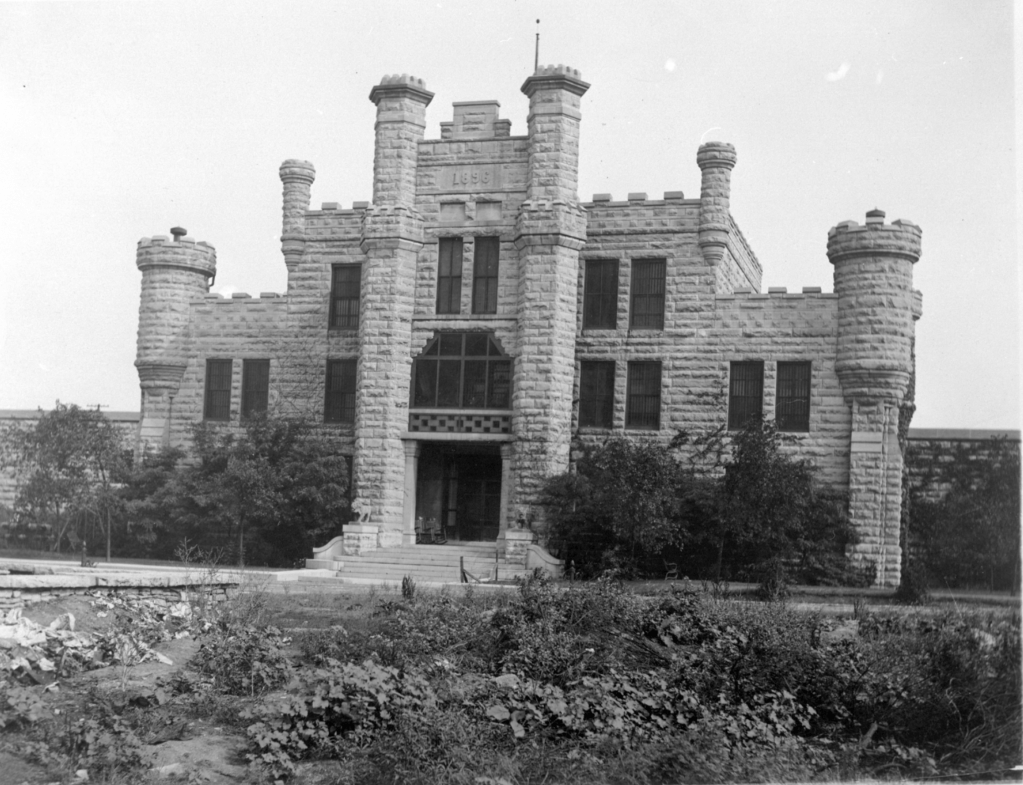
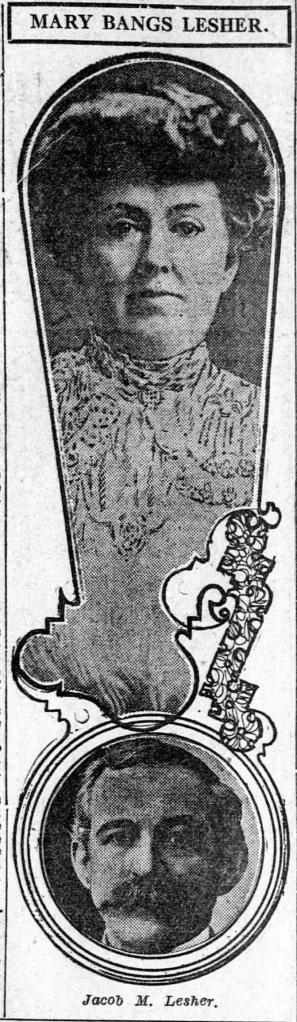
On March 15, 1914, Louisa Lindloff died of intestinal cancer while waiting for her date with the Supreme Court. One of her last published quotes was, “I have nothing to say — I am happy to die.” (Sadly, Lulu Blackwell preceded Louisa beyond the pearly gates by eight months, dying of septicemia inside Joliet State Prison on July 13, 1913. The only note of her death I found was a single line in an annual report published by the Illinois prison system.)

Supreme Court appeal and protestations notwithstanding — what do I think? “There was Mrs. Green, you know, she buried five children — and every one of them insured. Well, naturally, one began to get suspicious.” Though this Miss Marple quote from The Bloodstained Pavement was written about sixteen years after Louisa Lindloff’s 1912 conviction and undoubtedly about a different poisoner, I think it neatly sums up the spirit behind Louisa’s crimes. 

IMHO, it feels far too coincidental that: A) Julius Graunke & Charles Lipchow died in August, a year and three days apart from one another. B) William Lindloff & Alma Graunke also died in August, a year and a day apart from one another C) Frieda & Arthur Graunke died four years and two days apart from each other in June. John Otto Lindloff, who died in October, is the only outlier to this pattern. However, if Louisa worried he and Frieda would move beyond the easy reach of her box of Rough on Rats after they married — this might explain why she didn’t wait.

Together with the thousands of dollars, Louisa earned each time she buried someone? Plus, the lies she told the police upon discovering the insurance policies on Arthur’s life? It’s compelling, even without Sadie Ray’s uneven account of Louisa trying to slot her death into the timeline. Over and above that, Louisa’s excuse that cucumbers led to Arthur’s death is just flat ridiculous.

In other words, yes, I think she did it.

On the topic of Louisa’s Victims: After the trial concluded, Chicago Police Captain Baer went on record with his belief that on top of murdering Arthur, the rest of her immediate family, Charles Lipchow, and Eugenie Clavett — he’d uncovered evidence that Louisa had murdered fifteen more people, including a five-month-old infant. (Not to mention the countless animals witnesses swore Louisa killed while experimenting with different poisons.)

Assuming his intelligence was correct, that would bring the grand total of murders ascribed to Louisa to 23. 

Crime & Christie: Building on Their Bones

Now that Louisa Lindloff’s lawyer, George Remus, dealt with the arsenic hued elephant in the (court)room, it was time to address a far more problematic aspect of the case — Louisa’s pinpoint prophesies of death. Obviously, correctly predicting the exact expiration date for (at least) seven separate people is a tough mountain for any defense to climb. Yet, this peak wasn’t insurmountable, thanks to the mercurial nature of Chicago juries and the well-established Murderess Acquittal Formula.

However, the climb did prove far more treacherous than first anticipated after Judge Thomas G. Windes allowed Assistant State’s Attorneys Smith & Lowe to introduce the deaths of Julius Graunke, John Otto Lindloff, William Lindloff, Frieda Graunke, and Alma Graunke as well as, the corresponding life insurance payouts into evidence. These deaths, when taken in conjunction with Arthur’s (the only family member Louisa was actually on trial for murdering) and the ledger found secreted away beneath a floorboard in Louisa’s wardrobe (which demonstrated the correlation between Louisa’s dipping bank balance and the alleged murders) made the pattern crystal clear. 

Though this judicial decision was problematic, it didn’t seem to alter the razzle-dazzle strategy Louisa and her legal team set in motion in the run-up to her trial in November 1912.

Now, you need to understand that by the time Louisa’s alleged crimes came to light, Spiritualism was simultaneously flourishing and floundering in the United States. Spurred on by grieving families who lost fathers, husbands, brothers, and other relatives in brutal battles during the Civil War (forty-seven years before), this idea that the spirit remained intact after death and could be contacted brought genuine solace to those in mourning. (Spiritualism saw a similar uptick in popularity after WWI as well. Hence its inclusion in so many golden age mystery stories, including a Miss Marple short story, Motive v. Opportunity.)

Unfortunately, it didn’t take long for those with an eye for the main chance to start taking advantage. Now, to be fair, some spiritualists sincerely wanted to help the bereaved and those searching for answers. However, a far greater number chose to twist Spiritualism for their own gain.

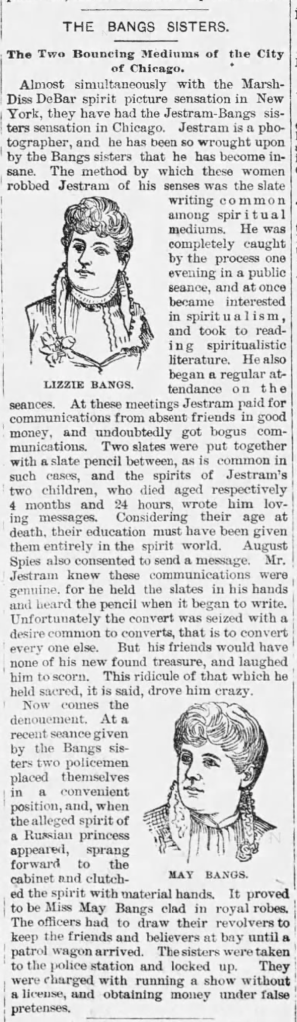
Like Chicago’s own Bangs Sisters.

Operating out of their parlor, May and Lizzie conducted seances during which the spirits sometimes “created” either writings or portraits for their still-living loved ones — for a hefty fee. 

However, by the time Louisa’s trial came around in 1912, a massive number of mediums, fortunetellers, and their ilk had been publicly unmasked as frauds. (Including the Bangs Sisters, who had their deceit exposed once in 1901, again in 1909, and finally sometime before 1913.)

Yet, despite the growing body of evidence compiled by scientists, magicians, and authorities demonstrating the literal tricks of the trade — people still wanted to believe. 

Whether Louisa counted herself as a true believer or amongst the double dealers hardly matters. 

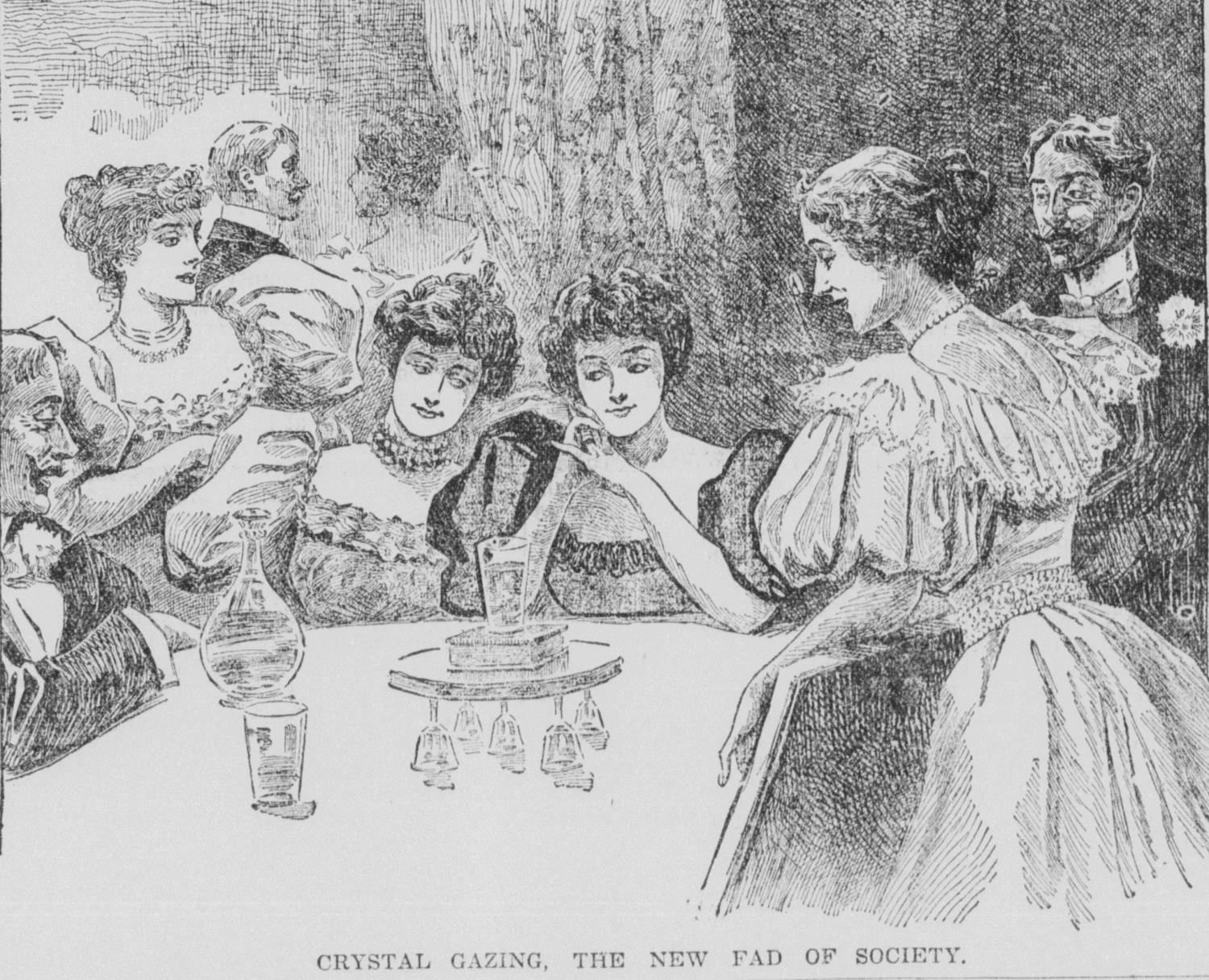
What does signify is the fact that within short order upon arriving at Cook County’s Murderess Row, Louisa leaned heavily into her advertised occupation of spiritualist medium. To this end, Louisa installed her favorite crystal ball within her jail cell. When reporters asked about the clear sphere, Louisa proudly boasted she’d paid $500 for the instrument, which contained a single tear shed by Cleopatra over Marc Anthony’s resting place within its heart. When used with her own second sight, this extraordinarily powerful reagent would swell and stretch beneath her gaze until images from the future filled her vision and/or she contacted someone across the River Styx. 

Unsurprisingly, Louisa used the crystalline orb to contact the son she was accused of murdering: “She says that she has communicated thus with Arthur, and that he tells her she will be exonerated, but that she is unable to get in touch with her late husband Wm. Lindloff. However, she is assured that Arthur will look him up.” This prediction, made just eleven days after Arthur’s death, was one of the first in a lengthy string of prophesies Louisa would deliver to anyone and everyone in earshot. 

And many were listening.

Amongst Louisa’s most vocal supporters were her fellow mediums, necromancers, and the like. During Louisa’s many and varied court appearances, these spiritualists routinely relayed their visions and spirit guide messages to reporters — all of which confirmed Louisa’s gifts, innocence, and imminent acquittal. Moreover, they and sympathetic members of the public contributed to Louisa’s defense fund, raising well over $1,800.

Although the state’s tests and investigation of Louisa’s crystal ball revealed it to be nothing more than a fifty-cent orb of glass, this information did not (seemingly) affect Louisa’s clients’ faith. Although ASA Smith & Lowe compelled a few to corroborate that Louisa had predicted the exact dates of several familial deaths (which Louisa later denied doing). They also testified to numerous predictions Louisa made that came about, which she couldn’t possibly have influenced the outcome of. (Louisa also made similar death day prophecies to Dr. Warner for Alma and Arthur’s death and predicted Arthur’s death at Alma’s funeral to her favorite Undertaker.)

(BTW: The loss of access to said sphere for police testing did not stem the tide of Louisa’s predictions. Instead, she would perform long, complicated divination rituals before an altar constructed from a framed photograph of Arthur and gifts he’d given her to achieve the same results.) 

To the jaded eye, this spiritualist angle appears to be nothing but a bunch of balderdash meant to feed the press and distract the public from the correlation between death and benefits. If it also happened to plant the idea Louisa was far too silly to commit such ruthless acts, so much the better. 

Next, George Remus attempted to fashion Louisa into a sympathetic figure caught in a web of circumstances far beyond her control. 

To this end, and to the complete surprise of everyone, Louisa included a hitherto unmentioned death while testifying in her own defense. Fourteen years before Julius’s death in 1905, Louisa and Julius’s infant son, Erick Graunke, died unexpectedly in 1891. In the article I read, there wasn’t a clear reason why Louisa brought Erick and his death up….Other than trying to garner sympathy from the jury? And/or hoping to get remains tested for arsenic, knowing none would be found, thereby breaking the pattern? I know it sounds unkind to intimate Louisa used her baby’s death for her own ends, but up until this point, he’d not come up once. So why now? It just seems…..well…..slightly shady that she would bring up his death at this point in time when no one in either Wisconsin or Illinois had once questioned it. 

(And this wasn’t the only time Louisa might’ve used an infant for her own ends. According to Captain Baer and Milwaukee prosecutors, there was a fair chance Louisa experimented with arsenic or other substances on a five-month-old infant she helped care for, leading to their death in 1907.)

Next, during her nearly two hours on the stand, Louisa elaborated on several tidbits she had shared with the press earlier in her incarceration. First, she painted her first husband, Julius Graunke, as a serial adulterer. Who passed a STD to her, and she unsuspectingly gave her children and second husband. Moreover, after mustering the courage to leave him, Julius tricked her into a reconciliation three months later. (BTW: While her neighbors in Milwaukee neither confirmed nor denied Louisa’s account in the articles I read, MANY testified to the fact they suspected she was carrying on with another man before, during, and after Julius’s last illness.)

Following her harsh account of Julius, Louisa portrayed John Otto Lindloff as a drunk whom neither she nor his brother/her future husband wanted marrying Frieda (Louisa’s eldest daughter).

At this point, Louisa donned the mantle of a long-suffering mother whose other daughter (Alma) routinely stayed out all night drinking and dancing. Utterly undeterred by Louisa’s warnings about her frail health or “whippings” she received, Alma continued to do as she pleased until her fast lifestyle caught up with her. (Whether these “whippings” were physical or verbal is unclear). Finally, Louisa painted herself and Arthur as victims. He, being a “good boy”, was forced to endure an STD he’d done nothing to earn. While she helplessly watched everyone she loved fall like dominoes due to the unexpected consequences of the arsenic laced medicines they all were compelled to take due to Julius’s infidelity.

Now, with the arsenic accounted for, circumstances sufficiently muddied, and a sympathetic tale on record, George Remus turned his sights on the last problem sticking in the proverbial craw of his defense — a one Miss Sadie Ray.

Crime & Christie: Cucumbers & Wallpaper

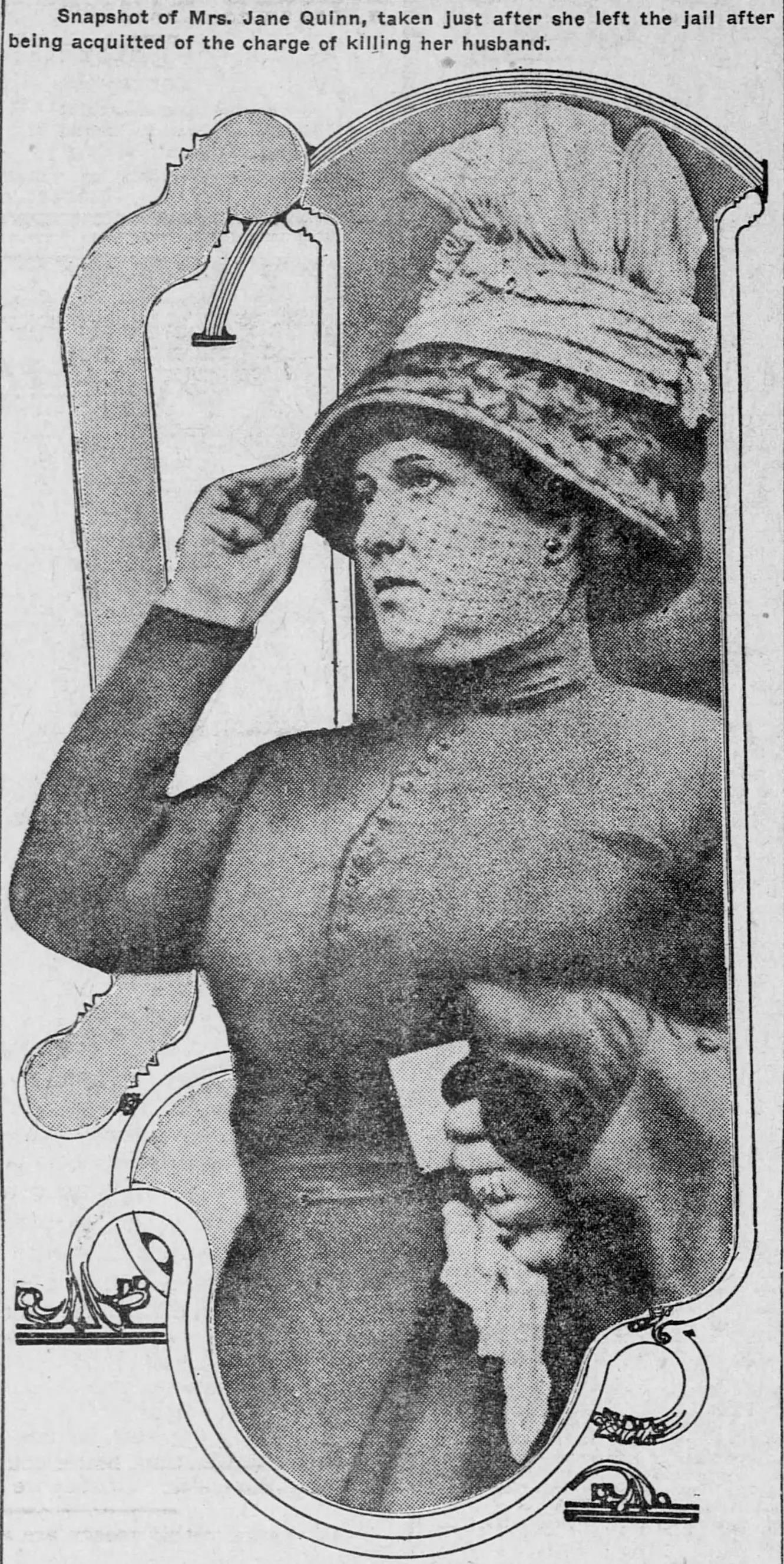
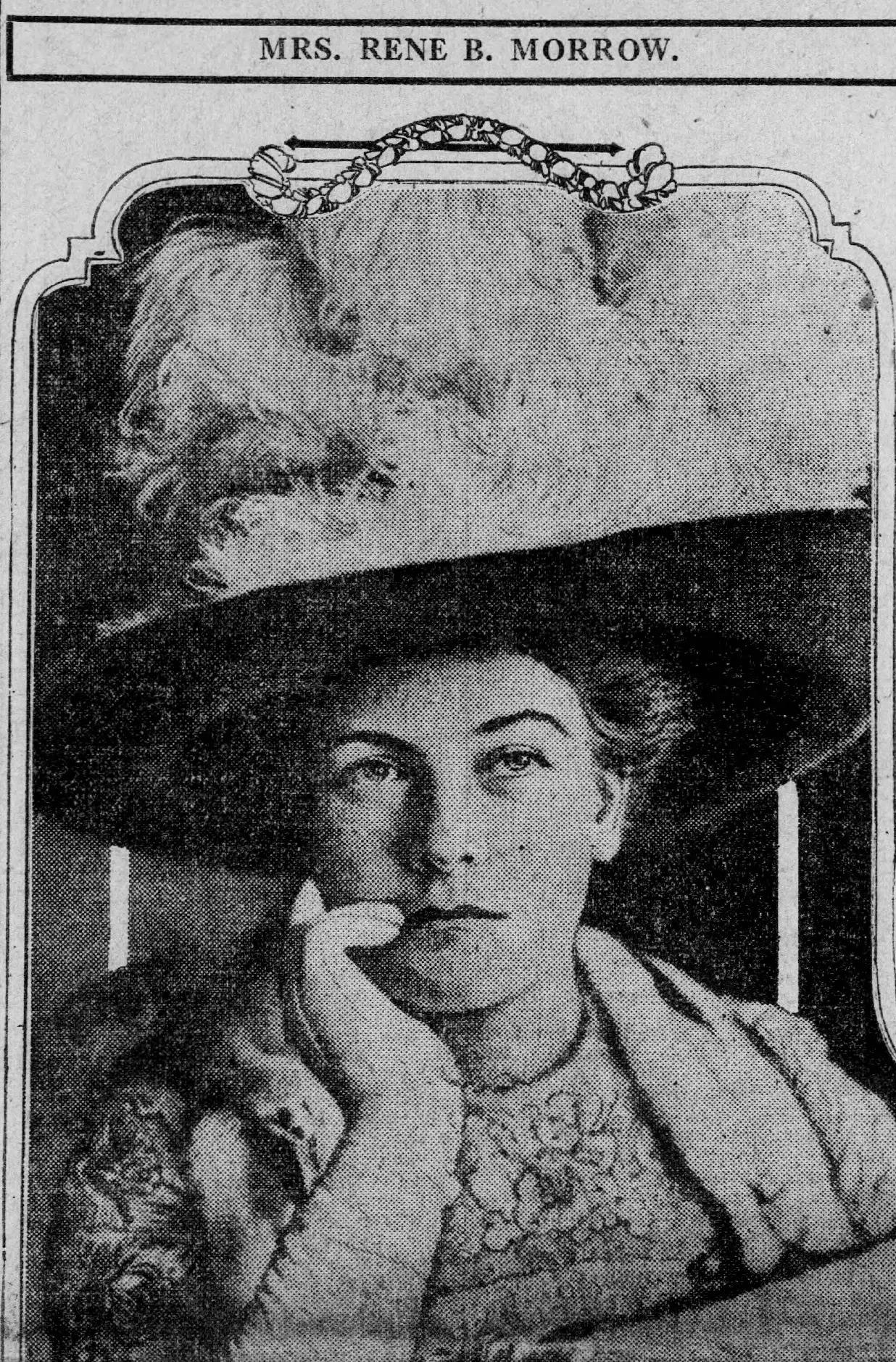
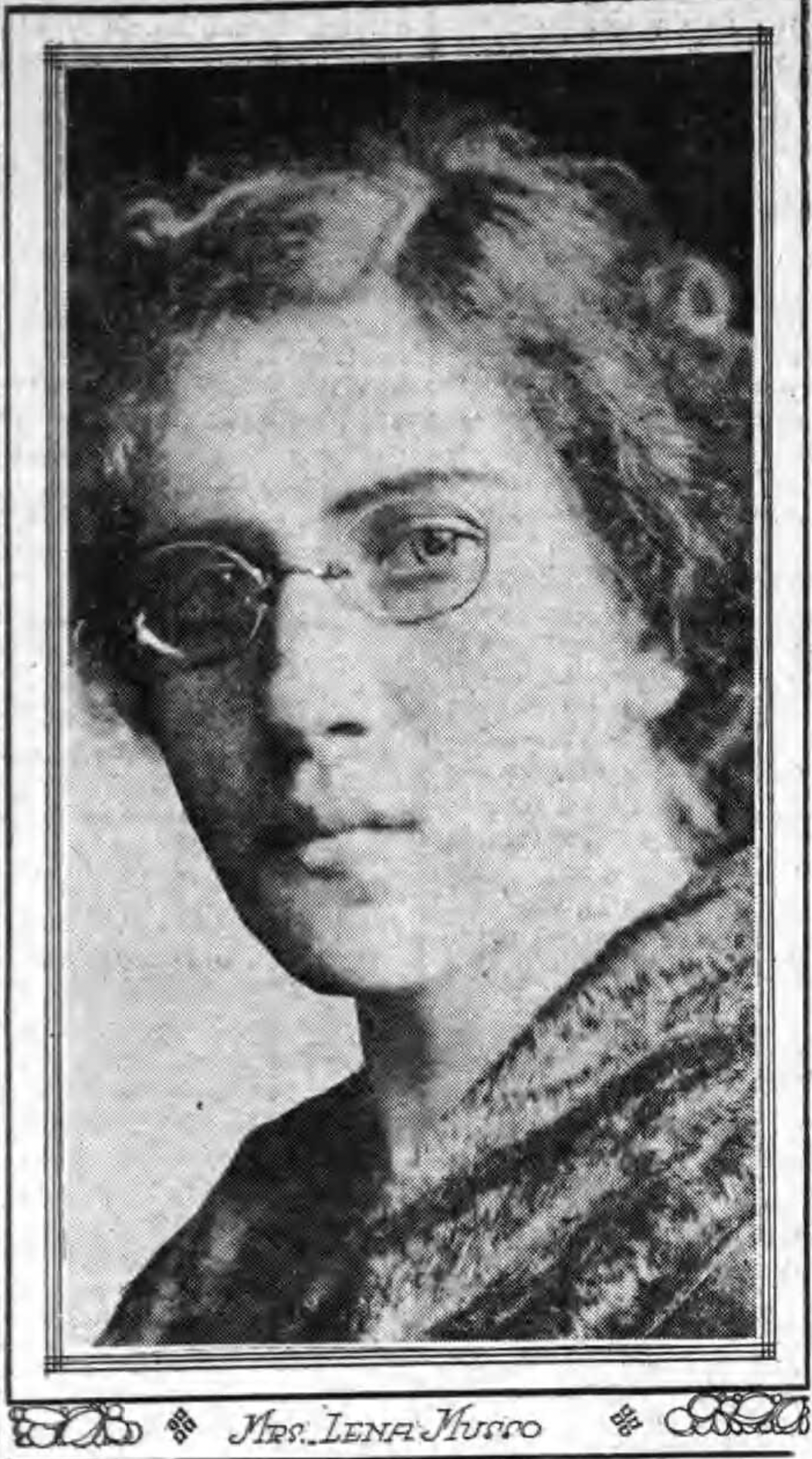
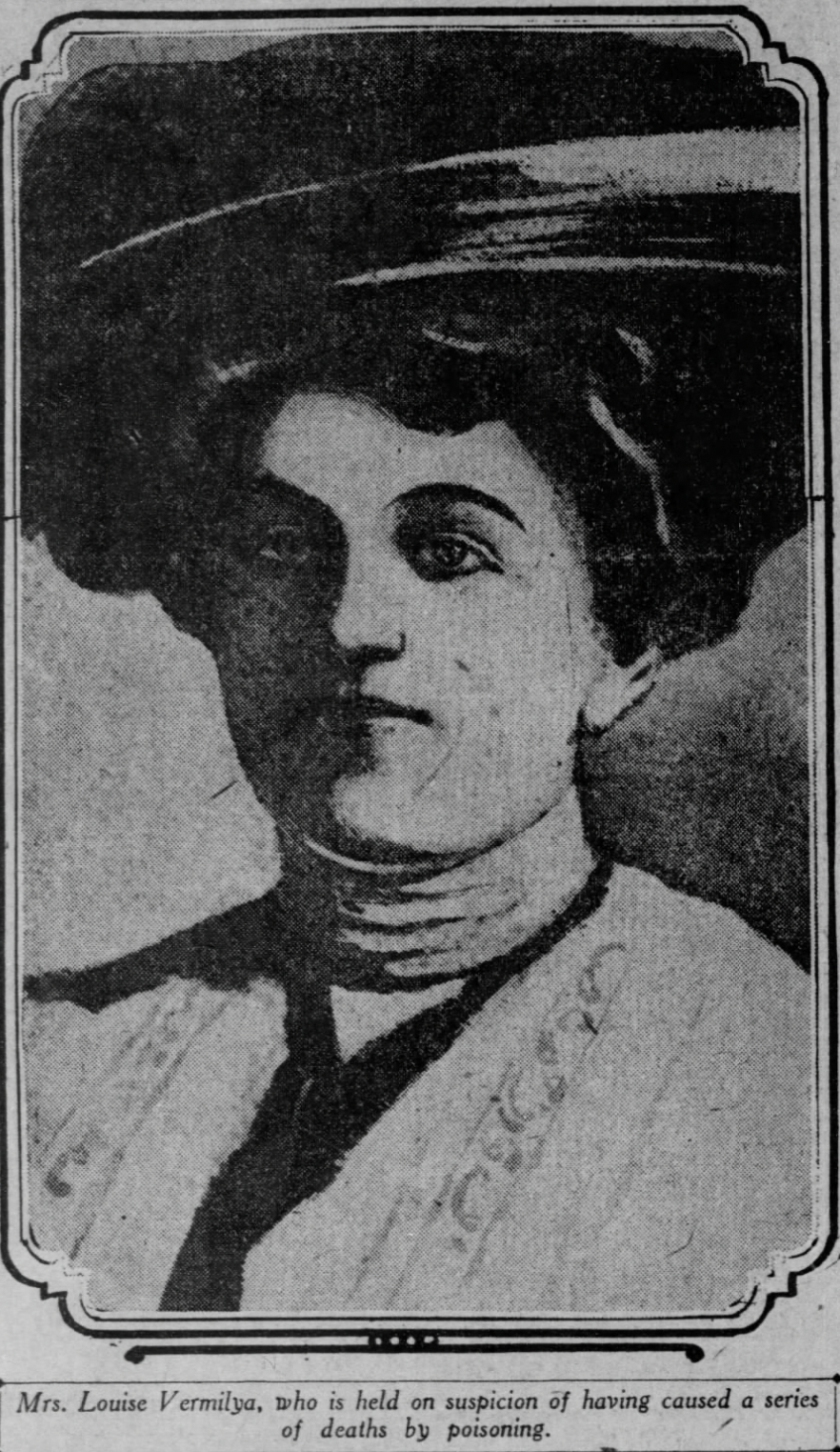
As we’ve seen, obtaining a conviction in historic Chicago was anything but certain. In 1912 alone, Assistant State’s Attorneys were forced to watch Florence Bernstein, Elizabeth Buchanan, Harriet Burnham, Rene B. Morrow, Lena Musso, and Jane Quinn walk out of Cook County courtrooms free as preverbal birds after (allegedly) shooting their husbands (and one love-rival) to death. Even the trial of Louise Vermilya, who police believed poisoned upwards of nine people, ended in a hung jury.

.….An outcome that undoubtedly buoyed Louisa Lindloff’s spirits, as Vermilya’s alleged crimes mirrored her own right down to the poison she favored, victim pool, and motive. (The two even shared a cell on Murderess Row for a spell.) Which begs the question, how? How did Vermilya flummox prosecutors and bamboozle six out of twelve jury members? And, more importantly, could Louisa improve upon Vermilya’s result and actually get away with murdering her son? 

First and foremost, any claim of self-defense would most likely collapse under the weight of the days, weeks, and months of suffering endured by Louisa’s victims. By targeting her children Frieda (18y), Alma (19y), and Alfred (15y), Louisa pretty much rendered any and all claims to Chicago’s ‘Unwritten Law’ null as well as negating the idea of self-defense and a crime of passion. Unable to access any of the cornerstones of the Murderess Acquittal Formula while eyeing the swelling mountain of circumstantial evidence piling up against her, Louisa found herself in a tight spot.

Until she hired famed criminal defense attorney George Remus. 

Specializing in murder cases, Remus was undoubtedly aware of the blueprint others of his ilk used to defend accused poisoners. Tailoring this strategy to fit Louisa’s case, while cherry-picking from the remaining elements of the Murderess Acquittal Formula and adding his own flair, Remus’s first step was to undermine the state’s assertion that Arthur was purposely poisoned by Louisa. 

Step One: Point out to one and all that owning arsenic, other poisons, and their derivatives isn’t a crime. Nor does their presence on a pantry shelf prove Louisa used them to harm those nearest and dearest to her. True, owning upwards of 80-plus bottles, boxes, and/or bags of said substances is a tad enthusiastic — but it’s not criminal.

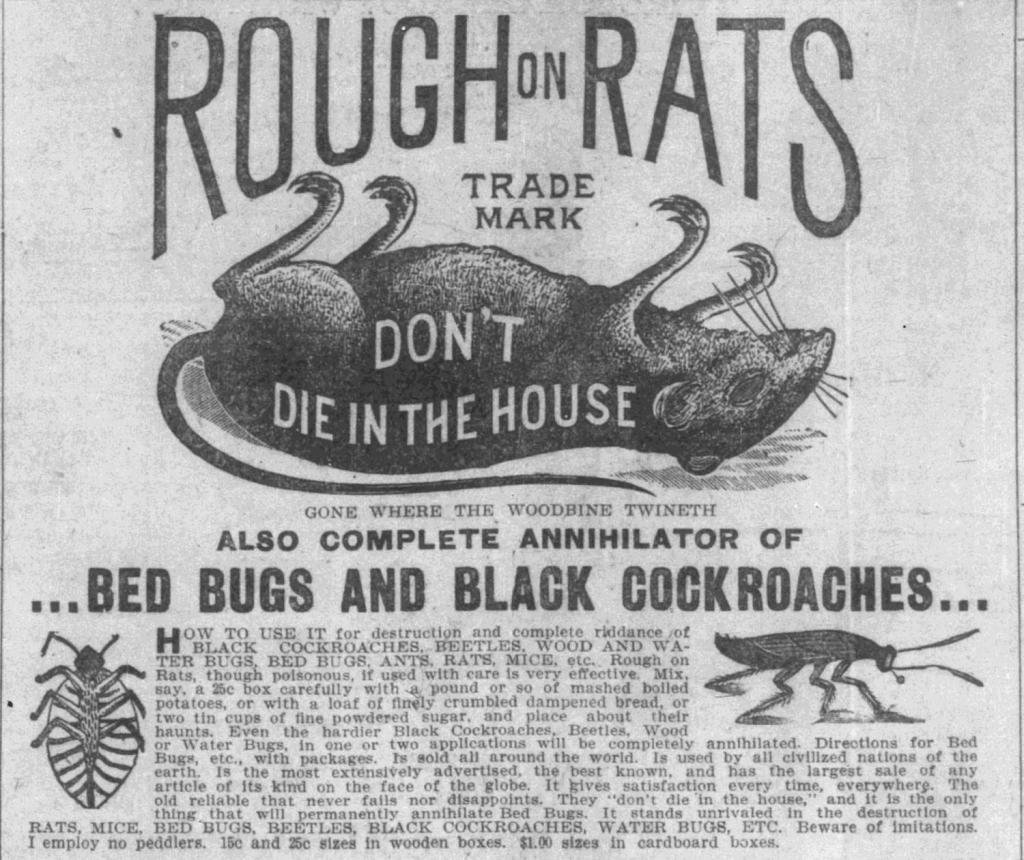
Furthermore, such a collection could (nearly) be explained by the abundance of rats, bedbugs, and other disease-carrying pests who absolutely love urban centers, like 1912 Chicago. With the city’s overcrowded neighborhoods, uneven trash removal, and many restaurants, it ensured everyone from housewives to shopkeepers struggled to keep vermin at bay. A proposition made more difficult by rodents’ infuriating habit of developing poison shyness. (Hence why Louisa owned so many varieties.?! Maybe?) Plus, accidental exposure to Rough on Rats (and therefore arsenic) was almost inevitable due to the recommended application methods.

Step Two: Call attention to the fact that arsenic is a naturally occurring element in the earth’s crust — which means — any arsenic found in the body could be due to natural exposure. Since Arthur’s employment didn’t entail any direct contact with soil (contaminated or otherwise), Louisa contended this incidental exposure came about through her son’s love of cucumbers, which he apparently “ate like a hog.” (Louisa’s description, not mine.)

While it’s true carrots, parsnips, and other such root vegetables can contain trace amounts of arsenic in their skins and, if not thoroughly washed, specks of arsenic-ladened earth can cling to their outsides — the same cannot be said of cucumbers. Between growing on vines rather than directly in the dirt and their thin skins — these vegetables contain very little arsenic in the parts we eat. Facts which could’ve rendered Louisa’s ‘cucumber defense’ shaky if: A. Scientists had discovered either detail by the start of Louisa’s trial on October 25, 1912. — And — B. If Assistant State’s Attorneys Claude T. Smith & Francis M. Lowes presented these scientific tidbits to the jury. 

Step Three: Identify all the other ways the victim(s) could’ve come into contact with the deadly element. 

Holding firm to Dr. Warner & Dr. Miller’s explanation that the wallpaper in Arthur’s sickroom was one source of exposure (despite their admission that this excuse was a ruse), Louisa added another legitimate wellspring – Medicine.

According to Louisa: Arthur, his sisters, and her husbands all suffered from a skin complaint for which they treated with arsenic based patent and prescription medicines. Which Dr. Warner did confirmed prescribing. 

From the Office of Full Disclosure: Prior to Louisa’s testimony at trial, the newspapers reported the family’s “hereditary skin complaint” in generic terms. It was only after Louisa took the stand that she euphemistically blamed her first husband, Julius Graunke, for passing on a venereal disease to her, which she, in turn, passed on to her children and her second husband. Perhaps she was alluding to herpes? Which was at one point treated with arsenic. However, thanks to reticence of the times when dealing with STDs, it’s unclear if the family actually suffered from said STD, an innocuous skin problem, or if Louisa invoked the idea to explain away the arsenic found in the bodies whilst simultaneously garnering sympathy from the jury.

Interestingly, unlike Louise Vermilya’s first trial, which was abandoned after a similar medicine based revelation, Louisa Lindloff’s continued. 

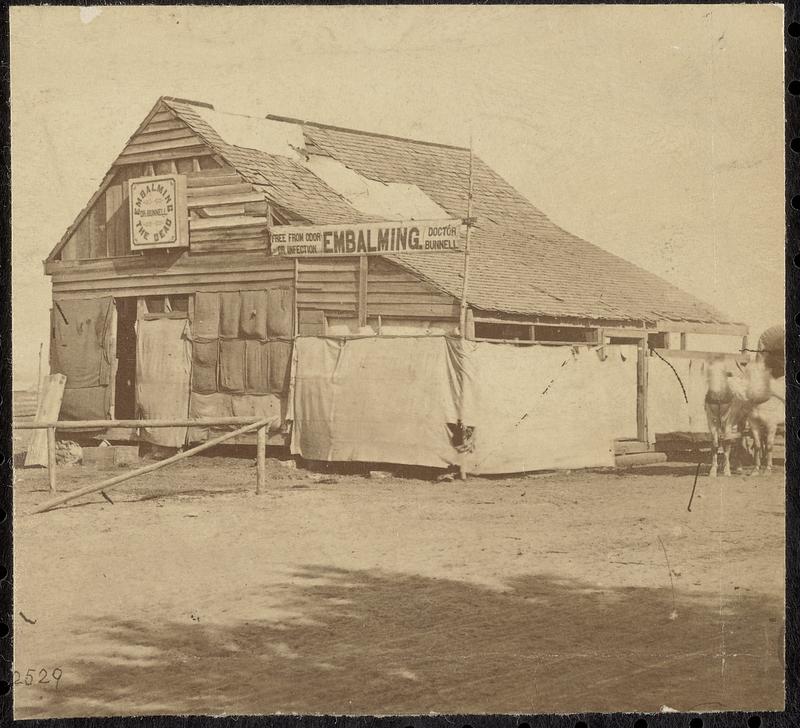
Another common way for substantial quantities of arsenic to enter the body: Embalming Fluid.

During the American Civil War, Dr. Thomas Holmes developed an arsenic-based chemical mixture, technique, and specialized apparatus to preserve Union soldiers’ bodies so they could remain (relatively) preserved during their journey back North for burial. When Holmes’ method proved successful, it was widely adopted. In cases like Louisa’s, the unintended consequence of this advancement in mortuary science is obvious. Since not even the most talented of chemists could differentiate between arsenic administered by nefarious means and arsenic used in embalming fluid, it often rendered results of the Marsh Test absolutely worthless in criminal poisoning cases where remains were tested after being embalmed and/or buried.

This detrimental side effect that reared its ugly head (again) on August 9, 1912. When Coroner H. L. Nathin was forced to abandon his inquest into Julius Graunke and John Otto Lindloff’s deaths due to the discovery that both sets of remains were treated with an arsenic based embalming fluid. (Charles Lipchow’s body was found bereft of the heavy metal. However, that does not mean Louisa didn’t poison him.) Thus ending the looming threat of extradition and prosecution, Milwaukee prosecutor’s promised should the notoriously fickle juries of Chicago acquit Louisa of murdering Arthur.

Speaking of prosecutors — they had their own strategy when dealing with multiple murderers like Louisa. Working under the assumption they could always try a poisoner for another murder, prosecutors would select their strongest case to take to court. Amongst Louisa’s many victims, ASA Smith & Lowes landed on Arthur as their best shot. Not only because his death was the most recent but on account of the quick thinking of two people. 

Apparently, before Arthur’s body ever left Chicago’s University Hospital, Coroner Hoffman seized his pancreas and spleen following the institution’s post-mortem. After confirming for himself neither organ appeared diseased, thus ruling out the COD listed on Arthur’s death certificate, Hoffman delivered both organs to Professor Walter S. Haines of Rush Medical College for chemical testing. 

Upon Prof. Haines’ confirmation that both organs were chalked full of arsenic, Coroner Hoffman ordered the exhumation of William Lindloff and Alma Graunke on June 19, 1912. Although Illinois outlawed arsenic-based embalming fluid back in 1907, Hoffman also requested samples of the fluids used on William and Alma’s bodies be tested as well. Unsurprisingly, on June 27, Prof. Haines’ reported both sets of remains were brimming with arsenic and none was found in the fluid. Thus prompting Hoffman to disinter Freida Graunke’s body, which, in turn, yielded the same results.

Once More From the Office of Full Disclosure: At some point, Coroner Hoffman had Arthur’s lungs, stomach, liver, and other organs tested as well. Though, thanks to the sensation around Louisa’s arrest, it’s a tad fuzzy when precisely this happened. What we do know is, one way or another, Oak Ridge’s Undertaker heard about the kerfuffle around Arthur’s death, and rather than embalming the boy’s body straightaway — he held off. So when Coroner Hoffman arrived at the mortuary to collect the remaining viscera, he found it uncontaminated. 

The Fourth & Final Step: Remind the jury arsenic is a cumulative poison, as well as, an acute one

To this end, while testifying in her own defense, Louisa shocked the entire courtroom on November 2, 1912, by admitting Arthur and the rest of her family undoubtedly died with arsenic in their systems. Whereupon she blamed the accumulation of arsenic found in Arthur’s system on the boy’s overindulgence of cucumbers, the wallpaper in his sickroom, and doctors for prescribing arsenic based medicines. 

As defenses go, it sort of held water….if you squinted at it really hard. However, the six grains of arsenic found in Arthur’s remains wasn’t the only damning element requiring an explanation.

Crime & Christie: The Unravelling Web of a Black Widow

Soon after Alma’s death, disaster struck Louise Lindloff’s occult practice. Seems police caught wind of Louisa’s work as a clairvoyant/medium/seer and shut her down. Though she skated through the encounter without her wrists being sullied by shackles, police made it abundantly clear Louisa could no longer contact those on the otherside of the veil for coin. Unable to groom clients for possible bequests or supplement her income with readings and unwilling to curb her spending or find honest employment — Louisa turned a gimlet-eye towards her remaining child for one last big score. 

While her crystal ball grew cold, Louisa toured the local insurance agencies stockpiling policies on Arthur Alfred Graunke’s life: Three totaling $515 were secured. Another, purchased on September 13, 1911, was for $1,000 and the final one for $2,000 was obtained on March 26, 1912. 

With all her ducks now in a row, Louisa started the clock.

From the Office of Full Disclosure: Most newspaper reports agree Arthur fell ill on a Wednesday — though whether it was June 5 or June 12 is a tad murky. Whichever Wednesday it was, seventy-something days after securing the last bit of insurance on Arthur’s life, Louisa served her son a meal of cucumbers, canned salmon, and ice cream. (Hopefully, not all mixed together. However, as a kid who lived through the nineteen-seventies jello mold craze? Such a hideous combo cannot be ruled out.) In any case, shortly after ingesting said meal, Arthur fell desperately ill with stomach cramps, vomiting, backaches, and other debilitating symptoms. 

Once again, Louisa sent for Dr. Augustus S. Warner.

Immediately after clamping eyes on Arthur, the third member of Louisa’s family to fall desperately ill in three years, Dr. Warner finally realized he was dealing with arsenic and a serial poisoner. After treating Arthur in the best way he knew how, and with all attempts to induce Louisa into sending her son to the hospital rebuffed, Dr. Warner made a tactical retreat from 2044 Ogden Avenue. 

Well aware that accusations of poisoning were grave and making an erroneous allegation could open a whole world of hurt for himself — Dr. Warner contacted a colleague to consult (unbeknownst to Louisa). After reading and discussing not only Arthur’s case but Alma and William’s, Dr. Joseph Miller came to the same conclusion as Dr. Warner: all three showed the telltale symptoms of arsenical poisoning. 

Returning to Louisa’s home on June 13, 1912, strategy in hand, the two doctors tag-teamed Louisa. Blaming the wallpaper affixed to the walls of Arthur’s sickroom (a classic scapegoat), the physicians told Louisa her son’s symptoms corresponded with a textbook case of arsenic poisoning. While they “believed” Louisa didn’t have a hand in Arthur’s current complaint, they pointed out that her consistent refusal to heed their recommendation to move Arthur to a proper medical facility could be construed by some as highly suspicious in light of their diagnosis. 

Reluctantly, Louisa finally acquiesced. However, replicating the scheme she used when William (her second husband) entered a similar institution, Louisa removed Dr. Warner as Arthur’s primary physician. When Arthur died, Dr. John M. Berger of University Hospital, chalked Arthur’s cause of death down as pancreatitis. Later, he admitted he’d only seen the fifteen-year-old about five minutes before said event and knew next to nothing about his colleague’s misgivings — hence the unobjectionable cause of death.

Straightaway, after learning of Arthur’s passing, Louisa sent her boarder, Henry Kuby, to Prudential Insurance Company for a blank death certificate to start the ball rolling on her last big payday.

Meanwhile, despite being barred from Arthur’s sickroom, Dr. Warner and Dr. Miller were anything but idle. Together, they compiled their paperwork and theories and took them to the Cook County Coroner and Juvenile Court Authorities. Who, in turn, didn’t waste a single second securing the proper permissions and warrants. The day after Arthur’s untimely death, whilst Louisa was planning his funeral, Captain Bernard Baer of the Fillmore Street Police Station and his officers rocked up at 2044 Ogden Avenue.

Warrants in hand, the policemen began searching the house from pillar to post while their Captain questioned Louisa. (Now, I don’t know the order in which Captain Baer fired off these queries at Louisa, so I’ll put them in an order that feels logical to me.)

When told the reason for the search was due to Arthur being poisoned, Louisa replied: “…If he was, I know nothing of it; my hands and body are clean.” Next, when asked if she had any poison in the house, Louisa categorically denied owning any. This lie was immediately laid bare by Officer Anthony McSwiggin, who not only located a box of Rough on Rats missing about 1/3 of its contents, but some strychnine, a mercury based poison, some form of barium, and other bottles labeled poison on a pantry shelf.

Next, investigators discovered a newly purchased grey wig (bought before Arthur’s death) and a trunk catalog. When Capt. Baer asked after these objects; Louisa admitted she planned on traveling (definitely not pulling a runner) that coming summer. An intention that did not jive with her bankbook, which showed Louisa only had $30 to her name. Furthermore, Louisa’s meticulous personal accounting showed a direct correlation betwixt the deaths of her nearest & dearest and when her bank balance dipped dangerous low.

Following these falsehoods, damning admissions, and deductions, Capt. Baer confronted Louisa with the collection of insurance policies she’d assembled on Arthur’s life. Her justification for having so many? Not only was it a German custom to heavily insure one’s immediate family members, but who would they leave such a large sum of money to, if not his mother? 

Apparently, feeling this rationale wasn’t enough, Louisa explained that it seemed prudent to amass multiple policies on Arthur’s life due to the hazardous nature of his job at Commonwealth Edison Company. And faster than Jackie Robison could round the bases, Capt. Baer exposed the false underpinnings of this excuse as well. Turns out Arthur was, in fact, an office boy earning $20 a month from the electric company. What’s more, Capt. Baer discovered that Louisa deceived the insurance companies about Arthur’s age, listing it as 16 rather than 15, in order to obtain the last two high-dollar policies.

Despite all the circumstantial evidence accumulated and Capt. Baer arresting her on June 15, 1921; Louisa managed to retain her freedom until June 17, when she was formally charged with Arthur’s murder and remanded to a Cook County jail, her bid for bail denied. Though she was allowed to attend Arthur’s funeral the next day, Louisa was escorted by two city detectives and a police matron, then promptly shepherded back behind bars.

Finally, after seven years and at least eight murders, the long arm of the law caught up with Louisa. Now, the million-dollar question was: Would a Chicago jury convict her of murder?

Crime & Christie: Louisa’s Ever Dwindling No. of Relations

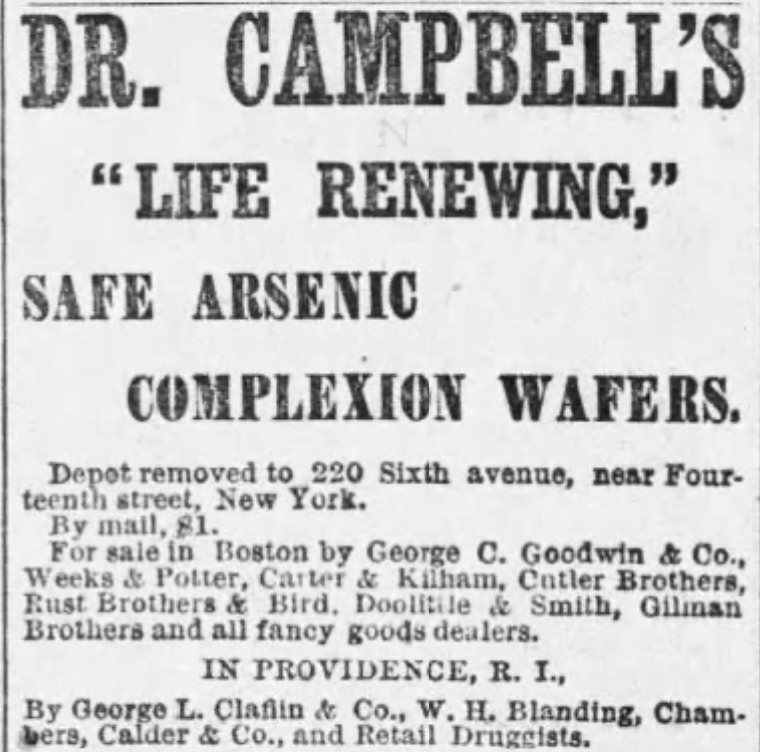
Despite science finally running arsenic to ground, the cultural memory of the “good old days” when arsenic was fondly known as ‘inheritance powder’ (as it helped part inconveniently living relatives from their fortunes/properties/titles in an expeditious fashion) remained. Egging on those tempted to employ arsenic for their nefarious deeds was the fact that it was available practically everywhere. Above and beyond being able to purchase the uncut stuff from druggists — products like fly paper, rat poison, and Scheele’s & Paris green pigments needed little to no refinement in order to kill. 

Speaking of druggists, at some point between 1889 and 1906, whilst living in Milwaukee, Louisa worked at Herman L. Emerich’s drugstore located at 1603 3rd Street. According to her fellow clerks, Louisa showed a marked thirst for knowledge about all the lethal substances stocked on the store’s shelves. On top of her unofficial education, Louisa’s position also granted her access to said substances. This could’ve allowed her to obtain any number of them without worrying about someone tracing, say, a purchase of pure arsenic or its slightly adulterated cousins, back to her. 

On the topic of employment, above and beyond the insurance payments Louisa collected and her new husband’s wages, by the time 1907/1908 rolled around, Louisa was earning an undisclosed amount of coin via her purported skills as a “spiritualist, medium, and seeress”. Amongst her unknown number of clients was a woman named Mrs. Eugenie Clavett. 

How Louisa entered Eugenie’s orbit or how long she performed for her is unknown. What we do know, thanks to her sister Mrs. Mary C. Nelson, was Eugenie was either already sick or became sick shortly after meeting Louisa. An illness Louisa exacerbated, Mary firmly believed, by coaxing Eugenie into rebuffing the prescription provided by her doctor in favor of one or more nostrums concocted by Louisa herself — only a few days before her death.

From the Office of Fairness: Eugenie’s case only came to light after Louisa was caught. When more often than not, people try to assign every death occurring around a poisoner to said poisoner. Nevertheless, there are four reasons why Mrs. Nelson’s accusation rings true in my mind. 

First, this was not the first time Louisa switched out a doctor’s prescribed medicine for a homemade “remedy”. According to later testimony, young Frieda and Alma both told Milwaukeean neighbors how their mother exchanged the doctor’s prescription for a concoction of her own design during their father’s final illness. 

Second, Louisa accurately “predicted” the day of Eugenie’s expiration — just as she had with Julius, John, and Frieda.

Moreover, right after Eugenie’s passing, Louisa started pressuring her teenage daughter, Mabel, to move from her Auntie Mary’s abode and in with herself. The fact young Mabel inherited $7,000 upon her mother’s death undoubtedly spurred on Louisa’s increasingly pushy demands to relocate. (Happily, the teen declined and lived.) 

Lastly, Eugenie’s probable murder coincides with a lull in familial deaths. 

Deaths that resumed on August 3, 1910. When William Lindloff, Louisa’s second husband, died in Chicago’s Denton Hospital from a brain aneurysm. Oddly enough, after being admitted to the hospital, Louisa barred Dr. Augustus S. Warner, who’d been treating William for a rapidly worsening heart ailment up until this point, from her husband’s bedside. A decision that may or may not have been due to him asking some uncomfortable questions about an inexplicable rash that started spreading all over William’s face and body just before his untimely demise. (Which is one of the symptoms of arsenic poisoning.)

It will amaze absolutely no one that Louisa promptly collected $600 from a mutual aid fund provided by William’s employer, McCormick Harvester Company, and a $1,000 life insurance policy underwritten by the Modern Woodmen of America.

Now, with six possible murders at her door, five of which netted her approximately $7,950, you’d think Louisa would quit while she was ahead. However, money ran like so much dry sand through her fingers, and by 1911, Louisa was again in desperate need of cash. Whereupon her gaze turned to her second eldest daughter, Alma.

Whether it was sheer laziness, cockiness over hoodwinking people on six separate occasions, or at Alma’s insistence — Louisa made the mistake of employing the services of Dr. Warner a second time. Diagnosing Alma’s symptoms, which included tiredness and lack of appetite, as stemming from a weak heart, Dr. Warner treated her for eight months. According to Alma’s suitor, Stewart Hall, Alma’s health took a turn for the worse: “On the night of July 29, 1911, when I called to take Alma to a theater she was feeling ill. She told me that she became ill immediately after eating a supper that her mother had prepared.” 

Six days after ingesting said meal, Alma was dead. 

According to Louisa, her daughter fell ill after overheating while dancing, which Dr. Warner thought enlarged the nineteen-year-old’s heart and, in turn, led to Alma’s death on August 4, 1911. Designating natural causes as cause of death, Alma’s death certificate was duly signed, and Louisa collected her daughter’s $1,300 insurance policy.

Leaving Louisa’s son, fifteen-year-old Arthur, as her only immediate family member above ground.

Crime & Christie: Arsenic the Element That Brings Everyone Together

Now, you’d think arsenic poisoning wouldn’t really square with Chicago’s Murderess Acquittal Formula. Not only because the administration of poison is (predominantly) a covert and (on the whole) premeditated act but on account of the sheer absurdity of translating the foundation of this Formula from “they both reached for the gun” — to — “they both reached for the box of Rough on Rats.” 

And yet, a handful of women still turned to this ancient element. 

The most notorious of the lot, who spent their fair share of time in Cook County’s Murderess Row, were the serial poisoners Tillie Klimek and Louise Vermilya. However, there is a third, lesser-known member of these ‘Sisters in Bane’ — Louise Lindloff. Who’s life and crimes and subsequent trial had it all — spiritualists, allegations of witness tampering, startling admissions, and a literal crystal ball. So, of course, that’s whose misdeeds we will explore next!

Now that we’ve mastered that portion of the name game let’s examine Louisa Lindloff’s life and multifarious crimes.

Originally, Louisa was born Louise Darkone in Colmar, Germany, on February 4, 1871. Seventeen years later, in March 1888, Louisa married Julius Graunke, who was about two years her senior. Approximately two years later, in April 1890, Louisa and Julius welcomed their first child, a girl they named Frieda, into the world. 

Following this joyous event, sometime between 1889 and 1891, Julius crossed the Atlantic Ocean, settled in Milwaukee (Wisconsin), and found work as a driver for the Fitzner & Thompson Commission House before sending for his wife and baby daughter. In short order, the couple expanded their family with a second daughter, Alma, born on December 18, 1891. Finally, Julius and Louisa completed their familial unit with son Arthur Alfred Otto, born on May 19, 1897.

Sadly, misfortune in the form of an undefined, debilitating illness struck Julius around late April or early May of 1905. During his three-month downward spiral, a neighbor, Mrs. Martha Greiner, heard Julius complain: “Louisa, there was something in my last medicine.” Louisa also confided in Martha: “Julius will only live a few days and when he is dead I’ll get $2,600. I’m going to open a saloon and buy a horse and buggy and have a good time.” This prediction came about, just as Louisa foretold, on August 12, 1905. 

The death certificate put the cause of death down as sunstroke, and Louisa promptly collected on Julius’s hefty insurance policy. 

Surprisingly, Louisa’s prophecy and tawdry comments failed to ring the necessary number of alarm bells within Martha to prompt a visit to the authorities, especially when combined with the sudden death of the Graunke family dog and the baffling death of a flock of chickens on an adjoining property around this period.

Perhaps Martha didn’t want to believe someone she knew was a killer? (Which, in fairness, would slow me down as well. Despite this blog and the sheer quantity of mysteries I’ve read.) Or, more likely, Martha bought (to some degree) into Louisa’s claim of being blessed with second sight since the age of eight. Which would “explain” how she was granted the foreknowledge of the date of her husband’s death. Either way, Martha and the other neighbors remained silent about what they’d seen and heard in the Graunke household.

Even when the thirty-four-year-old mother of three followed up on her promise of ‘having a good time’ and started kicking up her heels with her boarder Charles Lipchow. Who’d not only lived with the Graunke’s for a period before Julius’s death but whose recently deceased mother (or Auntie, I’ve read conflicting newspaper reports) bequeathed him a legacy somewhere between $5,000 and $15,000 (again, there are conflicting amounts). Who, in turn, lavished the bulk of his inheritance upon Louisa. 

But, alas, all good things must come to an end. 

On August 17, 1906, nearly a year to the day after Julius passed away, Louisa lost her good time Charlie. However, in a stroke of good fortune, before his death, Charles assigned Louisa as the beneficiary of his $550 life insurance policy provided by a cigar maker’s union (of which $116 went towards his funeral in Lincoln Memorial Cemetery). 

Whereupon Louisa assuaged her grief by becoming a bride (again) and married William Lindloff on November 7, 1906.

From the Office of Full Disclosure: It’s unclear, exactly when Louisa and her kids moved to 2044 Ogden Avenue in Chicago, Illinois. One account places the move just after Julius’s death in 1905. This would make sense if Louisa was trying to avoid the side-eye and whispers of her neighbors. And Charles’s hefty inheritance would’ve made the move from Milwaukee to Chicago, with three kids in tow, a great deal easier. What muddles the timing of Louisa’s out-of-state move is that Charles died in Wisconsin, not Chicago. So either Louisa moved after Charles’s death, Charles returned to Milwaukee with a belly full of poison and succumbed there or she poisoned him on a return visit?

Compounding my confusion is the fact that Louisa’s second husband worked for the McCormick Harvester Company, which was founded and operated out of Chicago. However, in 1902, McCormick merged with several similar manufacturers to form the International Harvester Company, which operated out of both Illinois and Wisconsin (amongst other states). So did the two meet, court, and marry in Milwaukee, Chicago, or some combination thereof? I’ve not found a copy of their marriage certificate, so I’m unsure.

Then there’s William’s brother, John Otto Lindloff, who resided with the newlyweds. One report I read stated that John Otto’s new sister-in-law absolutely detested the sight of him. Not only because he was courting her eldest daughter Frieda, but on account of the fact he became suspicious of Louisa after drinks and food she’d prepared made him ill immediately afterward. Then, on October 12, 1907, at the age of 24, John Otto died after suffering, for a short period, from dizziness, vomiting, stomach cramps, and other violent symptoms. According to his death certificate he died of apoplexy in Milwaukee, where he was subsequently buried. 

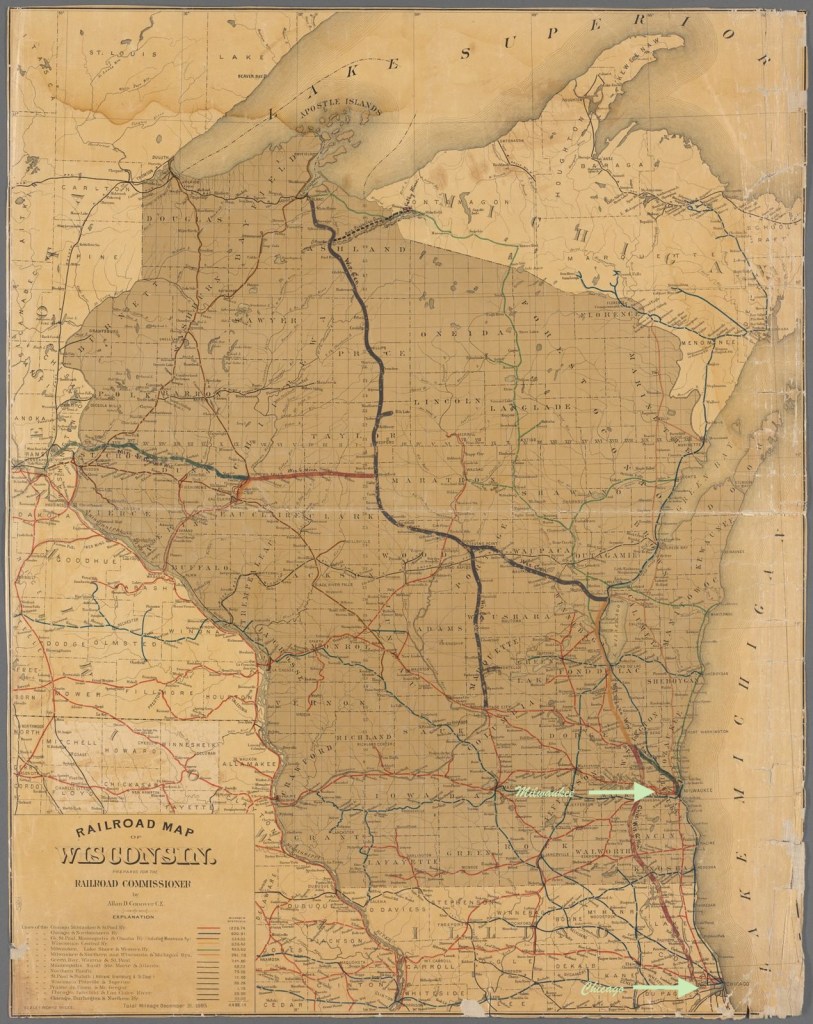
Hence why, I lean towards Louisa still living in Milwaukee, at least until 1907. It’s far simpler to slip a little something into someone’s food if you live in the same city, street, and home than Louisa traveling the hundred or so miles up the coast of Lake Michigan from Chicago to Milwaukee in order to perform the deadly deed. 

That being said, the distance would provide Louisa with a nice buffer after collecting John Otto’s $2,000 life insurance policy.

In any case, what I do know for certain is that Louisa, William, and the kids were in Chicago by June 11, 1908. As that’s the day Louisa’s eldest daughter, Frieda, unexpectedly passed away at the age of eighteen from typhoid fever and was later laid to rest in Oak Ridge (aka Glen Oak) Cemetery in Cook County, Illinois. It will surprise no one that the young laundress named her mother as the sole beneficiary of a Prudential life insurance policy in the amount of $1,350 before her death.

The reason why I find these timeline and geography questions so frustratingly fascinating is that I’ve no clue if Louisa possessed enough cunning to purposely tango to and fro over state lines in order to obscure her string of murders and subsequent insurance fraud or if it was just coincidence. Nor is it clear if Louisa used nicknames and shiny new surname to further distance herself from her earlier crimes. Either way, by happenstance or design, it worked. Despite four deaths in four years, all of which benefitted Louisa financially, no one questioned her run of bad luck.

Yet.

My 52 Weeks of Christie: A.Miner©2024

Crime & Christie: Seven Degrees of Separation

Fun Fact: Did you know Agatha Christie used arsenic as a murder weapon, misled investigators with, or referenced the chemical element in nearly 25% of her mysteries? True story! However, ages before Agatha Christie earned the moniker ‘Queen of Poisons’ for her application of arsenic (and other equally baneful substances) within her books, people the world over were already well aquatinted with the element.

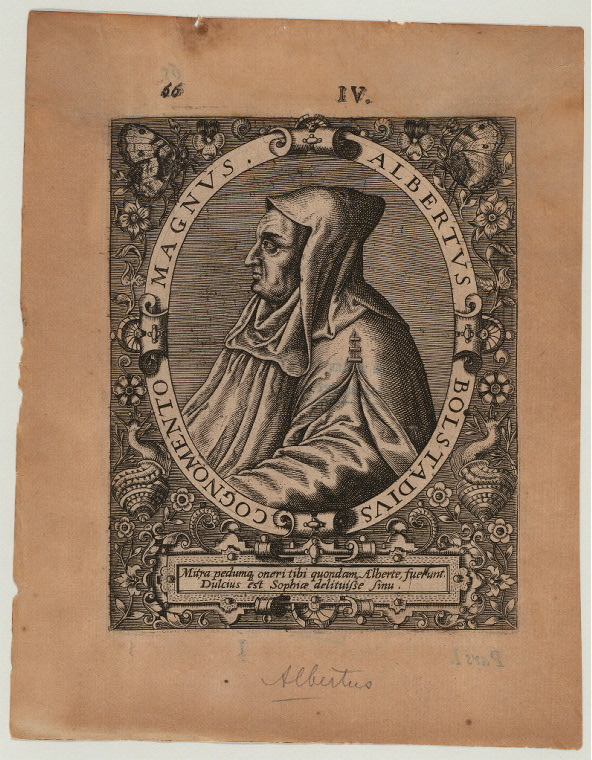
Although the discovery of this dangerous substance is generally ascribed to the Patron Saint of Natural Sciences, Philosophers, Medical Technicians, and Scientists — Saint Albertus Magnus, awareness of arsenic’s deleterious effects reaches back further still to the Ancient Greek physician Hippocrates (b.460 B.C. – d.370 B.C.), who described the symptoms of arsenic poisoning he’d observed in some miners who’d dug into a mineral vein laced with the heavy metal. 

Yet, even before the Father of Medicine noted the abdominal problems suffered by those miners, anecdotal evidence of chronic arsenic poisoning can be found in stories dating back to the Bronze Age — specifically, those tales containing the ‘lame blacksmith’ trope. 

It seems above and beyond the standard risks of molten metal, fire, and the perils of a mis-swung hammer — metalworkers faced an invisible hazard. When smelting copper ore (many varieties of which naturally contain some arsenic) or creating bronze by combining copper with arsenic (rather than or in addition to tin), a poisonous fume formed in the forge as the arsenic vaporized. Because arsenic is odorless, tasteless, and sufficiently soluble in hot liquids if mixed well enough (though this last quality probably didn’t come into play in this particular situation) — these metalsmiths had no idea they were habitually inhaling arsenic-polluted air….Until they started experiencing weakness and/or numbing in their legs and feet, difficulty breathing, and headaches — amongst other symptoms (before other diseases like cancer set in).

Thanks to the thousands of years between then and now, it’s unclear (or at least I’ve not found) when and who connected arsenic to the maladies commonly suffered by blacksmiths. Moreover, due to the ease in which both princes and paupers alike could obtain said element — the name of the first bright bulb who decided to rid themselves of an unwanted spouse/lover/relative/friend/enemy by mixing arsenic into their mulled wine or sprinkling it over their dinner plate has been lost to time. 

That being said, we do know by the time Pedanius Dioscorides, the ‘Father of Pharmacognosy’ (or the study of medicinal drugs obtained from plants, animals, fungi, and other natural sources), published the fifth and final volume in his De Materia Medica around 70 A.D. — he described arsenic as a poison. 

Knowledge Dioscorides could’ve obtained through first-hand experience as a physician in Roman Emperor Nero’s court. 

It seems a few months after Nero was crowned in 55 A.D., the newly minted emperor used arsenic (or ordered someone else) to poison his thirteen-year-old stepbrother Tiberius Claudius Caesar Britannicus. As the biological son of the former Emperor Claudius and one-time heir apparent, Tiberius seriously threatened Nero’s own claim — hence, he had to go. (There is some debate whether arsenic or belladonna was used to do the deed. I lean towards arsenic, only because belladonna isn’t always fatal, and I don’t see Nero taking a chance that Tiberius might escape the assassination attempt.)

After Nero’s act of fratricide, arsenic’s reign as the King of Poisons remained unchallenged until 1775. When Swedish chemist Carl Wilhelm Scheele (of Scheele’s Green fame) devised a methodology to reveal arsenic’s presence in a person’s remains, although the corpse needed to be stuffed full of arsenic to produce a positive result, Scheele’s initial strides at bringing arsenic and its adherents to heel were significant. 

Piling onto Scheele’s foray into toxicology was Johann Metzger. Who, in 1787, worked out a way to test if arsenic was present in a solution — but only if it hadn’t been consumed (picture the remnants of a half-finished bottle of pop, cup of coffee, or broth). Nineteen years later, Valentin Ross (or Rose; I’ve seen his name both ways) took Metzger’s technique one step further. In 1806, while pursuing a poisoner, Rose (or Ross) developed a way to process human organs (in this case, a stomach) that allowed Metzger’s test to be successfully run.

Next came the work of Mathieu Joseph Bonaventure Orfila, otherwise known as the ‘Father of Toxicology’. Amongst other advances in the field, Orfila refined Rose’s (or Ross’s) process, helping improve its accuracy. He also proved that after ingestion, arsenic gets distributed throughout the body. Orfila also aided in disseminating the work of Dr. Klanck, who, through extensive experimentation, determined the effect arsenic had on putrefaction and proved arsenic could be found in the remains of those long buried. 

The cumulation of these various discoveries came in 1836 when a British chemist, James Marsh, became so vexed at the acquittal of a poisoner that he devised a more sensitive, reliable, and accurate arsenic test — which remained in use (with refinements) until the 1970s.

Unsurprisingly, with the gold standard in arsenic detection being developed, the abuse of arsenic was curbed — but not curtailed. And within this liminal space, Chicago’s Cell Block Tango, Agatha Christie, and Cook County’s very real Murderess Row intersect.

Crime & Christie: Art Imitating Life

Troubled by Genevieve Forbes’ snide descriptions of Isabella — which, thanks to the syndication of newspaper articles, extended her coverage from coast to coast and inspired other (though not all) reporters to follow her lead — Isabella’s quintet of lawyers crafted a secondary strategy over and above their legal maneuvering. The plan, reminiscent of George Bernard Shaw’s 1913 play Pygmalion (only with far higher stakes than a simple bet), saw the defense team using the months between the stay of execution and the hearing before the Illinois Supreme Court to transform Isabella. 

Spearheaded by Helen Cirese (the first Italian American female lawyer admitted to the Illinois State Bar) and supported by Margaret Bonelli (the wife of another of Isabella’s lawyers), they sought to neutralize the press’s unsparing criticism of Isabella. Fully aware her appearance played a role in her conviction, Isabella eagerly agreed. Deferring to the duo’s expertise, Isabella allowed a hairdresser to dye and cut her hair into a modern, flattering style. They visited Murderess Row’s cosmetics cabinet, where Isabella was tutored on the artful application of make-up. Next, Helen bought a new dress, silk stockings, a fur coat, and a hat for Isabella to wear during court appearances. 

Well aware that these superficial changes were not enough, Helen, Margaret, and Isabella settled into more exacting lessons. First and foremost, they worked on improving Isabella’s nearly nonexistent English. This not only allowed Isabella to aid in her own defense but also meant she could finally interact with reporters. 

Next, Helen tutored Isabella on general American manners and deportment, the lack of which Genevieve Forbes took such a massive issue with (amongst other things). Grunting as a form of communication, while perfectly acceptable when she was growing up, amongst immigrants of similar backgrounds, and family — led to some of the most derogatory descriptions in the press. Hence, Isabella needed to unlearn this practice. Next, Isabella worked at holding back the habit of rocking in place, as this nervous habit also led to disparaging comments. Finally, Helen taught Isabella what was considered “proper” courtroom etiquette — sitting up straight, crossing her ankles, attentively watching the courtroom, and other such (inane) but necessary behaviors. 

While no amount of “Americanization” would ever appease Genevieve Forbes and others of her ilk — it did shift the majority of their remarks from strictly dehumanizing to simple snark. Other reporters, less invested in painting Isabella as an “…old, ugly, Italian peasant woman…”, started penning pieces that were (by comparison) more neutral in tone. Moreover, Isabella’s rapidly improving English meant she could interact with reporters, and she did. Isabella spoke of her babies waiting for her at home, of her innocence, and awareness of how her features played a role in her conviction — all of which helped humanize Isabella to the readers of the various rags around the country.

By the time the Illinois Supreme Court returned with its final ruling in November 1924 (I think), Isabella’s transformation was essentially complete….and gave, as intended, the Assistant States Attorney fits. Gone from the defendant’s chair was the “ugly” Italian woman he steamrolled with the press’s help. Instead, he found a smiling “Americanized” Isabella — surrounded by a bevy of highly competent lawyers. 

Lawyers who not only successfully persuaded the Illinois Supreme Court to overturn Isabella’s conviction and order a new trial for both Isabella and Peter. They also successfully argued the Court to disallow Isabella’s son Charles’s confession, ruling the body presented as the missing Frank Nitti couldn’t actually be proven as being Frank’s and deemed a whole bunch more circumstantial evidence inadmissible. The death knell of Assistant State’s Attorney Smith’s case came on December 2, 1924 — when it was announced Charles Nitti refused to testify against his mother in a second trial. 

A few days later, Smith dropped all charges against Isabella and Peter.

Thanks to Maurine Dallas Watkins’ play and the subsequent musical adaptation, Isabella’s case is now (in)famous. However, after scratching the surface, there’s far more at play in Isabella and Peter’s charge/conviction/successful appeal on first-degree murder charges than just one woman’s appearance….However, thanks to Genevieve Forbes’ unrelenting coverage, Isabella’s features played a far more significant role in her conviction than they should’ve.

Postscript: Frank Nitti’s disappearance and probable murder remain unsolved to this day. One of the background reasons why suspicion initially clung to Isabella was Frank’s brother James and at least one of Isabella’s sons believed Isabella started an affair with Peter before Frank went missing. Furthermore, one of Isabella’s sons contributed money to the prosecution, giving ASA Smith additional incentive to pursue Isabella.

All things being equal, I’ve no clue if Isabella and/or Peter buried Frank Nitti in a shallow grave — but I lean towards not.

However, Isabella believed she knew the author of all: “It was my son, Mike, who was mad because his father wouldn’t give him money to get married on…..Mike would keep still and let me die, so now I’ll tell on him.” Apparently, father and son got into a fistfight over $400 (about $7,250 in today’s money) after Frank refused to lend the hefty sum to his second oldest a few days before his evanescence. Moreover, Mike silenced everyone connected, save his mother (and I’m assuming Peter), by threatening to kill anyone who testified to witnessing said event. 

Actions which don’t exactly scream innocence. 

Though…If Mike did commit patricide, it could explain why Charles peddled the story of dumping their father’s body in the Des Plaines River with Peter. Mike could’ve, endeavoring to cover all his bases, threatened/bullied/cajoled his younger brother into the confession. Granted, this is pure supposition on my part, but Charles coming forward to accuse his mother bothers me. Assuming he wasn’t a vindictive jerk and Isabella didn’t do it — why would Charles come forward with such a tale?

In any case, in an odd twist of fate, on September 10, 1925 — Isabella was forced to visit the State’s Attorney’s office again. Only this time, she reported Peter Crudelle missing. On September 7, after taking a load of vegetables to market, Peter failed to return home with either their truck or the day’s earnings. It’s unclear precisely what happened to him, however, I read a rumor that Peter returned to Italy and married another woman. 

As for Isabella, she married Guiseppe Campobasso on November 2, 1940. Shortly thereafter, the couple became naturalized US citizens and moved to Los Angeles, where they resided (hopefully, happily) until Isabella passed away on December 10, 1957, at the age of 78.

My 52 Weeks With Christie: A.Miner©2024

Crime & Christie: The Court of Public Opinion

In early July 1923, Isabella Nitti-Crudelle and Peter Crudelle went on trial — pleading not guilty. Whereupon, Isabella drew some singularly harsh criticism from Genevieve Forbes, a prominent female reporter who covered the crime beat for the Chicago Tribune. 

Forbes took exception to basically everything about Isabella, calling her: “…dumb, crouching, animal-like Italian peasant” and “…dirty, disheveled woman…” amongst other derogatory terms. Other reporters picked up this language, calling Isabella: “Dumpy and squat and with no redeeming gift of grace, the dumb-like little peasant woman….creature of primitive physical instincts…mussy twisted hair and swarthy brow so seamed and crinkled with premature marks of age….leathery face and warped figure…” 

These dehumanizing descriptions go on and on and on.

By referring to Isabella in such terms, Forbes and the others of her ilk painted Isabella as subhuman and undeserving of compassion, sympathy, or mercy from their readers or the jury. Moreover, by focusing on Isabella’s southern Italian heritage, language, and mannerisms — Forbes tapped into the anti-immigrant sentiment of the day (as exemplified by the Immigration Act of 1924, crafted by a fan of eugenics and a man who thought the US needed a Mussolini type leader to pull the country out of the Great Depression). Which only increased Isabella’s status as unworthy of the leniency shown to the bevy of other accused murderesses who’d come before her. 

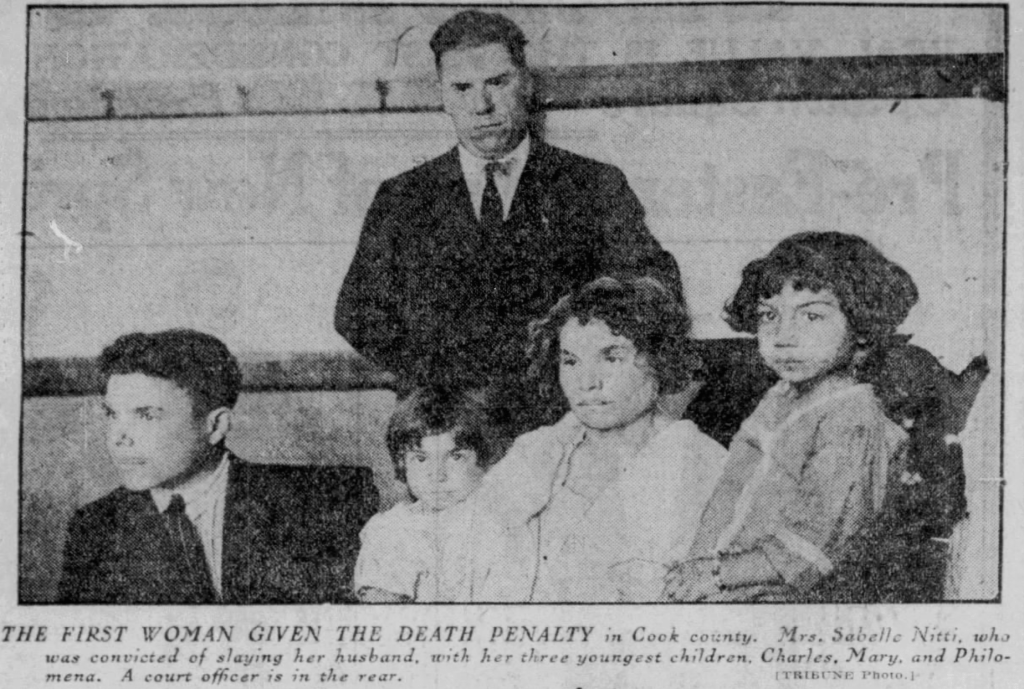
Unsurprisingly, Isabella and Peter (who’d practically become a footnote in the newspaper coverage of the crime) were convicted of Frank’s murder and sentenced to hang on October 12, 1923. A punishment that caused a sensation across the country, as Isabella was only the fourth woman ever to receive a death sentence in Illinois. 

While most believed Illinois’s Governor Len Small would commute Isabella’s death sentence to life in prison, which had been done for the two other women before Isabella — it wasn’t a sure thing. In 1845, Illinois’s Governor Thomas Ford failed to intervene on behalf of Elizabeth Reed, who’d hung after being convicted of poisoning her husband. Above and beyond Illinois’s single female execution seventy-eight years earlier, there’d been an uptick around the world of female death sentences being carried out: Dora Wright (1903 Oklahoma), Mary Rogers (1905 Vermont), Mary Farmer (1909 New York), Virginia Christian (1912 Virginia), Pattie Perdue (1922 Mississippi), and, across the pond in England, another cause célèbre murder case resulted in the hanging of Edith Thompson on January 9, 1923.

Even more worrisome, Isabella’s conviction failed to stem the flow of dehumanizing remarks. Many of the reports after Isabella’s date with the hangman was announced made it sound as if Isabella was grateful for her confinement on Murderess Row: “….she seems thankful for the better jail fare with occasional time for play, recreation, and with no worry now for poverty nor endurance of bitter cold.” Whether these comments were meant to assuage the public’s guilt over the state’s mandate of death or to make her execution sound akin to mercy is unclear. What we do know is Isabella was terrified. Alongside these reports of Isabella’s “gratefulness” were stories of her enduring panic attacks, obsessive cleaning & singing (undoubtedly done to try to keep her mind occupied), and at least two suicide attempts.

Thankfully, not everyone shared Genevieve Forbes’s point of view. 

After the death sentence was handed down, one juror’s wife threatened to leave him if Isabella hanged. Another group of women bent on obtaining Isabella’s freedom took Forbes to task for her attacks on Isabella’s appearance and character. Unsurprisingly, Forbes mocked their rebuke in print and labeled their efforts to free Isabella as: “…women’s primitive loyalty to a forlorn sister, down and out, and homely.

Crucially, besides gaining the sympathy of women around the city and the support of those opposed to the death penalty under any circumstance — Forbes’s inhuman rhetoric and reports of the trial itself inspired five Italian American lawyers (Swanson, De Stefano, Bonilli, Mirabella, and Helen Cirese) to step in and take Isabella’s (and Peter’s) appeal on pro bono. 

First, the legal team took aim at the circumstantial evidence used to convict: Identification of the body — which rested on a single ring, the inconsistencies between Charles Nitti’s confession and the state’s evidence (where he said the body was dumped in a river, yet the body identified as Frank’s was found in a catch basin), and the fact there was another suspect with plenty of motive whose identity was deemed inadmissible during the trial.

However, the main thrust of the quintet of lawyers’ appeal rested on the absolutely abysmal defense mounted by Isabella and Peter’s former trial lawyer, Eugene A. Moran who, the Illinois Supreme Court would later say, “….It is quite clear from an examination of the record that the defendants’ interest would have been much better served with no counsel at all than with the one they had.” 

For example: Despite securing a translator who spoke Barese, the Italian dialect Isabella spoke, Moran exchanged very few words with her prior to stepping into the courtroom — so how could she aid in her own defense? Moreover, during Moran’s cross-examination of Isabella and Peter, he repeatedly asked them questions that could’ve led them to incriminate themselves on the stand. Apparently, it got so bad that at one point, the trial judge stepped in, warning Moran he was harming his client’s defense. (A caution which didn’t alter Moran’s behavior a whit.)

(BTW: Before we paint Moran in villainous colors, according to a couple of recent articles/blog posts, he’d started suffering from some sort of mental health problems around this time. Which could account for this subpar court performance. Though I’ve been unable to verify this information, I thought it worth mentioning.)

Taking all these legal points under consideration, on September 26, 1923, Justice Orrin N. Carr stayed Isabella and Peter’s execution until their appeal could be presented to the Illinois Supreme Court in February 1924.

My 52 Weeks With Christie: A.Miner©2024
Crime & Christie: It’s Complicated

Admittedly, unlike the painting in Agatha Christie’s short story The Bloodstained Pavement, which tangentially helped solve a murder, the Trumbull portrait clearly caused one. Nor did the Chicago police need Miss Marple’s hard-won acumen to solve Paul F. Volland’s murder. Yet there’s one question I still haven’t found a definitive answer to: Did Vera Trepagnier’s looks play a substantial role in her conviction? 

According to the 1923 headline, “Can A Beauty Be Convicted?” which featured a photo of Vera amongst others below the headline, it did. Yet, as I (hopefully) showed in the previous posts, Vera’s conviction owed little to her looks and more to her own behavior, together with her lawyer’s failure to address the unique features of her crime in their efforts to shim her case down to fit the Murderess Acquittal Formula. More importantly, Vera herself never mentioned this line of reasoning (at least in the articles I read) in the interviews given after her conviction. Nor did the papers harp on about her features during her trial, focusing instead on her “gentle spiral” into poverty and the prominence of the late Paul F. Volland.

But what of the other handful of convicted murderesses during this period? Did their looks play a role? 

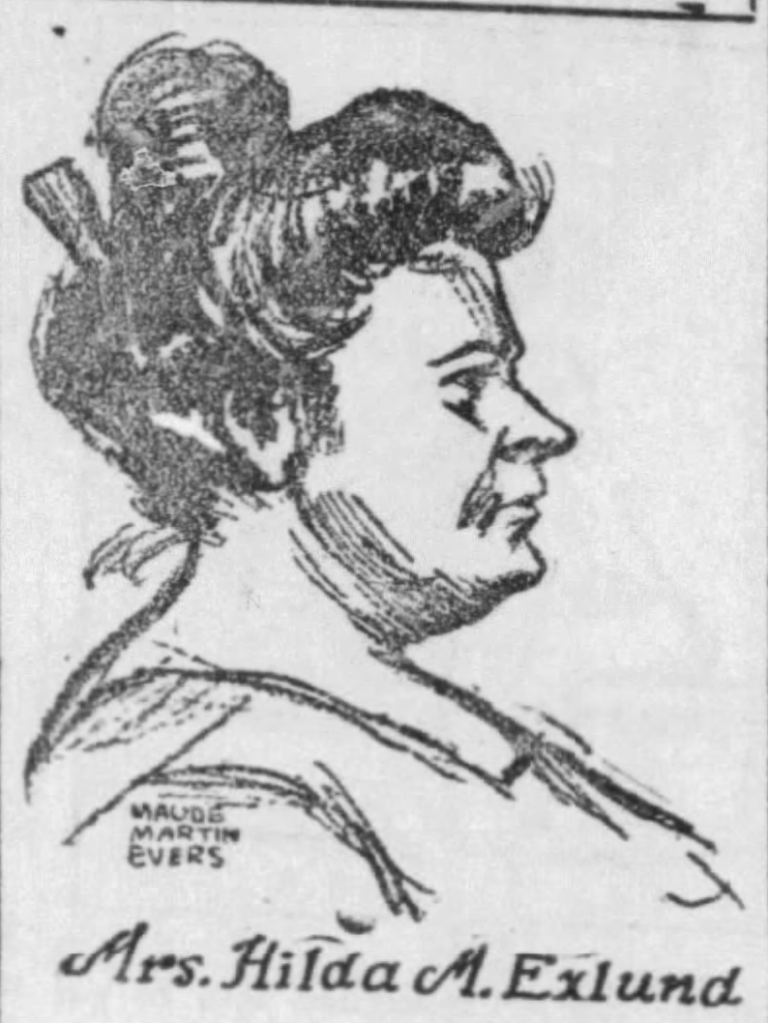
Hilda Exlund, a Swedish immigrant, certainly thought so: “If I had been young and pretty I suppose I’d have been turned loose just as the other women who have been tried for killing their husbands.” In fairness, Hilda’s lack of good looks did draw comment by the press. However, they weren’t harped on in any of the stories I read. Moreover, prior to her conviction, Hilda drew very little attention from Cook County’s press core. Meaning their news articles neither helped soften the potential jury pool leading up to the trial nor hurt Hilda’s chances for an acquittal. To my mind, what actually foiled Hilda’s acquittal prospects lay in the same realm as what sunk Vera Trepagnier’s bid for freedom seven months(ish) later.

According to Hilda: On the evening of October 16, 1918, whilst standing in the kitchen chopping a cabbage up for dinner, her husband Frank attacked her. In the ensuing struggle over the butcher knife, Hilda stabbed Frank repeatedly and killed him.

A clear case of self-defense, right? 

The hitch in the giddy-up here was, after speaking with friends and neighbors, police quickly uncovered a pattern of violence within the Exlund household perpetrated not by Frank against his wife — but by Hilda against her husband. According to their acquaintances and next-door neighbors, Hilda routinely abused her husband: Some spoke of Hilda’s habit of belittling, cursing, and beating Frank. Another relayed an episode where Hilda poured a pot of boiling hot water over Frank. Others spoke of an incident occurring a few weeks before his death, when Frank beat feet from his house while holding a bloodied handkerchief to his face, whereupon he told multiple people, “She tried to kill me.” Tallied together, these stories painted Hilda as the aggressor while reframing Frank’s possible motivation for striking first. More importantly — they negated Hilda’s claim to the “unwritten law.” 

During the ensuing trial in January 1919, Assistant State’s Attorney Edward Prindiville drew the jury’s attention to Hilda’s form by highlighting the disparity between Hilda’s “powerful physique” and her husband’s slim frame. Thus validating Hilda’s belief her looks played a role in her murder conviction and subsequent sentence of 14 years inside Joliet Prison — though not quite in the way the headline above insinuates. All that being said, the fact Hilda’s jury was comprised exclusively of married men or the fact she was tried in Judge Windes’ court (who presided over two other successfully prosecuted cases we’ll explore later) could’ve influenced the outcome as well.

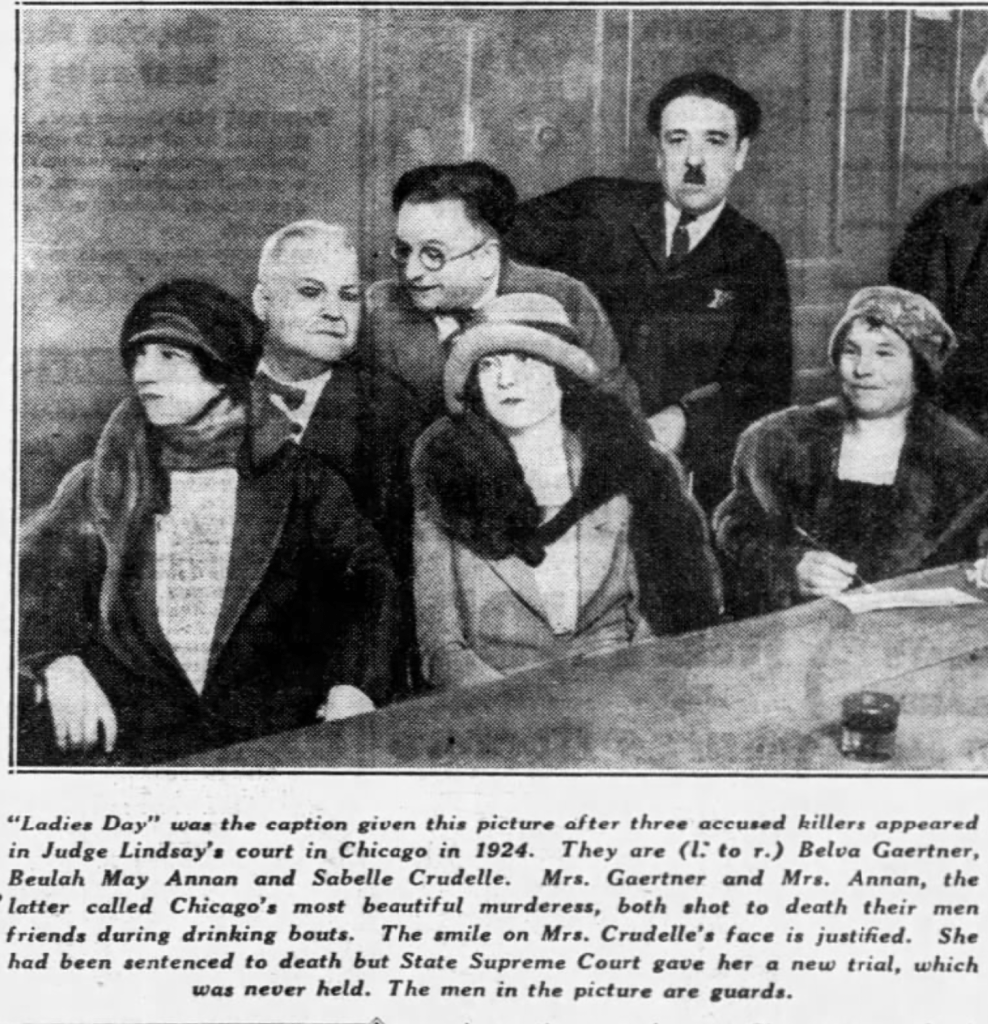
Weirdly, while studying Hilda’s crime — Chicago’s ‘Cell Block Tango’ kept echoing through my brain. Specifically, June’s portion of the song designated ‘Squish’, where she describes how her husband “ran into her knife ten times” during a fight that kicked off while she was “carving a chicken for dinner”. I do not know if Hilda inspired the third member of the “six merry murderesses” — but I do know who provided the inspiration for Katalin ‘Hunyak’ Helinszki. The Hungarian woman who sang the fourth refrain, ‘Uh-Uh’ during the aforementioned song and was hung later on in the musical. 

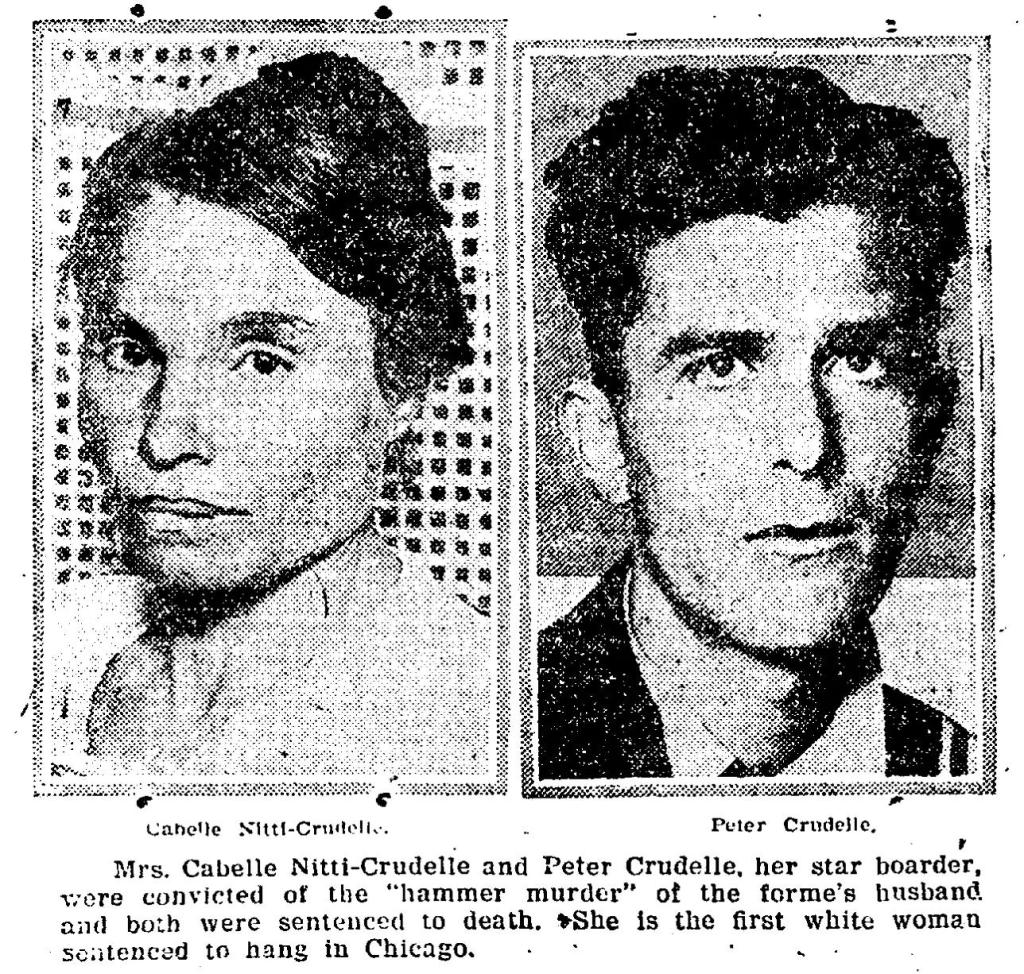
Her name was Isabella Nitti Crudelle* — and her looks alternately condemned and saved her from a trip to the scaffold.

Isabella’s ordeal began on July 29, 1922, when her husband, Frank Nitti, disappeared from their farm. Unsurprisingly, Isabella, with the aid of one of her sons, as she knew very little English at this point, reported him missing the next day. During the subsequent investigation, Isabella’s sixteen year old son Charles confessed to helping, under duress, Peter Crudelle (the Nitti’s farmhand/boarder) dispose of his father’s body in the Des Plaines River. After witnessing Isabella pinning down Frank’s hands while Peter repeatedly struck him in the head with a hammer while Frank slept under a cart. Unfortunately for the police, they had zero luck locating Frank’s corpse downriver, and without a body, the indictment against the pair was dismissed.

Endeavoring to break the case, in late September 1922, the police arrested and charged Peter and Isabella for adultery. However, whatever confession they’d hoped to extract from the couple failed to materialize and they were released. The couple would marry soon(ish) after, thus thwarting a repeat of this particular stratagem.

Fast forward to May 9, 1923: When a body was discovered in a nearby catch basin. James Nitti positively identified it as that of his brother Frank — based on a ring found on (or near, I’m not quite sure) the body. And despite Charles’s story not quite aligning (i.e., the body being found in a catch basin instead of on the banks of the Des Plaines River), the prosecutors decided to charge Peter with first-degree murder and Isabella as an accessory before and after the fact. Initially, Isabella’s son Charles was charged as an accessory after the fact, but turned state’s evidence to get out of trouble.

*I’m using Isabelle versus Sabella (the nickname used in the newspapers of the time), as it’s the name used on her headstone and two notes I’ve seen where she signed her name.

My 52 Weeks With Christie: A.Miner©2024
Crime & Christie: Han Shot First

Let’s be clear: I believe Paul F. Volland pulled a bait-and-switch on Vera Trepagnier. I think he used his position as President of the P. F. Volland Company, his business acumen, and knowledge of Vera’s strained circumstances to his advantage in order to obtain and keep the Trumbull portrait of George Washington. By dangling the promise of $5,000 before Vera, Volland gained possession of the painting. Next, by carefully wording the contract, he — not his company — secured ownership of the diminutive object if sales of the reproduction reached the 5k mark. If said sales didn’t pan out, which he was in the perfect position to ensure, Volland could point at the $500 advance and issue an ultimatum — either accept it as payment or repay the shortfall in a lump sum. Secure in the knowledge she couldn’t. 

The fact he didn’t maintain contact with Vera, nor had his lawyers issue said ultimatum until Vera made it patently clear she would continue to pester him for forever and a day, is why I’m inclined to view his actions under a crooked light. Because without that $5,000 promise, I don’t think Volland could’ve pried that painting out of Vera’s hands. (And I don’t see him giving Vera $500 as a charitable act.)

The question is, why would a wealthy man bilk a widow? The only concrete reason I found that might, and I mean might, explain such behavior occurred a few years before Volland’s death: When he nearly declared bankruptcy. Ultimately, Volland didn’t. But perhaps after skating so close to financial ruin, it invoked an unscrupulous or miserly side to his nature? Or maybe he grew up unable to rub two nickels together, which left him unwilling to pay a penny more for anything when he didn’t have to. Or perhaps he was just crafty. 

It’s unclear.

Interestingly, Vera’s charge of sharp business practices against Volland wasn’t the only one I found. A female musician contracted to write some sheet music for the P. F. Volland Company claimed that after Volland rejected her song, he later published it under someone else’s name without her permission or paying her for the work. What’s more, the day after Volland’s death, Chicago artists announced their intention to raise funds for Vera’s defense…..Again, this makes me wonder how fair Volland played with others when wheeling and dealing.

Unfortunately for Vera, partaking in dodgy business practices doesn’t automatically translate into owning a violent streak. (Nor does it mean he deserved to die.)

This begs the question: Why did Vera feel the need to bring a gun with her to discuss a dispute over a contract? According to the woman herself, “I took the revolver along to scare him. I had no intention of killing him, but that was done when he tried to take the weapon away from me.” An explanation I find believable. What I find harder to swallow is Vera’s claim the one and only day she packed the piece in her purse was the afternoon she accidentally shot Volland. 

As I see it, either the stars aligned and allowed Vera to seize an unexpected opportunity to lie her way into Volland’s presence — OR — Vera stalked Volland long enough to know he’d be in his office that particular day. If Vera relied on the ‘universe’ to provide her with an opportunity to enact her desperate plan, then it stands to reason she’d bring the gun along with her daily. Otherwise, how would she have it on hand precisely when she needed it? The latter stalking explanation, which Vera admitted doing, is the only way I see the ‘I only brought the gun with me once’ course of events as plausible. The problem there is it smacks of premeditation.

Either way, neither version of events paints Vera in glory. 

More importantly, by bringing the firearm with her, Vera cast herself into the role of instigator, severely undermining any claim of self-defense, crime of passion, or the ‘unwritten law.’ The prosecution weakened Vera’s claim further when they labeled her a blackmailer, presenting at least one nasty letter Vera wrote threatening to ruin Volland’s reputation by exposing his manipulative business practices — lest he make good on their deal. 

Without any other testimony (from, for instance, another firearms expert to refute the prosecution’s, a psychiatrist willing to declare Vera mentally unsound at the time of the murder, or anyone who could attest to Vera’s erratic behavior) to mitigate the prosecution’s arguments, Vera’s lawyers only managed to convince one juror out of twelve to find Vera not-guilty. (And he changed his mind by the second ballot.) 

Hence why, I feel Vera’s lawyers did her a disservice.

What happened after the guilty verdict? After Vera’s appeal for a new trial was denied in August 1919, she was transferred to Joliet State Prison to serve her sentence of one year to life. Sadly, at some point after September 1, 1920, Vera was transferred to Kankakee Insane Asylum. According to prison officials, the loss of the Trumbull’s portrait of George Washington (and probably the stress of the trial and incarceration) “unhinged” her mind — causing Vera to speak dreamily of nothing but her former prized possession to anyone willing to listen. 

Vera would die within the asylum walls on August 19, 1921.

In her will, Vera left several tracts of land in Maryland, a vase, and the Trumbull miniature to her grandson. Sadly, Vera forgot the vase had already been donated to a museum in New Orleans, so it wasn’t hers to give. And Vera’s only son sold the tracts of land to cover an overdue mortgage. 

As for the Trumbull miniature, an attorney by the name of Michael F. Looby was assigned by a probate court to sell it — which made quite a splash in the papers. Assured by art experts, museums, and collectors that ‘Exhibit A’ would fetch anywhere between $5,000 and $30,000, it went to auction. On September 23, 1922, Looby returned to Judge Horner’s courtroom and reported that due to the unpleasant notoriety attached to the painting, the highest bid received was $325. 

Whereupon Judge Horner approved the sale — to persons unknown and it disappeared from public view.

Crime & Christie: It’s Not Personal, It’s Just Business

On July 15, 1919, at 5:50 pm, after three ballots — the jury found Vera Trepagnier guilty of manslaughter and fixed a sentence of one year to life in prison. Paul F. Volland’s second ex-wife, Gladys Couch Volland, and his son, Gordon B. Volland, were both in court when the verdict was announced and applauded (metaphorically) the jury for holding Vera accountable for her actions. Unsurprisingly, State’s Attorney Hoyne lauded the victory of ASA Dwight and the jury’s decision. 

So what went wrong? Why did the jury find Vera guilty of manslaughter despite her lawyers following the formula that got 26 other women acquitted? 

Vera blamed the loss on another attorney, Frances E. Spooner — the only lawyer she’d found who agreed to fight the unbalanced contract she’d signed with Paul F. Volland in civil court. In an interview given shortly after her conviction, Vera claimed Spooner hamstrung her defense because she “…had all my papers about the case that led up to the killing, and she left town.” Which could be true? The one and only time I found Spooner’s name linked with Vera’s occurred the day after Vera’s bid for a new trial was denied, on August 16, 1919: When the papers reported Spooner was suing her former client for breach of contract, “…by killing Volland, she brought an end to the case and threw the plaintiff out of a job.” (I’ve no clue how this case ultimately panned out.) 

However, it’s equally possible Vera’s all-male defense team used Spooner as a convenient scapegoat to cover the collective backsides with their client after their loss. Spooner, one of the rare female attorneys in Chicago during this period, would make an easy target in any post-trial blame game.

Weighing in, over 100 years later, I see the scales of recrimination tipping ever so slightly in the direction of Vera’s cadre of lawyers and their decision to rely solely on Vera’s testimony. 

Why? First and foremost, Vera’s account doesn’t quite add up, in my estimation.

While it’s possible Vera’s version of events unfolded exactly as she said……Why would Volland start strangling her for simply refusing to leave his office? Granted, Vera had become a thorn in Volland’s paw. However, until that afternoon, he’d successfully kept her at arm’s length for years through a lack of communication, lawyers, and by using layers of security/secretaries/doormen as a shield. Moreover, if Vera failed to leave Volland’s office because he murdered her (worst case scenario) or she exited under her own power with hand-shaped bruises around her neck, disheveled from a struggle, and gasping — it would’ve been noticed by the office full of people working away in the middle of the day.

Speaking of people, while there weren’t any eyewitnesses other than Vera who saw what happened in Volland’s office, two individuals were close enough to hear some of what was happening inside. Both women spoke of hearing Vera’s voice growing louder and shriller as the interview went on while Volland’s remained low and even. Suggesting it was she, not him, who grew furious as the conversation continued.

The defense, in an attempt to shore up Vera’s assertion Volland struck first, claimed Volland was a “wife beater” and “woman-hater” which led to the dissolution of his second marriage. The only problem? Said second wife, Gladys Crouch Volland, still resided in Chicago and was more than willing to testify that her ex-husband never abused her or their daughters, nor was cruelty the reason why she sued for divorce. While it’s possible Gladys was lying, the fact she wasn’t called to the stand or her divorce decree read aloud by the defense — who’d subpoenaed her — suggests they couldn’t scrounge up enough proof that Volland abused his ex-wife to convince the presiding Judge to allow it into evidence. Making it likely that Vera’s attorneys simply spliced the idea into their opening remarks in the hopes that the jury would consider the unsubstantiated claim during their deliberations.

Furthermore, I found an announcement for Volland’s 1904 divorce from Laura Gordon Volland, his first ex-wife. While one of the gossipy articles alluded to money at the root of the marriage’s dissolution, none mentioned cruelty. (And the fact Laura remarried mere days after the finalization of the divorce decree hints at a different set of problems within the union.)

In my humble opinion? Upon realizing Volland wasn’t going to willingly hand back her miniature or write a check for five grand, Vera pulled a revolver on him and that’s when Volland “lept at her” — not the other way around. 

This fine — yet important distinction — is why Billy Flynn, in the musical Chicago, worked so hard to make sure the newspapers reported that Roxie Hart and her lover both reached for the gun. If it came out that Roxie pulled the gun on her boyfriend first, in a fit of rage rather than in self-defense, it would’ve negated her claim to the “unwritten law.” 

After her arrest, in an effort to invoke said statute for herself, Vera neatly summed up the “unwritten law” as this: “In my State men may lie, gamble, cheat in business, but they do not lay hands on a woman.” As I understand it, this tacit law allowed judges and juries to protect abused women who either snapped or needed to defend themselves at a point in time when domestic violence laws were nearly nonexistent. More importantly, it’s part of the foundation on which the murderess acquittal formula rested — hence why, in my opinion, it’s more than likely Vera swapped up the order of events to save her own skin.

Unfortunately for Vera, her uneven account wasn’t the only problem.

My 52 Weeks With Christie: A.Miner©2024