Rough on Rats: Pressing Her Luck

Flush with success and brimming with confidence over her first induced funeral, Ella Holdridge waited (about) five days before feeding her obsession with death, funerals, and wakes. 

Only this time, Ella made a mistake.

Whilst plenty of people noticed the two girls playing together on the day Leona fell ill, no one for a moment suspected Ella played a role in the toddler’s lingering death. Mainly because of the two-year-old’s inability to utter anything sensible after ingesting the water Ella polluted with Rough on Rats. 

However, this time, Ella targeted a pair of sisters — Susie & Jennie Eggleston.

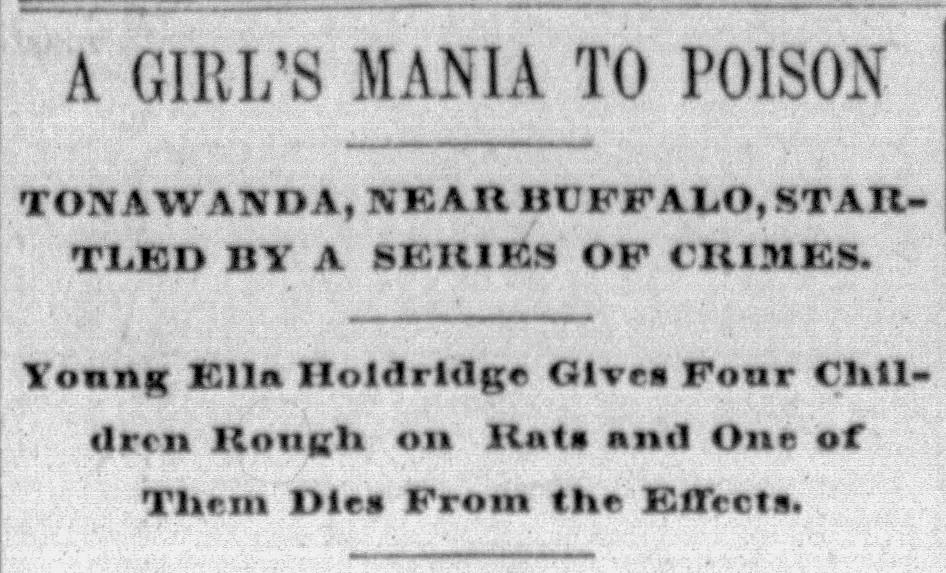
Due to the sensationalization of this case, there’s some ambiguity on what exactly happened next. (Newspapers of this era absolutely loved to hype up crimes like this — often at the expense of the facts.) However, these things seem certain: In and around July 16, 1892, Mrs. Eggelston decided to go shopping in Buffalo, NY (about twelve miles from their neighborhood in Tonawanda) — leaving her daughters at home. Now, one way or another, either knowing beforehand via the neighborhood grapevine or sussing out the intelligence from the pair as they played on their front porch — Ella realized the lack of adult supervision afforded her an opportunity to generate a double funeral. 

Using her status as an older kid (as she was fourteen to their ten and five) and the promise of making them “something nice,” Ella managed to herd the two inside their house. After (possibly) locking the doors after they went inside, Ella made a pot of cocoa with a generous measure of her secret ingredient, Rough on Rats, thrown in. When one of the sisters complained about the cocoa’s taste and refused to drink anymore, Ella compelled the girl to drink it: Through either verbal coercion, pushing her onto a sofa and pouring it down her throat, or throwing her onto the floor and forcing the liquid between her lips. After ensuring Susie and Jennie finished their mugs of cocoa, Ella told them not to tell anyone about what happened and left.

Later that evening, both girls became extraordinarily ill and their parents sent for Dr. Edmunds.

As both Susie and Jennie had been the picture of health prior to their mother’s trip into Buffalo and they’d pretty much identical symptoms which started nearly simultaneously — Dr. Edmunds suspected they’d gotten into something poisonous. Can you imagine his surprise upon learning about Ella’s strange-tasting hot chocolate and even stranger behavior? Then word reached him about another kid a few doors down who was desperately sick — with the same symptoms as the Eggelston sisters.

Seems sometime during the day, Ella also administered some Rough on Rats to five-year-old Ervin Garlock.

Whilst doctors worked diligently to save the lives of the three kids — news of Ella’s possibly poisonous food and drink spread like wildfire around the neighborhood of Kohler and Morgan Street. Leading every parent hither, thither, and yon to interrogate their children as to whether they’d eaten anything given to them by Ella.

After Susie, Jennie, and Ervin’s lives were back on solid footing, Dr. Edmunds and Dr. Harris compared notes….and discovered Leona’s symptoms mirrored those of the other poisoned children. Unsurprisingly, the duo of doctors took their suspicions to Justice of the Peace Rogers and Coroner Hardleben — who called Ella in for questioning posts haste.

At first, the fourteen-year-old denied everything. 

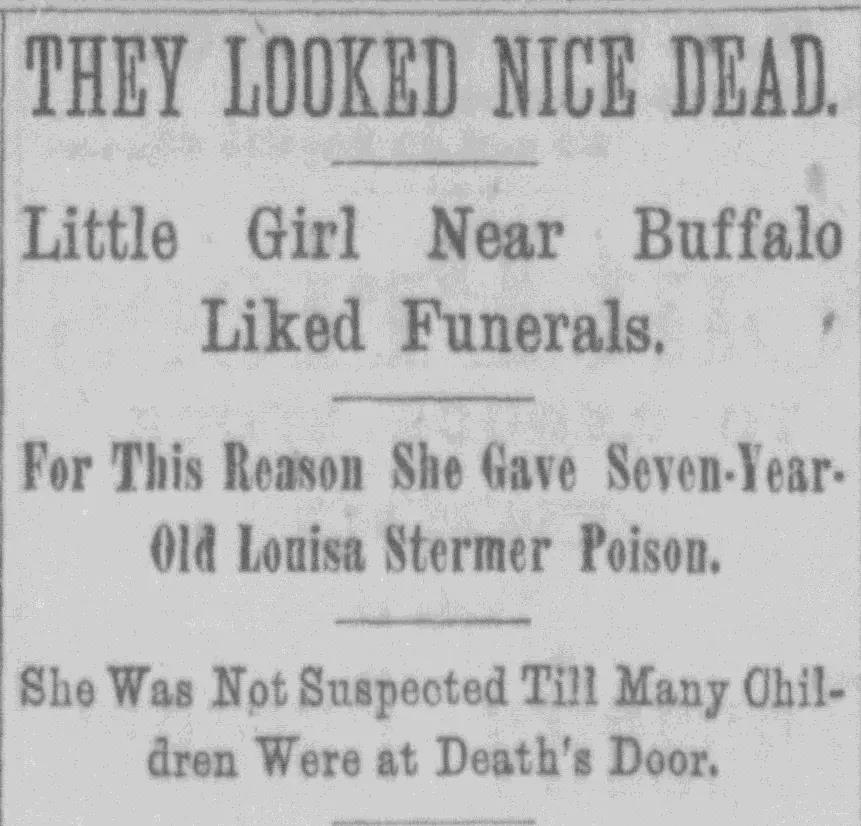
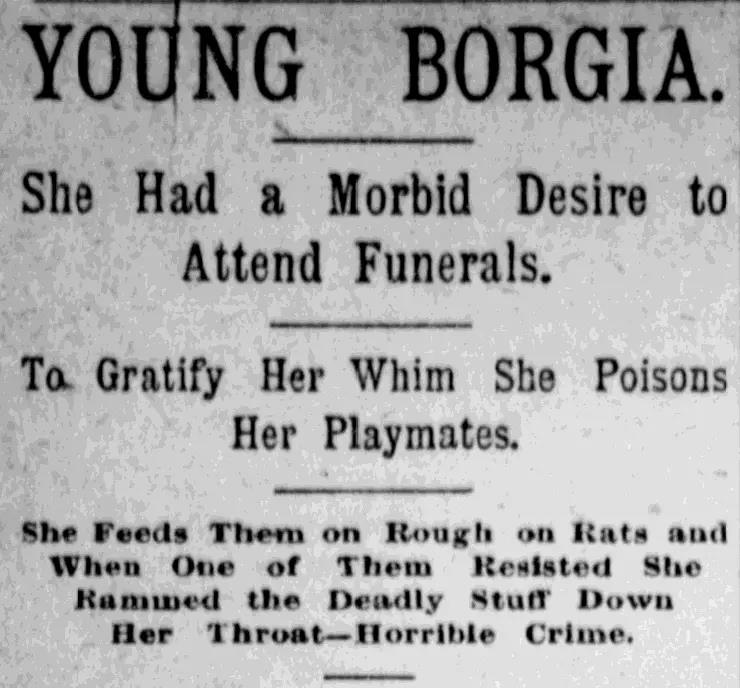
However, when one of the officials bluffed and told Ella someone had seen her making the cocoa, and they knew she’d put poison in it — she opened her eyes wide and said….“Dear me, is that so?” And went on to make a full confession. Telling the adults she’d poisoned Susie and Jennie: “…because she wanted to go to a funeral, and thought they would look so nice dead.” When they asked after Leona’s murder: “Yes, she’s dead. Poor L{eona} But she looked awful pretty and her funeral was awful nice.” When Justice of the Peace Richard asked why she used Rough on Rats, Ella replied: “If it killed rats and mice it would kill children.

(Prompting authorities to exhume poor Leona’s body and send her stomach to Dr. Vandenbergh for analysis.)

On July 16, 1892, Ella was charged with murder.….and this is where things get a bit murky. 
I know on July 18, 1892, Franklin Holdridge (Ella’s Dad) committed Ella to the care of Father Baker’s Institution at Limestone Hill. I believe the “institution” the papers referenced was a protectory. 

Protectories are akin to nonreligious reform or industrial schools. They took in all kinds of kids, from orphans to juvenile delinquents — educated them in religion, morals, and science, then trained them in a trade or for a manufacturing position. Whilst not a prison, Father Baker’s protectory would afford far more supervision and possible rehabilitation for a budding poisoner. (It undoubtedly gave Ella space from her obsession because I can’t imagine the nuns or priests in charge would’ve allowed her to attend funerals or visit the graveyard — given her history.)

In any case, this prompt change of address not only kept the children in Ella’s old neighborhood safe, including her much younger siblings, it might’ve also (possibly) given the jury a reason to find her not guilty. 

I say possibly because, unfortunately, I can’t find any direct news pieces on Ella’s trial. Save a blurb written just under eight years after the events of July 1892. It states that despite Ella’s confession and testimony in which she reiterated her belief that Leona and the others would “…look well dead…” a “…jury didn’t see fit to punish her.” 

Perhaps Ella pleaded insanity? Or, due to her age, her lawyers argued she didn’t understand the enormity of her actions? Or maybe they didn’t want to send a pretty young girl to jail for the rest of her life. I don’t honestly know. However, I suspect it didn’t hurt that of her four victims — Susie, Jennie, and Ervin managed to live through the ordeal she put them through.

I also reckon Ella remained in Father Baker’s care for a spell after her trial, though this is purely conjecture on my part. (Mostly because I can’t see a way for her to return home to Tonawanda after killing a child, no matter the outcome of a trial. Though again, it is possible.)
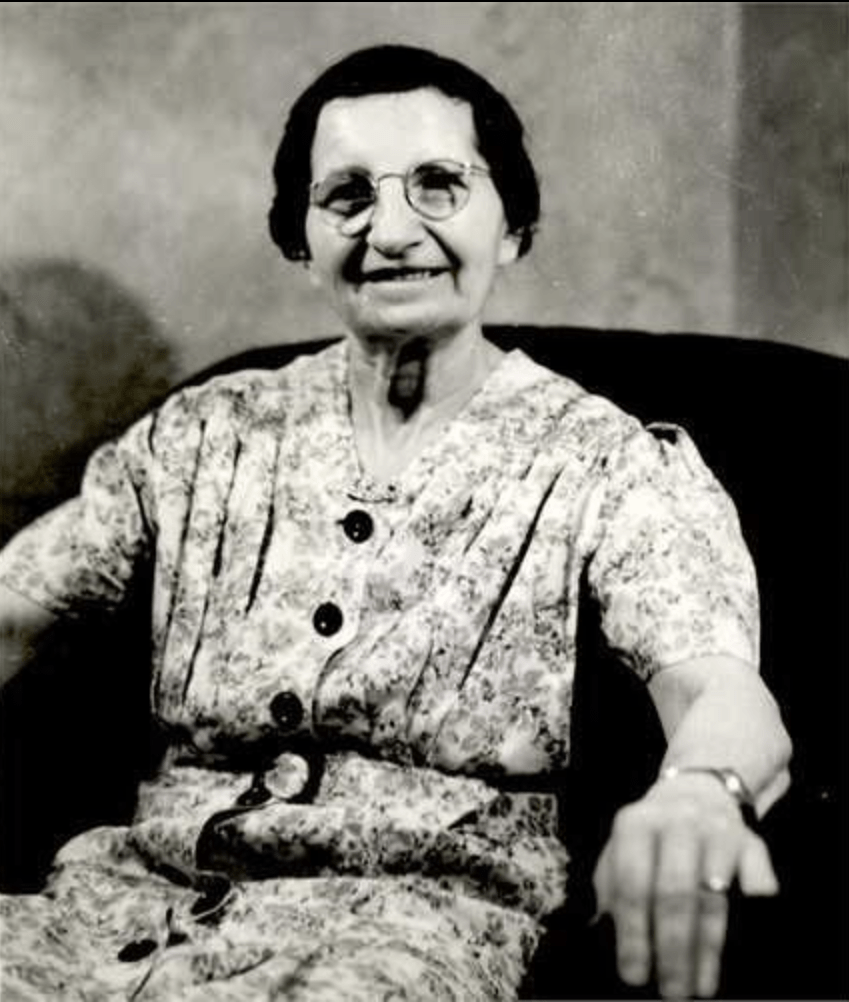
However, I do know that by the time Ella was about 24, she was married to a man named Neil McGilvray with a baby daughter on the way. In 1905, they had another daughter. In 1908, the family moved to Monessen, Pennsylvania, where Ella would remain for the next 37 years until her death in 1945 at the age of 65.

Rough on Rats: Ella’s Deadly Obssession

Roughly forty years after the publication of Moby Dick and seventy years before Graham Young’s initial poisoning spree — a fourteen-year-old girl named Ella Holdridge lived with her family and three siblings in the small town of Tonawanda in Erie County, New York. Unlike Captain Ahab, who was obsessed with a great white whale or Graham Young, who’s idée fixe was poisons — Ella was spellbound by death.

Whenever she discovered someone in the community passed away — Ella would (according to her stepmother) literally jump for joy, clap her hands, and exclaim, “He’s Dead! He’s Dead!” Her excitement not only stemmed from the death itself but from the knowledge there would be a funeral, a wake, and a fresh grave in her near future. Because, irregardless if she was invited or not, if Ella could attend — she would turn up….Shouldering her way to the front of the queue at the viewing, then to the grave’s edge to witness the coffin being lowered into the earth.

It’s unclear from where Ella’s fascination with death and funerals sprung. Perhaps Ella dimly recalled watching her mother slowly succumb to TB, the inevitable funeral, and the wake that followed. Though as Ella was only 2 or 3 years old at the time, those memories would be murky — but still echoing somewhere within her mind. Or maybe her interest was sparked by newspaper reports of Jack the Ripper’s bloody exploits in Whitechapel — the serial killer’s frenzied attacks roughly spanned the years between Ella’s ninth and thirteenth birthdays. It’s also possible Ella was just naturally inclined towards the macabre. Irregardless of whatever sparked Ella’s interest in death and all its trappings — she was hooked. 

Unfortunately, in the summer of 1892, a drought occurred in the local cemeteries — i.e., a distinct lack of funerals.

Okay, so here’s the thing: During my research, I found a number of GLARING inconsistencies in the news reports pertaining to this case. So, I fact-checked this case as well as I could after 130 years….Which led to a vexing urge to box the ears of the original reporters….

Unlike some of the articles I’ve read from around this time, none of the newspapers (I found) list Ella’s address. However, the Buffalo Weekly Express does mention Ella’s neighborhood. Using a helpful map ap, I discovered three cemeteries lie less than a mile from the cross-streets mentioned: Tonawanda City Cemetery, Saint Francis Cemetery, and Salem Church Cemetery. All of whom were in operation at this time and aligned with Ella’s stepmother’s intelligence.

Next, I found between the three aforementioned cemeteries, there were only 14 burials between January – April, 0 in May and 2 in June. Assuming Ella could only attend a fraction of these 16 funerals — due to things like school, family commitments, and whether or not the deceased family actually held a service. I imagine Ella was desperate to satiate her obsession by the time July of 1892 rolled around.

Which might help to explain what happened next. 

Unlike Graham Young, whose idée fixe I sincerely doubt would allow him to stoop to using a poison as inelegant as Rough on Rats (unless he’d no other options, in other words, during his incarcerations) it suited Ella Holdridge’s purposes just fine. 

On July 7, 1892 — while playing with two-year-old Leona Stermer, Ella gave her a glass of adulterated water. Within hours, Leona was writhing in pain and violently ill. Leona’s parents called in Dr. Harris, who thought she’d contracted cholera morbus (what we now call gastroenteritis) and treated her thusly. Sadly he was unsuccessful as Leona died two days later. (And yes her name is Leona Stermer — not Louisa Sterner, Zoena Stuermer, or Lena as reported in various newspapers. It took some serious crosschecking, but I finally pinned down Leona’s correct name.)

Unbeknownst to the Stermers and Dr. Harris — whilst Leona lay dying, Ella would regularly sidled up and surreptitiously watched the goings on inside the house. After gauging the distress she’d witnessed, Ella would dash back home and say things to her stepmother like: “I guess she’d almost dead now!” (Interestingly enough, this behavior lines up with Graham Young’s during his second poisoning spree. Apparently, he would repeatedly call the hospitals, where his colleagues lay dying of the poison he administered to them, to “check” on them. Presumably so he could update his scientific journals with the most accurate information he could obtain.)

Needless to say, when Leona Stermer was buried on July 11, 1892 — Ella was front and center during the planning, preparation, and execution of Leona’s funeral rites….And no one, not even Ella’s parent’s, suspected anything was amiss with the toddler’s death.

Yet.

My 52 Weeks With Christie: A.Miner©2023

Rough on Rats: Crooked House, Kids Who Kill & Two Motives

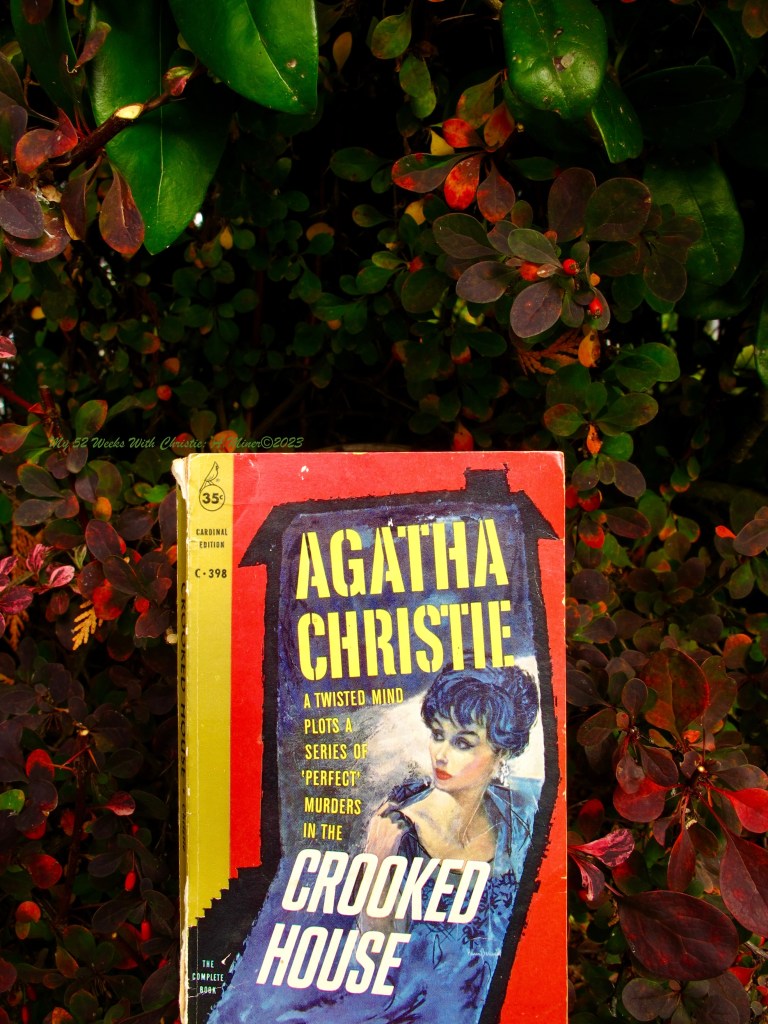
From the Office of Spoilers: If you’ve not read Crooked House by Agatha Christie, I suggest you do — then read my vintage true crime posts as one directly impacts the other. However, if you’ve no qualms with knowing the ending of a book before you begin it, read on. Either way, you’ve been warned.

Now, on with the show.

According to experts, far more learned than I, Agatha Christie’s publisher, William Collins (of Collins Crime Club fame), found the ending of Crooked House so shocking he requested Christie change it. 

She declined.

By leaving the novel untouched, Crooked House now stands as one of the best twist endings in Christie’s entire catalogue of works (second only to The Murder of Roger Ackroyd — in my humble estimation). Though, on reflection, I’m not sure exactly why the revelation of Aristide Leonides’ murderer harkens such disbelief. Within moments of meeting our malefactor, they give us their motive; Charles Hayward’s Old Man practically spells out the whys & wherefores a few pages later, and Charles himself catches sight of the penultimate clue. Yet, for the past seventy-four years, the solution continues to blindside readers. And therein lies Christie’s cunning, the ability to mark and exploit our collective blindspots….…..Because how often, really, would you look at a kid and see a poisoner?

Turns out, more often than you’d think.

Some follow the pattern set by Crooked House’s thirteen year old baddie Josephine Leonides, whose motive for murdering her grandfather was his refusal to pay for her ballet lessons. By adult eyes, Josephine’s reason seems childish, and despite her being fictional — she’s not alone in this brand of flawed rationale. In my research for this set of posts, I’ve discovered kids who’ve killed because they were rebuked too often by their mother, because their father thwarted their ambition to become a train robber, and because they wanted to see if their “chubby” playmate’s insides resembled that of pig’s (that was a singularly gruesome crime).

However, it’s the crimes of Gertrude Taylor, a case I’ll explore in more detail in this series, which reminded me forcibly of Josephine’s puerile impulse to pick up a bottle of poison. Not only did she target her nearest and dearest, but she did so so her brother wouldn’t take his upright organ with him when he moved house. 

Yet other kids find themselves following (roughly) in the obsessive footsteps of the Tea Cup Poisoner. 

Graham Young’s fascination with poisons not only led to an in-depth study into the subject, at the age of fourteen he started experimenting with them….on his family and friends. In some respects, Young’s diabolical deeds are unique. His ability to dazzle druggists with his knowledge to procure deadly substances like thallium, antimony, atropine, aconitine, and digitalis sets him apart from most other child poisoners. 

However, the overwhelming obsession that led to Young’s abominable “experimentation” is not. 

Seventy years before and across the pond, another fourteen-year-old named Ella Holdridge found herself utterly transfixed, not by poisons, but by death. Whilst her family and friends considered it an odd fixation for a young girl, no one thought much about it. Until the summer of 1892, when, due to a distinct lack of local funerals she could attend, Ella took it upon herself to supply the local churchyard with a fresh corpse….Another case I’ll cover in the next few weeks.

Above and beyond Gertrude Taylor and Ella Holdridge’s ages, alleged crimes, and underdeveloped moral muscles — one more feature unifies this pair of kid killers: A self-made man who built his empire upon the back of dead rats. 

Ephraim Stockton Wells.

My 52 Weeks With Christie: A.Miner©2023