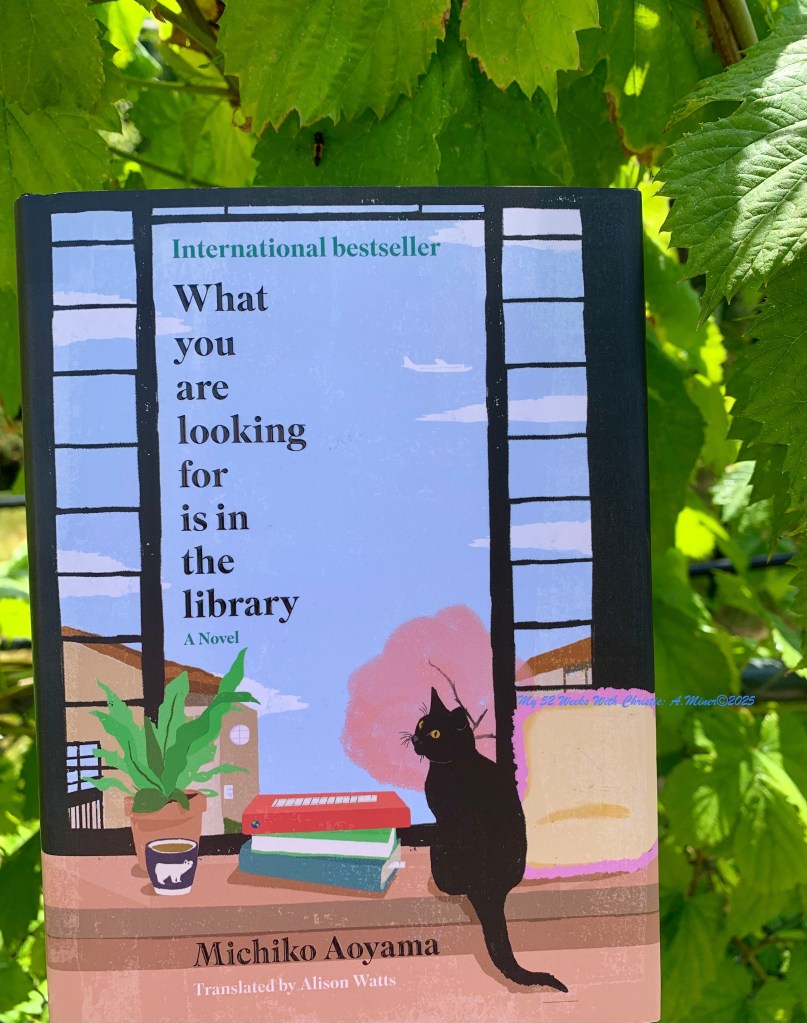
Book Review: One of the Best Books I’ve Read this Year

What you are looking for is in the Library — Michiko Aoyama

Translated by: Alison Watts

Last Christmas, my husband gave me a copy of The Kamogawa Food Detectives (by Hisashi Kashiwai), a Japanese cozy mystery series to which I’m now thoroughly addicted. 

Fast forward a six months.

Whilst perusing my way through the stacks of a bookshop, an idle query crossed my mind — ‘I wondered if Kashiwai’s American publisher had released the third installment yet?’ Wandering over to the fiction section (where many mysteries reside to fool genre snobs into thinking they aren’t reading/loving a mystery), I discovered that, alas, I need to wait a few more months.

Sigh.

Turning away from the shelf in question, I spied a stack of The Kamogawa Food Detectives distinctive dust jackets on a nearby table. Curious if the display contained a theme, hoping against hope, a bookseller grouped together similar titles I hurried over. 

Huzzah! 

Amongst the piles of translated tomes I discovered What You Are Looking For is in the Library by Michiko Aoyama. I love reading books about books and essays on food just as much as I love reading mysteries. So, after practically throwing my money at the cashier in my eagerness, I rushed home and dove straight into its pages….

Librarians, much like booksellers, help unite people with books. And, every now and then, they recommend the perfect title at the exact time their patron needs it most. 

It’s a kind of magic.

Most people don’t realize this skill can’t be taught; it’s acquired over time through practice, observation, and, most importantly, listening. Sayuri Komachi, “Tokyo’s most enigmatic librarian.”, owns this skill in spades and uses it to help those living in the ward where her Library resides.

I devoured this book in a day. 

Then I read it again.

And again.

Slower.

Reading how Sayuri releases each patron with a book recommendation that possesses the possibility of nudging them into shifting their perspective is fantastic. Equally fantastic, is the fact we are allowed to watch five of these masterful moments unfold in What You Are Looking For is in the LibraryEach one demonstrating the power and importance of libraries, librarians, and physical books all in one fell swoop. (Or, at least, that’s my interpretation.)

Moreover, the interconnectedness of the people, places, and things made What You Are Looking For is in the Library a joy to readEach library patron makes cameos in subsequent chapters, thus showing the subtle passage of time, whilst also allowing us (the reader) to see if these new perspectives stick or if the library patron slipped back into old habits. 

Whilst I savored every chapter (eventually), my favorite is — Masao, 65, retired. Within these handful of pages, Aoyama transforms Sayuri Komachi from a mountaintop mystic into a human being. And, unlike the great and terrible Oz’s reveal, this peek behind the curtain in no way disappoints. 

I would recommend this book to anyone. Especially those feeling a tad frustrated or lost in their own lives. Or if you need to witness kindness in action. Or someone who enjoys reading about books or felting. Yes, the craft plays a significant role in the stories.

(Ignore the cat on the cover. It does not play a role. In case you’re worried.)

My 52 Weeks With Christie: A.Miner©2025

Mystery Review: “The Restaurant of Lost Recipes”

Hisashi Kashiwai — The Kamogawa Food Detectives

Translated by Jesse Kirkwood

Once upon a time, I wanted to do something nice for my mom-in-law’s birthday. This proved a tad challenging for a woman who’s not a huge reader, hobby enthusiast, or coffee drinker until I recalled a notorious family legend: where she, whilst gabbing away with her relatives, polished off an entire cake by herself — one bite at a time.

The cake in question was a gooey butter cake — a regional favorite, which, at that point in time, hadn’t hit the mainstream (yet). So, finding a recipe online was a non-starter. Even worse, in a fit of downsizing, she tossed out all her handwritten family cookbooks, thinking all the tried-and-true recipes within them were now redundant, thanks to the internets. Which left me up a creek without a paddle because I had no clue what went into this confection besides sugar, butter, eggs, and flour.

Fortunately for me, a few months later, Bake From Scratch magazine ran a feature on regional or lost bakes (I can’t recall which) that included this St. Louis treat. And my mom-in-law was thrilled when we showed up for the next family gathering (Thanksgiving, I believed) with it in tow.

However, if I’d failed to purchase that month’s magazine or the publisher decided against running that feature, I might never have run across the recipe. 

And that’s where The Kamogawa Food Detectives (would in theory) come in. 

If I lived in Japan and faced a similar conundrum of a lost recipe, needed to reconnect with an old memory linked to a specific dish, wanted to recreate my grandmother’s signature ramen or other similar culinary mystery — The Kamogawa Food Detectives would do their level best to figure it out and reproduce it for me.

If you enjoyed watching Netflix’s Midnight Diner or Midnight Diner: Tokyo Stories ten-to-one, you’d enjoy reading The Kamogawa Food Detectives as the two share a similar-ish vibe. (BTW: You should try the Midnight Diner if you haven’t already; it’s a fantastic show.)

Though the story does feature food, a lot of magnificent-sounding food, at its heart, The Kamogawa Food Detectives is a mystery. Nagare, a former police detective, follows leads, interviews people, and uses his experiences and intuition to solve each case brought to the agency housed in the back of the family restaurant. Whilst Koishi, Nagare’s daughter, is the people person of the outfit. Conducting the initial interview with the clients, she pulls out as much information as possible about the dish in question, the person responsible for its creation, and the client’s relationship with it/them. 

In some ways, the format of The Kamogawa Food Detectives reminds me of Issac Asimov’s Black Widower short stories in so far as the structure of each case follows a pretty rigid pattern.* Admittedly, this makes the book sound formulaic, which I suppose in a way they are — but in the best possible way as this set pattern compels Kashwai to find unique ways to inject twists, turns, and surprises into the stories — which he does beautifully. Moreover, the precise arrangement of standard story features is comforting rather than feeling derivative.

Though the chapters in the book read more like short stories than a continuous novel, the thread linking each episode together is not only the book’s repeating pattern and delectable dishes of food but also Koishi and Nagare’s lives. With each investigation, you learn just a tad more about them. And it’s these little scraps that kept me from setting aside the book between chapters and reading onwards. It’s also what compelled me to pick up the book and reread it again a few days later, at a far more leisurely pace, savoring each and every word.

I would recommend The Kamogawa Food Detectives to anyone who enjoys reading about food or non-murder mysteries or those who delight in Japan and/or the country’s cuisine and are looking for something cozy/interesting/lovely to read on a cold winter’s night.

*(BTW: The collections of Asmov’s short stories are all out of print but are definitely worth tracking down. Try here. And thank you, Fran, for turning me onto them all those years ago!)