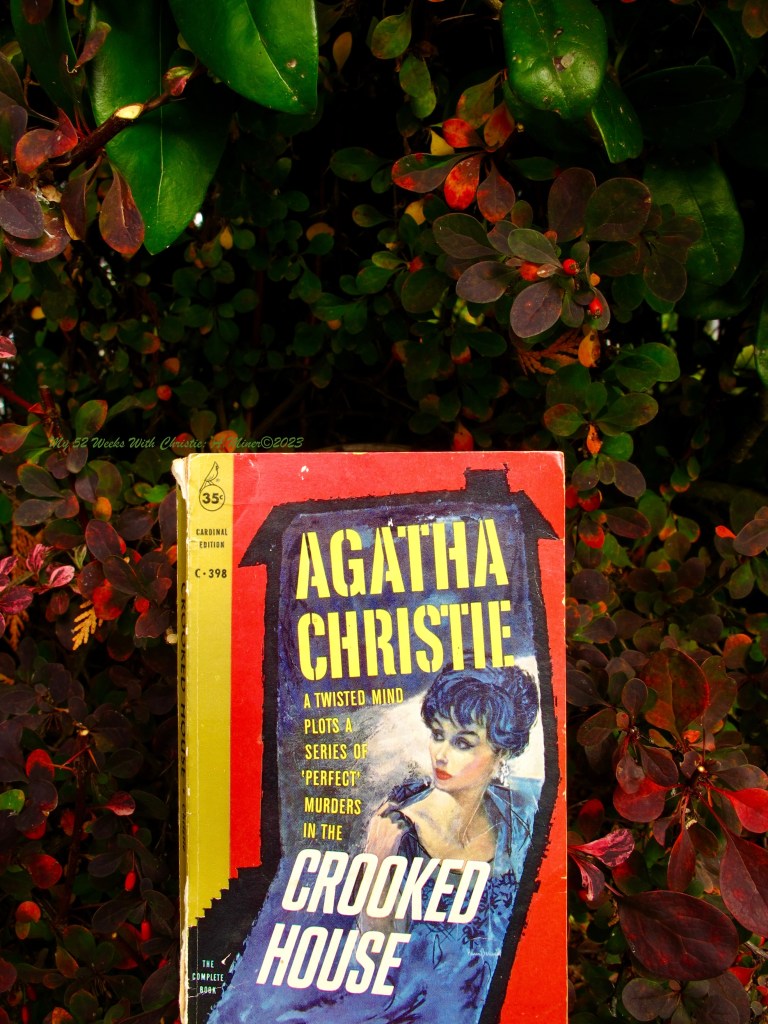
Crime & Christie: George Washington, Art, and Revolution

Recently, on a whim, I reread the Miss Marple short story The Bloodstained Pavement. After finishing the story (for the umpteenth time), an idle thought crossed my mind: I wonder if an artist has ever solved a crime whilst painting a painting? Curiosity sparked, I plugged in some keywords into an old newspaper archive.

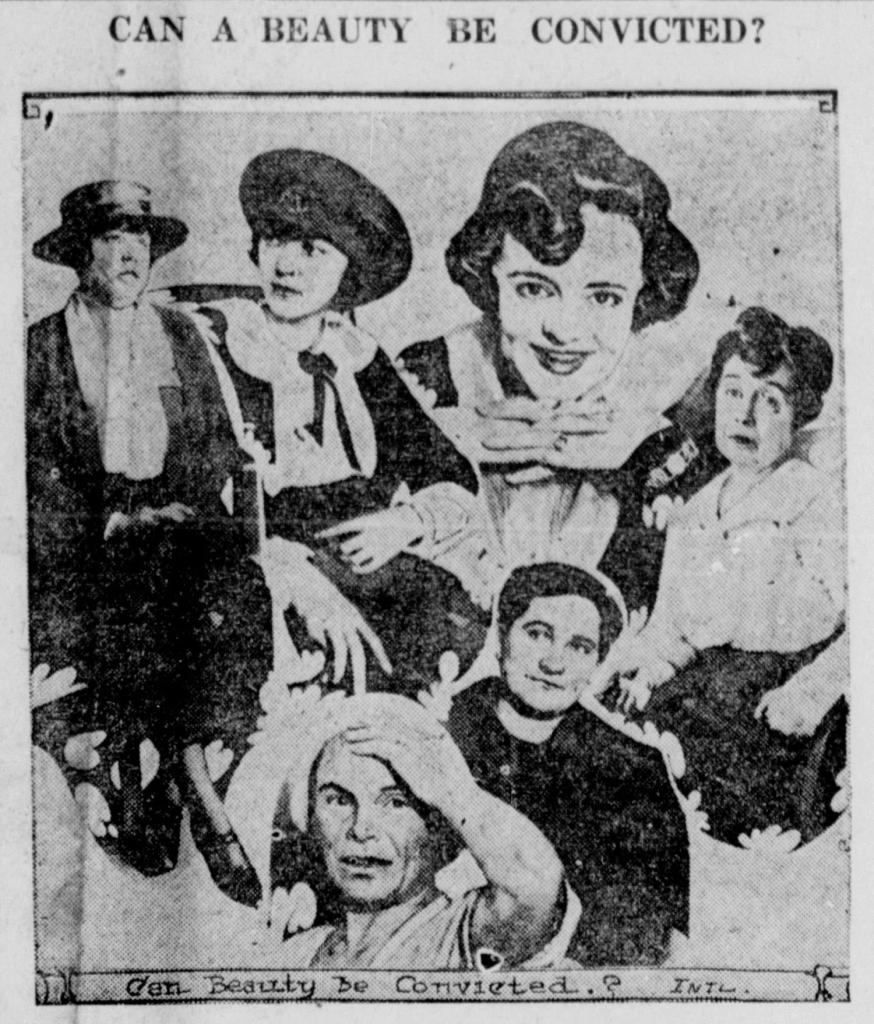
It came back with:

Diverted by this curious headline (mere minutes after my original query flew through my head), I jotted down the brief list of names printed below the photo collage. Deciding I could spare a few seconds to suss out the meaning of this singular bit of news — I, in a fair imitation of The Fool, blithely stepped off an unobserved precipice.

Fast forward several months.

Surfacing from a mares’ nest of mind-boggling murders, wafer-thin defenses, and musical numbers — I’d grasped a slender thread (loosely) linking The Bloodstained Pavement and the aforementioned fantastic headline to a crap ton of crime in Chicago spanning betwixt 1907 to 1919. 

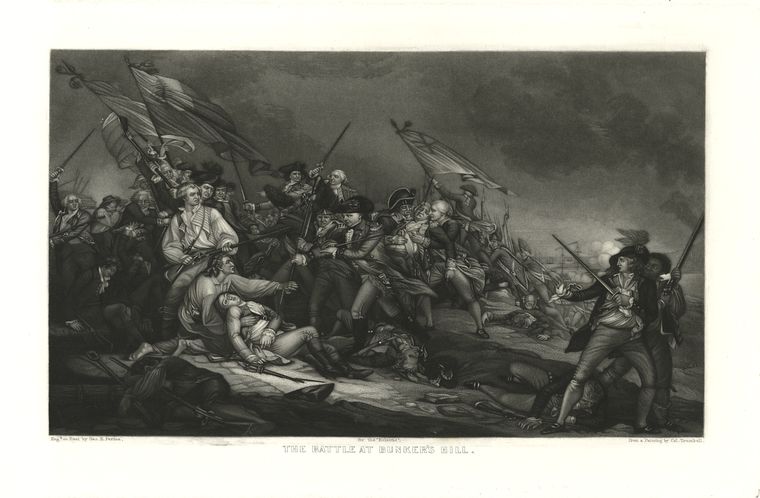
And it all starts with an artist named John Trumbull.

Never heard of him before? Well, ten to one, you’ve probably seen his work: in history books, if you’ve ever been to the rotunda in the U.S. Capitol building (in Washington D.C.), scanned the back of a two-dollar bill, or gazed upon Alexander Hamilton’s portrait on a ten spot. How did Trumbull find himself commissioned with such momentous projects? Well, between being the son of Connecticut’s Governor, graduating from Harvard, and serving under George Washington & Horatio Gates during the American Revolution — Trumbull met a plethora of the fledgling country’s early leaders. 

However, before Trumbull became known for his hyper-detailed life-sized scenes, earned a commission from Congress, or painted the portraits of several founding fathers — he sailed for London in 1780. Unsurprisingly, whilst in the capital of the UK, Trumbull met up with Benjamin Franklin. (Seriously, Trumbull’s life is a who’s who of historical figures.) Franklin, in turn, introduced the aspiring artist to Benjamin West — whose subject matter meshed well with Trumbull’s artistic aspirations. Under West’s tutelage, Trumbull began practicing painting techniques by filling small canvasses with images of the war he’d fought in and miniature portraits. 

Apparently, Trumbull enjoyed the latter exercise so much that he’d go on to paint over 250 of these mini-pics over the next 63-ish years. 

Amongst the bevy of minis Trumbull created was a portrait of George Washington (one of his favorite subjects). Painted in predominantly blues and golds on an oval-shaped piece of ivory, it measured 2.25 by 1.75 inches. According to legend, after completing the Lilliputian sized portrait, Trumbull presented it to a Virginian bride as a wedding gift. After this, this unnamed bride moved both herself and the pocket-sized portrait to Kentucky. Next, the fun-sized painting relocated with one of her kids to Tennessee, her grandkids decamped with it in tow to Arkansas, and finally, it wound up in Louisiana, where it was gifted to Vera Trepagnier. 

Elizabeth Vera McCullough or Vera (as she seemed to prefer), was born into a wealthy family in Belfast, Ireland, around 1860. Round about the age of seventeen, she and her family immigrated to the U.S. and settled in Louisiana. Sometime over the next seven years, Vera caught the eye of her future husband and sugar planter — Francois Edmund Trepagnier. The two married around 1886, when Vera was 24 and Francois was 52 (give or take). They had a son by the following year. 

(Upon marrying Francois, Vera also became the stepmother to three kids from Francois’s first marriage — the eldest of whom was only two years younger than herself….which sounds….awkward.)

Fast-forward four years to when the Trepagnier sugar plantation flooded and ruined their entire crop. In the wake of the devastation and unable to recover, Francois and Vera were forced to economize: first, they let go of all their servants, then sold all their furniture, and finally, the plantation itself. Sadly, despite trying to find a fresh start in Florida, the pressure of unexpectedly tumbling downwards through a significant number of tax brackets proved too much for Francois. Who, whether by illness or suicide (it’s unclear), passed away around 1891. 

Despite losing her husband, estate, and way of life, Vera retained possession of the diminutive Trumbull portrait.

In 1916, during the WWI war effort, about twenty-five years after these life-altering events, found Vera working for the Treasury Department in Washington D.C. Now a grandmother who wanted to help her grandson get a good education, Vera finally decided to investigate the legend around her pocket-sized portrait. Placing the ivory miniature beneath the lens of a microscope for a better look at the artist’s signature, Vera discovered the painting’s lore true. Even better, thanks to the private tutors who’d educated her in her youth, Vera not only knew who Trumbull was, she understood how valuable a rendering of George Washington by his hand could be. 

With this knowledge, Vera traveled to Philadelphia, hoping to make money off the tiny thing while (hopefully) retaining possession of it. 

(Cue dramatic music.)

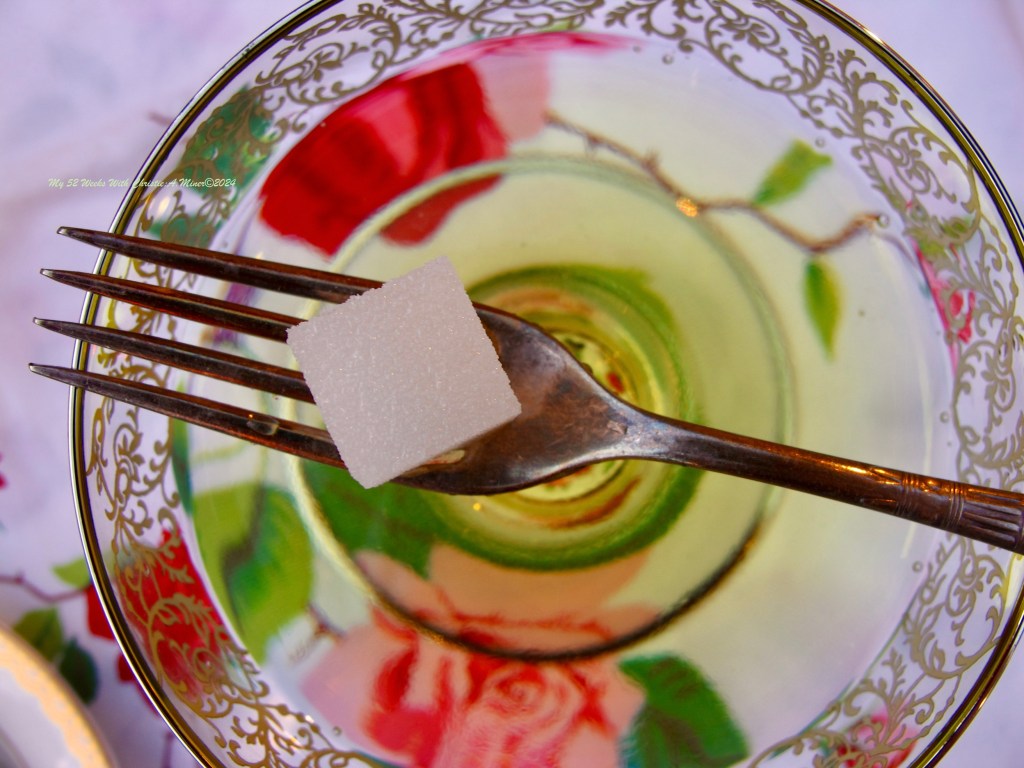
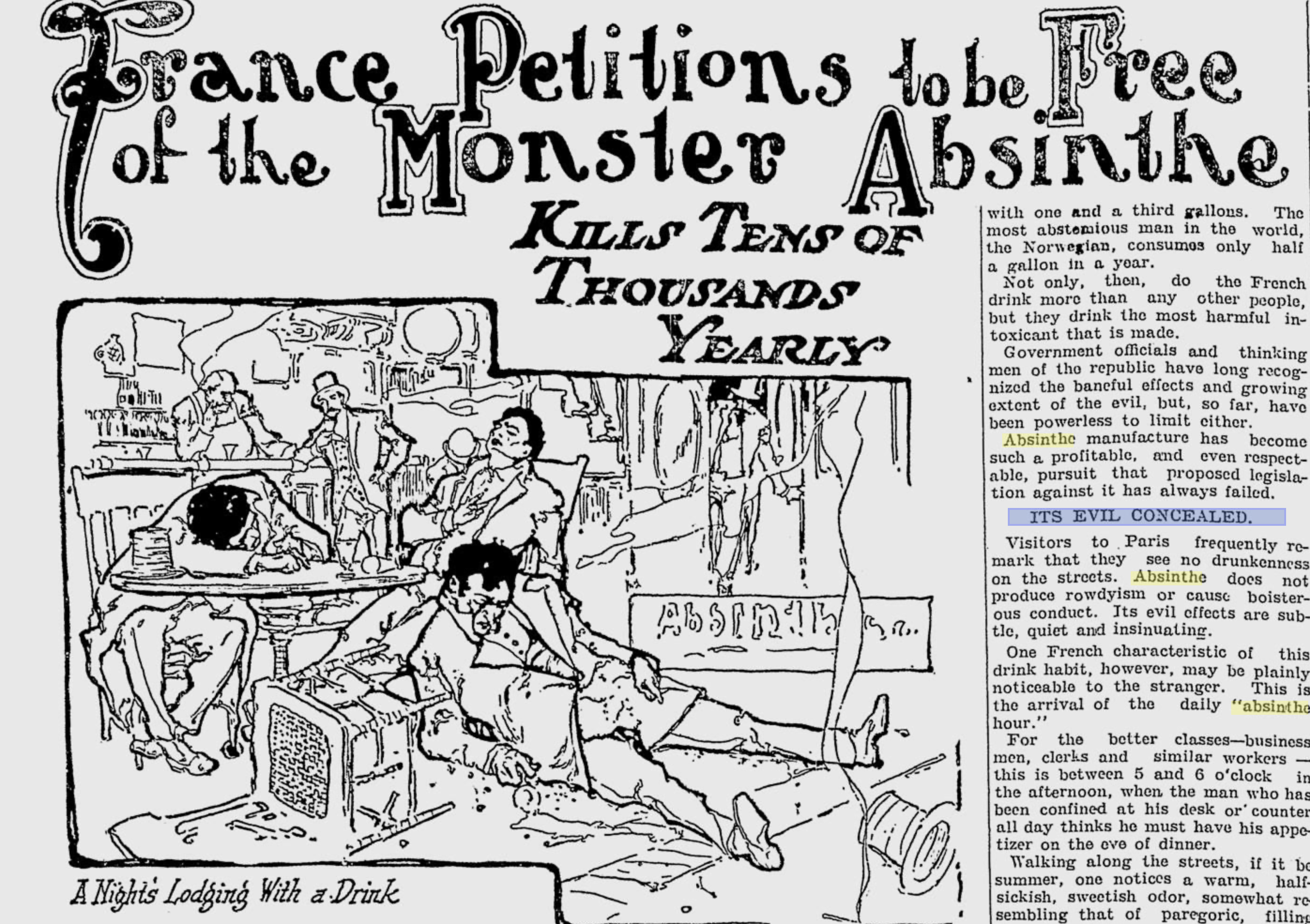
Absinthe: People have killed for less…But not by much.

Now that we’ve established absinthe’s meteoric rise and even faster fall in the realm of public opinion, we can now focus on my original question: Why haven’t I read mysteries where, during the summing up, the malefactor yells, “Absinthe made me murder/rob/eat Uncle Singin McBuzzleworth!”

One Unscientific Opinion/Answer: The “Absinthe made me do it!” defense didn’t hold up in real-life courtrooms. 

When examining classic mystery and real-life motives like avarice, revenge, envy, and sex — the “Absinthe made me do it!” defense appears weak by comparison. Moreover, despite large swaths of the population (within many countries) purportedly believing absinthe poisoned the minds and hearts of any who partook of the Green Fairy’s potion — defense councils were still hard-pressed to engender enough sympathy in jury members to make this justification stick. 

Take the case of Auguste-Leon Thabuis. 

Near the township of Dole in the department of Jura in France sits Saint-Ylie Hospital (or Asylum; the French translator app I used was not flawless). Back in 1909, the 1,500 people (or so) residing within Saint-Ylie were separated into different pavilions by age and gender then sub-divided further based on their ailment — those possessing some sort of paralysis lived in one ward, those with mental health issues in another, and the “incurables” (their word, not mine) lived in their own wing. 

In April 1909, the hospital director hired Auguste-Leon Thabuis to work in the men’s paralysis ward. Besides discovering he owned a terrific thirst, which he quenched at a nearby tavern, hospital administrators found no problem with Thabuis’s work.

Fast forward seven months.

On Friday, November 19, 1909, Thabuis reported to his supervisor that Justin Garneret (age 61) had died. Busy with one thing or another, Thabuis’s superior didn’t take the time to look the body over, instead they told Thabuis to get on with it. Which he did — leaving Justin Garnet’s body in his room, Thabuis went to prepare the earth for her newest resident — as he also moonlighted as a gravedigger and amphitheater boy for the hospital when needed.

Now it’s unclear precisely what roused the other nurses’ suspicions, perhaps because Justin Garneret’s death came completely out-of-the-blue or the curious piece of serendipity which found four other patients passing away, about one every other day, on Thabuis’s watch starting on November 10, 1909. Either way, they snuck a peek at Mr. Garneret’s body whilst Thabuis was away….And were rewarded with the sight of darkening fingermarks encircling Mr. Garneret’s neck. 

Fetching Hospital Director Bierry and Chief Physician Santenoise, the nurses explained their misgivings and subsequent discovery. 

At about this point, Thabuis returned to Mr. Garneret’s room with a coffin. In the ensuing conversation, during which I imagine Thabuis sweating more than a few bullets, Dr. Santenoise questioned the nurse about the undeniable signs of strangulation. Unfortunately (for Thabuis), the Chief Physician didn’t buy the story he spun: That one of the lunatics must’ve snuck out of their ward, into his, strangled Mr. Garneret, then crept back to their room — their absence and presence remaining undetected by everyone the entire time.

When the public prosecutor, examining magistrate, their clerk, and two trained forensic examiners answered Dr. Santenoise’s summons, Thabuis told them that Mr. Garneret attacked him and he’d been forced to defend himself. This explanation, which went over about as well as his first, prompted Thabuis’s immediate arrest — during which he cried out, “I’m innocent! I’m innocent!” Mr. Garneret’s autopsy, carried the same night around eight pm, confirmed the nurses’ worst fears — he was indeed murdered.

The Question Was: Did the other four patients who died under Thabuis’s care over the past eight days meet the same fate? 

Performing a quadruple exhumation and autopsy the following Friday, authorities found some answers. Sadly, the bodies of the first two possible victims decomposed to the point where murder couldn’t be conclusively proven. The third victim, Francoise-Emile Menefere (age 54), bore bruises in the outline of two hands around his neck and a bruise on his chest. The fourth victim, Xavier Guinez (age 54), sported a similar bruising pattern as well as a row of four broken ribs and other defensive injuries. (It seems in addition to using his hands, the murderer used his knees to compress his victim’s chest to hasten the deed.)

With cause of death now established and confident they had their man, investigators turned to motive…..which proved troubling. Not because they found its establishment difficult but because the only dependable benefit Thabuis received from any of the deaths was the single extra franc he earned for each grave he dug. This veritable pittance was hastily spent at the neighborhood tavern. Where, when “flush” with cash, Thabuis reputedly drank up to four liters of wine and twenty-two glasses of absinthe.

All these facts & theories, together with the unsavory intelligence Thabuis sent notes to grieving families asking if they’d like him to maintain their loved ones’ graves in exchange for a small donation, emerged during his trial, which commenced in July of 1910. (It’s unclear if Thabuis wrote the families of the men he murdered.) This seedy behavior, coupled with a job history that included terminations due to theft, insolence towards a nun, coming to work while inebriated, and serving a three-month prison sentence for insulting a Swiss police officer — didn’t help his case. 

However, his public defender, Milleret, was up to the task.

Amongst the sixteen witnesses called by the prosecution, Milleret determined that while all the nurses, who’d first raised the alarm, believed Thabuis culpable in the murder of Mr. Garneret (based on his and their movements that day), none could confidently assign his hand to the deaths of Mr. Menefere or Mr. Guinez. While the prosecution argued that Mr. Garneret’s murder proved the pattern. Milleret countered this by pointing out that the prosecution could not call a single “reliable” eyewitness to the crimes.

(Now, here comes the cream, at least for the question I’m trying to answer.)

In a Classic Scenario of ‘I didn’t do it. But if I did it.’: Milleret attempted to establish that Thabuis suffered from a classic case of hereditary degeneration and, therefore, shouldn’t be held accountable for his actions. (Yes, this case explicitly put absinthism to the test.) Not only did Thabuis prefer the embrace of the green fairy above all others — Milleret argued this devotion/addiction decayed Thabuis’s moral fiber to the point where taking another man’s life in pursuit of another glass felt justifiable. Moreover, due to weak genes he’d inherited from his father, whose excessive drinking sent him to an early grave six years prior, Thabuis’s ethical putrefaction was all but guaranteed.

It’s unclear if the alienist the prosecutor brought in successfully refuted Thabuis’s defense or (more likely in my estimation due to the slant of the newspaper reports) the members of the jury couldn’t overcome the repugnance of Thabuis killing a man for a single franc. Either way, it only took the jury three-quarters of an hour to find Thabuis guilty of Mr. Garneret’s murder and sentence him to seven years in prison and a ten-year ban of stay. (I’ve no clue what that last bit means. Maybe it banned him from working in another hospital for ten years after his release?)

In any case, the regular rejection of Magnan and Legrain’s absinthism defense by juries presents a fascinating counterpoint to the anti-absinthe campaign, which embraced these theories and was, at that moment in time, gaining momentum across several continents. Perhaps if women, the backbone of the temperance movement, were allowed to serve on juries during this period, acquittals based on the “Absinthe made me do it!” wouldn’t have been rarer than hen’s teeth.

Moreover, the lack of acquittals based solely on “Absinthe made me do it!” may have signaled to Golden Age mystery writers the inherent weakness in this particular solution. Since their livelihoods were based on fashioning viable and (generally) believable solutions for their readers, placing the blame solely on absinthe for the unfortunate fate befalling Uncle Singin McBuzzleworth could place a lackluster ending on an otherwise strong story — which might cause an author to lose readers. 

An idea I imagine any pro would find insupportable.

My 52 Weeks With Christie: A.Miner©2024

Absinthe: Let’s All Panic!

While increased availability and/or Magnan and Legrain’s theories swayed some back towards wine (which most experts considered harmless), a far greater number now viewed the absinthe as a guilty pleasure — which only enhanced its protracted pizzaz. This not-so-subtle brush-off made teetotalers, doctors, and winemakers despaired over the idea that they may never rid themselves of the glittering Green Fairy. 

Then Jean Lanfray came along.

Originally a Frenchman, Jean Lanfray lived and worked in Switzerland. Arriving home on the afternoon of August 28, 1905, Lanfray promptly picked a fight with his wife over the state of his boots. Seems she hadn’t gotten around to waxing them as he’d requested and, in short order, both spouses were seething. When Lanfray told his wife to shut up….She said, “I’d like to see you make me!” Whereupon he fetched his Vetterli rifle — shot his wife in the head, turned the gun on his two daughters (both under five), then attempted to kill himself.

After his arrest, the reeling residents of Commugny (the town in which Lanfray and his family lived) attended a townhall meeting on September 3, 1905, where they learned Lanfray ingested two ounces of absinthe and that his wife was about four months pregnant with their son at the time of her murder. Horrified at the latter revelation and feeling powerless in the wake of this senseless violence, townsfolk needed someone or something to blame. Unable to put Lanfray immediately on trial, as he lay in a nearby hospital recovering from his suicide attempt, they chose absinthe as their scapegoat. Within days of the assembly, the citizenry sent a petition with 82,000 signatures to their state capital, asking legislators to ban the “Green Monster”.

The unintended consequence of the community’s appeal? They set a clear defense strategy for Lanfray’s lawyers — absinthe made him do it. An assertion medical experts supported during Lanfray’s brief trial. Absinthe notwithstanding, the fact Lanfray also quaffed seven glasses of wine, six glasses of cognac, two coffees laced with brandy, and two creme de menthes on that fateful Monday diluted the effectiveness of this defense. And while this prodigious intake prior to the murders and his very obvious remorse kept his neck out of the noose, on February 23, 1906 a jury found Lanfray guilty of murder. 

Three days after being sentenced to thirty years imprisonment Lanfray, haunted by his own actions,  would hang himself in his jail cell.

Despite the clear flaw in the blame game being played (i.e. the liters of other alcohol Lanfray consumed), on May 15, 1906, the Canton of Vaud (the state where Commugny is located) banned absinthe. Shortly thereafter, Geneva followed suit in response to their own absinthe-drinking husband named Sallez, who murdered his wife about a month after Lanfray’s crimes. (Brazil and Belgium beat both to the punch by banning absinthe outright in 1905.)

Temperance unions extracted an entirely different lesson from this series of tragic events. 

They discovered a potent weapon in their fight — moral panic. By spotlighting every crime where absinthe played a role, even a minor one, they could catastrophize the “threat” absinthe posed to society’s safety and wellness. To this end, not only were Magnan’s skewed scientific experiments widely reprinted along with his theories on absinthism, Legrain lent his time, reputation, and words: “….after three years’ absinthe drinking a man becomes weak minded…moody, taciturn, suspicious, eccentric, untrustworthy and apt to quarrel without cause. If he continues to take the deadly liquor his body becomes an automaton, and he obeys without hesitation the auto-suggestions of his mind often killing, maiming and destroying with savage glee those nearest and dearest to him.” 

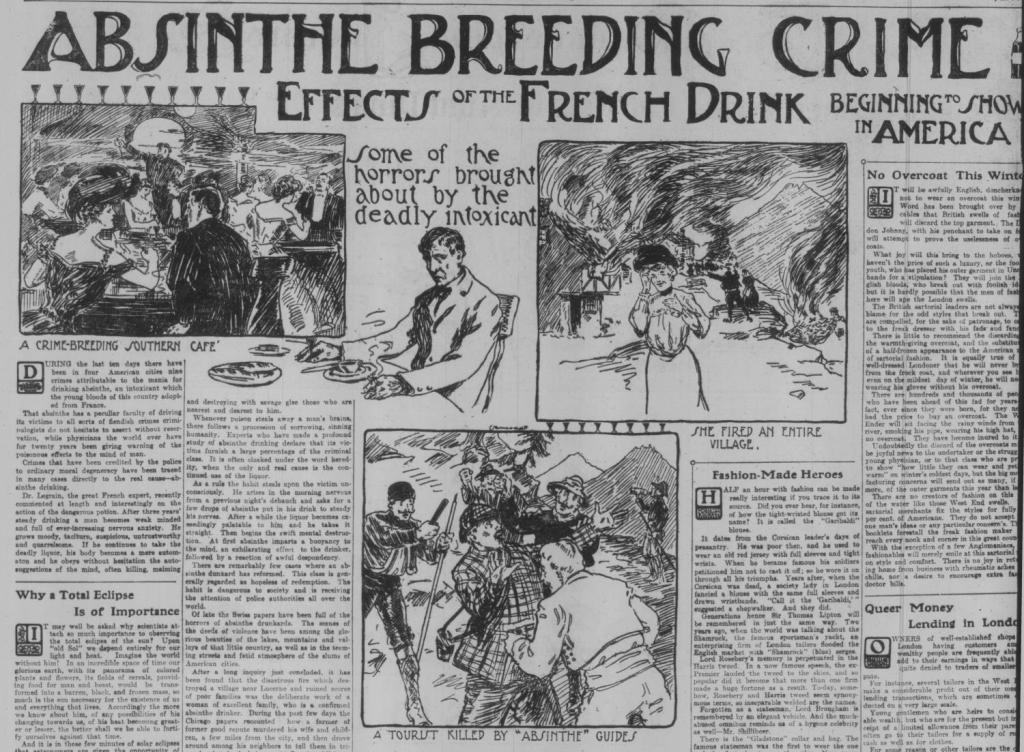
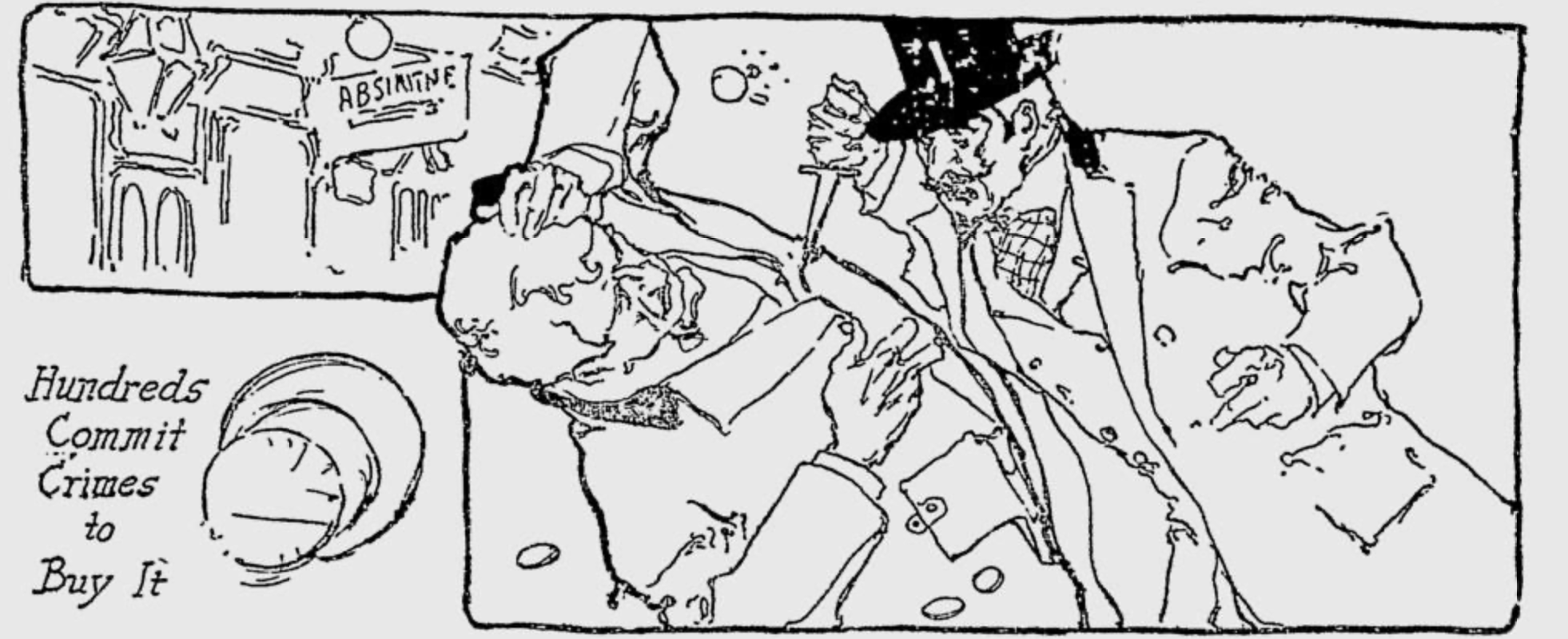
Fanning the anti-absinthe flames further, temperance unions and their members began churning out art, movies, and pamphlets corroborating these scientific findings. The most effective arrow in their quiver? Syndicated newspaper articles, in which the author detailed the alarming or violent behavior of absinthe drinkers. Amongst the many offenses attributed to “absinthe fiends” were: A) A man named Valentin Boyer, who was convinced that his enemies were persecuting him via electricity. When circumstances forced him to enter Paris, he donned a 385-pound coat made of copper and a hat made of lead with a visor covering his face. He was promptly arrested for his odd appearance. B) A man attending a national fete set fire to 37 dresses as he couldn’t resist applying his cigar to every blue dress he saw. C) A woman of good standing was arrested and imprisoned for setting fire to a village near Lucerne and destroying several houses owned by “the poor.” D) Near Nyon, an absinthe addict maimed cattle and set a series of fires. E) A 12-year-old girl was stabbed to death near Thorwaldensen’s Lion of Lucerne by a man employed at a match factory in Geneva. F) A man decapitated a young girl in Lausanne. G) Six Valois guides murdered a tourist and hacked him to pieces. H) Whilst in police psychiatric care, it was noted absinthe addicts would often try to bite off and eat pieces of their friends and family’s faces when they leaned in for a kiss. 

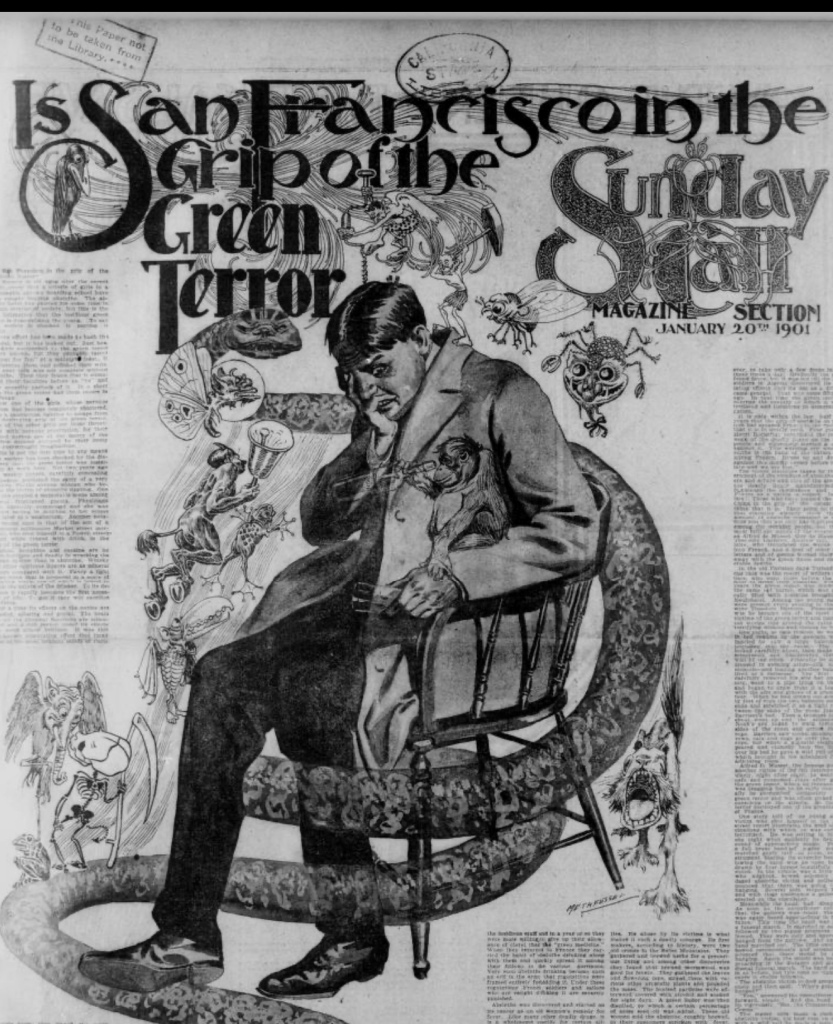
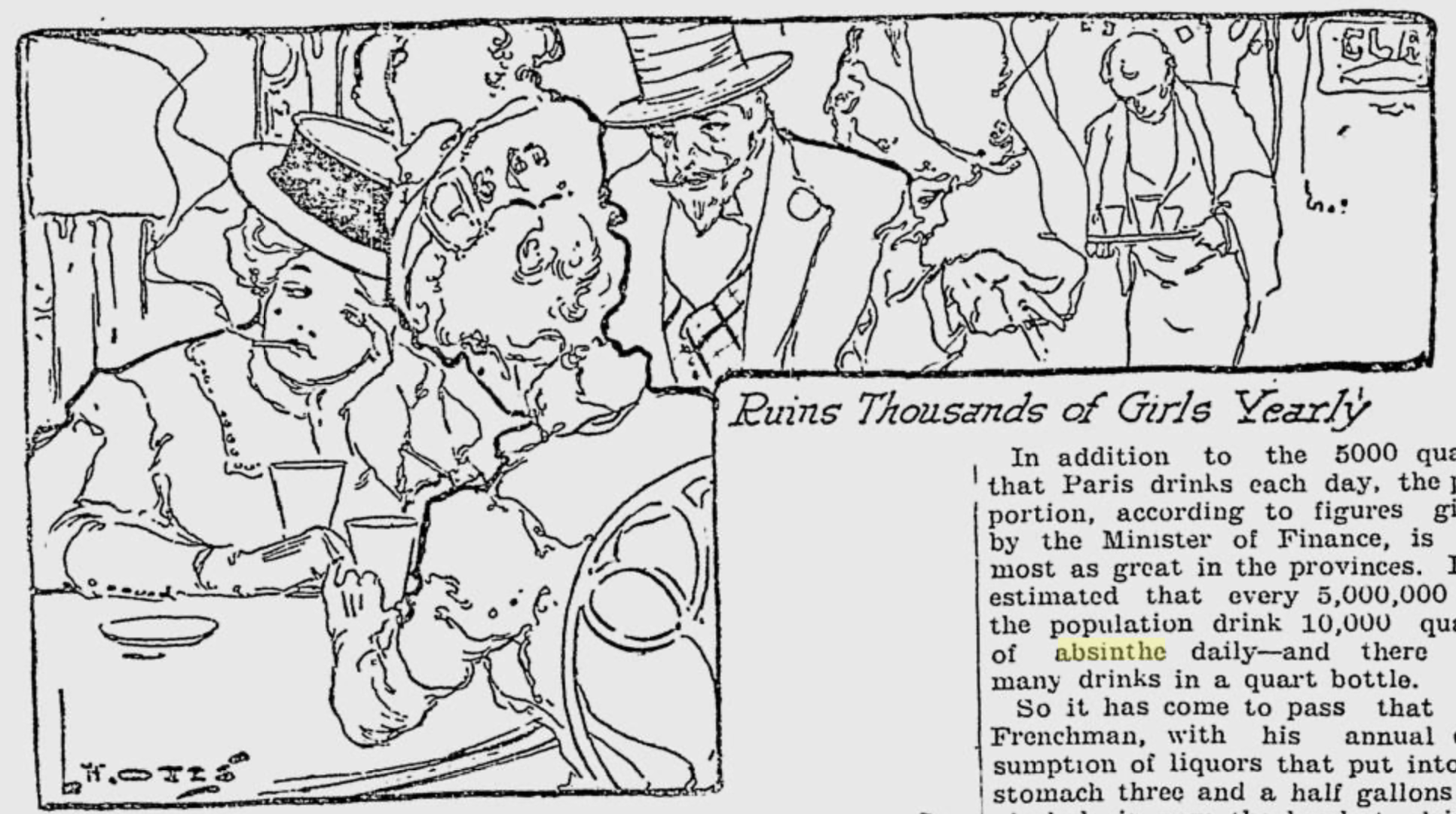
Unsurprisingly, these tales of arson, murder, and cannibalism snowballed as editors keen on increasing their readership (and/or were part of the temperance movement themselves) lept onto the anti-absinthe bandwagon. Not only did they feature any local/regional cases that even tangentially intersected with the “green monster.” They also published their own exposes on the dangers absinthe posed to their communities. Some linked the drink to the same dangers posed by opium or morphine. Others warned husbands to watch their wives lest they be lured into absinthe dens and robbed of their pin money and jewelry while they lay in an absinthe-induced stupor. Still others advised parents to keep a weather eye on their daughters lest absinthe tempt them into a wickedness and ruin.

At some point, one bright bulb took this fear-mongering to another level by linking Magnan and Legrain’s theories of social degeneration due to absinthe drinking to the bitter loss of Alsace-Lorraine during the Franco-Prussian War in 1871. Doubling down newspapers across the world started questioning France’s fighting fitness (and, by extension, every other country that allowed absinthe within its borders). Thereby creating a green-tinted scapegoat for the growing anxiety and helplessness people felt as they watched Germany, the Austro-Hungarian Monarchy, and the Ottoman Empire growing stronger as the world hurtled towards 1914 and the start of World War One. (Though they didn’t know it yet.)

Unsurprisingly, this relentless pressure and constant fear bore fruit in 1909 when the Netherlands banned the spirit. Switzerland amended its constitution to add an absinthe prohibition in 1910, the USA’s Pure Food and Drug Act barred its import in 1912, and France banned the spirit in 1914. 

From the Office of Cynical Speculation: When reading these “reports” of absinthe induced crimes cracks start to appear when they inevitably reference the Lanfray case. Rarely do any of these “news stories” cite Lanfray by name; none mention the date of his offenses or conviction, nor the specific town where the murders took place. They generally refer to him as a farmer living near Coppet who murdered his young wife and children. 

Why so vague? Not only with Lanfray but in the description of the other cases? Other than the rare mention of Lanfray by name, only the first of my examples ever mentioned one of these “absinthe fiends” by name — few gave a specific location and none contained a firm date.

Playing Devil’s Advocate Here: They could have omitted these details to keep the newspaper column under a specific word count. Or perhaps the authors thought these examples were so famous everyone would instantly get the reference. I know the Lanfray case became the cause célèbre in Europe for a time thanks to the anti-absinthe movement. So, it’s not out of the realm of possibility.

However, the doubting Thomas living in the back of my brain wonders if the lack of detail stems from the desire to obfuscate the particulars of their examples…..In order to make it difficult for the public or their opponents (of which there were more than a few, though they were far less organized and funded) to suss out details which didn’t align with the thrust of the anti-absinthe campaigner’s aims. Again, take the Lanfray case as an example. If those unfamiliar with the murders learned of the liters of wine and wine-based beverages he consumed and compared it to the two ounces of absinthe….Well, people might draw a different conclusion and blame the wrong kind of alcohol — which flies in the faces of winemakers’ self-interest. Hence why it may’ve been left out.

So what about the other examples of absinthe-induced crimes? Do they own similar inconsistencies? 

I don’t know. I attempted to verify the finer points of the other cautionary tales and came up with bupkis. I couldn’t find a single newspaper piece aligning with the criminal information outlined in these syndicated articles. In fairness, these purported transgressions are well over a century old, and my French (while improving) is still lackluster at best. 

While, I do not believe the authors made this anecdotal evidence up….…I am not sure they were above exaggeration either.

My 52 Weeks With Christie: A.Miner©2024

Rough on Rats: Bad Taste

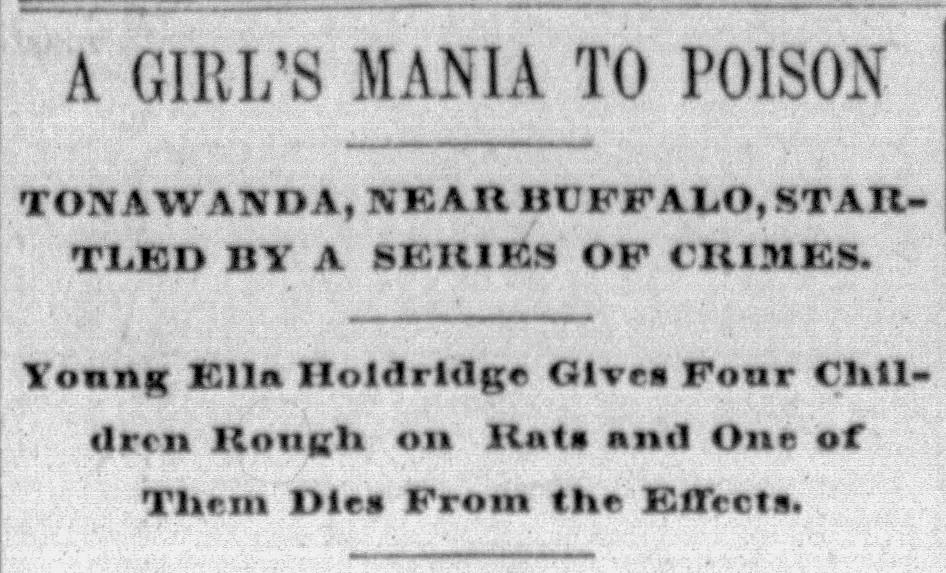
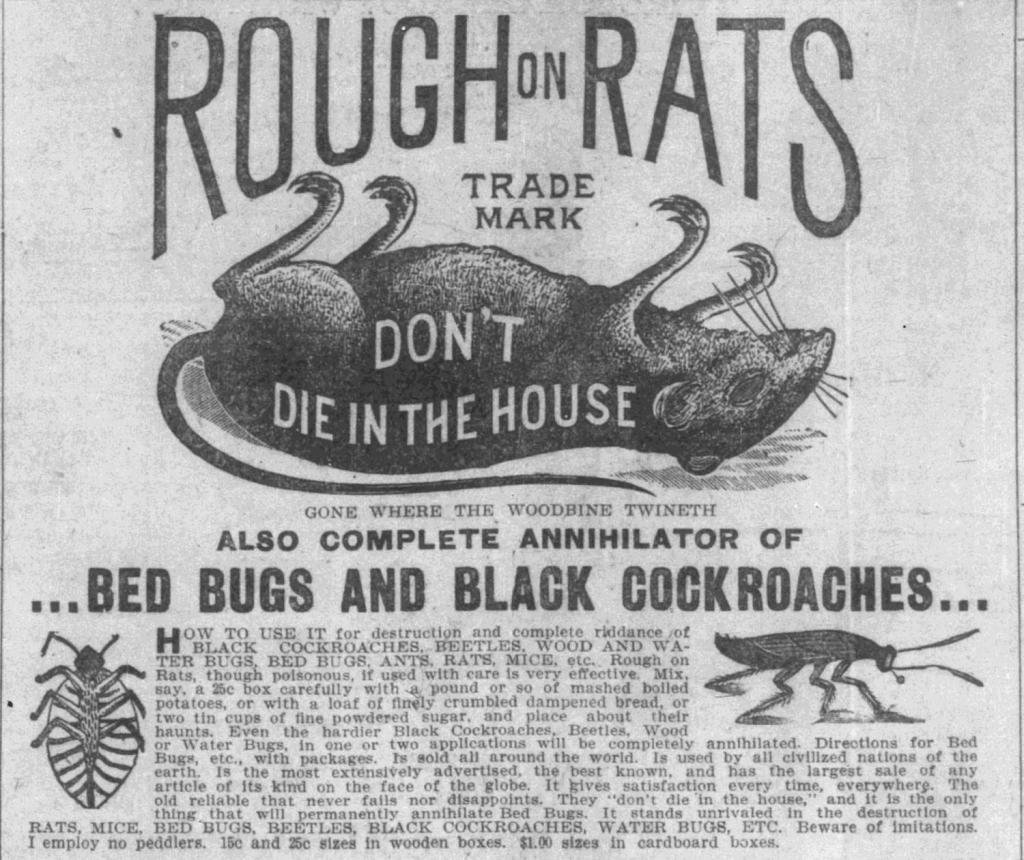
Whilst it’s impossible for me to say if Ephraim Stockton Wells was aware of either Gertrude Taylor or Ella Holdridge, I cannot imagine him unaware of the unintended consequences of his patent product. Accidental deaths, suicides, and murders abounded for years in “all civilized nations of the earth” where Rough on Rats was sold. The comic below, which he included in one of his ads, proves at least by 1901, Ephraim knew of one common misuse of Rough on Rats. 

At best, including this comic strip was in poor taste. At worst, it shows his contempt for the multitudes of people who’d used his product for this purpose.

More likely, and this is conjecture on my part, he was thumbing his nose at all the physicians, lawyers, and scientists who’d criticized him and Rough on Rats for DECADES. Not only did they take exception to the lack of information about Rough on Rats’ composition on the label. (Remember it was a patent product: Meaning the name, not the formula, was trademarked. Hence, it did need to include this info.) These professionals also laid a portion of the blame for the product’s misuse at his door.

And I don’t think they are wrong.

Very few ads, which Ephraim Stockton Wells proudly boasted he wrote and illustrated himself, mention Rough on Rats in the same breath as poison. In fact, the only ones I found that clearly state Rough on Rats is a poison was after 1901 when state governments started catching up with what their residents had already figured out: Rough on Rats killed people just as well as rodents. And started requiring Ephraim’s most popular product (and those like it) be “plainly labeled as poison.” 

Which he did. 

However, Rough on Roches, Ants & Bedbugs — and — Rough on Moth, Fly & Flea are clearly marketed as non-poisonous. The only problem is, up until now, Rough on Rats claimed to kill these same pests. While I suppose it is possible Ephraim changed his formula to something akin to Diatomaceous Earth (a non-toxic substance that can deal with these bugs), which started being mined in Germany around 1863, I’m not totally sold on the idea he swapped formulas as, as far as I can tell, Ephraim still didn’t disclose the ingredients for either of these insecticides. Though, in fairness, I’ve not found them linked to any human deaths.

Above and beyond Ephraim’s failure to disclose arsenic as Rough on Rats’ primary ingredient, I think what critics really took exception to was his recommended mechanisms for delivering Rough on Rats to rodents and other pests.

One of the main difficulties facing any rodenticide is poison shyness.

Poison shyness is where rats and mice learn to associate the smell, taste, or similar types of food with becoming sick after eating it. (Hence, why they nibble at food before wholesale scarfing ensues.) Once said aversion is triggered, it can take weeks or months for rodents to forget why they won’t snack on whatever made them sick. This explains why premade poisonous pellets, cakes, and blocks rapidly lose their effectiveness. 

Ephraim skirted this thorny problem by asking his customers to mix their own bait. For indoor mouse issues, he suggested blending Rough on Rats with bacon grease, lard, or butter, then spreading it on a piece of bread or meat. Upon completing this step, he instructed his customers to place the adulterated food wherever they’d seen them scurrying around in the past.

As strategies go, it’s sound.  

By giving your vermin morsels they’ve already taste-tested, you avoid triggering their evolutionary adaptation. Unfortunately, despite the bit of coal dust added in for coloring to help make Rough on Rats’ addition to food & drink more obvious, in the middle of the night, bleary eyes accompanied by a growling stomach only see the triangles of buttered bread left on a kitchen counter as a tempting snack — not as bait. (BTW: This really happened and the midnight-snacker didn’t make it.) 

Then, there’s the secondary poisoning risk presented by Ephraim’s directions for dispatching sparrows, squirrels, chipmunks, skunks, gophers, and moles. He asked customers to combine the thinly disguised powdered arsenic with cornmeal or boiled potatoes and then spread the amalgamation about the yard, field, or undergrowth. This method, of course, led to numerous pet and livestock deaths.

Moreover, prior to Rough on Rats’ 1901 schism from insects, Ephraim’s instructions on how to administer the Rough on Rats to eradicate infestations of flies, fleas, ticks, lice, gnats, water bugs, ants, cockroaches, beetles, potato bugs, and bedbugs virtually ensured accidental exposure (and sometimes death) to pets, children, and adults. Because no matter how carefully one crams arsenic-laded grease into the seams of a bed frame, floorboards, or baseboards — you either get the stuff on your fingers during the application process, while you sleep, or walk across the floor. (To deal with bedbugs, fleas, and beetles.) Never mind dusting shelves in pantries, cupboards, or inside kitchen drawers with a mixture of confectioners sugar and Rough on Rats. (To dispatch cockroaches and beetles.) 

These widely published methods of assassinating pests, in a roundabout way, also gave the idea of how to dispatch other humans. Because if rats didn’t taste the poison, how could humans?

So, while you could argue Ephraim’s doesn’t bear all the blame for the deaths linked to Rough on Rats….his conscience isn’t exactly clear either.

Though whether or not Ephraim felt this burden is unknown, as according to people more learned than I, he didn’t leave any writing (open to public perusal at least) on the subject upon his death in 1913. Nor did his sons, who’d taken over the day-to-day operations of Ephraim’s empire around 1903. 

Happily, Rough on Rats eventually faded from store shelves and popularity as other rodenticides and pesticides surged in popularity. (DDT, Thallium, and Warfarin, for example — all of which caused their own chaos.) In 1955, Ephraim’s family sold the brand Rough on Rats to Brown Manufacturing Co. in Le Roy, New York. They, in turn, went out of business sometime in the sixties.

Ending Rough on Rats reign.

My 52 Weeks With Christie: A.Miner©2023

Rough on Rats: Pressing Her Luck

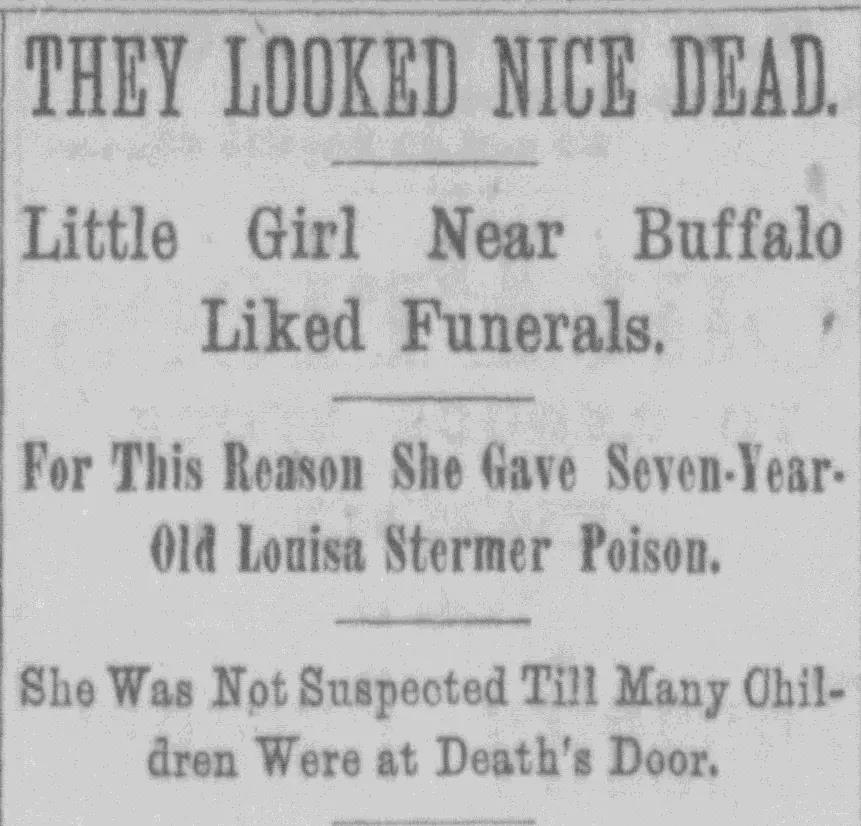
Flush with success and brimming with confidence over her first induced funeral, Ella Holdridge waited (about) five days before feeding her obsession with death, funerals, and wakes. 

Only this time, Ella made a mistake.

Whilst plenty of people noticed the two girls playing together on the day Leona fell ill, no one for a moment suspected Ella played a role in the toddler’s lingering death. Mainly because of the two-year-old’s inability to utter anything sensible after ingesting the water Ella polluted with Rough on Rats. 

However, this time, Ella targeted a pair of sisters — Susie & Jennie Eggleston.

Due to the sensationalization of this case, there’s some ambiguity on what exactly happened next. (Newspapers of this era absolutely loved to hype up crimes like this — often at the expense of the facts.) However, these things seem certain: In and around July 16, 1892, Mrs. Eggelston decided to go shopping in Buffalo, NY (about twelve miles from their neighborhood in Tonawanda) — leaving her daughters at home. Now, one way or another, either knowing beforehand via the neighborhood grapevine or sussing out the intelligence from the pair as they played on their front porch — Ella realized the lack of adult supervision afforded her an opportunity to generate a double funeral. 

Using her status as an older kid (as she was fourteen to their ten and five) and the promise of making them “something nice,” Ella managed to herd the two inside their house. After (possibly) locking the doors after they went inside, Ella made a pot of cocoa with a generous measure of her secret ingredient, Rough on Rats, thrown in. When one of the sisters complained about the cocoa’s taste and refused to drink anymore, Ella compelled the girl to drink it: Through either verbal coercion, pushing her onto a sofa and pouring it down her throat, or throwing her onto the floor and forcing the liquid between her lips. After ensuring Susie and Jennie finished their mugs of cocoa, Ella told them not to tell anyone about what happened and left.

Later that evening, both girls became extraordinarily ill and their parents sent for Dr. Edmunds.

As both Susie and Jennie had been the picture of health prior to their mother’s trip into Buffalo and they’d pretty much identical symptoms which started nearly simultaneously — Dr. Edmunds suspected they’d gotten into something poisonous. Can you imagine his surprise upon learning about Ella’s strange-tasting hot chocolate and even stranger behavior? Then word reached him about another kid a few doors down who was desperately sick — with the same symptoms as the Eggelston sisters.

Seems sometime during the day, Ella also administered some Rough on Rats to five-year-old Ervin Garlock.

Whilst doctors worked diligently to save the lives of the three kids — news of Ella’s possibly poisonous food and drink spread like wildfire around the neighborhood of Kohler and Morgan Street. Leading every parent hither, thither, and yon to interrogate their children as to whether they’d eaten anything given to them by Ella.

After Susie, Jennie, and Ervin’s lives were back on solid footing, Dr. Edmunds and Dr. Harris compared notes….and discovered Leona’s symptoms mirrored those of the other poisoned children. Unsurprisingly, the duo of doctors took their suspicions to Justice of the Peace Rogers and Coroner Hardleben — who called Ella in for questioning posts haste.

At first, the fourteen-year-old denied everything. 

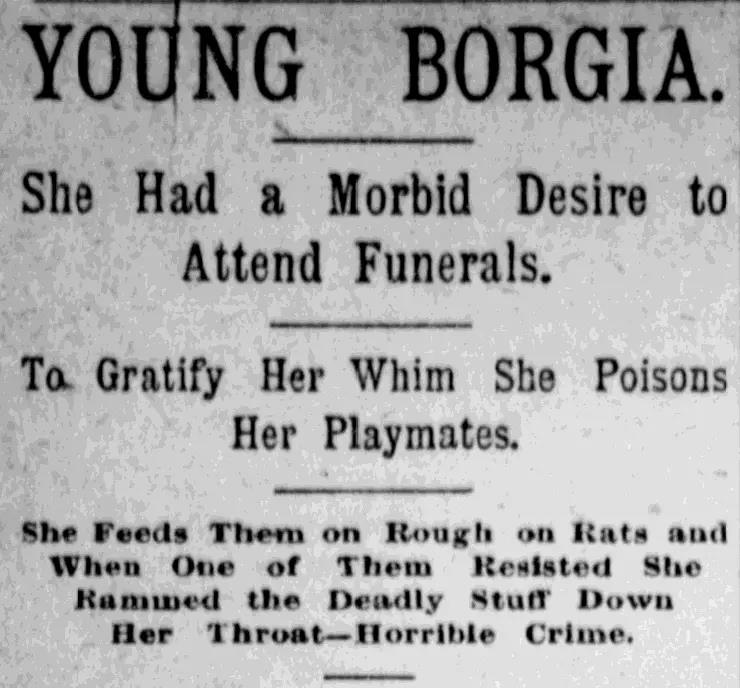
However, when one of the officials bluffed and told Ella someone had seen her making the cocoa, and they knew she’d put poison in it — she opened her eyes wide and said….“Dear me, is that so?” And went on to make a full confession. Telling the adults she’d poisoned Susie and Jennie: “…because she wanted to go to a funeral, and thought they would look so nice dead.” When they asked after Leona’s murder: “Yes, she’s dead. Poor L{eona} But she looked awful pretty and her funeral was awful nice.” When Justice of the Peace Richard asked why she used Rough on Rats, Ella replied: “If it killed rats and mice it would kill children.

(Prompting authorities to exhume poor Leona’s body and send her stomach to Dr. Vandenbergh for analysis.)

On July 16, 1892, Ella was charged with murder.….and this is where things get a bit murky. 

I know on July 18, 1892, Franklin Holdridge (Ella’s Dad) committed Ella to the care of Father Baker’s Institution at Limestone Hill. I believe the “institution” the papers referenced was a protectory. 

Protectories are akin to nonreligious reform or industrial schools. They took in all kinds of kids, from orphans to juvenile delinquents — educated them in religion, morals, and science, then trained them in a trade or for a manufacturing position. Whilst not a prison, Father Baker’s protectory would afford far more supervision and possible rehabilitation for a budding poisoner. (It undoubtedly gave Ella space from her obsession because I can’t imagine the nuns or priests in charge would’ve allowed her to attend funerals or visit the graveyard — given her history.)

In any case, this prompt change of address not only kept the children in Ella’s old neighborhood safe, including her much younger siblings, it might’ve also (possibly) given the jury a reason to find her not guilty. 

I say possibly because, unfortunately, I can’t find any direct news pieces on Ella’s trial. Save a blurb written just under eight years after the events of July 1892. It states that despite Ella’s confession and testimony in which she reiterated her belief that Leona and the others would “…look well dead…” a “…jury didn’t see fit to punish her.” 

Perhaps Ella pleaded insanity? Or, due to her age, her lawyers argued she didn’t understand the enormity of her actions? Or maybe they didn’t want to send a pretty young girl to jail for the rest of her life. I don’t honestly know. However, I suspect it didn’t hurt that of her four victims — Susie, Jennie, and Ervin managed to live through the ordeal she put them through.

I also reckon Ella remained in Father Baker’s care for a spell after her trial, though this is purely conjecture on my part. (Mostly because I can’t see a way for her to return home to Tonawanda after killing a child, no matter the outcome of a trial. Though again, it is possible.)

However, I do know that by the time Ella was about 24, she was married to a man named Neil McGilvray with a baby daughter on the way. In 1905, they had another daughter. In 1908, the family moved to Monessen, Pennsylvania, where Ella would remain for the next 37 years until her death in 1945 at the age of 65.

Rough on Rats: Ella’s Deadly Obssession

Roughly forty years after the publication of Moby Dick and seventy years before Graham Young’s initial poisoning spree — a fourteen-year-old girl named Ella Holdridge lived with her family and three siblings in the small town of Tonawanda in Erie County, New York. Unlike Captain Ahab, who was obsessed with a great white whale or Graham Young, who’s idée fixe was poisons — Ella was spellbound by death.

Whenever she discovered someone in the community passed away — Ella would (according to her stepmother) literally jump for joy, clap her hands, and exclaim, “He’s Dead! He’s Dead!” Her excitement not only stemmed from the death itself but from the knowledge there would be a funeral, a wake, and a fresh grave in her near future. Because, irregardless if she was invited or not, if Ella could attend — she would turn up….Shouldering her way to the front of the queue at the viewing, then to the grave’s edge to witness the coffin being lowered into the earth.

It’s unclear from where Ella’s fascination with death and funerals sprung. Perhaps Ella dimly recalled watching her mother slowly succumb to TB, the inevitable funeral, and the wake that followed. Though as Ella was only 2 or 3 years old at the time, those memories would be murky — but still echoing somewhere within her mind. Or maybe her interest was sparked by newspaper reports of Jack the Ripper’s bloody exploits in Whitechapel — the serial killer’s frenzied attacks roughly spanned the years between Ella’s ninth and thirteenth birthdays. It’s also possible Ella was just naturally inclined towards the macabre. Irregardless of whatever sparked Ella’s interest in death and all its trappings — she was hooked. 

Unfortunately, in the summer of 1892, a drought occurred in the local cemeteries — i.e., a distinct lack of funerals.

Okay, so here’s the thing: During my research, I found a number of GLARING inconsistencies in the news reports pertaining to this case. So, I fact-checked this case as well as I could after 130 years….Which led to a vexing urge to box the ears of the original reporters….

Unlike some of the articles I’ve read from around this time, none of the newspapers (I found) list Ella’s address. However, the Buffalo Weekly Express does mention Ella’s neighborhood. Using a helpful map ap, I discovered three cemeteries lie less than a mile from the cross-streets mentioned: Tonawanda City Cemetery, Saint Francis Cemetery, and Salem Church Cemetery. All of whom were in operation at this time and aligned with Ella’s stepmother’s intelligence.

Next, I found between the three aforementioned cemeteries, there were only 14 burials between January – April, 0 in May and 2 in June. Assuming Ella could only attend a fraction of these 16 funerals — due to things like school, family commitments, and whether or not the deceased family actually held a service. I imagine Ella was desperate to satiate her obsession by the time July of 1892 rolled around.

Which might help to explain what happened next. 

Unlike Graham Young, whose idée fixe I sincerely doubt would allow him to stoop to using a poison as inelegant as Rough on Rats (unless he’d no other options, in other words, during his incarcerations) it suited Ella Holdridge’s purposes just fine. 

On July 7, 1892 — while playing with two-year-old Leona Stermer, Ella gave her a glass of adulterated water. Within hours, Leona was writhing in pain and violently ill. Leona’s parents called in Dr. Harris, who thought she’d contracted cholera morbus (what we now call gastroenteritis) and treated her thusly. Sadly he was unsuccessful as Leona died two days later. (And yes her name is Leona Stermer — not Louisa Sterner, Zoena Stuermer, or Lena as reported in various newspapers. It took some serious crosschecking, but I finally pinned down Leona’s correct name.)

Unbeknownst to the Stermers and Dr. Harris — whilst Leona lay dying, Ella would regularly sidled up and surreptitiously watched the goings on inside the house. After gauging the distress she’d witnessed, Ella would dash back home and say things to her stepmother like: “I guess she’d almost dead now!” (Interestingly enough, this behavior lines up with Graham Young’s during his second poisoning spree. Apparently, he would repeatedly call the hospitals, where his colleagues lay dying of the poison he administered to them, to “check” on them. Presumably so he could update his scientific journals with the most accurate information he could obtain.)

Needless to say, when Leona Stermer was buried on July 11, 1892 — Ella was front and center during the planning, preparation, and execution of Leona’s funeral rites….And no one, not even Ella’s parent’s, suspected anything was amiss with the toddler’s death.

Yet.

My 52 Weeks With Christie: A.Miner©2023

Rough on Rats: Who Really Put the Arsenic in the Coffee?

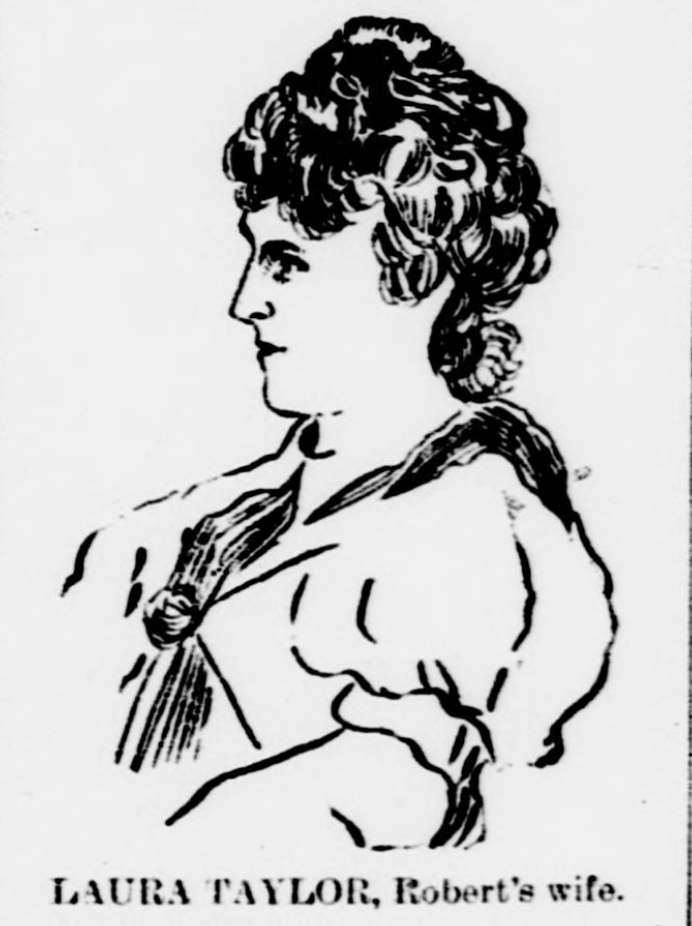
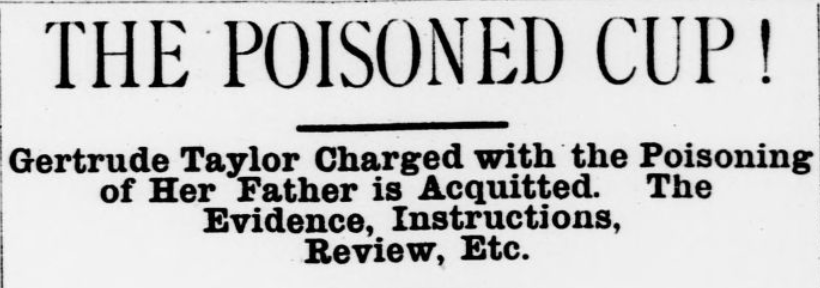
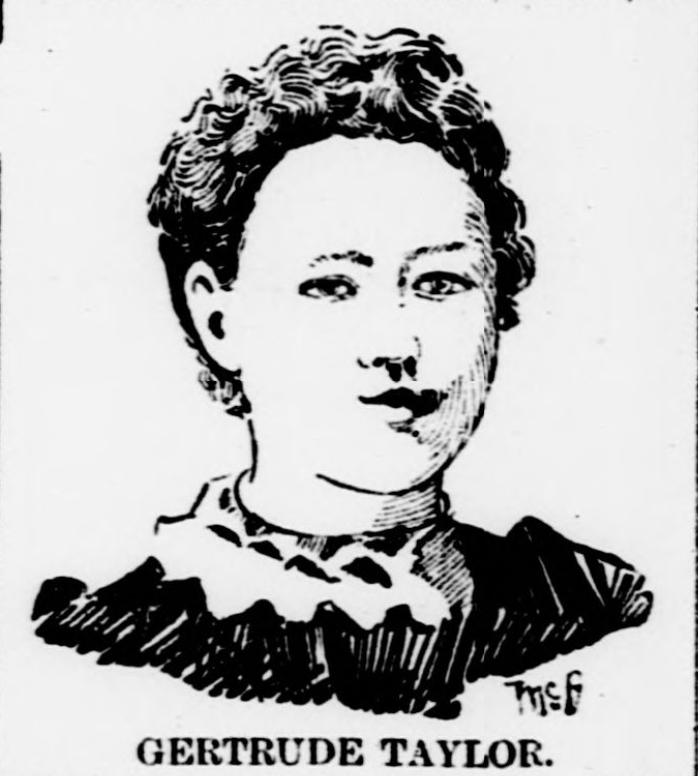
Whilst there weren’t any reports of jiggery-pokery in Gertrude’s trial, there are several odd discrepancies when you compare Gertrude’s single unguarded statement to a reporter against her, Robert, Laura, and (her mother) Sarah’s subsequent testimony.

Ignoring Gertrude’s denial of adding Rough on Rats to the coffee pot, the first disparity between this newspaper clipping and courtroom testimony comes when Gertrude explains what prompted her to buy the box of Rough on Rats. Above, she claims her father sent her to the drugstore to buy the rat poison. In the courtroom, Gertrude switched her story, stating the purchase was made because the night before the murder, her mother commented on how “rats {were} going to take the place.” A statement Sarah, her mother, corroborated under oath. 

So, which is true? 

Did her defense team decide to put forth the trial version, as it had someone who could truthfully attest to its accuracy and doesn’t wholly negate Gertrude’s initial statement to the paper? Or was a convenient circumstance, recalled later, used to mask Gertrude’s childish revenge plan? And if you owned two reasonable explanations for purchasing the poison, why keep mum during Dr. Kaltenbach and her Aunt’s initial inquisitions? Unless you hadn’t anything other than the ugly truth to tell….

However, the most telling inconsistencies betwixt Gertrude’s unscripted answers and later testimony occur over the family’s upright organ and Gertrude’s state of mind. 

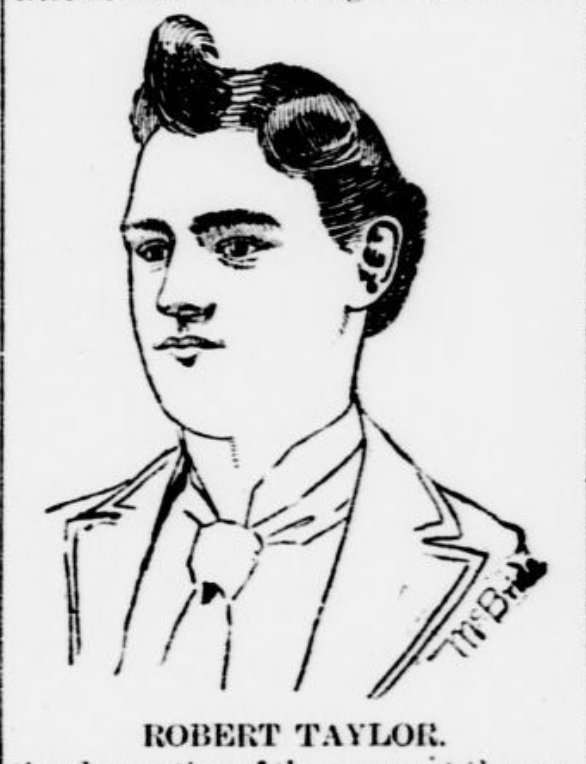
1) Robert: “…no trouble existed between himself…and Gertrude or between his wife and Gertrude….we never had any trouble about the family organ, and had no intention of removing it, from the home of my parents…

—— I suppose it’s just possible that a newly married older brother could’ve been entirely oblivious to his younger sister’s upset….. 

2) Laura: “She seemed envious at times, but this lasted only a short time, and there was no positive enmity between them….Her husband had stated to her that he did not intend to take the organ with them….

—— ….Laura, however, was not oblivious to Gertrude’s jealousy, which conflicts with Robert’s rosy view of their relationship with Gertrude. I also find it difficult to believe Laura didn’t bring up Gertrude’s envy issues with her husband. Because, in theory, he’d have a better idea of how to handle a green-eyed little sister.

Moreover, I think this bit, “Her husband had stated…he did not intend to take the organ…” is a potential lie by omission as Laura’s not revealing her intentions on the organ but simply regurgitating her husband’s. Yes, I know at that point in time, a wife was expected to abide by her husband’s decisions…..But this calls to mind an axiom from My Big Fat Greek Wedding — “The man is the head {of the family}, but the woman is the neck. And she can turn the head any way she wants.” 

3) Sarah: “…Gertie always treated her father as well as any child could. There had never been any trouble between members of the family or children only what would naturally arise.”

—— A belief Sarah could’ve held right up until she poured the poison-laced coffee that night.

On the whole, the testimony of Gertrude’s kin successfully contradicted, or at least partially mitigated, Gertrude’s spontaneous answers on March 20th (above) — and weakened the motive of jealousy the prosecution was trying to establish as the basis for the murder. Though, frankly, I believe Gertrude’s off-the-cuff answers hold more honesty than those of her relations. I think her family split hairs and told what was technically true in order to keep Gertrude from the gallows. 

(And yes, I do believe the prosecution would’ve sought the death penalty against the thirteen-year-old — as five jurors were excused from service due to their “conscientious scruples” against a sentence of death. Hauntingly enough, one of the newspaper articles I found advertised that if Gertrude had been anything other than an attractive young girl, the townspeople would’ve lynched her for allegedly murdering Dillon Taylor. 

Especially since the townspeople of Craig found Gertrude’s unscripted admission of anger and hate tantamount to a confession. On top of this,  Gertrude’s utter lack of emotion and concern at being accused of patricide during her court appearances didn’t help her cause either. A situation Gertrude later remedied by breaking down and weeping whilst on the stand, in front of the all male jury, during her trial.)

In any case, mitigating Gertrude’s motive is all well and good, but her defense needed more. They needed to give the jury an alternate, credible explanation the twelve men could use to find Gertrude not guilty.

The only problem was the classic formula of offering a substitute suspect for the jury to blame wouldn’t work in this case. The only outsider to enter the Taylor home that day was Tyler Cristman, and despite choosing of milk over coffee that evening (the near identical choice Gertrude made, which landed her in the hot seat) — it doesn’t seem anyone ever considered him a suspect in Dillon’s murder. Moreover, during Sarah’s testimony, she stated no one other than Tyler entered their house that day. 

Leaving Gertrude’s attorney only the immediate family to offer up in Gertrude’s place….

Speculation on the Baseness of Human Behavior à la Miss Marple: Sex & Money: Interestingly enough, of these two archetypical motives for murder, Sarah owned half of this quintessential duo — inheriting $100,000 worth of land upon Dillon’s death. 

As for the sex? Perhaps Gertrude correctly recognized her father’s shift of affection but misidentified from whom they moved. Not realizing, in the throws of egocentric youth, Dillon hadn’t transferred his affections from her — but from his wife to his daughter-in-law? If Dillon and Laura started an affair, it would explain why he refused to relent to Gertrude’s pleas over the organ.

BTW — I’m not pulling this theory from thin air.

While both women possessed the opportunity to put the poison in the coffeepot — Gertrude passed through the kitchen when she returned home from her trip to the drugstore, and Sarah prepared supper that night, alone…It was Sarah who poured everyone’s coffee that evening. An ordinary act that could’ve allowed her to guarantee her husband received a lethal amount of arsenic whilst administering smaller doses to herself and the rest of her family. (Hence why only Dillon died. While Robert & Laura recovered a week later.)

Thanks to Asa Sharp’s testimony, we know he kept a store of arsenic on his farm and used it frequently. This could explain how Sarah got ahold of the dangerous element without linking her name to a purchase record. What’s more chilling? Thanks to the bevy of highly publicized poisoning cases, the rodenticide’s main ingredient was less than secret. So what if Sarah purposely prompted her daughter’s purchase of Rough on Rats? Banking on Gertrude’s youth & good looks, her parent’s influence, and her brothers’ money to get her daughter cleared of all charges.

Can you imagine how wild A.C. & Arthur Sharp would’ve become if Gertrude’s attorney presented Sarah as his alternative suspect? Or Robert? Who, according to his own testimony, was alone in the kitchen when Gertrude arrived home — giving him at least the opportunity to put arsenic in the coffee pot.

As it was, Gertrude’s legal team found an entirely different pretext to present to the jury. In an oddly serendipitous event, one week before Gertrude’s trial started, two farmhands found a box of Rough on Rats right around the area where Gertrude told her Aunt she’d lost it. Not only was the box appropriately weathered, having spent nearly two months exposed to the elements — it still bore the druggist’s wrappings.

This piece of evidence, combined with her family’s measured testimony, allowed the jury to reach a not-guilty verdict in less than two hours. 

Leaving Dillon Taylor’s murder, as far as I can tell, unsolved to this day. 

An outcome that I find just as insupportable as Sophia Leonides from Crooked House would’ve. Because how can you ever feel safe amongst your nearest and dearest again? Every sugar cookie at Christmas, each pie eaten at Thanksgiving, every piece of candy procured from a family member at Halloween holds a potentially poisonous center — and it’s not paranoia at play here — one of your next of kin proved themselves capable of committing such a dastardly deed. 

What’s to stop them from striking again?

What’s to say they won’t follow Josephine Leonides’ example and kill anyone who crosses them? Or years later, they let something slip, panic, and murder again to cover their original sin? What if one of your fam follows Edith de Haviland’s example but gets it wrong? Or someone, eaten up by uncertainty, sends both the innocent and guilty to the grave — just to stop the relentless spiral of anxiety and dread?

Whilst sitting here and writing this piece, I can better appreciate why so many of Christie’s detectives (or people close to them) need to find the culprit in manor house mysteries — which, weirdly enough, the very non-fictional murder of Dillon Taylor neatly slips into. It creates a cloud of suspicion that forever clings to those involved, like so much smoke that not even death can fully dissipate.

Don’t believe me?

What if I were to tell you Robert Taylor committed suicide on March 30, 1930? Now, there’s a myriad of reasons why he could’ve hung himself: depression, familial estrangement (in 1889, two years after Gertrude’s trial, he sue his mother and siblings – including his 6yr. old sister Nancy, — for what I don’t know, but it doesn’t speak of happy families), or cancer diagnosis (a disease that claimed his younger brother Duke’s life nine years later). 

But doesn’t a tiny part of you wonder, after thirty-four years and twenty days, if his guilty conscience finally caught up with him?

As for Gertrude, she married sometime around 1900-1901 to a man named Marcus Spencer. They had a daughter about 1903 and another two years later. Gertrude was widowed on August 30, 1915, after her husband died of TB (a disease which, apparently, killed his two sisters and brother before him). Gertrude herself passed away on September 12, 1958, from a cerebral thrombosis at the age of 76.

And, despite all my research, I am none the wiser to who actually murder Dillon Taylor. I lean toward Gertrude, but really her original indictment is based solely on Dr. Kaltenbach’s misgivings and one imprudent interview. And, as we’ve seen in other cases, we don’t know how closely the police looked at the other people seat at the supper table on March 10, 1896….

Leaving open the possibility someone other than Gertrude assassinated Dillon Taylor.

My 52 Weeks With Christie: A.Miner©2023
Rough on Rats: One Doctor’s Suspicions

Dubious of Gertrude’s lucky escape, Dr. Kaltenbach swiftly sussed out Gertrude’s choice of water over coffee was inconsistent with her regular suppertime eating habits. With this nugget of knowledge stuck in his craw, Dr. Kaltenbach continued to care for the rest of the poison-stricken Taylor family — who now needed to contend with making funeral arrangements for their patriarch, Dillon. And whilst they and the extended family handled those details — Dr. Kaltenbach quietly started piecing together a case against Gertrude. 

Knowing he’d need more than his gut feeling and deductions to accuse any member of such an influential family, especially a thirteen-year-old girl, Dr. Kaltenbach set about confirming the coffee was indeed how the poison was administered.

Now For a Deduction On My Part: Whilst the gold standard in detecting arsenic, the Marsh Test, had been around since 1836, there’s a good chance a small-town general practitioner had never performed it. It’s also equally possible Dr. Kaltenbach simply didn’t have the time to conduct the highly sensitive test — as he’d seven or eight seriously sick people to treat whilst trying to keep a weather eye on his prime suspect and the extended family from entering the sickrooms (just in case he’d honed in on the wrong person).

Either way or both, Dr. Kaltenbach decided he only needed to prove poison was present in the coffee for the inevitable inquest into Dillon Taylor’s death, so after securing and spiriting away the leftover coffee from the pot and its dredges for later analysis. He then poured the remnants from the family’s coffee cups into the slop buckets of three hogs and fed them the adulterated mash. When the poor piggies exhibited the exact same symptoms as those experienced by the Taylor family and died — Dr. Kaltenbach knew he’d proven the first portion of his theory.

Which, of course, led to the inevitable question: Where did Gertrude get the arsenic?

Assuming he’d a quiet nose around the obvious places one would store caustic chemicals in a home, without finding any, Dr. Kaltenbach moved on to the next obvious means of acquisition — the town druggist. Turns, mere hours prior to the mass poisoning, Gertrude visited the drugstore and bought a bar of soap and a box of Rough on Rats.

With the druggist William Butts’ information in his hip pocket, Dr. Kaltenbach confronted Gertrude.

At first, Gertrude lied and flat denied possessing Rough on Rats. When Dr. Kaltenbach pressed further, telling her he knew she’d bought a box, she eventually admitted to the purchase. With that established, Dr. Kaltenbach asked where it was, and Gertrude told the doctor she’d secreted it away upstairs. Sending her to fetch it so he could (presumably) inspect how much of the rat poison remained — Gertrude left and never returned. A short time after he’d been left hanging, Dr. Kaltenbach asked Gertrude’s Aunt, Mrs. Ada Sharp, if she could get Gertrude to divulge the information. A task which Mrs. Sharp was only partially able to complete as Gertrude refused to tell her Aunt why she’d bought Rough on Rats, though she did confess to losing the box on the way home.

Armed with all this information, Dr. Kaltenbach related what he’d found out and witnessed during the Coroner’s Inquest held on March 17, 1896. This, in turn, resulted in the exhumation of Dillon Taylor, who’d been buried four days before, for a post-mortem. (During which Dillon’s stomach was removed for chemical analysis….Said testing was performed around May 5, 1896, and the chemist found not only arsenic but powdered glass in Dillon’s organ as well. When the chemist compared what he’d discovered in Dillon’s stomach to a box of Rough on Rats, purchased specifically for this test, the results aligned perfectly. As the fresh two ounce box of Ephraim Well’s rat poison contained about one ounce of powdered arsenic and the rest was powdered glass and starchy substances. The chemist went on to posit each cup of coffee contained about 20 to 24 grains of arsenic — more than enough to kill a man.)

The coroner’s jury also returned a verdict naming Gertrude as the one responsible for her father’s death.

On March 19, 1896 — Gertrude was arrested.

Thanks to a few remarks made to the press prior to the hiring of defense lawyers — we learn that Green Taylor, Dillon’s brother, “….was determined to sift the crime to the bottom and to prosecute the guilty person to the end.” To my ear this sounds a lot like a man who has a doubt or two about his niece’s innocence — but is smart enough to only allude to them when speaking with reporters. However, unlike Edith de Haviland, whose clarity of sight and strength of character allowed her to see what the rest of her family couldn’t or wouldn’t admit to themselves and then act on it, Green Taylor either ended up holding his tongue when he realized thirteen-year-old niece might hang or was persuaded into swallowing Gertrude’s story. 

Whichever way, by the time Gertrude went to trial in May of 1896, Green Taylor sat with his other brother in the court — supporting his niece.

If any influence was exerted on Green Taylor, to shift his stance at least in the public eye, was undoubtedly brought to bear by Gertrude’s other Uncles — A.C. & Arthur Sharp, Gertrude’s mother’s brothers, and most vocal supporters. Not only would they not listen to a word said against their niece, they paid the thirteen-year-old’s $1,000 bail (about $36,000 in today’s money), financed her defense, and told a reporter Gertrude “…would never be convicted if money can save her.” 

As the entire Sharp family was extremely wealthy and prominent in Missouri society — this wasn’t an idle boast. 

My 52 Weeks With Christie: A.Miner©2023
Rough on Rats: The Alleged Cimes of 13yr. old Gertrude Taylor

A jealous hate is different—that rises out of affection and frustration…..I think people more often kill those they love than those they hate. Possibly because only the people you love can really make life unendurable to you.” (Pg. 113)

This Crooked House quote references the real-life case of Constance Kent. Who, at the age of sixteen, took her nearly four-year-old half-brother Francis to the outhouse in the middle of the night and slit his throat….Not because she didn’t love him, but on account of her father — who experts suspect shifted all his affections from the children of his first marriage (Constance) to those of his second (Francis). This changeover provided ample food for the green-eyed monster within Constance to feed upon until that fateful June night when she finally lashed out in revenge. Whilst this is a vast simplification of the circumstances leading to Constance Kent’s penultimate act, it gives you an idea of the point Charles Hayward’s father was trying to make about ‘jealous hate’.

Interestingly enough, if you make a ven diagram with Constance Kent’s motives (jealous hate & revenge) in one circle and Crooked House’s black hat Josephine Leonides’ in another (the puerile rage at being denied ballet lessons) — you’d discover within the overlapping area the alleged crimes of Gertrude Taylor.

Gertrude Taylor (13 yrs) sat smack dab in the middle of Dillon Taylor and his wife Sarah’s brood with two older brothers (24 & 15), one younger brother (11), and a younger sister (4). Between her whipsmart brain, good looks, and status as the eldest daughter — Gertrude was the apple of her father’s eye.

Then came October 1895.

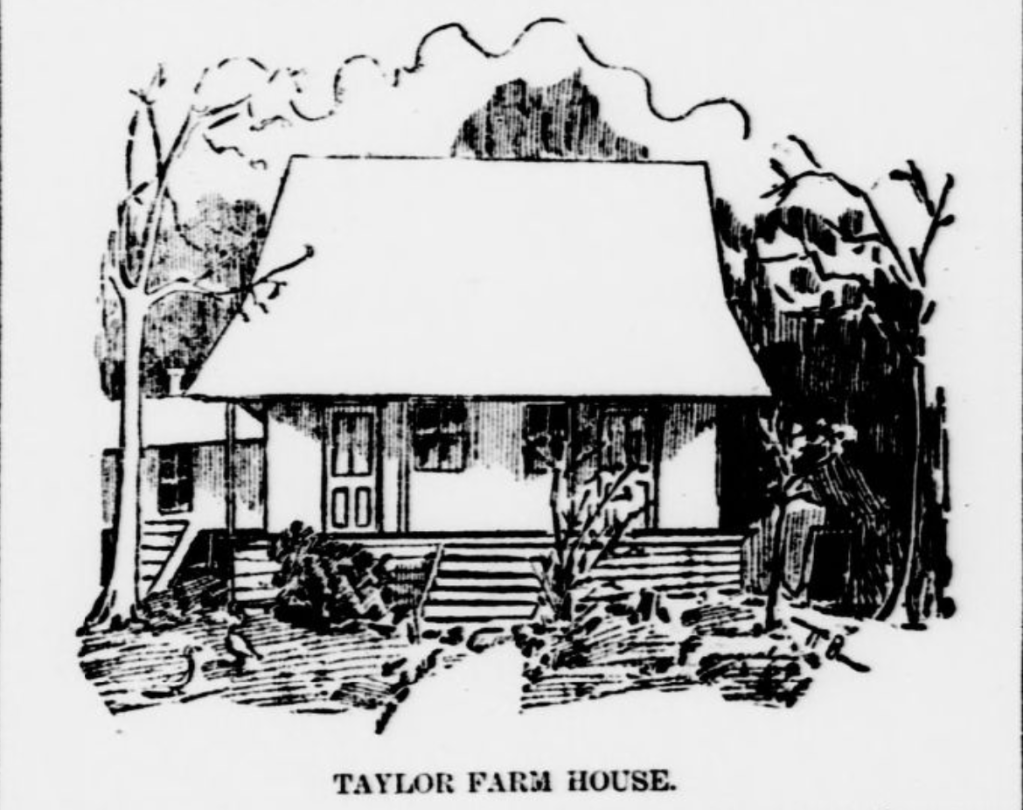
Gertrude’s eldest brother, Robert, married Laura Varnes. Following their nuptials, the newlyweds settled into Robert’s parent’s household — a circumstance everyone knew was temporary as Dillon promised to build them a house somewhere on his farm the next spring. As one of the largest landholders in Craig, Missouri, as well as one of its most prominent families, Dillon and his wife had more than enough space and money to give the couple such a generous gift. 

No big deal…Except…In Gertrude’s eyes, her status as eldest daughter eroded to a certain extent with the addition of Laura to the Taylor family tree. Reading between the lines, it appears Dillon went out of his way to ensure Laura felt welcome, probably hoping it would smooth her transition into his household and into marriage with his son. Knowing his Gertrude enjoyed receiving gifts, Dillon employed a similar tack with Laura, and one afternoon, when in town together, he purchased both her and Gertrude new capes. An occasion Dillon apparently thought nothing of, yet bred resentment in Gertrude — who did not enjoy sharing the spotlight with her new sister-in-law.

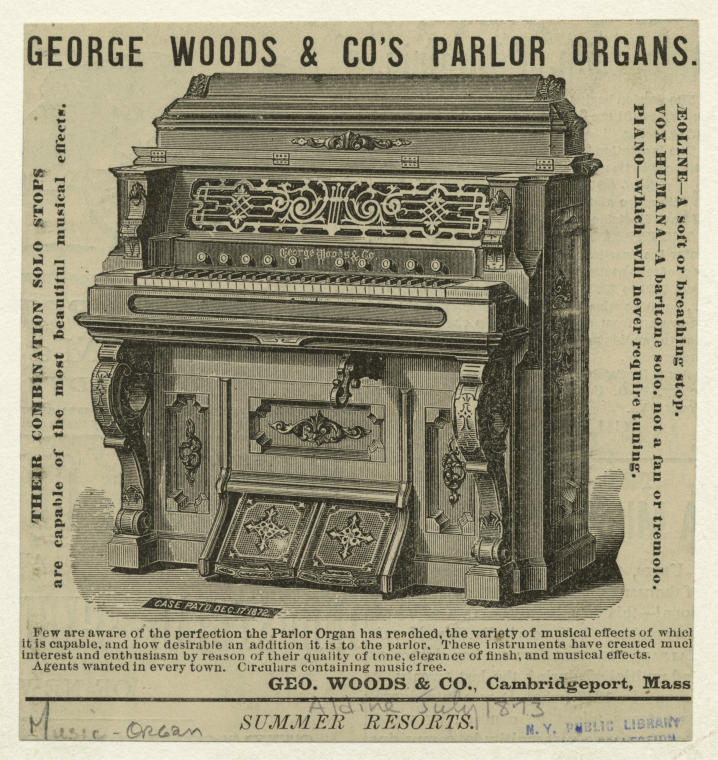
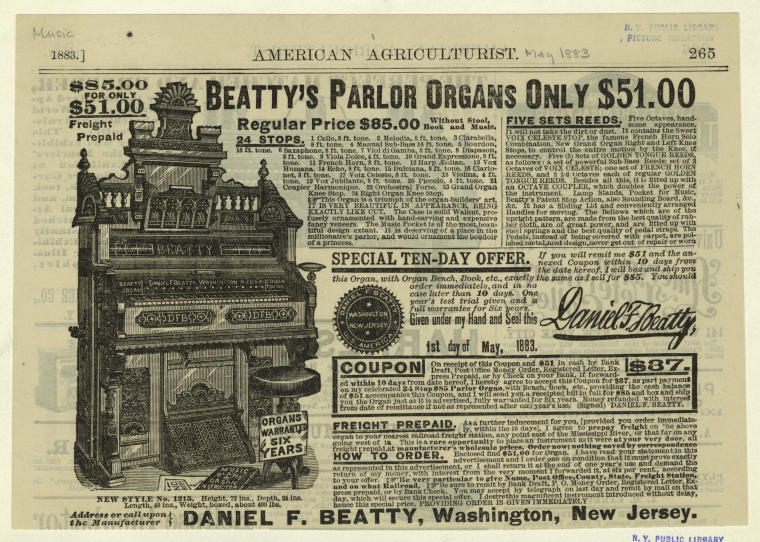
Compounding Gertrude’s rapidly souring situation, at some point between October 1895 and February 1896, Dillon gifted the family’s upright organ to Robert and Laura. Not wanting her sister-in-law to take the instrument away when she moved house, Gertrude begged her father to change his mind — she even threatened to leave home and live with her Aunt should the continue to “be mean to her”.

Yet, Dillon remained steadfast in his decision.

(It’s unclear if either Gertrude or Laura played the instrument. However, according to reports, Dillon usually gave Gertrude whatever she wanted. And his refusal to relent in this particular instance make me suspect Gertrude enjoyed noodling around on the instrument whilst her sister-in-law knew how to play it properly.)

Unsurprisingly, her father’s failure to yield solidified Gertrude’s growing belief that Dillon now favored Laura above herself. A situation that would hurt anyone, but for a thirteen-year-old — it would feel unbearably unfair.

Though the exact straw broke the proverbial camel’s back remains a mystery, we know events came to a head on March 10, 1896.

That evening at the supper table, Sarah worked her way around the two tables (one for the adults and the other for the kids — the latter of which Gertrude sat at), pouring coffee into everyone’s cup. Noting the unusual aroma wafting from the pot, Sarah commented on it, and everyone agreed with her assessment. Then, of course, the entire party took a sip and discovered the liquid tasted unusually bitter as well. Chalking up the odd taste to the grinder not being adequately cleaned after milling peppercorns — everyone continued consuming the coffee….until it began burning their throats.

Within minutes, everyone started feeling massively ill. 

Suspecting his family had been poisoned en masse, Dillon asked his dinner guest, Tyler Cristman, to fetch a doctor. (As Tyler had drank milk with dinner and only sipped the coffee when everyone started complaining about it, the gut-wrenching sickness afflicting everyone else took longer to present itself in him.) By the time he returned with Dr. Kaltenbach in tow, the entire Taylor family was crippled with stomach cramps, nausea, and vomiting. After hearing about the strange tasting coffee, Dr. Kaltenbach agreed with Dillon’s theory and deduced they were suffering from acute arsenic poisoning. 

The good doctor also noticed one member of the ill-fated dinner party who failed to show a single sign of sickness — Gertrude. Seems she’d eschewed the coffee, in favor of a glass of water on this particular evening.

This observation and explanation set wheels into motion.

Not willing to take any chances with a potential poisoner in the house, Dr. Kaltenbach not only secured the aid of a couple of other local doctors (allowing for better care whilst adding extra sets of eyes), he barred nearly everyone from visiting the afflicted (including Gertrude and the majority of the extended family). Dr. Kaltenbach even went so far as to lock the sickroom’s doors. 

Sadly, despite his best efforts, Dillon died less than twenty-four-hours later.

My 52 Weeks With Christie: A.Miner©2023

Rough on Rats: (Un)Truth In Advertising

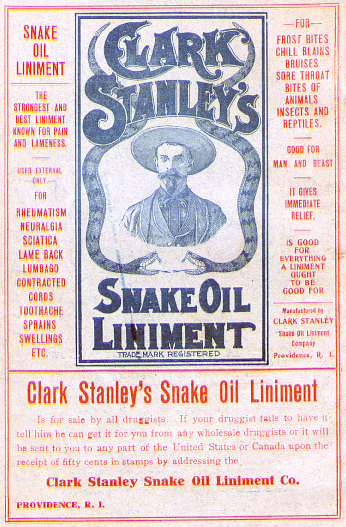
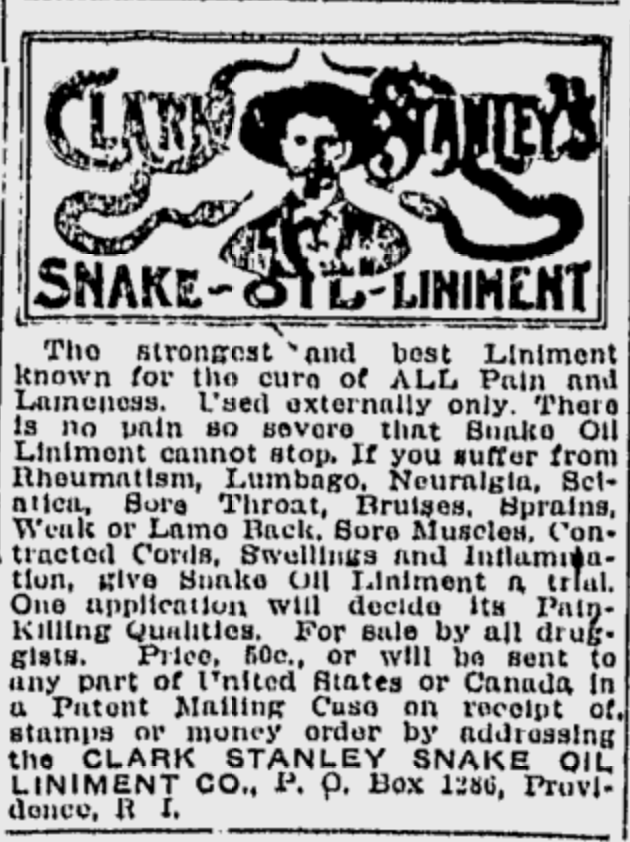
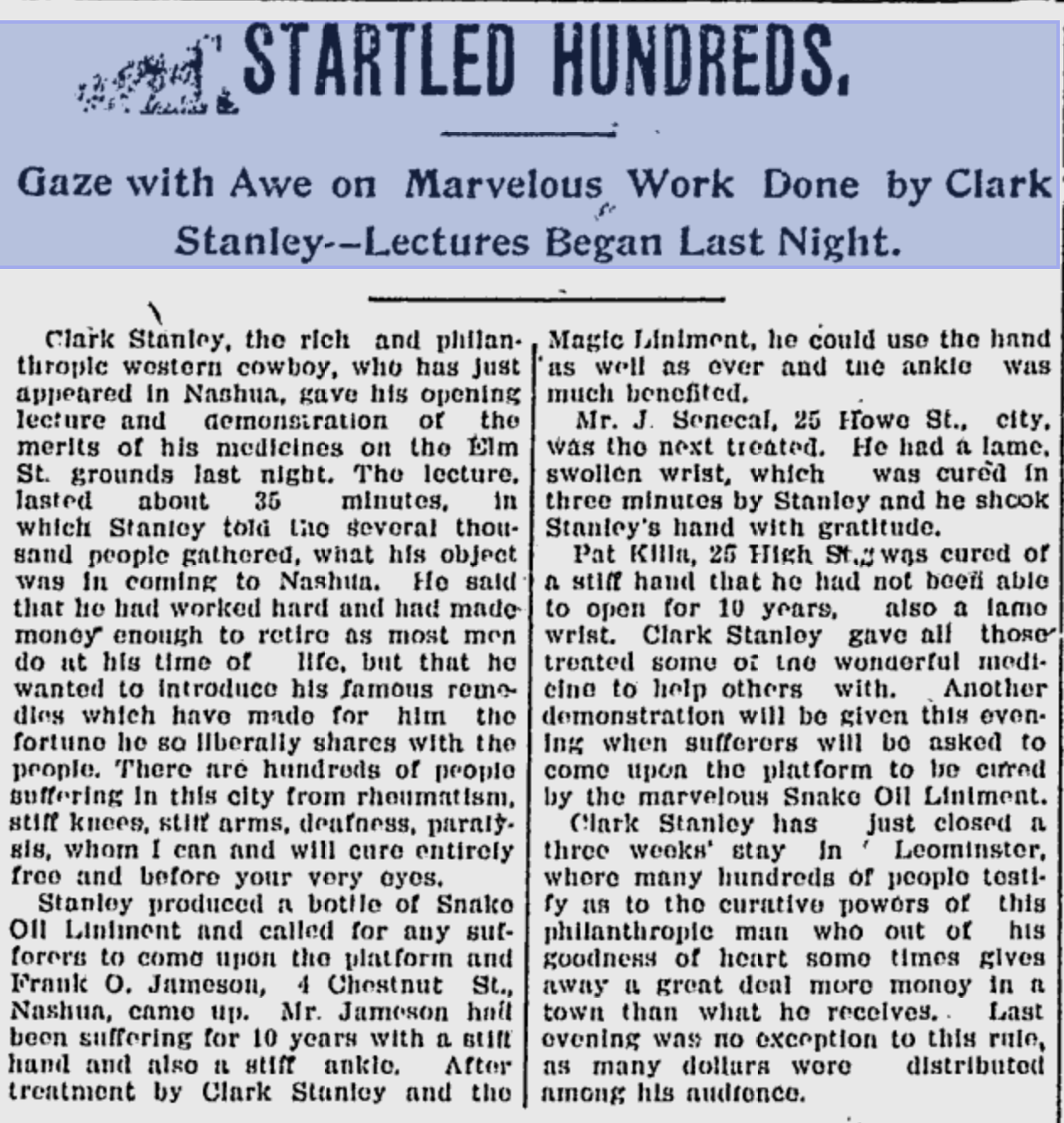
Ever wondered how ‘snake oil’ came to epitomize quack medicine? Or who the first snake oil salesman was? (Well, thanks to a great book called Quackery and some research, I can tell you.) During the 1893 World’s Fair in Chicago, a man named Clark Stanley took to one of the Fair’s many stages. Dressed in the height of frontier fashion, he produced a rattlesnake from a bag and then proceeded to slit it open in front of the crowd. Ignoring the blood and gore, Stanley plunged the snake into boiling water. Then he waited for the snake’s fat to rise to the surface, whereupon he skimmed it off, mixed it into a pre-prepared solution, stoppered the bottles, and sold it to an eager crowd under the name Clark Stanley’s Snake Oil Liniment.

Over the next twenty-three years, Stanley’s liniment would make him a fortune. Then came Upton Sinclair’s graphic and stomach-turning expose on the meat packing industry — which inspired the passage of the 1906 Pure Food and Drug Act. 

From the title of the Act, you can guess where this is going.

The Drug portion of the Act allowed federal authorities to target patent medicines. These proprietary “medicines,” also known as nostrums, salves, powders, balms, elixirs, drafts, syrups, tinctures, essences, and liniments, DID NOT patent their ingredients or formulas. Instead, they trademarked their names, labels, packaging, and/or bottle shapes. Meaning that up until the 1906 Act of Congress, the hucksters of these “medicines” didn’t (generally) need to worry about doctors, chemists, or other interested parties testing their effectiveness. Hence, manufacturers rarely placed an ingredient list on their products or, like Stanley’s Liniment, only provided one or two key (usually “exotic”) components. Whilst claiming they’d cure you of everything from the common cold, aches & pains, cancer, sexually transmitted diseases, and death — amongst other things.

Yeah……You laugh, but common sense often gets tossed out the window when desperation settles in for an extended stay.

In any case, Stanley got away with selling his Snake Oil Liniment until May 20, 1916. When crates of his Snake Oil, bound for Massachusetts, were seized by federal authorities and analyzed by the Bureau of Chemistry. In short order scientists revealed Stanley’s secret formula: “light mineral oil (petroleum product) mixed with about 1 per cent of fatty oil (probably beef fat), capsaicin, and possibly a trace of camphor and turpentine.”

Unsurprisingly, not a single microscopic mote of snake, rattle or otherwise, was found within the liniment. 

As these ingredients did not cure pain, lameness, rheumatism, sciatica, paralysis, inflammation, animal & insect bites, or reptile/insect/animal poison — as the Snake Oil literature claimed…..Led Stanley to plead nolo contendere (which means Stanley accepted the conviction as if he pleaded guilty without actually admitting he did anything wrong) and pay a twenty-dollar fine (about $576 in today’s money).

Now, by comparison to the majority of his contemporaries who used things like grain alcohol, cocaine, opium, morphine, strychnine, lead, uranium, and radium in their products — Stanley’s Snake Oil Liniment was pretty safe (if one followed the recommendation on the advert — “Used Externally Only”). The problem was anyone who picked up a newspaper back then was inundated with adverts for these dodgy cure-all concoctions — because the ad revenue they generated paid the bills. 

Enter Ephraim Stockton Wells. 

By the Spring of 1862, Ephraim owned and operated a drugstore on Monticello & Harrison Avenue in Jersey City, New Jersey. One day, whilst he was helping customers in the front of the shop — rats tucked into his lunch in the back. Upon discovering the sad remains of his midday meal, Ephraim vowed revenge on the vermin who’d left him with an empty stomach. Drawing on all his knowledge of chemistry and drugs, Ephraim concocted a deadly compound to rid the world of the rodent scourge. When he told his wife of his plan, she joked about him being rough on rats — and the name stuck. (This origin story, of which there are several variants, probably contains a small kernel of truth.)

From 1863 to 1880, Rough on Rats would be Ephraim’s side hustle.

Initially, Wells only sold the deadly rodenticide at his Jersey City drugstore. Then, perhaps, after casting an eye across the shelves of patent medicine his store stocked and his customers bought by the bag full, Ephraim recalled an episode from a few years earlier. After the NYC drugstore he worked at unexpectedly folded, Ephraim placed an advert about himself in a newspaper, and by the next week, he’d a job in Michigan. Either inspired by these real life events or simply following in his contemporaries’ footsteps — Ephraim patented the name Rough on Rats. And in a stroke of genius or foresight, Ephraim also patented similar sounding names, to thwart future competition. (Moreover, Ephraim would end up employing a veritable fleet of lawyers to defend his trademarks.) With his brand now secure Ephraim moved onto phase two, and between 1872-1880 he spent forty-thousand dollars (which is just shy of 1.2 million dollars in today’s money) advertising Rough on Rats in newspapers across the country.

This ambitious gamble nearly bankrupted him. 

However, by 1881, Ephraim’s investment paid off. Allowing him to sell his drugstore, convert another property into a manufacturing facility, and focus all his energies on growing his mail-order business. Which he did with relish. Not only did Ephraim place $140,000 worth of adverts, of his own design, in every magazine and newspaper he could think of every year for the next twelve years — he also expanded his empire into England, New Zealand, and Australia. Seeking trademark protection in each new country to once again keep “imitators” at bay. 

The only problem? Ephraim’s multi-national trademark hid a dirty little secret: Rough on Rats’ primary component was white arsenic.

Known since Cleopatra’s time, refined by the Borgias, and made cheaply available via the Industrial Revolution — by 1862, everyone from emperors to paupers knew of arsenic’s legendary lethality. (Thereby making Ephraim’s claim he “used all his knowledge of chemistry and drugs” to concoct his popular product a bit of a stretch.) And despite Rough on Rats failure to disclose its secret ingredient, it didn’t take long for the general public to work out that Rough on Rats worked just as well on humans as it did on vermin. 

This omission, when taken in conjunction with Rough on Rats adverts, poses an ethical conundrum — i.e. how much responsibility should Ephraim Stockton Wells shoulder in the hundreds, if not thousands, of non-rodent related deaths connected to Rough on Rats? 

In the majority of murders linked to the rodenticide, I’d agree Ephraim’s conscience is clear — except — in one narrow category: Where kids purchased, administered, and murdered with Rough on Rats. Whilst regulation on the sale of arsenic were inconsistent at the state level in the US — by 1872 (the start of Rough on Rats heyday) most restricted the sale of arsenic to minors. Meaning, Ephraim’s omission allowed kids to buy poison they’d otherwise be denied.

A flaw in the law which Gertrude Taylor slipped through in 1896.

My 52 weeks With Christie: A.Miner©2023

Rough on Rats: Crooked House, Kids Who Kill & Two Motives

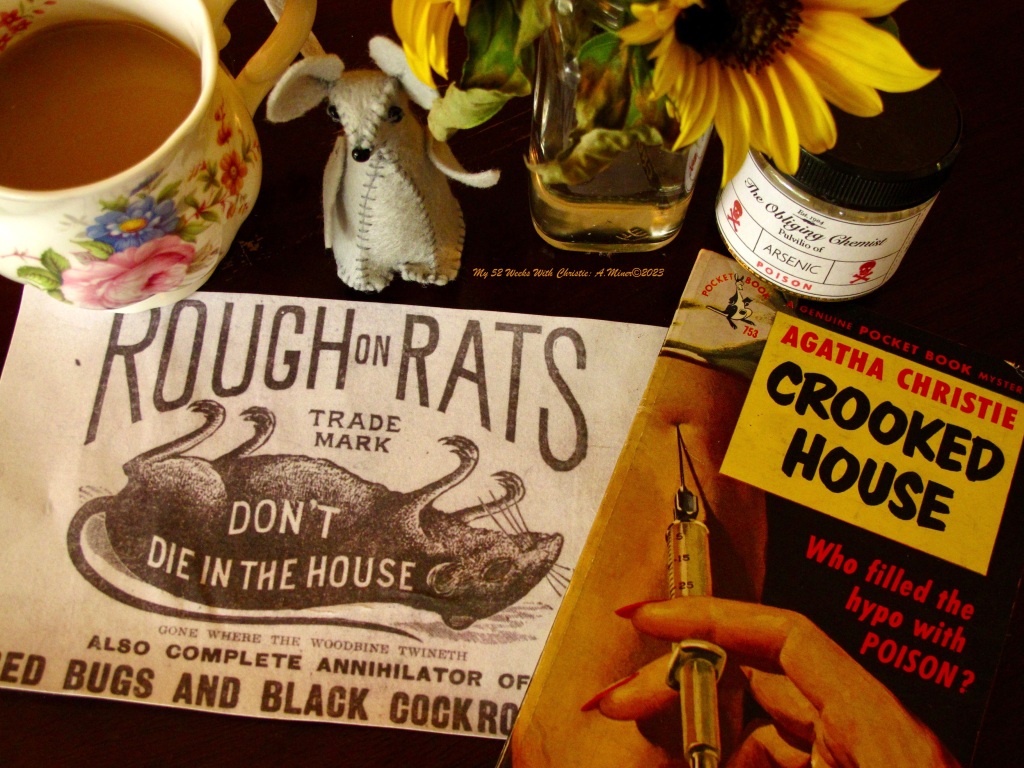
From the Office of Spoilers: If you’ve not read Crooked House by Agatha Christie, I suggest you do — then read my vintage true crime posts as one directly impacts the other. However, if you’ve no qualms with knowing the ending of a book before you begin it, read on. Either way, you’ve been warned.

Now, on with the show.

According to experts, far more learned than I, Agatha Christie’s publisher, William Collins (of Collins Crime Club fame), found the ending of Crooked House so shocking he requested Christie change it. 

She declined.

By leaving the novel untouched, Crooked House now stands as one of the best twist endings in Christie’s entire catalogue of works (second only to The Murder of Roger Ackroyd — in my humble estimation). Though, on reflection, I’m not sure exactly why the revelation of Aristide Leonides’ murderer harkens such disbelief. Within moments of meeting our malefactor, they give us their motive; Charles Hayward’s Old Man practically spells out the whys & wherefores a few pages later, and Charles himself catches sight of the penultimate clue. Yet, for the past seventy-four years, the solution continues to blindside readers. And therein lies Christie’s cunning, the ability to mark and exploit our collective blindspots….…..Because how often, really, would you look at a kid and see a poisoner?

Turns out, more often than you’d think.

Some follow the pattern set by Crooked House’s thirteen year old baddie Josephine Leonides, whose motive for murdering her grandfather was his refusal to pay for her ballet lessons. By adult eyes, Josephine’s reason seems childish, and despite her being fictional — she’s not alone in this brand of flawed rationale. In my research for this set of posts, I’ve discovered kids who’ve killed because they were rebuked too often by their mother, because their father thwarted their ambition to become a train robber, and because they wanted to see if their “chubby” playmate’s insides resembled that of pig’s (that was a singularly gruesome crime).

However, it’s the crimes of Gertrude Taylor, a case I’ll explore in more detail in this series, which reminded me forcibly of Josephine’s puerile impulse to pick up a bottle of poison. Not only did she target her nearest and dearest, but she did so so her brother wouldn’t take his upright organ with him when he moved house. 

Yet other kids find themselves following (roughly) in the obsessive footsteps of the Tea Cup Poisoner. 

Graham Young’s fascination with poisons not only led to an in-depth study into the subject, at the age of fourteen he started experimenting with them….on his family and friends. In some respects, Young’s diabolical deeds are unique. His ability to dazzle druggists with his knowledge to procure deadly substances like thallium, antimony, atropine, aconitine, and digitalis sets him apart from most other child poisoners. 

However, the overwhelming obsession that led to Young’s abominable “experimentation” is not. 

Seventy years before and across the pond, another fourteen-year-old named Ella Holdridge found herself utterly transfixed, not by poisons, but by death. Whilst her family and friends considered it an odd fixation for a young girl, no one thought much about it. Until the summer of 1892, when, due to a distinct lack of local funerals she could attend, Ella took it upon herself to supply the local churchyard with a fresh corpse….Another case I’ll cover in the next few weeks.

Above and beyond Gertrude Taylor and Ella Holdridge’s ages, alleged crimes, and underdeveloped moral muscles — one more feature unifies this pair of kid killers: A self-made man who built his empire upon the back of dead rats. 

Ephraim Stockton Wells.

My 52 Weeks With Christie: A.Miner©2023