Mystery Review: The News From Fair Verona….

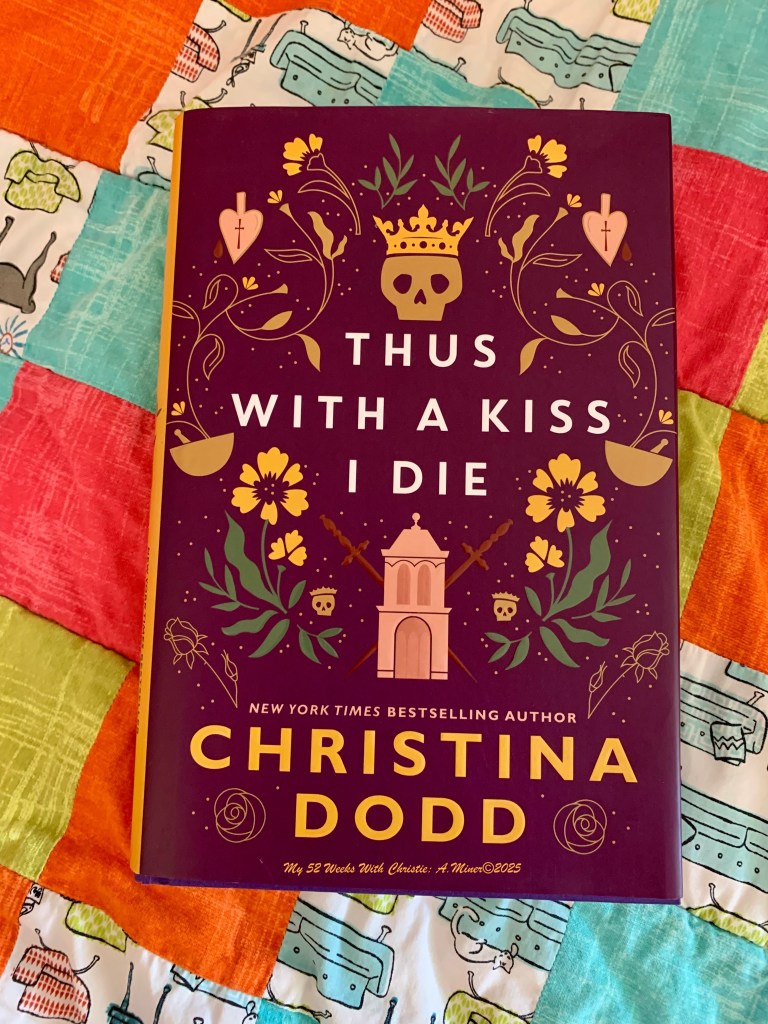
Thus With A Kiss I Die — Christiena Dodd

Akin to many high school students, I read Shakespeare’s Romeo & Juliet in English class during my sophomore year. During that month-long unit, in which we learned a bit of history, language, and the biography of The Bard himself, I did not find my love of Shakespearean plays. The protracted timeline of reading four acts stuffed with 25,993 words, plus the inevitable essay test at the end, completely drained the joy of reading the text away. 

Now, I understand the pressure our teacher was under, walking the tightrope between managing her classroom, the curriculum, and parents looking for any reason to censor/ban the play. In fairness, I have read Romeo & Juliet multiple times since high school. However, it’s been a minute since I delved into Shakespeare’s iambic pentameter, and I’d forgotten just how violent The Bard’s world could be — but fortunately, Christina Dodd didn’t. 

Within Thus With A Kiss I Die, we find our fair Rosaline faced with several mysteries, emergencies, and potential tragedies within Verona. Not the least of which: Who assassinated the last Prince of Verona? If, and it’s a big if, Rosaline is going to wed the current Prince (the son of said murdered man), this question needs to be laid to rest. Otherwise, how will she ever sleep safe and sound within the palace? 

Especially since the former Prince and potential father-in-law is now haunting her.

Thus With A Kiss I Diethe second installment featuring the daughter of Romeo & Juliet, is a tad darker than the first in series. However, as it pays homage to Hamlet, I’d expect nothing less. Never fear, Dodd does a masterful job of balancing these potentially tragic themes with wit and more than a bit of bawdy humor. 

Thus With A Kiss I Die is a superb follow-up to A Daughter of Fair Verona — which you should read before starting the second installment. Happily, Dodd doesn’t spoil the first book by giving away the murderer’s identity in the second (a pet peeve of mine). However, there are several ongoing storylines that might leave you a bit adrift if you’re not already acquainted with them. Plus, A Daughter of Verona is such an excellent read, I doubt you’ll feel vexed by needing to read the first book first.

BTW: You don’t need to know much more than the broadest of strokes of Romeo & Juliet to enjoy these books. So don’t let the literary influence deter you from reading these two books!

Mystery Review: A new twist on Romeo & Juliet

A Daughter of Fair Verona — Christina Dodd

If Seattle Mystery Bookshop were still breathing, I’d have at least five copies of this book on my recommendation shelf! No, probably ten. Seriously, it’s been a long while since I’ve giggled/snorted/chortled out loud this much whilst reading a mystery. Christina Dodd does an excellent job of blending Shakespeare’s characters, language, the values of the day, moods, and manners with today’s sensibilities. Yet the dark undercurrents lurking beneath the laughs (one would expect nothing less of a book based on the Bard’s body of work), keep A Daughter of Fair Verona from becoming a parody of Shakespeare’s original work.

But I’m getting ahead of myself. 

A Daughter of Fair Verona is about Rosaline, the eldest daughter of Romeo & Juliet. Yes, that Romeo and Juliet. Turns out, the aim of a dagger held by a thirteen-year-old girl isn’t quite as true as one would suppose. As for the bottle of poison? Romeo fell victim to biology — as it isn’t uncommon for those who ingest a large quantity of a toxic substance to vomit it right back up again. In this case, this biological safeguard allowed Romeo to survive and live happily ever after with his Juliet.

Fast forward nineteen years.

Rosaline, the eldest daughter of the ever growing Montague family, has every intention of remaining a spinster. After nearly two decades of witnessing Romeo and Juliet’s passion (apparently, their drama did not taper off as they got older), Rosaline wants nothing to do with marriage, passion, and romance — despite her parents’ efforts to match her with a mate.

Attempts which Rosaline repeatedly manages to sidestep rather neatly. 

Unfortunately, neither paternal unit has given up on settling Rosaline into her “happily ever after”. And, for the fourth time, they announce they’ve found their eldest daughter a husband. Who, unfortunately, turns up with a knife in his chest during his and Rosaline’s engagement ball….And the murderer is just getting started.

I cannot impress upon y’all how much fun this book is! Seriously, Dodd captures both the darkness and light of Shakespeare’s work. Even better? There are no asides explaining the cultural/societal norms of Shakespearean literature, nor are there history lessons or footnotes that explain politics. Dodd keeps the narrative focused on Rosaline and the mystery, allowing the plot to unfold at full tilt from the front to back cover. 

If my shelf were still around, I would grab a copy of A Daughter of Fair Verona and press it into your hands, telling you, “trust me, you’re going to have fun.”

2014 Part One: Shakespeare, Three Witches, & Evil

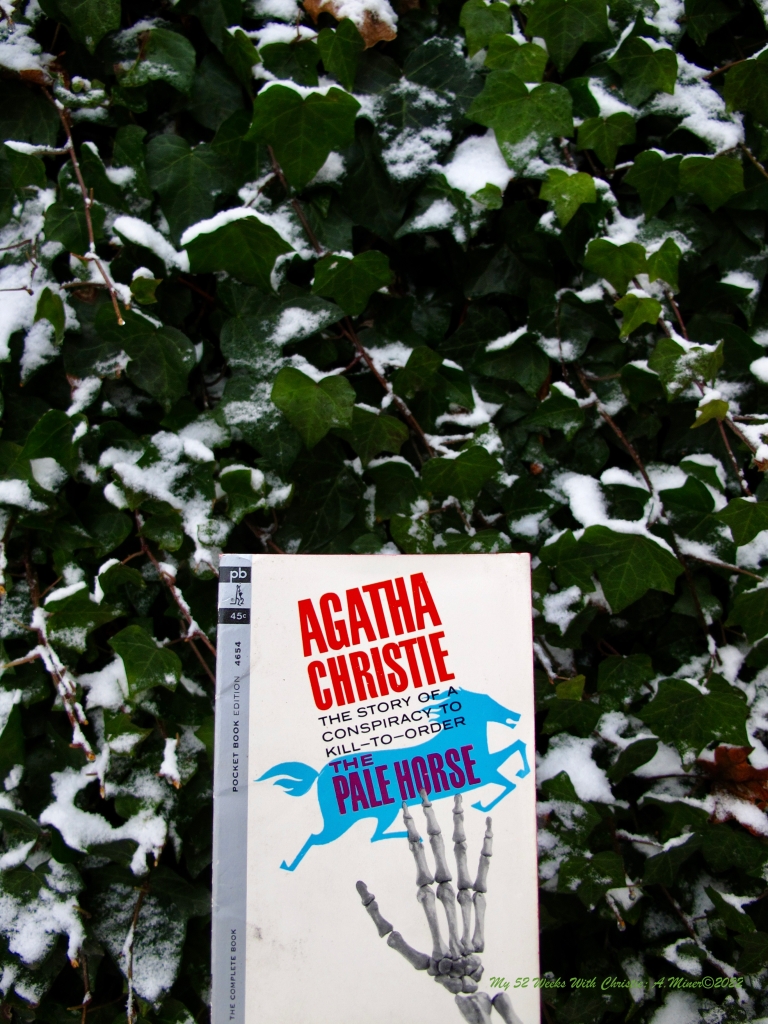
My 52 Weeks With Christie: My 2014 Review of The Pale Horse

First Published: The Pale Horse. Collins Crime Club, UK, 1961.

I Read: The Pale Horse. Pocket Books, New York, 1967.

Series: Ariadne Oliver

Summary: It starts with a priest, who hears the last confession of a dying woman unlike any he’s heard before. The woman gives him a list of names of connected somehow to wickedness, before the Father can do anything about the list he is brutally murdered. The investigating officer police find said list and discovers the names on the list belong to people who have recently passed away, seemingly of natural causes.

The police surgeon is not so sure.

At the same time through a series of crazy random happenstances Mark Easterbrook becomes involved in the investigation. Discovering the deaths all seem to revolve around  something called The Pale Horse, “Revelation, Chapter Six, Verse Eight. And I looked, and behold a pale horse: and his name that sat on him was Death, and Hell followed him…” (pg. 209). Mark, not one to believe in the supernatural, decides to look for a more concrete solution to how the people on the list really died…

Review: This book, like many before it, is a fantastic read. One which contemplates the nature of evil; not in a preachy way, more Shakespearian in feel. Through this contemplation on the nature of evil Christie creates a clinging sinister atmosphere on each page of the book. Making you all most believe she will write her first supernatural solution to a mystery novel, thus breaking the Rules of Fair Play. Once again Christie does a wonderful job playing with her audience’s comfort levels and preconceived notions about things we cannot always explain satisfactorily. 

I really loved this book, again not overly surprising. However just like the Miss Marple in The Moving Finger, Ariadne Oliver plays a very small role in the narrative (however larger than Marple in Moving Finger). A deus ex machina role for Oliver which provides Mark Easterbrook with the inspiration for the solution to the mystery. Which I found slightly disappointing as this is the only independent encounter with Oliver outside of the Poirot series.  This is really such a small thing it did not perceptibly diminish my enjoyment of the read, just something to know going into the book.

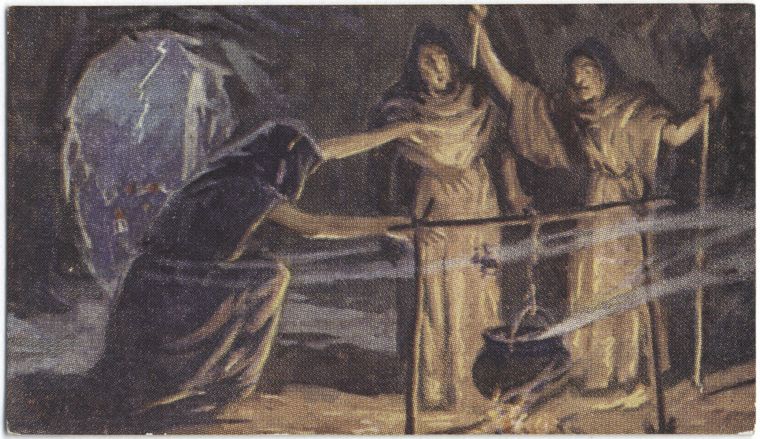
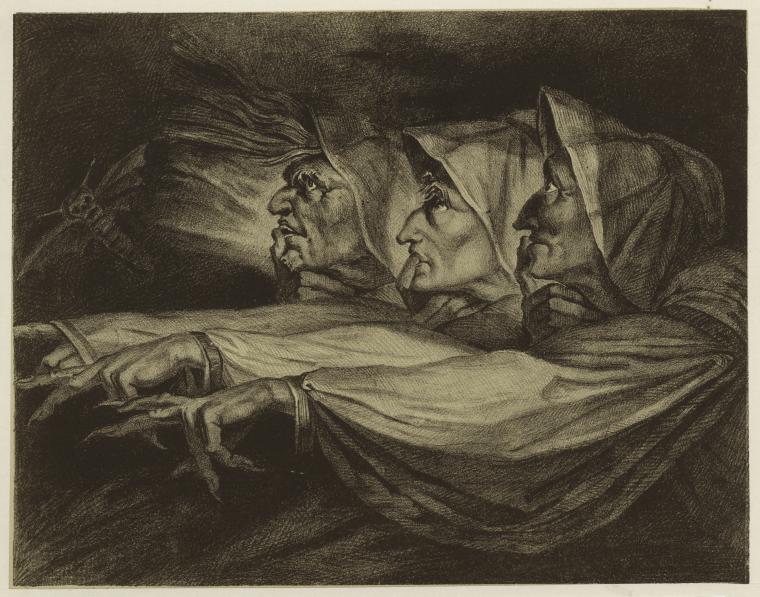
Speaking of a menacing Shakespearian feel to a novel…..How many of you out there have seen a performance of The Scottish Play? You know the one I mean, the name that thespians do their absolute level best not to say on stage (or anywhere else for that matter)…. Have you ever given any thought to how the three witches in the beginning of the play are represented? Often the actress dressed up to look like old crones with hooked warty noses, long black robes, conical hats and black cats. Seemingly almost unhinged in nature uttering their prophesies for Banquo and his fellow general, more akin to monsters than women.

Did you ever think this is a safe way of portraying evil?

David (minor character from The Pale Horse) a thespian during his college years had a different idea of how to portray the three, “I’d make them very ordinary. Just sly quiet old women. Like the witches in a country village.” (pg. 33). I say I have to agree with David on this point, and subsequently Christie since she is the one who penned the book (and Fran who also things this would be brilliant staging). Done right this could lend an extra layer of malevolence to the three witches scenes. Why? In general we want to be able to identify evil at a glance, we want the stereo typical indicators, we want to Know who to watch out for.

Portraying evil as ordinary means it can creep or seduce its way into out lives without our noticing, making it difficult to ward ourselves against. 

This is one reason serial killers or rapists haunt our imagination, since more often than not they look ordinary. Sometimes they are even charismatic or charming in their way. The ones who have been caught and shown on the news don’t seem to have any one trait to identify them as serial killers. No twitch, sign or limp identifies them to the police and the public as a dangerous individual. Profilers, psychologists and police officers who have extensive training can — through psychology and experience not a birthmark. This is one underlying reason why they seem to be so difficult to catch. But I digress.

This idea of ordinary evil is what makes The Pale Horse such a singular sinister book!

(BTW — if you want to see a really great version of The Scottish Play, click here. Patrick Stuart plays the lead and the three witches are seriously eerie/creepy!)

AmberMiner©2014