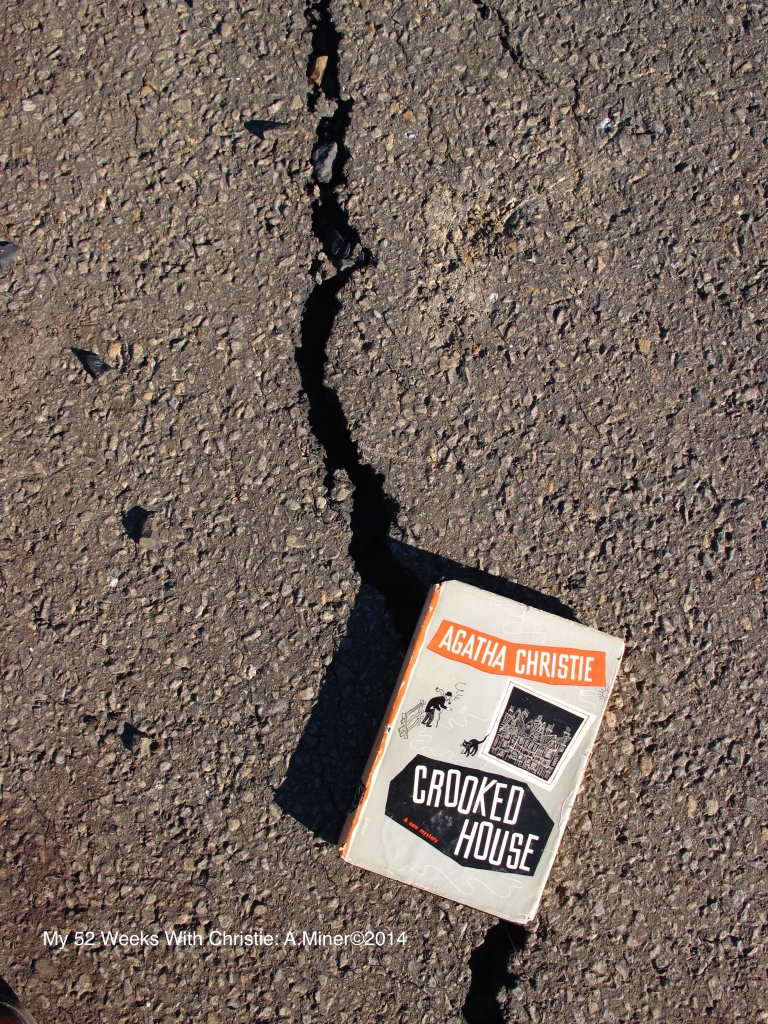
Crooked House
First Published: In Cosmopolitan (US magazine) in 1948.
I Read: Crooked House. Harper, New York, 2011.
Series: Stand Alone.
Detective: Charles Hayward
Summary: Charles and Sophia met overseas, fell in love and were separated by their duties in the War. They decided if they lived through it and still liked each other then they would get married. Two years later the War is over, both are back in England and Charles meets with Sophie to reaffirm their arrangements. While the war is finished, there is an unexpected battle on the home front — Sophia’s grandfather, patriarch of the Leonide’s family, has been murdered. The whole family is convinced his second, and much younger, wife is the culprit. However there is little evidence against her, and everyone who lives in the house had a pretty good motive for murder. And much to Charles’s consternation, Sophia refuses to marry him until the mystery is put to bed, giving him a very strong motive to see the whole business through…
Review:Much like the Murder Of Roger Ackroyd, either you know how the book ends or you do not and I cannot really review it for fear of spoiling the ending. Suffice it to say I thought this book brilliantly clever; you can tell Christie had fun while writing it. The mystery itself is a bit different, as the Rules of Fair Play, which normally Christie strictly adheres to, she took a bit of liberty with them in this mystery. You see, there are really only two clues which give a hint as to who the culprit is and even then they are a bit convoluted. The ending makes complete and utter sense when you read it, however the ability to reach the correct conclusion on your own, well, let’s just say it is a bit more difficult than usual.
One of the best characters in the book beyond the Charles Hayward and Sophia was Sofia’s great aunt Edith de Haviland. Edith was the only one in the whole of the Leonide family who figured out who committed the murder. Charles thought, “I had a suspicion that there might be more going on under the battered felt hat than I knew.” (pg. 35), and he wasn’t wrong in his assessment of Edith. Which brings us to an important point, Christie’s use of spinsters in key roles in her mysteries.
It all started when Michael Morton cut Caroline Sheppard from the stage adaptation of The Murder Of Roger Ackroyd and replaced her with a young girl (“for plot purposes” is the phrase I heard when I read this snippet of information, it has no basis in fact — just in my imagination). Caroline Sheppard was the spinster sister of Doctor Sheppard; she seemed abreast everything going on in the village without ever leaving her house. This directorial cut catalyzing Dame Christie into giving a voice to those women who never married and never had children (and were past reproductive age) — in other words the spinster.
Using notes from Caroline Sheppard and her memories of her grandmother (& her grandmother’s friends) — Christie created her second beloved sleuth, Miss Marple (btw Christie is one of the only authors to have created two equally famous sleuths). Christie was not alone in putting this group on the literary map; Miss Marple is just arguable one of the most popular. As a group I find them an interesting read, as they are allowed to do things which married or single ladies are not. And obviously with her use of Edith in Crooked House, Miss Marple is not the end of the line in Christie’s use of this type of character, I cannot wait until I meet another spinster!
Random (And Almost Relevant) Facts: During the period in which Christie was penning her mysteries, there were a plethora of spinsters populating the world. Why? World Wars One and Two had decimated the numbers of eligible males. Millions of men died at sea, in trenches and on beaches — creating a “surplus” of marriageable women back home after the wars. This allowed for the rise of respectability among this group, since mathematically speaking it was infinitely harder to “find” a husband (or for that matter remarry, since so many husbands and fiancees died as well).
And since I am on a roll….
Mother Teresa is not a spinster. While researching spinsters I found many lists which included her on them. Seriously. Greta Garbo, Coco Chanel, or Elizabeth the First all can be considered spinsters, I am not sure I would have ever used that term to their face (because I am not stupid), but the term is applicable. Mother Teresa is different, she willingly took herself out of the procreation and marriage pool when she took her vows, to become a nun. Which is different than either choosing not to or not having the opportunity to marry and/or having kids. I just needed to point this out, since I guess I had stronger feelings on the use of the word “spinster” than I thought….
Favorite Quote:
“It was rather like the exit of a bumblebee and left a noticeable silence behind it.” (pg. 55)
Interesting Note: This is one of the hardest edged solutions I have read so far in her books. When it was first published her publisher considered it so controversial they asked her to change it. Christie refused and the book is better for it (she’d been writing for thirty years at this point, so she could get away with saying no)!
Also this is one of the few Christie mysteries which has never been made into a play, movie or tv show. The BBC made it into a radio play in 2008; but so far that’s it!
Cheating: Still no cheating. I hear London and Edinburgh are lovely at Christmas time……
A.Miner©2014
 My 52 Weeks With Christie
You must be logged in to post a comment.