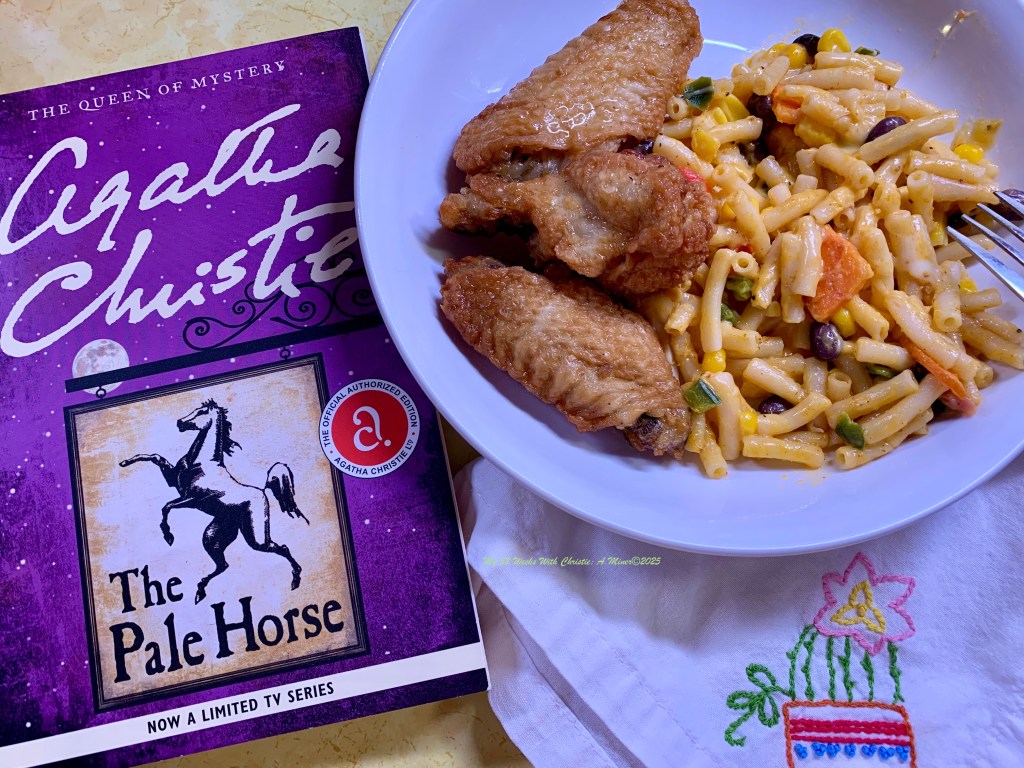
I’ve added veggies and extra cheese to boxed Mac-n-cheese for years. But have you ever tried putting buffalo wing sauce on it? Turns out it’s wonderful! Spicy, cheese, and perfect with wings!
I’ve added veggies and extra cheese to boxed Mac-n-cheese for years. But have you ever tried putting buffalo wing sauce on it? Turns out it’s wonderful! Spicy, cheese, and perfect with wings!

This Week’s Recipe: Pumpkin Seed Oatmeal Cookies
I like a bowl of oatmeal for breakfast. However, occasionally, I need to run out the door in haste — hence my quest to bake an appropriately healthy oatmeal cookie!
Thus, my fascination with oatmeal cookies.
One reason I enjoy futzing with Betty Crocker recipes is they’ve been tested and refined over so many years that you can change and swap around elements without creating an inedible lump.
Things I’ve tried:
– Swapping white sugar for honey created a really soft cake like texture
– Swapping half the AP flour for graham flour made a very crispy cookie
– Adding golden flax seeds was nice, but they get caught in your teeth
– Adding flaxseed meal worked pretty well
– Swapping currants for raisins worked well
What I’ve currently settled on: I omit the fruit, as raisins and currants always seem to catch in the oven on me. I add a cup and a half of raw pumpkin seeds, which have a similar texture to walnuts. I also add a half cup of flaxseed meal.
Let me know if anyone has a favorite oatmeal cookie recipe they’d like to share!
My 52 Weeks With Christie: A.Miner©2024

My 52 Weeks With Christie: A 2022 Revisit to The Pale Horse Part 3
On September 13, 1987 a security guard failed to show up for his shift at an abandoned medical clinic in Goiania, Brazil. This seemingly unremarkable event set into motion events that would eventually cumulate into a mass cesium-137 radiation event — second only in size and severity to Chernobyl.
On that fateful day, taking advantage of the guards absence, a pair of men absconded with the deserted clinic’s tele-therapy device. Not knowing what they’d stolen, the two begun disassembling the steel and lead liners in hopes they’d fetch a good price from the salvage yards. Unsurprisingly, they both rapidly begun exhibiting signs of radiation sickness and burns. Which prompted one of the men to visit a doctor — who put his symptoms down as food poisoning. Whilst he was told to go home and rest, his friend continued to break up the device. Eventually, he managed to puncture the housing’s heart with a screwdriver…and discovered a deep blue glowing substance residing inside.
Getting sicker by the minute the thieves sold the perforated device to a salvage yard.
That night the new owner, spying a beautiful blue glow emanating from his backyard, decided to bring the device inside his house. Using a screw driver he widened the hole slightly, and found a glittering blue gem inside. Scraping the ‘gem’ he managed to dislodge and extract several pieces of the cesium-137. He then gave away the twinkling pieces, about the size of a grain of rice, to his favorite family members and neighbors for good luck.
However, after his wife grew sick, the same day he’d begun fiddling around with and gifting people with the twinkling blue dust, he sold it to another scrapyard….spreading sickness, along with radioactive dust, even further afield.
Finally, the now ailing wife of the first salvage yard owner noticed how everyone who’d come into contact with the device or it’s pretty innards grew gravely ill — she retrieved the device from the other salvage broker and took it to a hospital. Where a doctor figured out they weren’t suffering from food poisoning or a cold but from radiation sickness.
The doctor then persuaded the Brazilian government to intervene.
In the end, well over 100,000 people were tested for exposure to cesium-137, 249 were found to have been exposed and amongst the 249 — there were 44 serious cases which cumulated in 4 – 7 deaths (my source materials are conflicted on this number), including the wife who’d initially alerted authorities.

(A photo taken in 2020 by Gustavo Leighton of an area in Goiania — though not of the cesium-137 contaminated area. I just though people might like to see how beautiful the area is!)
Again, how does this 1987 tragedy influence my Pale Horse research? Turns out, this was the first large scale, systematic test of the efficacy of Prussian Blue treatment in humans.
Now in possession of another firm date, which I must admit was far more recent than I’d ever dreamt when I begun my informal inquiry, I started scouring the Library’s database for more modern research papers.
And struck gold. (Whilst the plumbers realized several fixtures in the house hadn’t been properly installed….)
In Mexico from 1978 – 1986, where thallium based rat poisons hadn’t been banned, 50 cases of exposure due to an accident, attempted suicide, or murder were recorded. Of the 50 — 26 were treated with Prussian Blue and as expected those patients recovered significantly faster. (The other 24 were treated with the standard non-Prussian Blue medicines.)
Another study, held from 1990 – 1995, administered Prussian Blue to cattle in areas of the Ukraine, Belarus, and Russia hardest hit by the 1986 Chernobyl disaster. Scientists hoped to reduce the lingering cesium-137 from the food chain (i.e. milk and meat) by treating the cows with Prussian Blue. Which it did. (It also proved to be cost effect way of doing so.)
How?
Turns out Prussian Blue clears up a case of mistaken identity.

When cesium-137, radioactive thallium, or regular thallium enters your body — their ions fool your body, for a hot second, into thinking they’re potassium ions. Since we need potassium for all kinds of important functions, our body’s are keen on absorbing it — which is how the poisons get a foot hold in your system. Now the body isn’t bamboozled for very long, and when it figures out the toxic ions aren’t actually potassium, they get unceremoniously dumped into the intestines….Unfortunately, a large number of the deadly ions fool the body once again and get reabsorbed.
The binary cycle — which ends with either recovery (if the dose was small enough) or death (more often than not) — played out over and over again. Until a scientist came up with a theory, exposed some rats to cesium-137, and then treated some with pharmaceutical grade Prussian Blue in 1963.
The crystalline structure of the insoluble version of Prussian Blue trapped the cesium-137 by exchanging its own potassium ions for the poisonous ones. Because of Prussian Blue’s strong affinity for cesium-137 the pigment held firmly onto to the poisonous ion — even through the intestine. So the treated rats end up whizzing and pooping out the toxin much faster than their traditionally treated and non-treated counterparts.
Armed with even more info I turned, once again, to the library database….and found, in a single line of a chemistry textbook, a name. (And the plumbers informed me the five feet of cast iron sewer line, which didn’t get a new liner, was the source of our continuing back-up problems — needed replacing. Cue more apocalyptic sounds echoing up from the underside of our house.)
Nigrovic.
Dr. Vladimir Nigrovic.
Who got the Prussian Blue ball rolling in 1965 when he published a paper, Retention of Radiocaesium By The Rat As Influenced By Prussian Blue And Other Compounds, informing the world of his findings. (Born in Yugoslavia in 1934, Dr. Nigrovic emigrated to the U.S. and went on (after his Prussian Blue find) to have an impressive career in medicine, academia, and as a teacher. He sadly passed away in 2008.) Four years later, in 1969, a German pharmacologist named Horst Heydlauf of Karlsruhe suggested Prussian Blue as an antidote for thallium poisoning.
And there it was, the answer I sought — the names of the two scientists who figured out a pigment could help those poisoned by cesium-137 and thallium.
You’d think their names would be easier to suss out!
Now, I didn’t discover how they came up with their theories, if they were indeed inspired by The Entombment of Christ by Pieter van Der Werff (the first known painting to have Prussian Blue in its creation) or by an offhand comment from a colleague but either way, their find has saved live all over the world.
And, having finally answered my own question, my search was over.
And so too was the trial and tribulations of our house’s plumbing problems (knock on wood). It only took three weeks, the rapid depletion of our savings, and several holes in our garden before we could do some nerve wracking loads of laundry and dishes….On the upside I now fully appreciate the luxury of running water, a fully functioning sewer line, and plumbers!
(Whom I fervently hope I don’t need to hire again anytime in the near future!)
A.Miner©2022
My 52 Weeks With Christie: A 2022 Revisit to The Pale Horse Part 2
In fairness to all the scientists studying Prussian Blue, uncovering its curative properties couldn’t really come about until someone discovered Thallium. A feat which finally happened….157 years after Prussian Blue’s in a moment of scientific synchronicity.
As it turned out both Sir William Cooks and Claude-Auguste Lamy independently observed, tested, and published papers about a new element in 1861. (They also presented their find, in separate demonstrations, at the Great London Expo in 1862. Which led to a massive brouhaha as Lamy was awarded a medal for the discovery and Crooks was not.) In any case, whilst Cooks got to name the new silvery-white metal (after the Greek word thallos — in honor of the bright green flame it produced when burned), Lamy holds the dubious distinction of being the first confirmed case of thallium poisoning.
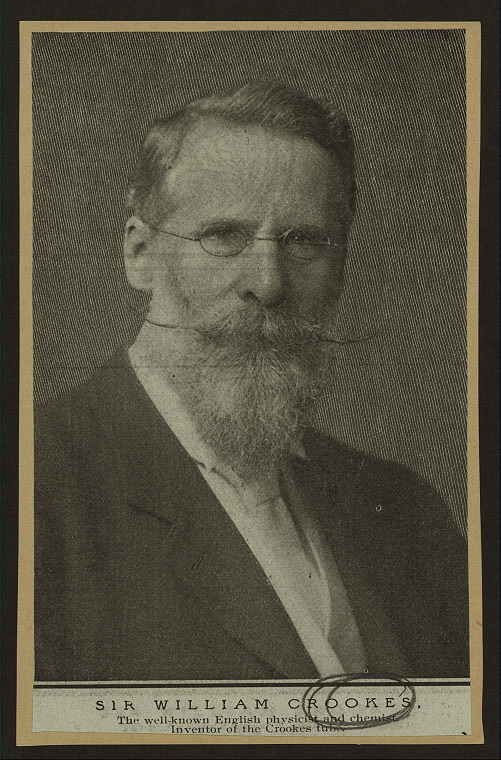
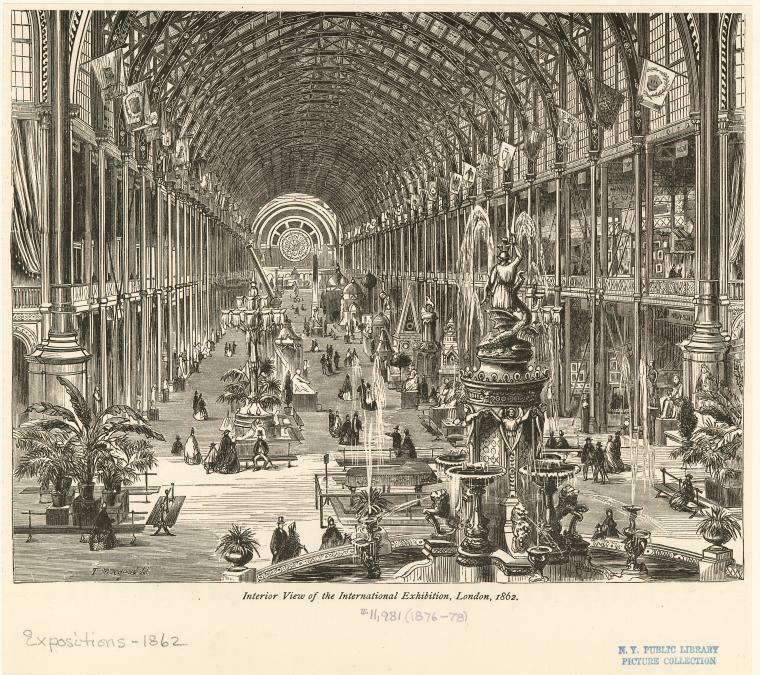

(Sir William Crookes on the left — The Interior of The Great London Expo in the center — Claude Auguste Lamy on the right)
Apparently, during Lamy’s pursuit and study of the newest heavy metal on the periodic table, he began suffering lower limb pain and weakness. Theorizing thallium as the source of his health problems, Lamy set about testing his notion.
(***Trigger Warning*** I’ve no clue what Lamy had against puppies.)
Dissolving 5 grammes of thallium sulphate in milk, Lamy offered the polluted mixture to two two-month-old puppies. Who, after taking an initial drink, refused to swallow another ounce of Lamy’s lethal potion. Leaving the remainder in the yard overnight, probably hoping the puppies would lap up more poison (the jerk), Lamy went outside the following morning and discovered the dish empty.
Taking a good look around his yard, Lamy quickly determined that an adult dog, two hens, and six ducks had unexpectedly finished off the puppy’s foul brew. Over the next several hours, all the unfortunate animals, puppies included, began exhibiting signs of depression, fatigue, paralysis of lower limbs, convulsions, pain, and eventually death. When Lamy performed a necropsy on the corpses, none of the animal’s organs showed any significant signs of poison. However, when Lamy subjected the animal’s organ tissue to spectral analysis, the tell-tale vibrant green flame gave thallium’s presence away.
Wanting to make sure of his findings, Lamy gave another luckless two-month-old puppy a grain and a half of thallium sulfate. When the poor thing died forty hours later, Lamy finally felt confident enough to infer that thallium sulfate was a potent poison.
When Lamy published his findings in 1863, he made sure to tack on a warning to anyone thinking of using this easily dissolvable and nearly tasteless toxin for nefarious purposes, “…there is not a poison that can be traced with more certainty…than this.” (Cork Examiner Sept. 8, 1863; issue 4333.)
Super, so I now knew when and how people figured out you shouldn’t lick a lump of thallium. However, I still hadn’t found a link to Prussian Blue. (And BTW – The fact Lamy knew thallium sulfate is nearly tasteless makes me wonder if he didn’t do a taste test and inadvertently poison himself.)
Stymied, I decided to reread The Pale Horse. (Plus, as we didn’t have any running water or plumbers in the house for a few days, and I needed something to do.) Whereupon, thanks to my early research, another detail stuck in my craw.
Assuming Christie set The Pale Horse in and around 1961 (the book’s publication year) and Lamy had already established thallium’s lethalness back in 1863. Then why was Rhoda Despard (Mark Easterbrook’s cousin) using a thallium cream to remove a patch of hair on her dog in order to cure their case of ringworm? Especially since, over the intervening ninety-eight years, newspapers had provided ample proof that people shouldn’t have access to thallium.
Don’t believe me?
Well, amongst other infamous stories reported in the papers betwixt 1863 and 1961 there were the accidental deaths of three little boys in 1929 at St. John’s Hospital (Leicester Square) from a miscalculated dose of thallium meant to cure their case of ringworm. A few years later, in 1935, a New York father of five named Fredrick Gross was accused (and ultimately found not guilty) of murdering his wife and four of his five children with thallium-laced hot chocolate. Three years later, in 1938, Austria executed Martha Marek by guillotine for murdering her husband, daughter, aunt, and two boarders with thallium-based rat poison. Finally, there’s Australia’s infamous ‘Thallium Craze’ — which all started thanks to an infestation of rats and mice around the country (but mainly in Sydney) in the 1950s. Since no one is keen on sharing their abode with rodents, retailers stocked large quantities of thallium-based rat poison on their shelves. The easy access and perfect purchasing camouflage coupled with high profile poisoning trials of Yvonne Fletcher, Caroline Grills, Veronica Monty, and Beryl Hague — led to at least one hundred people finding themselves at the wrong end of a thallium-laced cups of tea, cakes, and cocktails.
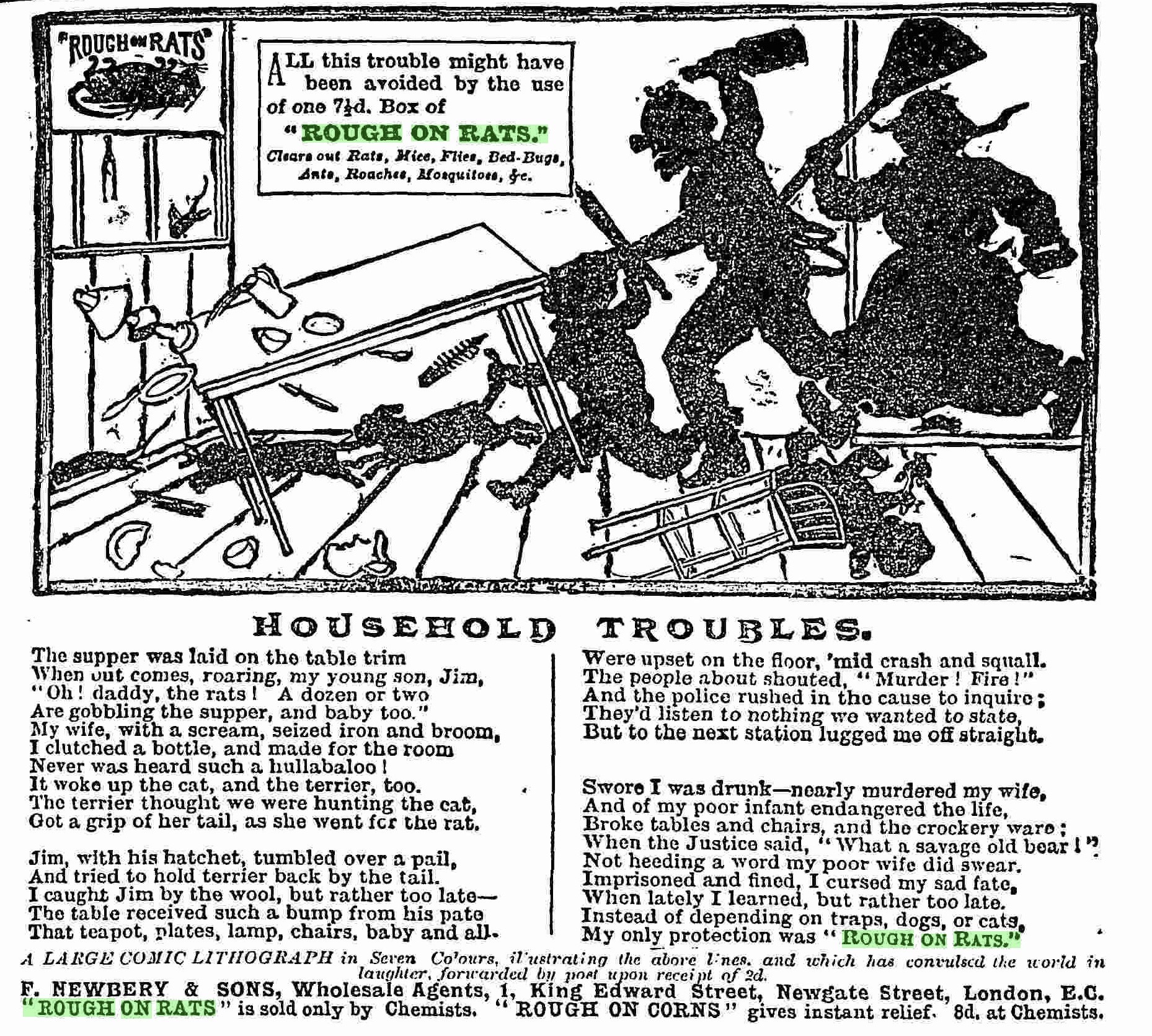
(In fairness to Rough On Rats, it doesn’t actually contained thallium — it was an arsenic based rat poison. Which isn’t any less lethal. But I wanted to show how prevalent this style of pest control substance was back in the 1880’s with this newspaper advertisement. Plus, Rough On Rats was cited in the poisoning cases of Ceely Rose and Ada Applegate — to name just a couple of cases.)
However, none of the articles I found ever mentioned the survivors, and there were a few, being treated with Prussian Blue. Nor did Christie write about The Pale Horse’s heroine, Ginger, being treated with the stuff during her hospital stay either. And since our authoress wrote about the poison in such detail it saved a number of lives over the years — I can’t imagine she would’ve omitted its antidote.
So I did what I should’ve done in the first place, after smacking myself in the head and saying ‘Doh!’ — I googled ‘Prussian Blue AND antidote’ — whereupon I made a startling discovery.
(Now, I probably should’ve started my search with Wikipedia. However, armed with a newly minted library e-card, I was fully committed to the newspaper/scientific paper/government org rabbit hole in which I’d already leapt and didn’t think of it….Plus, my hyper-focus search allowed me to block out the apocalyptic sounds emanating from under the house.)
The FDA didn’t approve Prussian Blue as a treatment for thallium poisoning until 2008, and the World Health Organization only added it to its Essential Medicines list in 1999. Switching back to the Library’s digital database, I found a number of helpful research papers corroborating and elaborating upon the aforementioned info.
I also learned Prussian Blue is an antidote for Cesium-137 poisoning as well…and this little tidbit cracked the informational floodgates wide open. (Thankfully, my kitchen floor remained dry….which is more than can be said about the bathroom’s.)
A.Miner©2022

My 52 Weeks With Christie: A 2022 Revisit to The Pale Horse Part 1
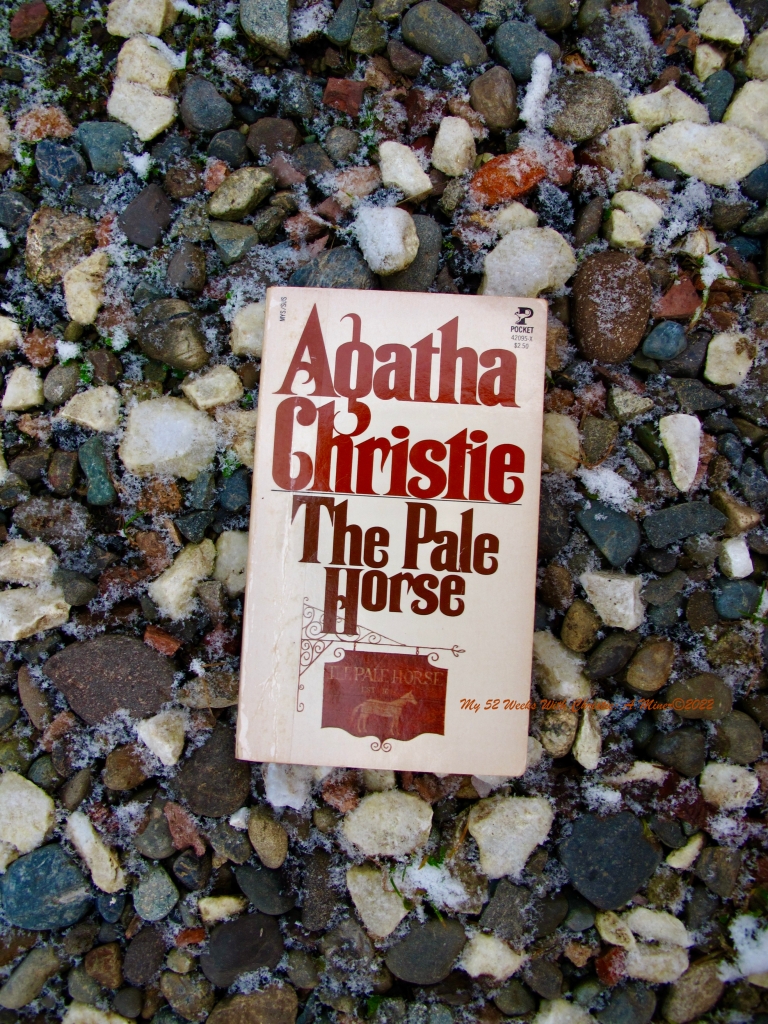
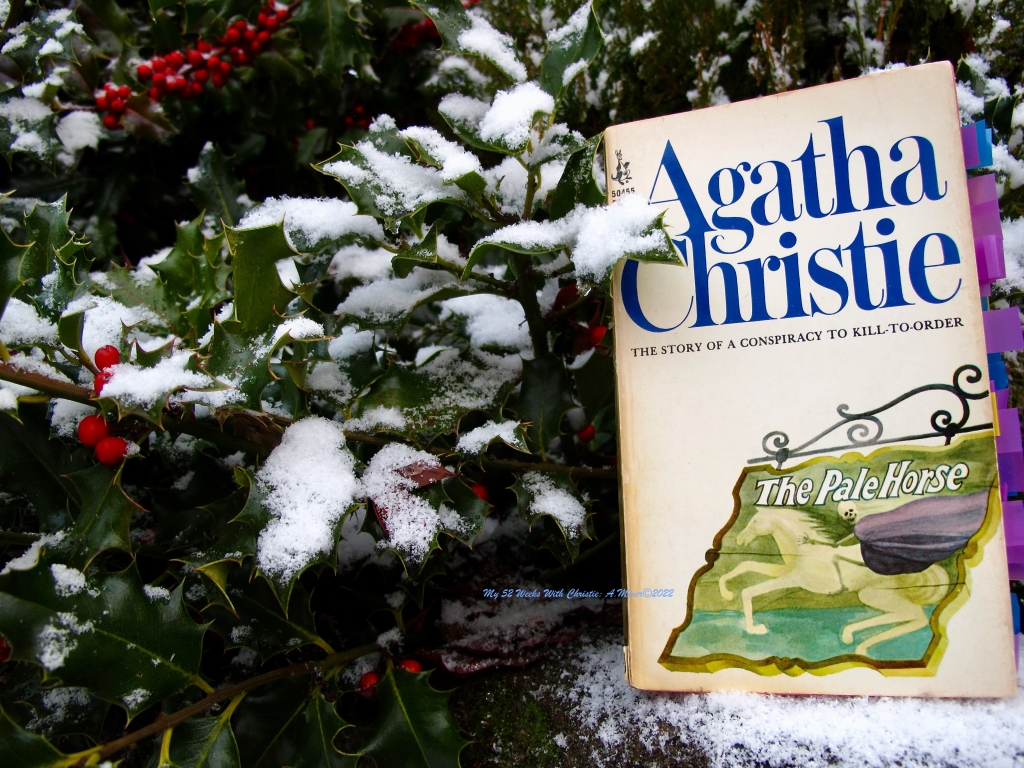
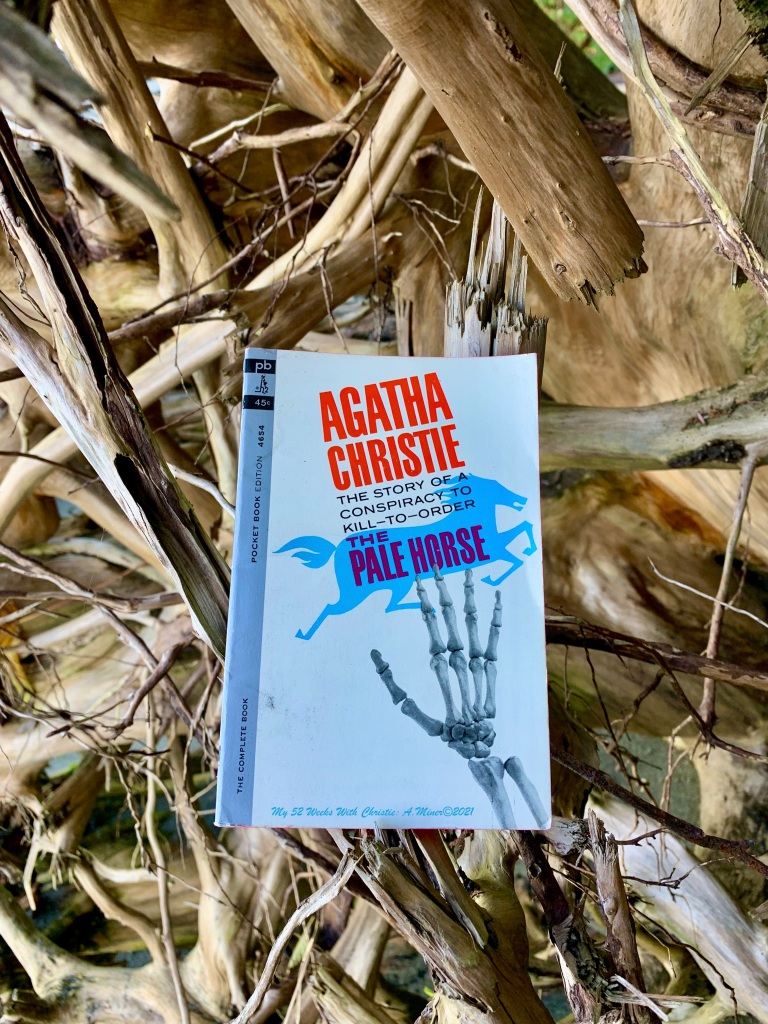
The Pale Horse by Agatha Christie
Word of Warning: If you haven’t read Christie’s The Pale Horse, proceed at your own risk, as this write-up contains spoilers. I’ll try and mitigate them if I can….but in covering what I want to cover in this piece, there isn’t a good way of avoiding plot points. So if you’ve already cracked this book’s cover or don’t mind having critical elements of the mystery revealed before you pick up the story — read on!
The 2022 Follow-Up: Ever since I first read The Pale Horse, all the way back in 2014, I’ve wondered how on earth someone came up with the idea of administering Prussian Blue to people suffering from Thallium poisoning. It seems improbable that a scientist would stare at Gainsborough’s The Blue Boy and think — ‘Hey! I bet that deep blue pigment would make a great antidote for heavy metal poisoning.’ However, other than the occasional idle thought, I never did much of anything to answer my own question.
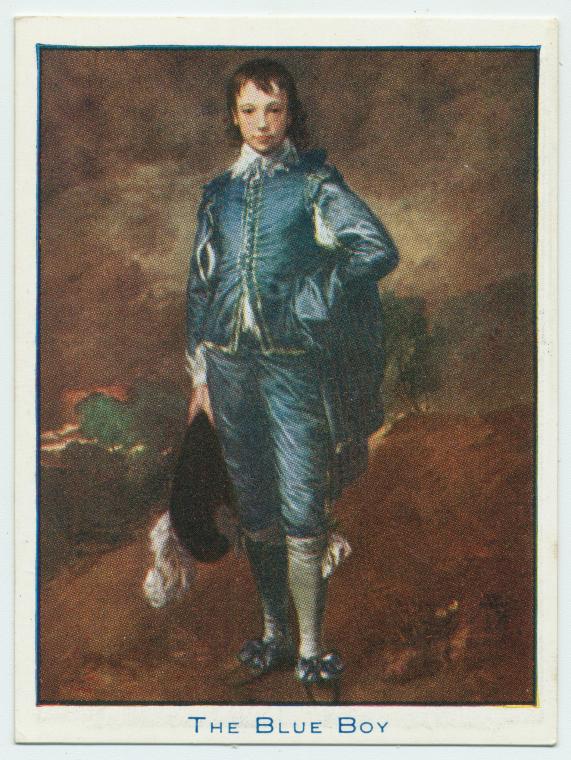
(BTW — This photo of a photo does not do the painting justice.)
Until our house insisted we needed to replace all its pipes, water heater, and sewer line.
Turns out writing fiction, for me, doesn’t work so well when you’ve got a pair of plumbers wandering all over and under your house banging, clanging, and sawing holes in your walls.
Who knew?
And, for whatever reason, this long-neglected Prussian Blue colored question popped into my head again — and needing a distraction from the crew digging up my flower beds (for the second time in as many weeks), I began my search in earnest.
In fairness, I didn’t actually nail down how scientists landed on Prussian Blue as an antidote. So it’s possible that the inspiration stick struck them whilst watching the blue ink flow from their fountain pens. (Assuming they owned such writing implements, favored blue ink above black, purple, or green, and knew Prussian Blue is a component of the ink’s recipe.) However, it’s not probable.
And yet….
The very first bucket of Prussian Blue was an accidental creation. Thallium was discovered by two scientists, independently of one another, at nearly the same time. So there is precedent for unlikely coincidences occurring.
Unfortunately, the same serendipity did not strike when I Googled ‘Who discovered Prussian Blue was an antidote for Thallium poisoning’. (That would’ve been entirely too easy.)
So down the rabbit hole I leapt, looking for answers — beginning my quest with Prussian Blue.
As told by Georg Ernst Stahl, Prussian Blue’s origin story places the pigment’s synthesis at the door of color maker Johann Jacob Diesbach. Working in a shared Berlin lab in 1704, Diesbach initially set out to create a red hue. The only problem was he’d run out of a key ingredient, potash. Borrowing some of his lab-mate, Johann Konrad Dippel, Diesbach continued mixing the formula — unaware that Dippel’s potash was contaminated with animal material. When Diesbach finished his mixture, rather than creating the anticipated red, he’d accidentally concocted Prussian Blue for the first time.
Here’s where things get a bit murky.
Apparently, Stahl wrote his account twenty-five years after Diesbach’s discovery. Since then, a series of letters from Johann Leonhard Frisch and Gottfried Wilhelm Leibniz have come to light (two eminent scientists of the day). Whilst these primary source materials seem to confirm Diesbach as Prussian Blue’s inventor — Frisch later declares Prussian Blue as his own invention. An assertion undoubtedly rooted in Frisch’s claims to have improved upon the original color and lowered its manufacturing costs. There’s also a good chance Frisch was trying to save face with this boast — as Diesbach’s father-in-law informed Leibniz of Prussian Blue’s actual creator.
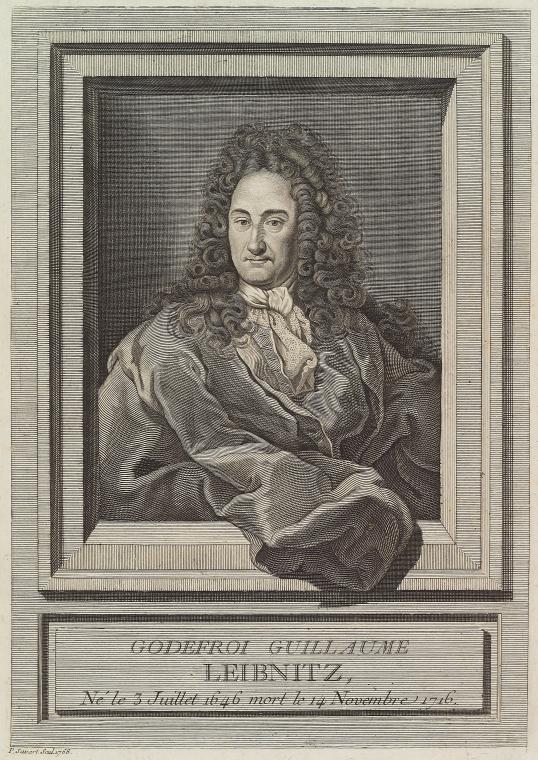
(Fun Fact: Even back in the day Leibniz was a BFD. Amongst his other achievements: he’s considered one of the most important people in the history of both math and philosophy — and — whilst overseeing a German library created a method for cataloging books that influenced other libraries all over Europe. Hence why someone might tell a lie in order to impress this very impressive man.)
Either way, Diesbach and Frisch only managed to keep Prussian Blue’s formula a secret (allowing both men to cash in) until 1724, when John Woodward published a Prussian Blue how-to recipe. Thereby allowing manufacturers to flood the market with variants of this iconic color.
Crucially to my Pale Horse inspired inquiry, Woodward’s verified formula enabled other scientists to research Prussian Blue’s chemical properties. In the hopes of nailing down its composition, stoichiometry, and structure.
Unfortunately, this is where the trail went cold, and the plumbers discovered our sewer pipe needed lining because it was older than Methuselah. (*sigh*)
Other than uncovering Carl Wilhelm Scheele’s talent for concocting toxic substances. None of the distinguished chemists or alchemists of the eighteenth or nineteenth centuries figured out Prussian Blue’s exact structure or that it was an antidote for thallium.
Unwilling to give up, especially since the plumbers added another week of plumbing fun to the agenda, I started tugging a different line of inquiry.
A.Miner©2022
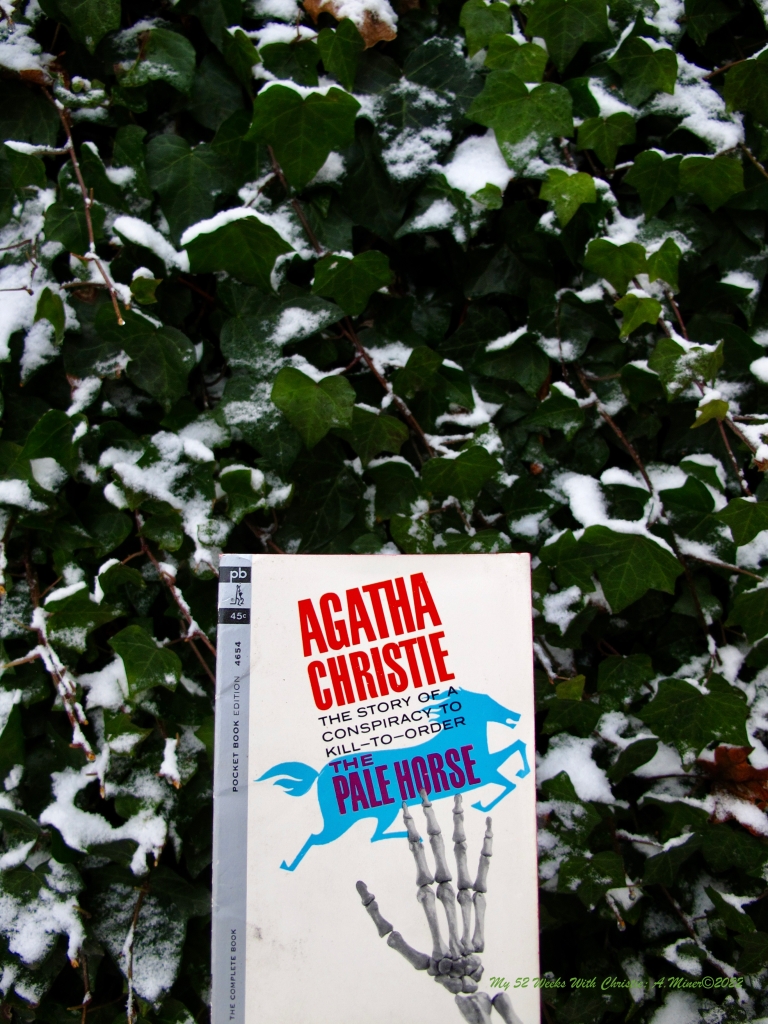
My 52 Weeks With Christie: My 2014 Review of The Pale Horse
First Published: The Pale Horse. Collins Crime Club, UK, 1961.
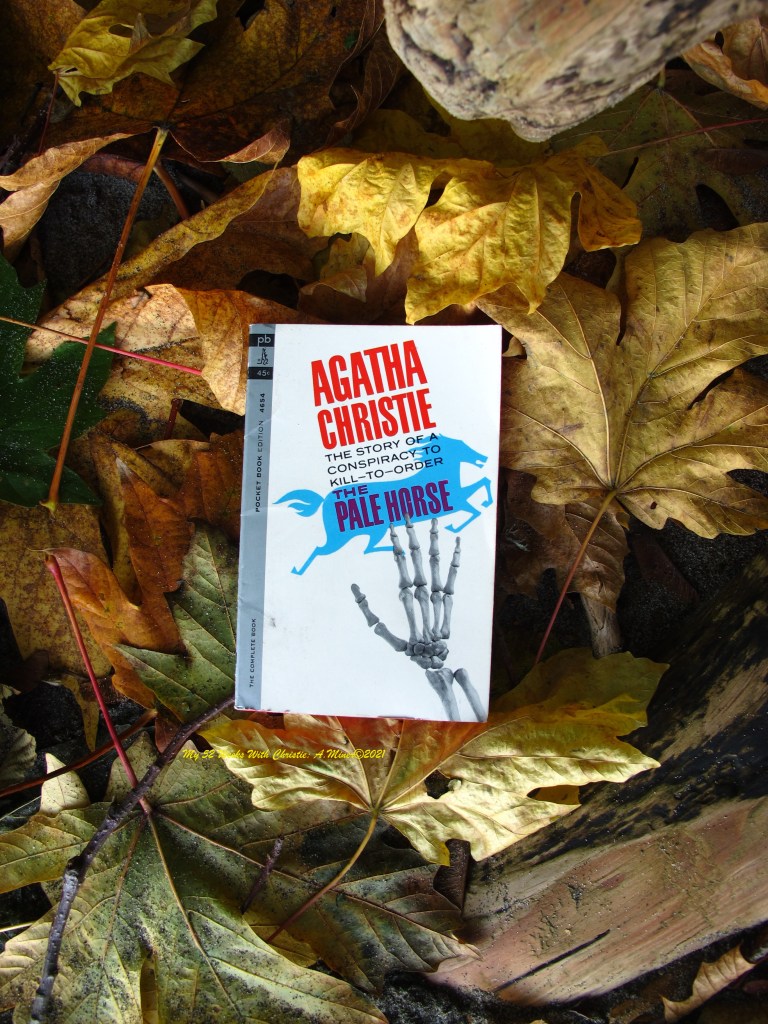
I Read: The Pale Horse. Pocket Books, New York, 1967.
Series: Ariadne Oliver
Summary: It starts with a priest, who hears the last confession of a dying woman unlike any he’s heard before. The woman gives him a list of names of connected somehow to wickedness, before the Father can do anything about the list he is brutally murdered. The investigating officer police find said list and discovers the names on the list belong to people who have recently passed away, seemingly of natural causes.
The police surgeon is not so sure.
At the same time through a series of crazy random happenstances Mark Easterbrook becomes involved in the investigation. Discovering the deaths all seem to revolve around something called The Pale Horse, “Revelation, Chapter Six, Verse Eight. And I looked, and behold a pale horse: and his name that sat on him was Death, and Hell followed him…” (pg. 209). Mark, not one to believe in the supernatural, decides to look for a more concrete solution to how the people on the list really died…
Review: This book, like many before it, is a fantastic read. One which contemplates the nature of evil; not in a preachy way, more Shakespearian in feel. Through this contemplation on the nature of evil Christie creates a clinging sinister atmosphere on each page of the book. Making you all most believe she will write her first supernatural solution to a mystery novel, thus breaking the Rules of Fair Play. Once again Christie does a wonderful job playing with her audience’s comfort levels and preconceived notions about things we cannot always explain satisfactorily.
I really loved this book, again not overly surprising. However just like the Miss Marple in The Moving Finger, Ariadne Oliver plays a very small role in the narrative (however larger than Marple in Moving Finger). A deus ex machina role for Oliver which provides Mark Easterbrook with the inspiration for the solution to the mystery. Which I found slightly disappointing as this is the only independent encounter with Oliver outside of the Poirot series. This is really such a small thing it did not perceptibly diminish my enjoyment of the read, just something to know going into the book.
Speaking of a menacing Shakespearian feel to a novel…..How many of you out there have seen a performance of The Scottish Play? You know the one I mean, the name that thespians do their absolute level best not to say on stage (or anywhere else for that matter)…. Have you ever given any thought to how the three witches in the beginning of the play are represented? Often the actress dressed up to look like old crones with hooked warty noses, long black robes, conical hats and black cats. Seemingly almost unhinged in nature uttering their prophesies for Banquo and his fellow general, more akin to monsters than women.
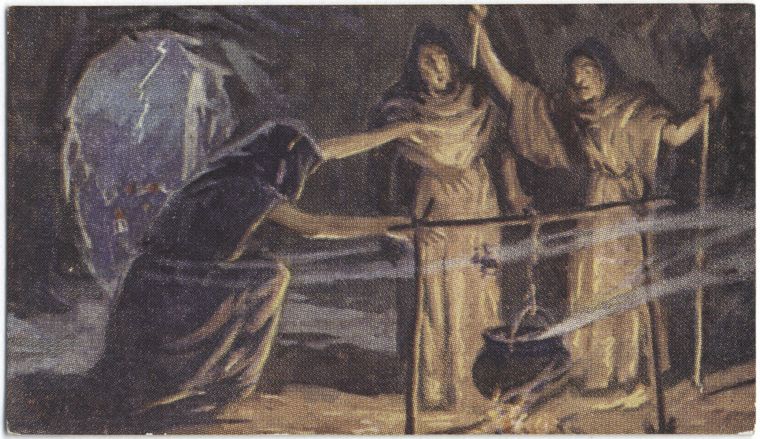

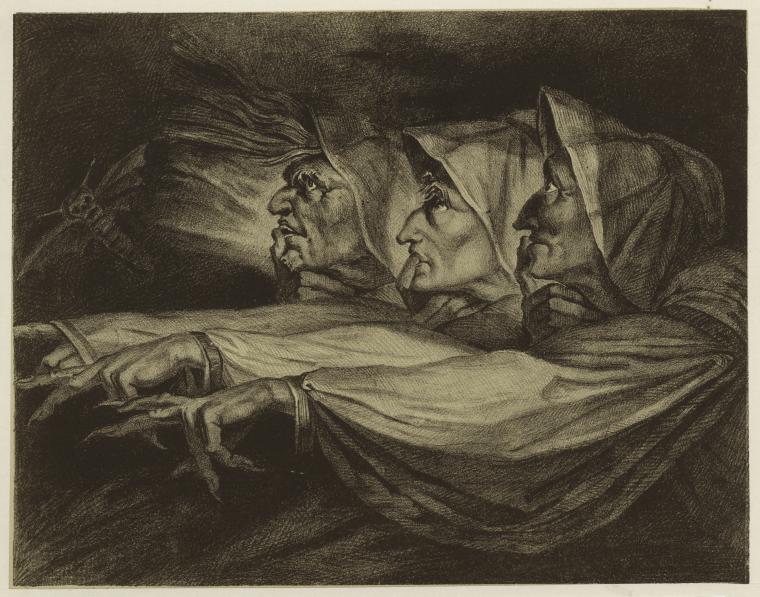
Did you ever think this is a safe way of portraying evil?
David (minor character from The Pale Horse) a thespian during his college years had a different idea of how to portray the three, “I’d make them very ordinary. Just sly quiet old women. Like the witches in a country village.” (pg. 33). I say I have to agree with David on this point, and subsequently Christie since she is the one who penned the book (and Fran who also things this would be brilliant staging). Done right this could lend an extra layer of malevolence to the three witches scenes. Why? In general we want to be able to identify evil at a glance, we want the stereo typical indicators, we want to Know who to watch out for.
Portraying evil as ordinary means it can creep or seduce its way into out lives without our noticing, making it difficult to ward ourselves against.
This is one reason serial killers or rapists haunt our imagination, since more often than not they look ordinary. Sometimes they are even charismatic or charming in their way. The ones who have been caught and shown on the news don’t seem to have any one trait to identify them as serial killers. No twitch, sign or limp identifies them to the police and the public as a dangerous individual. Profilers, psychologists and police officers who have extensive training can — through psychology and experience not a birthmark. This is one underlying reason why they seem to be so difficult to catch. But I digress.
This idea of ordinary evil is what makes The Pale Horse such a singular sinister book!
(BTW — if you want to see a really great version of The Scottish Play, click here. Patrick Stuart plays the lead and the three witches are seriously eerie/creepy!)
AmberMiner©2014

This Week’s Recipe: Easy Cream Biscuits
Inspiration: One Sunday, my husband had a hankering, and we just happened to have a small carton of cream on hand. So we made a batch of Betty Crocker’s Easy Cream Biscuits!
I say ‘we’ made the biscuits because the only other time I tried to make biscuits, I epically failed! They were the size of silver dollars and about as flat. They made decent crackers, but obviously, that wasn’t what I’d been aiming for, but they were tasty nonetheless. Hence, whilst making my second batch ever — I had supervision.
In addition, since that incident, I’ve got a rolling pin that’s got bits you put on it so you can’t roll things too thinly. (One of the issues of the other batch!)

Unsurprisingly, I didn’t alter the recipe a whit….and they turned out great!
Christie: Whilst I can’t see Poirot partaking of biscuits and gravy (as my husband I did), I can definitely see Inspector Japp tucking into a plate!
 My 52 Weeks With Christie
You must be logged in to post a comment.