Crime & Christie: Cucumbers & Wallpaper

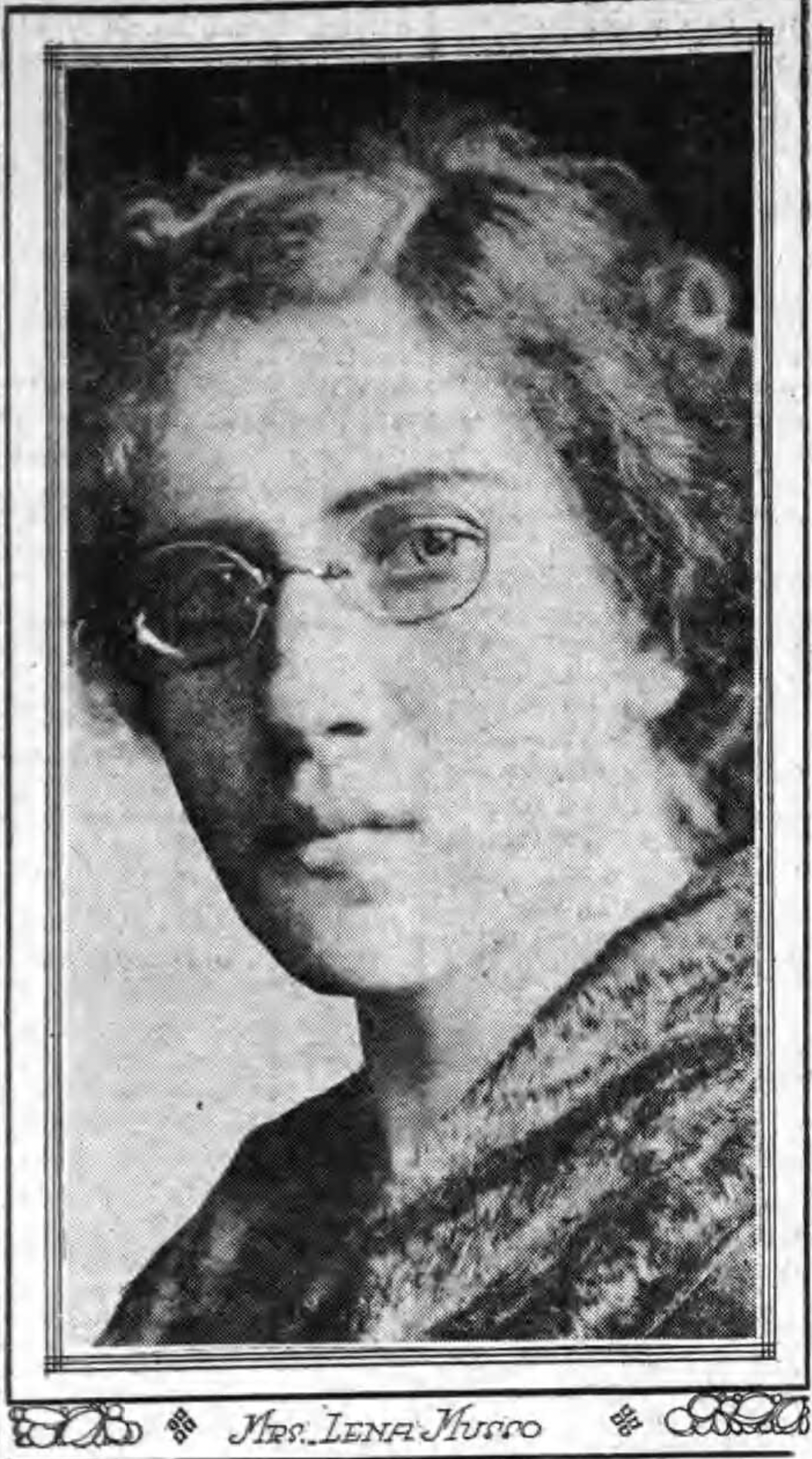
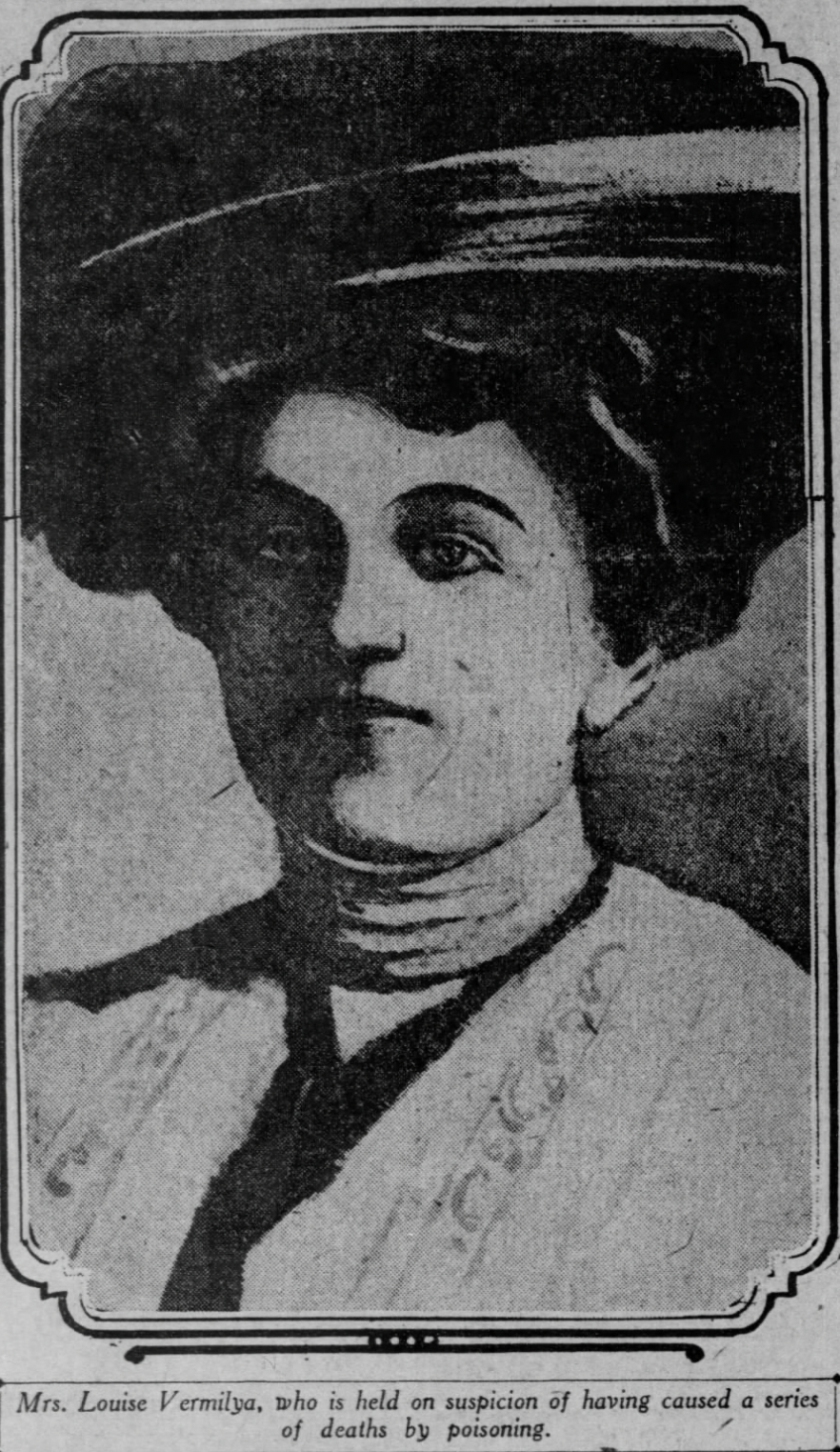
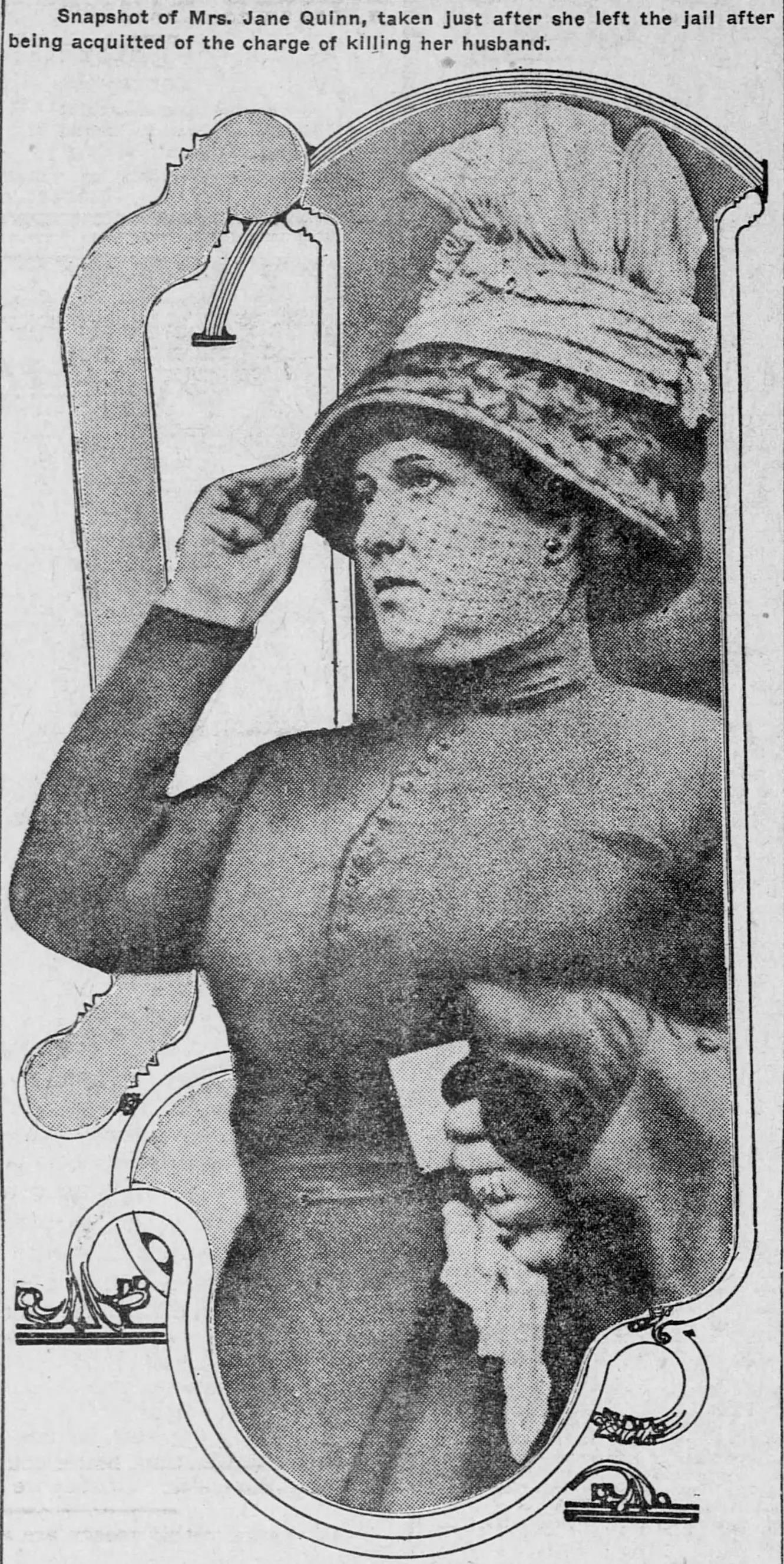
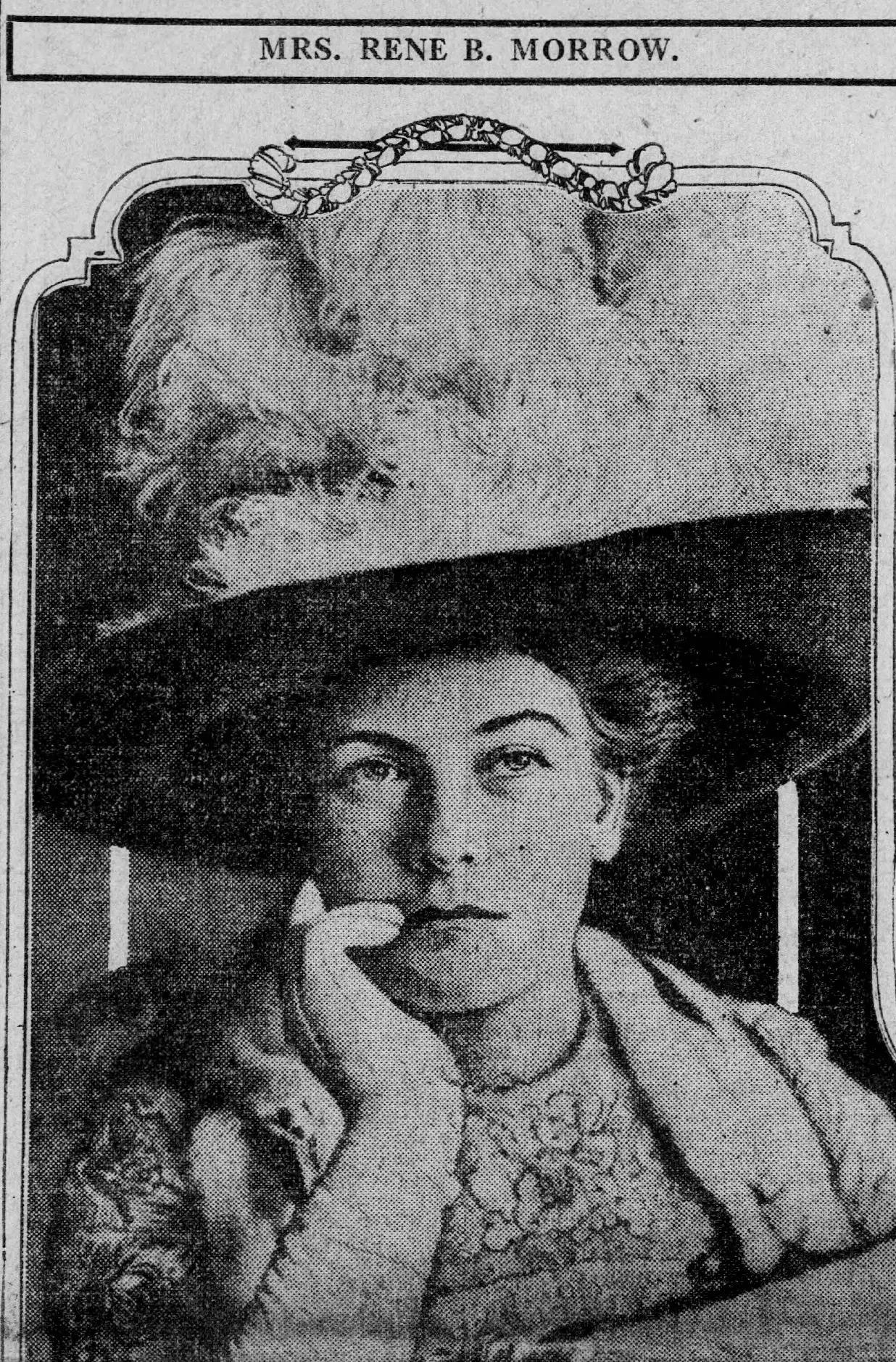
As we’ve seen, obtaining a conviction in historic Chicago was anything but certain. In 1912 alone, Assistant State’s Attorneys were forced to watch Florence Bernstein, Elizabeth Buchanan, Harriet Burnham, Rene B. Morrow, Lena Musso, and Jane Quinn walk out of Cook County courtrooms free as preverbal birds after (allegedly) shooting their husbands (and one love-rival) to death. Even the trial of Louise Vermilya, who police believed poisoned upwards of nine people, ended in a hung jury.
.….An outcome that undoubtedly buoyed Louisa Lindloff’s spirits, as Vermilya’s alleged crimes mirrored her own right down to the poison she favored, victim pool, and motive. (The two even shared a cell on Murderess Row for a spell.) Which begs the question, how? How did Vermilya flummox prosecutors and bamboozle six out of twelve jury members? And, more importantly, could Louisa improve upon Vermilya’s result and actually get away with murdering her son? 

First and foremost, any claim of self-defense would most likely collapse under the weight of the days, weeks, and months of suffering endured by Louisa’s victims. By targeting her children Frieda (18y), Alma (19y), and Alfred (15y), Louisa pretty much rendered any and all claims to Chicago’s ‘Unwritten Law’ null as well as negating the idea of self-defense and a crime of passion. Unable to access any of the cornerstones of the Murderess Acquittal Formula while eyeing the swelling mountain of circumstantial evidence piling up against her, Louisa found herself in a tight spot.

Until she hired famed criminal defense attorney George Remus. 

Specializing in murder cases, Remus was undoubtedly aware of the blueprint others of his ilk used to defend accused poisoners. Tailoring this strategy to fit Louisa’s case, while cherry-picking from the remaining elements of the Murderess Acquittal Formula and adding his own flair, Remus’s first step was to undermine the state’s assertion that Arthur was purposely poisoned by Louisa. 

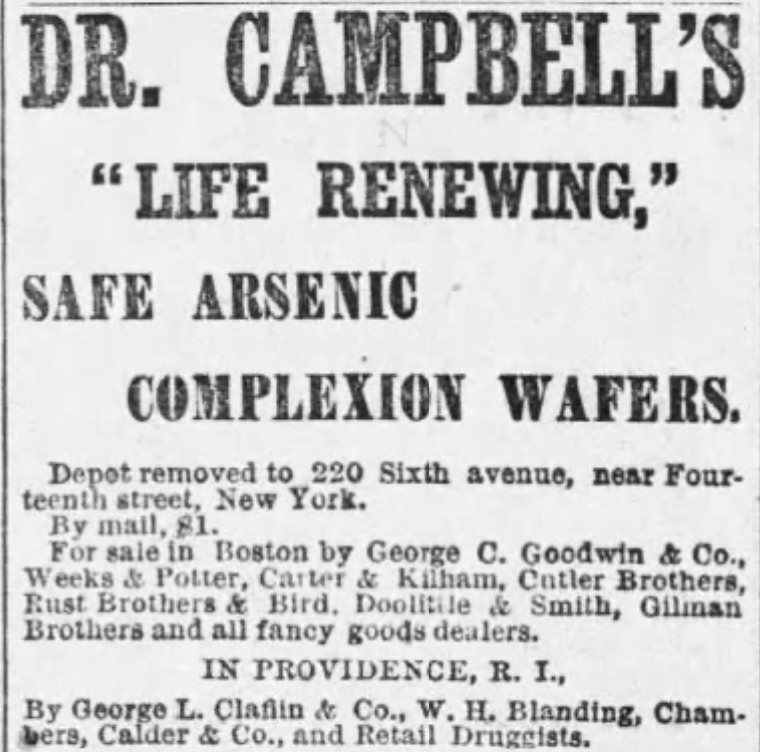
Step One: Point out to one and all that owning arsenic, other poisons, and their derivatives isn’t a crime. Nor does their presence on a pantry shelf prove Louisa used them to harm those nearest and dearest to her. True, owning upwards of 80-plus bottles, boxes, and/or bags of said substances is a tad enthusiastic — but it’s not criminal.

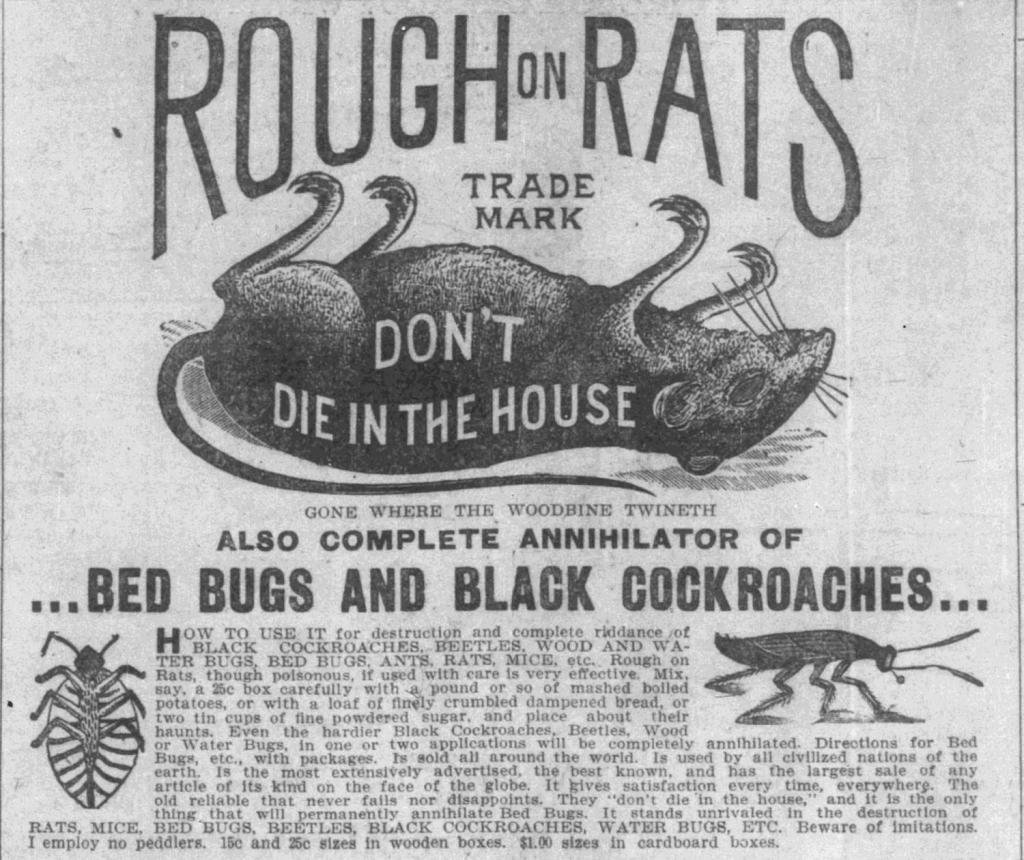
Furthermore, such a collection could (nearly) be explained by the abundance of rats, bedbugs, and other disease-carrying pests who absolutely love urban centers, like 1912 Chicago. With the city’s overcrowded neighborhoods, uneven trash removal, and many restaurants, it ensured everyone from housewives to shopkeepers struggled to keep vermin at bay. A proposition made more difficult by rodents’ infuriating habit of developing poison shyness. (Hence why Louisa owned so many varieties.?! Maybe?) Plus, accidental exposure to Rough on Rats (and therefore arsenic) was almost inevitable due to the recommended application methods.

Step Two: Call attention to the fact that arsenic is a naturally occurring element in the earth’s crust — which means — any arsenic found in the body could be due to natural exposure. Since Arthur’s employment didn’t entail any direct contact with soil (contaminated or otherwise), Louisa contended this incidental exposure came about through her son’s love of cucumbers, which he apparently “ate like a hog.” (Louisa’s description, not mine.)

While it’s true carrots, parsnips, and other such root vegetables can contain trace amounts of arsenic in their skins and, if not thoroughly washed, specks of arsenic-ladened earth can cling to their outsides — the same cannot be said of cucumbers. Between growing on vines rather than directly in the dirt and their thin skins — these vegetables contain very little arsenic in the parts we eat. Facts which could’ve rendered Louisa’s ‘cucumber defense’ shaky if: A. Scientists had discovered either detail by the start of Louisa’s trial on October 25, 1912. — And — B. If Assistant State’s Attorneys Claude T. Smith & Francis M. Lowes presented these scientific tidbits to the jury. 

Step Three: Identify all the other ways the victim(s) could’ve come into contact with the deadly element. 

Holding firm to Dr. Warner & Dr. Miller’s explanation that the wallpaper in Arthur’s sickroom was one source of exposure (despite their admission that this excuse was a ruse), Louisa added another legitimate wellspring – Medicine.


According to Louisa: Arthur, his sisters, and her husbands all suffered from a skin complaint for which they treated with arsenic based patent and prescription medicines. Which Dr. Warner did confirmed prescribing. 

From the Office of Full Disclosure: Prior to Louisa’s testimony at trial, the newspapers reported the family’s “hereditary skin complaint” in generic terms. It was only after Louisa took the stand that she euphemistically blamed her first husband, Julius Graunke, for passing on a venereal disease to her, which she, in turn, passed on to her children and her second husband. Perhaps she was alluding to herpes? Which was at one point treated with arsenic. However, thanks to reticence of the times when dealing with STDs, it’s unclear if the family actually suffered from said STD, an innocuous skin problem, or if Louisa invoked the idea to explain away the arsenic found in the bodies whilst simultaneously garnering sympathy from the jury.

Interestingly, unlike Louise Vermilya’s first trial, which was abandoned after a similar medicine based revelation, Louisa Lindloff’s continued. 

Another common way for substantial quantities of arsenic to enter the body: Embalming Fluid.

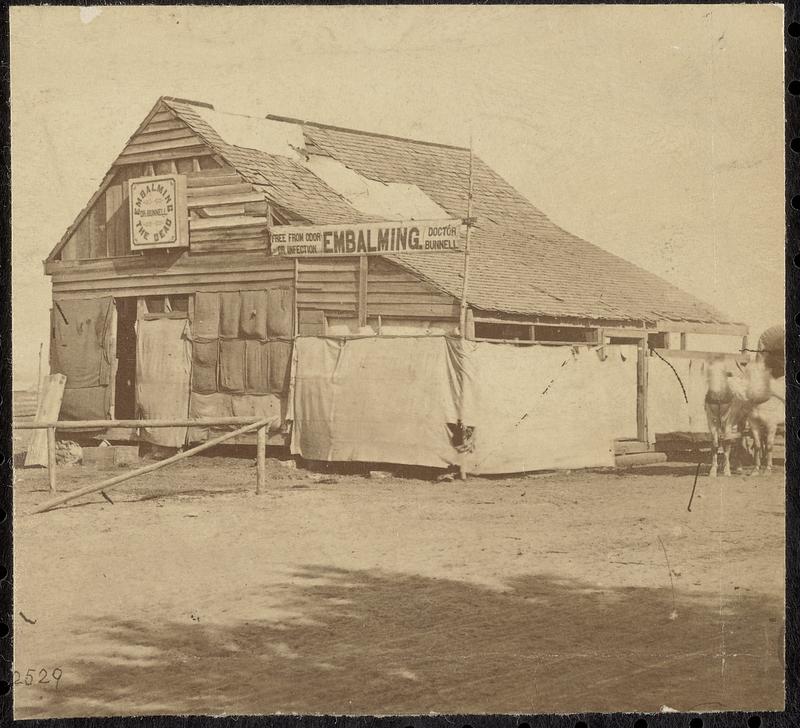
During the American Civil War, Dr. Thomas Holmes developed an arsenic-based chemical mixture, technique, and specialized apparatus to preserve Union soldiers’ bodies so they could remain (relatively) preserved during their journey back North for burial. When Holmes’ method proved successful, it was widely adopted. In cases like Louisa’s, the unintended consequence of this advancement in mortuary science is obvious. Since not even the most talented of chemists could differentiate between arsenic administered by nefarious means and arsenic used in embalming fluid, it often rendered results of the Marsh Test absolutely worthless in criminal poisoning cases where remains were tested after being embalmed and/or buried.

This detrimental side effect that reared its ugly head (again) on August 9, 1912. When Coroner H. L. Nathin was forced to abandon his inquest into Julius Graunke and John Otto Lindloff’s deaths due to the discovery that both sets of remains were treated with an arsenic based embalming fluid. (Charles Lipchow’s body was found bereft of the heavy metal. However, that does not mean Louisa didn’t poison him.) Thus ending the looming threat of extradition and prosecution, Milwaukee prosecutor’s promised should the notoriously fickle juries of Chicago acquit Louisa of murdering Arthur.

Speaking of prosecutors — they had their own strategy when dealing with multiple murderers like Louisa. Working under the assumption they could always try a poisoner for another murder, prosecutors would select their strongest case to take to court. Amongst Louisa’s many victims, ASA Smith & Lowes landed on Arthur as their best shot. Not only because his death was the most recent but on account of the quick thinking of two people. 

Apparently, before Arthur’s body ever left Chicago’s University Hospital, Coroner Hoffman seized his pancreas and spleen following the institution’s post-mortem. After confirming for himself neither organ appeared diseased, thus ruling out the COD listed on Arthur’s death certificate, Hoffman delivered both organs to Professor Walter S. Haines of Rush Medical College for chemical testing. 
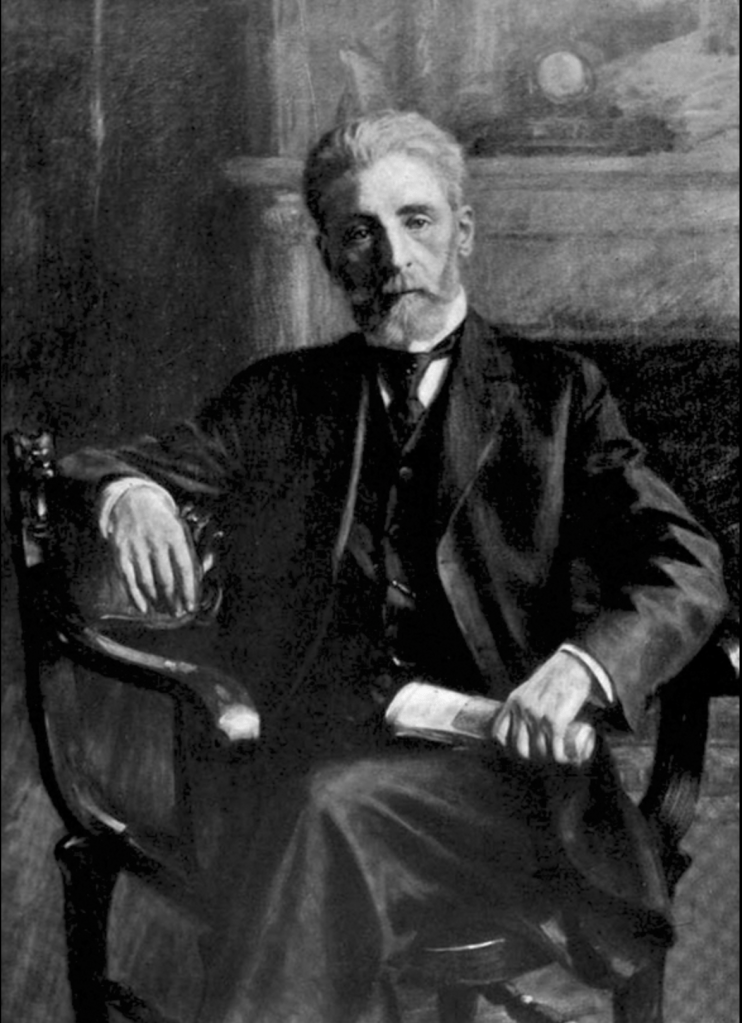
Upon Prof. Haines’ confirmation that both organs were chalked full of arsenic, Coroner Hoffman ordered the exhumation of William Lindloff and Alma Graunke on June 19, 1912. Although Illinois outlawed arsenic-based embalming fluid back in 1907, Hoffman also requested samples of the fluids used on William and Alma’s bodies be tested as well. Unsurprisingly, on June 27, Prof. Haines’ reported both sets of remains were brimming with arsenic and none was found in the fluid. Thus prompting Hoffman to disinter Freida Graunke’s body, which, in turn, yielded the same results.

Once More From the Office of Full Disclosure: At some point, Coroner Hoffman had Arthur’s lungs, stomach, liver, and other organs tested as well. Though, thanks to the sensation around Louisa’s arrest, it’s a tad fuzzy when precisely this happened. What we do know is, one way or another, Oak Ridge’s Undertaker heard about the kerfuffle around Arthur’s death, and rather than embalming the boy’s body straightaway — he held off. So when Coroner Hoffman arrived at the mortuary to collect the remaining viscera, he found it uncontaminated. 

The Fourth & Final Step: Remind the jury arsenic is a cumulative poison, as well as, an acute one

To this end, while testifying in her own defense, Louisa shocked the entire courtroom on November 2, 1912, by admitting Arthur and the rest of her family undoubtedly died with arsenic in their systems. Whereupon she blamed the accumulation of arsenic found in Arthur’s system on the boy’s overindulgence of cucumbers, the wallpaper in his sickroom, and doctors for prescribing arsenic based medicines. 

As defenses go, it sort of held water….if you squinted at it really hard. However, the six grains of arsenic found in Arthur’s remains wasn’t the only damning element requiring an explanation.

Crime & Christie: The Unravelling Web of a Black Widow

Soon after Alma’s death, disaster struck Louise Lindloff’s occult practice. Seems police caught wind of Louisa’s work as a clairvoyant/medium/seer and shut her down. Though she skated through the encounter without her wrists being sullied by shackles, police made it abundantly clear Louisa could no longer contact those on the otherside of the veil for coin. Unable to groom clients for possible bequests or supplement her income with readings and unwilling to curb her spending or find honest employment — Louisa turned a gimlet-eye towards her remaining child for one last big score. 

While her crystal ball grew cold, Louisa toured the local insurance agencies stockpiling policies on Arthur Alfred Graunke’s life: Three totaling $515 were secured. Another, purchased on September 13, 1911, was for $1,000 and the final one for $2,000 was obtained on March 26, 1912. 

With all her ducks now in a row, Louisa started the clock.

From the Office of Full Disclosure: Most newspaper reports agree Arthur fell ill on a Wednesday — though whether it was June 5 or June 12 is a tad murky. Whichever Wednesday it was, seventy-something days after securing the last bit of insurance on Arthur’s life, Louisa served her son a meal of cucumbers, canned salmon, and ice cream. (Hopefully, not all mixed together. However, as a kid who lived through the nineteen-seventies jello mold craze? Such a hideous combo cannot be ruled out.) In any case, shortly after ingesting said meal, Arthur fell desperately ill with stomach cramps, vomiting, backaches, and other debilitating symptoms. 

Once again, Louisa sent for Dr. Augustus S. Warner.

Immediately after clamping eyes on Arthur, the third member of Louisa’s family to fall desperately ill in three years, Dr. Warner finally realized he was dealing with arsenic and a serial poisoner. After treating Arthur in the best way he knew how, and with all attempts to induce Louisa into sending her son to the hospital rebuffed, Dr. Warner made a tactical retreat from 2044 Ogden Avenue. 

Well aware that accusations of poisoning were grave and making an erroneous allegation could open a whole world of hurt for himself — Dr. Warner contacted a colleague to consult (unbeknownst to Louisa). After reading and discussing not only Arthur’s case but Alma and William’s, Dr. Joseph Miller came to the same conclusion as Dr. Warner: all three showed the telltale symptoms of arsenical poisoning. 

Returning to Louisa’s home on June 13, 1912, strategy in hand, the two doctors tag-teamed Louisa. Blaming the wallpaper affixed to the walls of Arthur’s sickroom (a classic scapegoat), the physicians told Louisa her son’s symptoms corresponded with a textbook case of arsenic poisoning. While they “believed” Louisa didn’t have a hand in Arthur’s current complaint, they pointed out that her consistent refusal to heed their recommendation to move Arthur to a proper medical facility could be construed by some as highly suspicious in light of their diagnosis. 

Reluctantly, Louisa finally acquiesced. However, replicating the scheme she used when William (her second husband) entered a similar institution, Louisa removed Dr. Warner as Arthur’s primary physician. When Arthur died, Dr. John M. Berger of University Hospital, chalked Arthur’s cause of death down as pancreatitis. Later, he admitted he’d only seen the fifteen-year-old about five minutes before said event and knew next to nothing about his colleague’s misgivings — hence the unobjectionable cause of death.

Straightaway, after learning of Arthur’s passing, Louisa sent her boarder, Henry Kuby, to Prudential Insurance Company for a blank death certificate to start the ball rolling on her last big payday.

Meanwhile, despite being barred from Arthur’s sickroom, Dr. Warner and Dr. Miller were anything but idle. Together, they compiled their paperwork and theories and took them to the Cook County Coroner and Juvenile Court Authorities. Who, in turn, didn’t waste a single second securing the proper permissions and warrants. The day after Arthur’s untimely death, whilst Louisa was planning his funeral, Captain Bernard Baer of the Fillmore Street Police Station and his officers rocked up at 2044 Ogden Avenue.

Warrants in hand, the policemen began searching the house from pillar to post while their Captain questioned Louisa. (Now, I don’t know the order in which Captain Baer fired off these queries at Louisa, so I’ll put them in an order that feels logical to me.)

When told the reason for the search was due to Arthur being poisoned, Louisa replied: “…If he was, I know nothing of it; my hands and body are clean.” Next, when asked if she had any poison in the house, Louisa categorically denied owning any. This lie was immediately laid bare by Officer Anthony McSwiggin, who not only located a box of Rough on Rats missing about 1/3 of its contents, but some strychnine, a mercury based poison, some form of barium, and other bottles labeled poison on a pantry shelf.

Next, investigators discovered a newly purchased grey wig (bought before Arthur’s death) and a trunk catalog. When Capt. Baer asked after these objects; Louisa admitted she planned on traveling (definitely not pulling a runner) that coming summer. An intention that did not jive with her bankbook, which showed Louisa only had $30 to her name. Furthermore, Louisa’s meticulous personal accounting showed a direct correlation betwixt the deaths of her nearest & dearest and when her bank balance dipped dangerous low.

Following these falsehoods, damning admissions, and deductions, Capt. Baer confronted Louisa with the collection of insurance policies she’d assembled on Arthur’s life. Her justification for having so many? Not only was it a German custom to heavily insure one’s immediate family members, but who would they leave such a large sum of money to, if not his mother? 

Apparently, feeling this rationale wasn’t enough, Louisa explained that it seemed prudent to amass multiple policies on Arthur’s life due to the hazardous nature of his job at Commonwealth Edison Company. And faster than Jackie Robison could round the bases, Capt. Baer exposed the false underpinnings of this excuse as well. Turns out Arthur was, in fact, an office boy earning $20 a month from the electric company. What’s more, Capt. Baer discovered that Louisa deceived the insurance companies about Arthur’s age, listing it as 16 rather than 15, in order to obtain the last two high-dollar policies.

Despite all the circumstantial evidence accumulated and Capt. Baer arresting her on June 15, 1921; Louisa managed to retain her freedom until June 17, when she was formally charged with Arthur’s murder and remanded to a Cook County jail, her bid for bail denied. Though she was allowed to attend Arthur’s funeral the next day, Louisa was escorted by two city detectives and a police matron, then promptly shepherded back behind bars.

Finally, after seven years and at least eight murders, the long arm of the law caught up with Louisa. Now, the million-dollar question was: Would a Chicago jury convict her of murder?

Crime & Christie: Arsenic the Element That Brings Everyone Together

Now, you’d think arsenic poisoning wouldn’t really square with Chicago’s Murderess Acquittal Formula. Not only because the administration of poison is (predominantly) a covert and (on the whole) premeditated act but on account of the sheer absurdity of translating the foundation of this Formula from “they both reached for the gun” — to — “they both reached for the box of Rough on Rats.” 

And yet, a handful of women still turned to this ancient element. 

The most notorious of the lot, who spent their fair share of time in Cook County’s Murderess Row, were the serial poisoners Tillie Klimek and Louise Vermilya. However, there is a third, lesser-known member of these ‘Sisters in Bane’ — Louise Lindloff. Who’s life and crimes and subsequent trial had it all — spiritualists, allegations of witness tampering, startling admissions, and a literal crystal ball. So, of course, that’s whose misdeeds we will explore next!

Now that we’ve mastered that portion of the name game let’s examine Louisa Lindloff’s life and multifarious crimes.

Originally, Louisa was born Louise Darkone in Colmar, Germany, on February 4, 1871. Seventeen years later, in March 1888, Louisa married Julius Graunke, who was about two years her senior. Approximately two years later, in April 1890, Louisa and Julius welcomed their first child, a girl they named Frieda, into the world. 

Following this joyous event, sometime between 1889 and 1891, Julius crossed the Atlantic Ocean, settled in Milwaukee (Wisconsin), and found work as a driver for the Fitzner & Thompson Commission House before sending for his wife and baby daughter. In short order, the couple expanded their family with a second daughter, Alma, born on December 18, 1891. Finally, Julius and Louisa completed their familial unit with son Arthur Alfred Otto, born on May 19, 1897.

Sadly, misfortune in the form of an undefined, debilitating illness struck Julius around late April or early May of 1905. During his three-month downward spiral, a neighbor, Mrs. Martha Greiner, heard Julius complain: “Louisa, there was something in my last medicine.” Louisa also confided in Martha: “Julius will only live a few days and when he is dead I’ll get $2,600. I’m going to open a saloon and buy a horse and buggy and have a good time.” This prediction came about, just as Louisa foretold, on August 12, 1905. 

The death certificate put the cause of death down as sunstroke, and Louisa promptly collected on Julius’s hefty insurance policy. 

Surprisingly, Louisa’s prophecy and tawdry comments failed to ring the necessary number of alarm bells within Martha to prompt a visit to the authorities, especially when combined with the sudden death of the Graunke family dog and the baffling death of a flock of chickens on an adjoining property around this period.

Perhaps Martha didn’t want to believe someone she knew was a killer? (Which, in fairness, would slow me down as well. Despite this blog and the sheer quantity of mysteries I’ve read.) Or, more likely, Martha bought (to some degree) into Louisa’s claim of being blessed with second sight since the age of eight. Which would “explain” how she was granted the foreknowledge of the date of her husband’s death. Either way, Martha and the other neighbors remained silent about what they’d seen and heard in the Graunke household.

Even when the thirty-four-year-old mother of three followed up on her promise of ‘having a good time’ and started kicking up her heels with her boarder Charles Lipchow. Who’d not only lived with the Graunke’s for a period before Julius’s death but whose recently deceased mother (or Auntie, I’ve read conflicting newspaper reports) bequeathed him a legacy somewhere between $5,000 and $15,000 (again, there are conflicting amounts). Who, in turn, lavished the bulk of his inheritance upon Louisa. 

But, alas, all good things must come to an end. 

On August 17, 1906, nearly a year to the day after Julius passed away, Louisa lost her good time Charlie. However, in a stroke of good fortune, before his death, Charles assigned Louisa as the beneficiary of his $550 life insurance policy provided by a cigar maker’s union (of which $116 went towards his funeral in Lincoln Memorial Cemetery). 

Whereupon Louisa assuaged her grief by becoming a bride (again) and married William Lindloff on November 7, 1906.

From the Office of Full Disclosure: It’s unclear, exactly when Louisa and her kids moved to 2044 Ogden Avenue in Chicago, Illinois. One account places the move just after Julius’s death in 1905. This would make sense if Louisa was trying to avoid the side-eye and whispers of her neighbors. And Charles’s hefty inheritance would’ve made the move from Milwaukee to Chicago, with three kids in tow, a great deal easier. What muddles the timing of Louisa’s out-of-state move is that Charles died in Wisconsin, not Chicago. So either Louisa moved after Charles’s death, Charles returned to Milwaukee with a belly full of poison and succumbed there or she poisoned him on a return visit?

Compounding my confusion is the fact that Louisa’s second husband worked for the McCormick Harvester Company, which was founded and operated out of Chicago. However, in 1902, McCormick merged with several similar manufacturers to form the International Harvester Company, which operated out of both Illinois and Wisconsin (amongst other states). So did the two meet, court, and marry in Milwaukee, Chicago, or some combination thereof? I’ve not found a copy of their marriage certificate, so I’m unsure.

Then there’s William’s brother, John Otto Lindloff, who resided with the newlyweds. One report I read stated that John Otto’s new sister-in-law absolutely detested the sight of him. Not only because he was courting her eldest daughter Frieda, but on account of the fact he became suspicious of Louisa after drinks and food she’d prepared made him ill immediately afterward. Then, on October 12, 1907, at the age of 24, John Otto died after suffering, for a short period, from dizziness, vomiting, stomach cramps, and other violent symptoms. According to his death certificate he died of apoplexy in Milwaukee, where he was subsequently buried. 

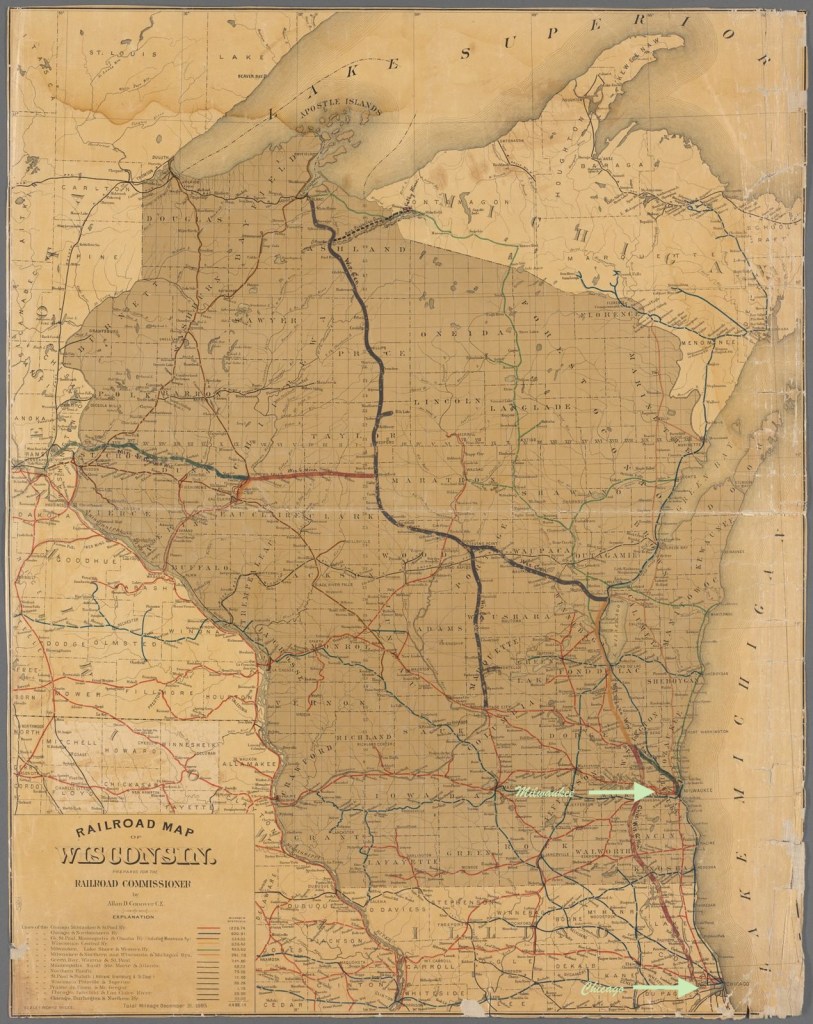
Hence why, I lean towards Louisa still living in Milwaukee, at least until 1907. It’s far simpler to slip a little something into someone’s food if you live in the same city, street, and home than Louisa traveling the hundred or so miles up the coast of Lake Michigan from Chicago to Milwaukee in order to perform the deadly deed. 

That being said, the distance would provide Louisa with a nice buffer after collecting John Otto’s $2,000 life insurance policy.

In any case, what I do know for certain is that Louisa, William, and the kids were in Chicago by June 11, 1908. As that’s the day Louisa’s eldest daughter, Frieda, unexpectedly passed away at the age of eighteen from typhoid fever and was later laid to rest in Oak Ridge (aka Glen Oak) Cemetery in Cook County, Illinois. It will surprise no one that the young laundress named her mother as the sole beneficiary of a Prudential life insurance policy in the amount of $1,350 before her death.

The reason why I find these timeline and geography questions so frustratingly fascinating is that I’ve no clue if Louisa possessed enough cunning to purposely tango to and fro over state lines in order to obscure her string of murders and subsequent insurance fraud or if it was just coincidence. Nor is it clear if Louisa used nicknames and shiny new surname to further distance herself from her earlier crimes. Either way, by happenstance or design, it worked. Despite four deaths in four years, all of which benefitted Louisa financially, no one questioned her run of bad luck.

Yet.

My 52 Weeks of Christie: A.Miner©2024

Crime & Christie: It’s Complicated

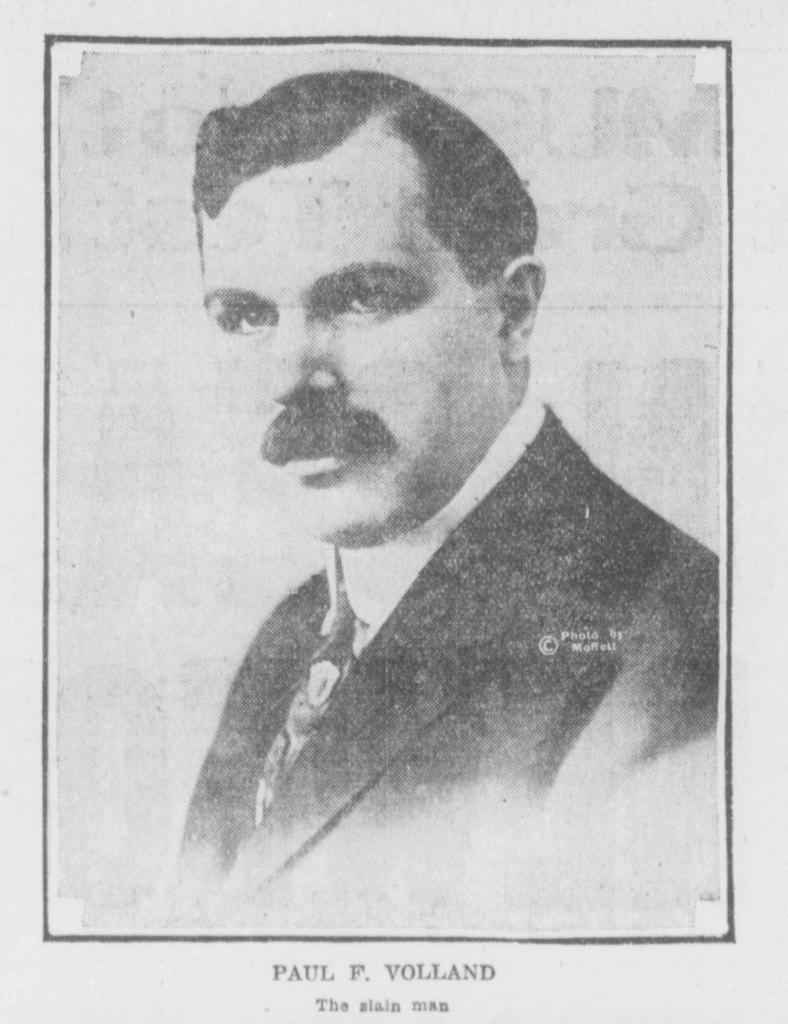
Admittedly, unlike the painting in Agatha Christie’s short story The Bloodstained Pavement, which tangentially helped solve a murder, the Trumbull portrait clearly caused one. Nor did the Chicago police need Miss Marple’s hard-won acumen to solve Paul F. Volland’s murder. Yet there’s one question I still haven’t found a definitive answer to: Did Vera Trepagnier’s looks play a substantial role in her conviction? 

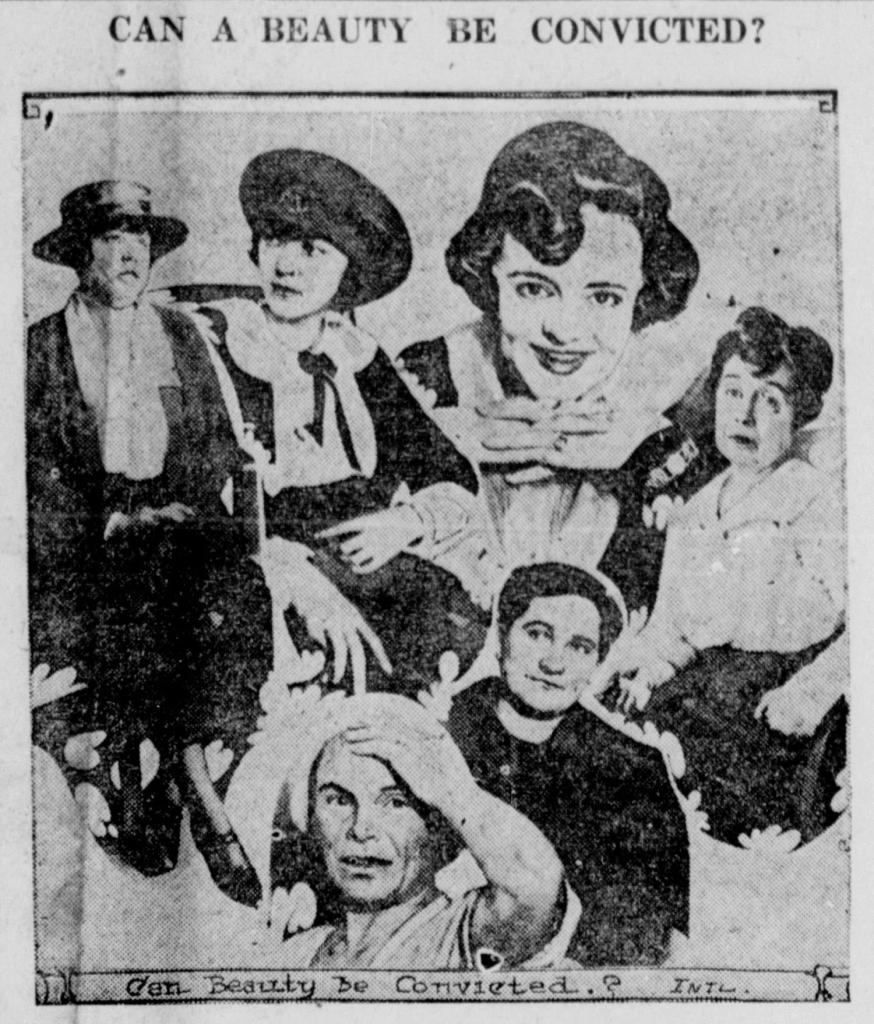
According to the 1923 headline, “Can A Beauty Be Convicted?” which featured a photo of Vera amongst others below the headline, it did. Yet, as I (hopefully) showed in the previous posts, Vera’s conviction owed little to her looks and more to her own behavior, together with her lawyer’s failure to address the unique features of her crime in their efforts to shim her case down to fit the Murderess Acquittal Formula. More importantly, Vera herself never mentioned this line of reasoning (at least in the articles I read) in the interviews given after her conviction. Nor did the papers harp on about her features during her trial, focusing instead on her “gentle spiral” into poverty and the prominence of the late Paul F. Volland.

But what of the other handful of convicted murderesses during this period? Did their looks play a role? 

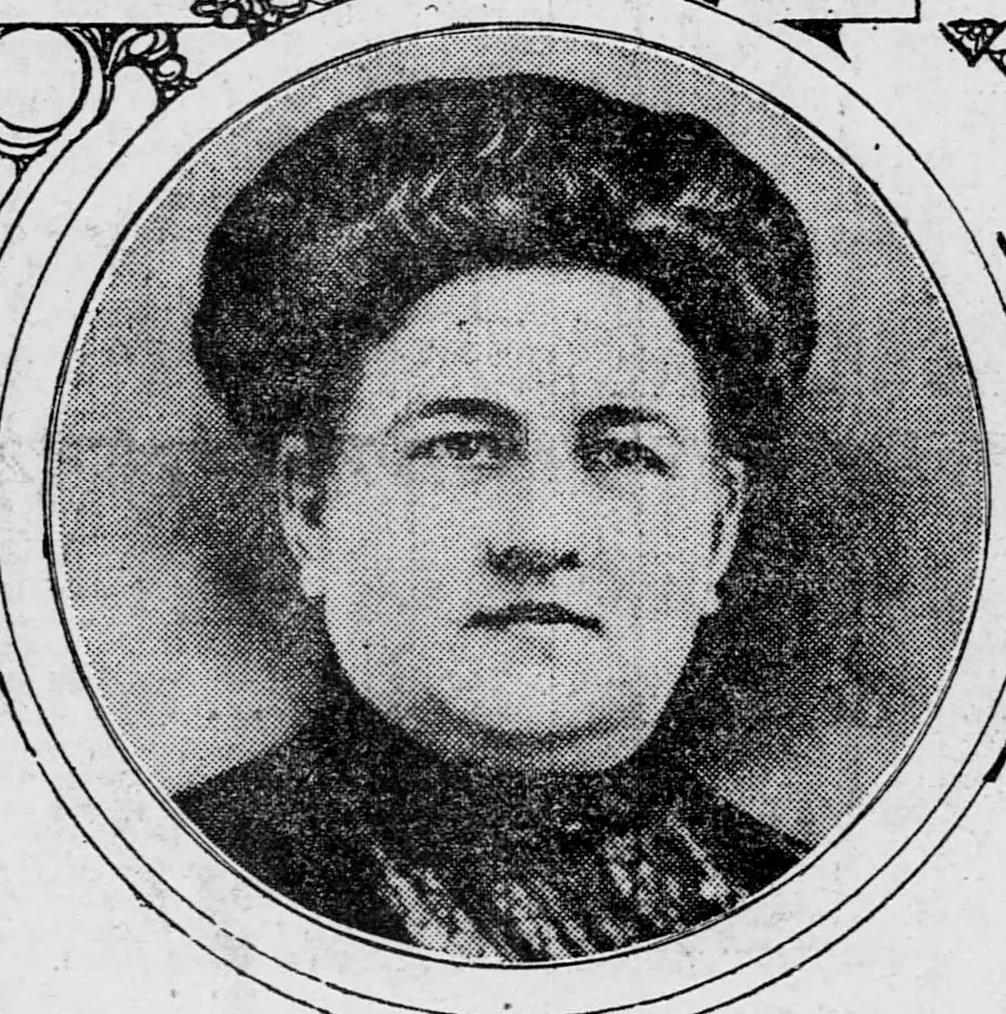
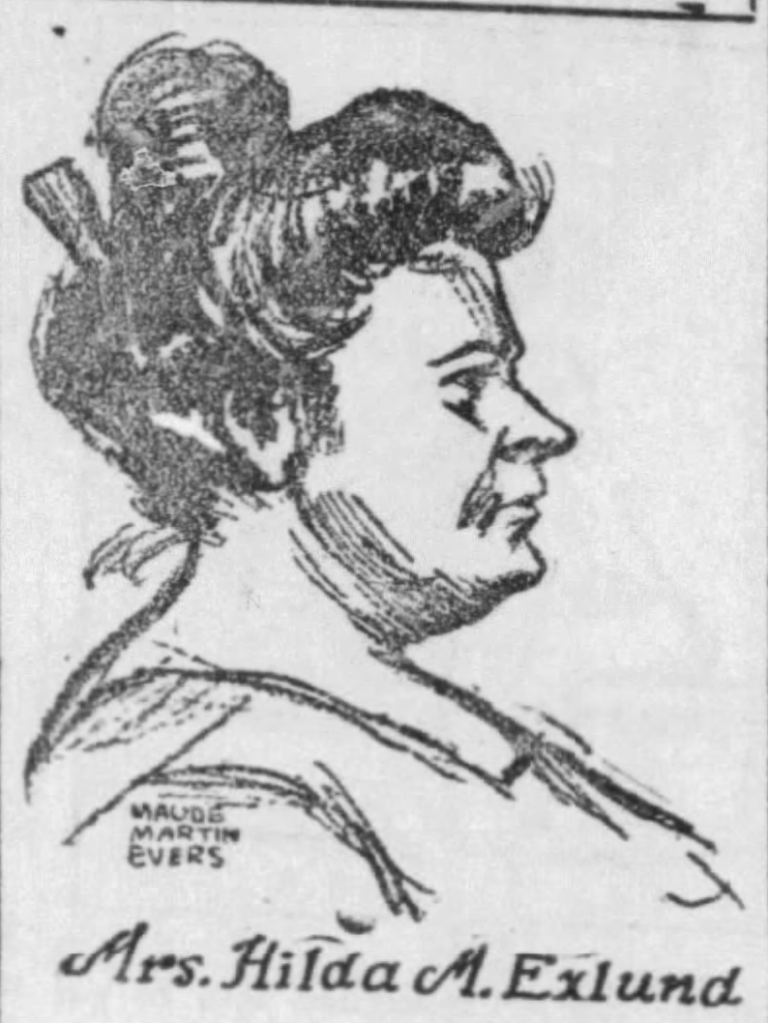
Hilda Exlund, a Swedish immigrant, certainly thought so: “If I had been young and pretty I suppose I’d have been turned loose just as the other women who have been tried for killing their husbands.” In fairness, Hilda’s lack of good looks did draw comment by the press. However, they weren’t harped on in any of the stories I read. Moreover, prior to her conviction, Hilda drew very little attention from Cook County’s press core. Meaning their news articles neither helped soften the potential jury pool leading up to the trial nor hurt Hilda’s chances for an acquittal. To my mind, what actually foiled Hilda’s acquittal prospects lay in the same realm as what sunk Vera Trepagnier’s bid for freedom seven months(ish) later.

According to Hilda: On the evening of October 16, 1918, whilst standing in the kitchen chopping a cabbage up for dinner, her husband Frank attacked her. In the ensuing struggle over the butcher knife, Hilda stabbed Frank repeatedly and killed him.

A clear case of self-defense, right? 

The hitch in the giddy-up here was, after speaking with friends and neighbors, police quickly uncovered a pattern of violence within the Exlund household perpetrated not by Frank against his wife — but by Hilda against her husband. According to their acquaintances and next-door neighbors, Hilda routinely abused her husband: Some spoke of Hilda’s habit of belittling, cursing, and beating Frank. Another relayed an episode where Hilda poured a pot of boiling hot water over Frank. Others spoke of an incident occurring a few weeks before his death, when Frank beat feet from his house while holding a bloodied handkerchief to his face, whereupon he told multiple people, “She tried to kill me.” Tallied together, these stories painted Hilda as the aggressor while reframing Frank’s possible motivation for striking first. More importantly — they negated Hilda’s claim to the “unwritten law.” 

During the ensuing trial in January 1919, Assistant State’s Attorney Edward Prindiville drew the jury’s attention to Hilda’s form by highlighting the disparity between Hilda’s “powerful physique” and her husband’s slim frame. Thus validating Hilda’s belief her looks played a role in her murder conviction and subsequent sentence of 14 years inside Joliet Prison — though not quite in the way the headline above insinuates. All that being said, the fact Hilda’s jury was comprised exclusively of married men or the fact she was tried in Judge Windes’ court (who presided over two other successfully prosecuted cases we’ll explore later) could’ve influenced the outcome as well.

Weirdly, while studying Hilda’s crime — Chicago’s ‘Cell Block Tango’ kept echoing through my brain. Specifically, June’s portion of the song designated ‘Squish’, where she describes how her husband “ran into her knife ten times” during a fight that kicked off while she was “carving a chicken for dinner”. I do not know if Hilda inspired the third member of the “six merry murderesses” — but I do know who provided the inspiration for Katalin ‘Hunyak’ Helinszki. The Hungarian woman who sang the fourth refrain, ‘Uh-Uh’ during the aforementioned song and was hung later on in the musical. 

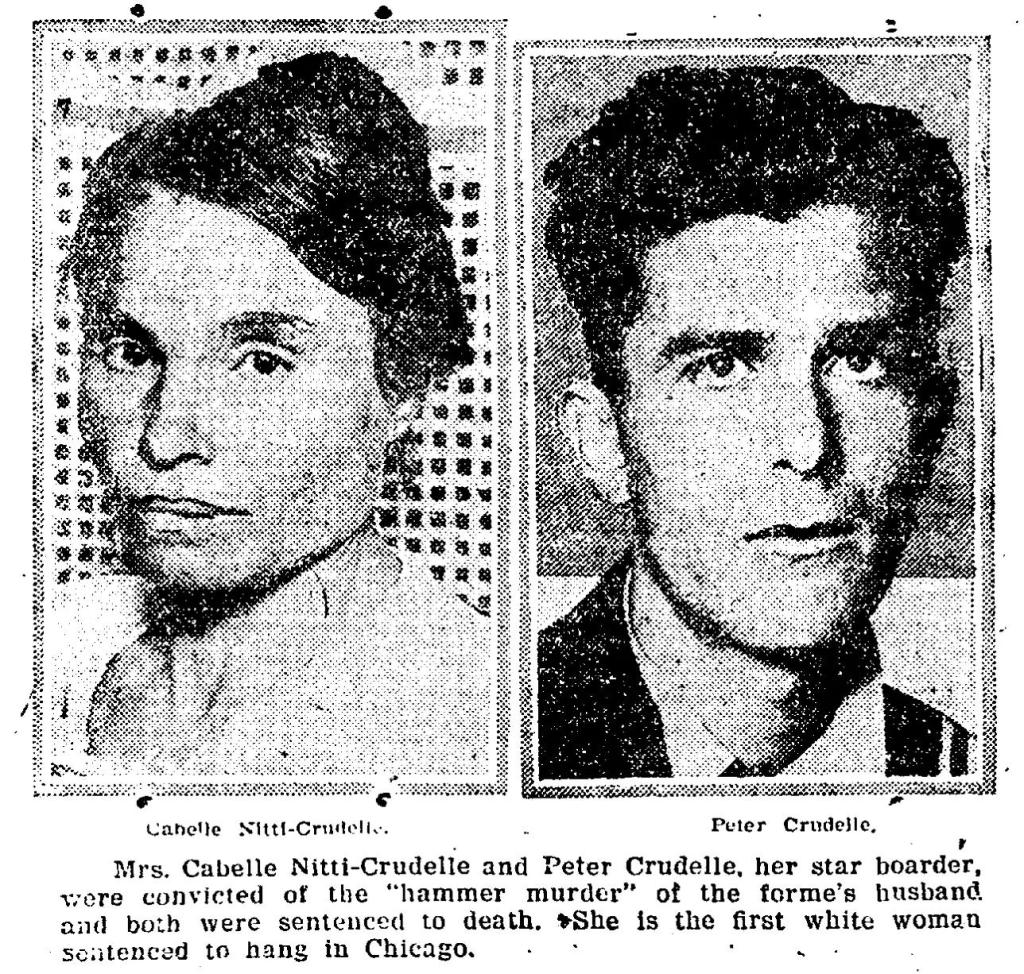
Her name was Isabella Nitti Crudelle* — and her looks alternately condemned and saved her from a trip to the scaffold.

Isabella’s ordeal began on July 29, 1922, when her husband, Frank Nitti, disappeared from their farm. Unsurprisingly, Isabella, with the aid of one of her sons, as she knew very little English at this point, reported him missing the next day. During the subsequent investigation, Isabella’s sixteen year old son Charles confessed to helping, under duress, Peter Crudelle (the Nitti’s farmhand/boarder) dispose of his father’s body in the Des Plaines River. After witnessing Isabella pinning down Frank’s hands while Peter repeatedly struck him in the head with a hammer while Frank slept under a cart. Unfortunately for the police, they had zero luck locating Frank’s corpse downriver, and without a body, the indictment against the pair was dismissed.

Endeavoring to break the case, in late September 1922, the police arrested and charged Peter and Isabella for adultery. However, whatever confession they’d hoped to extract from the couple failed to materialize and they were released. The couple would marry soon(ish) after, thus thwarting a repeat of this particular stratagem.

Fast forward to May 9, 1923: When a body was discovered in a nearby catch basin. James Nitti positively identified it as that of his brother Frank — based on a ring found on (or near, I’m not quite sure) the body. And despite Charles’s story not quite aligning (i.e., the body being found in a catch basin instead of on the banks of the Des Plaines River), the prosecutors decided to charge Peter with first-degree murder and Isabella as an accessory before and after the fact. Initially, Isabella’s son Charles was charged as an accessory after the fact, but turned state’s evidence to get out of trouble.

*I’m using Isabelle versus Sabella (the nickname used in the newspapers of the time), as it’s the name used on her headstone and two notes I’ve seen where she signed her name.

My 52 Weeks With Christie: A.Miner©2024

Crime & Christie: Han Shot First

Let’s be clear: I believe Paul F. Volland pulled a bait-and-switch on Vera Trepagnier. I think he used his position as President of the P. F. Volland Company, his business acumen, and knowledge of Vera’s strained circumstances to his advantage in order to obtain and keep the Trumbull portrait of George Washington. By dangling the promise of $5,000 before Vera, Volland gained possession of the painting. Next, by carefully wording the contract, he — not his company — secured ownership of the diminutive object if sales of the reproduction reached the 5k mark. If said sales didn’t pan out, which he was in the perfect position to ensure, Volland could point at the $500 advance and issue an ultimatum — either accept it as payment or repay the shortfall in a lump sum. Secure in the knowledge she couldn’t. 

The fact he didn’t maintain contact with Vera, nor had his lawyers issue said ultimatum until Vera made it patently clear she would continue to pester him for forever and a day, is why I’m inclined to view his actions under a crooked light. Because without that $5,000 promise, I don’t think Volland could’ve pried that painting out of Vera’s hands. (And I don’t see him giving Vera $500 as a charitable act.)

The question is, why would a wealthy man bilk a widow? The only concrete reason I found that might, and I mean might, explain such behavior occurred a few years before Volland’s death: When he nearly declared bankruptcy. Ultimately, Volland didn’t. But perhaps after skating so close to financial ruin, it invoked an unscrupulous or miserly side to his nature? Or maybe he grew up unable to rub two nickels together, which left him unwilling to pay a penny more for anything when he didn’t have to. Or perhaps he was just crafty. 

It’s unclear.

Interestingly, Vera’s charge of sharp business practices against Volland wasn’t the only one I found. A female musician contracted to write some sheet music for the P. F. Volland Company claimed that after Volland rejected her song, he later published it under someone else’s name without her permission or paying her for the work. What’s more, the day after Volland’s death, Chicago artists announced their intention to raise funds for Vera’s defense…..Again, this makes me wonder how fair Volland played with others when wheeling and dealing.

Unfortunately for Vera, partaking in dodgy business practices doesn’t automatically translate into owning a violent streak. (Nor does it mean he deserved to die.)

This begs the question: Why did Vera feel the need to bring a gun with her to discuss a dispute over a contract? According to the woman herself, “I took the revolver along to scare him. I had no intention of killing him, but that was done when he tried to take the weapon away from me.” An explanation I find believable. What I find harder to swallow is Vera’s claim the one and only day she packed the piece in her purse was the afternoon she accidentally shot Volland. 

As I see it, either the stars aligned and allowed Vera to seize an unexpected opportunity to lie her way into Volland’s presence — OR — Vera stalked Volland long enough to know he’d be in his office that particular day. If Vera relied on the ‘universe’ to provide her with an opportunity to enact her desperate plan, then it stands to reason she’d bring the gun along with her daily. Otherwise, how would she have it on hand precisely when she needed it? The latter stalking explanation, which Vera admitted doing, is the only way I see the ‘I only brought the gun with me once’ course of events as plausible. The problem there is it smacks of premeditation.

Either way, neither version of events paints Vera in glory. 

More importantly, by bringing the firearm with her, Vera cast herself into the role of instigator, severely undermining any claim of self-defense, crime of passion, or the ‘unwritten law.’ The prosecution weakened Vera’s claim further when they labeled her a blackmailer, presenting at least one nasty letter Vera wrote threatening to ruin Volland’s reputation by exposing his manipulative business practices — lest he make good on their deal. 

Without any other testimony (from, for instance, another firearms expert to refute the prosecution’s, a psychiatrist willing to declare Vera mentally unsound at the time of the murder, or anyone who could attest to Vera’s erratic behavior) to mitigate the prosecution’s arguments, Vera’s lawyers only managed to convince one juror out of twelve to find Vera not-guilty. (And he changed his mind by the second ballot.) 

Hence why, I feel Vera’s lawyers did her a disservice.

What happened after the guilty verdict? After Vera’s appeal for a new trial was denied in August 1919, she was transferred to Joliet State Prison to serve her sentence of one year to life. Sadly, at some point after September 1, 1920, Vera was transferred to Kankakee Insane Asylum. According to prison officials, the loss of the Trumbull’s portrait of George Washington (and probably the stress of the trial and incarceration) “unhinged” her mind — causing Vera to speak dreamily of nothing but her former prized possession to anyone willing to listen. 

Vera would die within the asylum walls on August 19, 1921.

In her will, Vera left several tracts of land in Maryland, a vase, and the Trumbull miniature to her grandson. Sadly, Vera forgot the vase had already been donated to a museum in New Orleans, so it wasn’t hers to give. And Vera’s only son sold the tracts of land to cover an overdue mortgage. 

As for the Trumbull miniature, an attorney by the name of Michael F. Looby was assigned by a probate court to sell it — which made quite a splash in the papers. Assured by art experts, museums, and collectors that ‘Exhibit A’ would fetch anywhere between $5,000 and $30,000, it went to auction. On September 23, 1922, Looby returned to Judge Horner’s courtroom and reported that due to the unpleasant notoriety attached to the painting, the highest bid received was $325. 

Whereupon Judge Horner approved the sale — to persons unknown and it disappeared from public view.

Crime & Christie: Fool’s Gold

I’ve no clue why Vera Trepagnier chose Philadelphia as her hunting ground for a money-making opportunity for the Trumbull miniature. Yet, this decision proved fortuitous, as Vera learned the name of a man who fit the parameters of her needs perfectly — Paul Frederick Volland. 

Originally hailing from Germany, Paul Frederick Volland worked as an engraver and diamond merchant prior to setting up his own firm (with two silent partners) in 1908. Whilst the P. F. Volland Company, as it was known, published all kinds of print-based products ranging from poetry to cookbooks and music to calendars. One of the firm’s specialties lay in creating beautiful, high-quality greeting cards and postcards — which undoubtedly is why Vera and her portrait were pointed in Paul F. Volland’s direction.

By all accounts, when Paul F. Volland met Vera in Philly in February 1917, he was so taken with the Trumbull miniature he made Vera an offer on the spot: If Vera would loan him Trumbull’s mini portrait of George Washington, he would, in turn, create and sell postcard-sized reproductions worthy of framing. Confident his company could easily sell 150,000 copies a year at a dollar a piece, Volland assured Vera she’d see at least $5,000 in royalties yearly. 

This suited Vera’s needs down to the ground. Not only could she make money off the last vestige of her former fortune, but she’d also retain ownership of the picture. To a woman who’d hovered just above the poverty line for the better part of the three decades, this sum surely sounded like a godsend — not only in accomplishing her goal of helping her grandson with his education but with her own expenses as well. So, with visions of dollar signs dancing in her head, Vera lent Volland the miniature, signed the requisite contract, and received a $500 advance.

If this deal sounds like a bit of fool’s gold…..well……you’d be right.

After acquiring both her signature and the piece of art, Paul F. Volland ghosted Vera. A circumstance Vera didn’t realize until the promised royalty checks failed to materialize. 

Puzzled, Vera wrote Volland. 

According to later testimony, when Volland eventually responded to her missives, he informed Vera that the firm decided against printing and placing reproductions of her miniature on the market. Vera’s disappointment with Volland’s decision transformed into outrage a few months later when she spotted a copy of the supposedly abandoned print run in the window of a shop, framed and retailing for a whopping $2 — double the price he’d initially quoted her.

Unsurprisingly, Vera immediately took to her stationary, posting letter after letter to Paul F. Volland — without receiving a single reply. Unwilling to take his lie lying down and determined to get her property back, Vera made the momentous decision to leave Washington D. C. and accepted a tutoring position (or perhaps that of a maid, Vera’s words differ from the reporters on this point) with a wealthy family in Rock Island, Illinois, around November/December 1918.

Now living, give or take, only 168 miles from the P. F. Volland Company’s offices, Vera took the first opportunity she could to visit the man himself. (At this point, events become a tad muddled, as it’s unclear if Vera spoke to Volland in his office, if he was called down to the building’s lobby to talk with her there, or if they met on the street. Due to following events and some non-scientific deductions, I lean towards the middle option being the likeliest for this impromptu meeting.) 

Geography aside, when Volland met with Vera, he informed her that not only did the reproductions of the George Washington miniature not sell nearly as well as he’d originally envisioned, but if she wished to reacquire her property she’d need to write him a check for $174 (or about $3,026 in today’s money) to cover the shortfall between her advance and the postcard’s paltry sales. Moreover, if she wished to discuss the issue further, she would need to go through the P. F. Volland Company’s lawyers, as he would not speak with her directly again.

Incensed, Vera engaged lawyers of her own and immediately felt the full brunt of not asking a law professional to probe the contract before signing on the dotted line. Above and beyond the 1917 document being written entirely in favor of the P. F. Volland Company from top to bottom, the agreement also stipulated that upon reaching the $5,000 mark in royalties, Vera would cede ownership of the miniature to Paul F. Volland (not his company). Moreover, the deal left Vera with very little recourse in pursuing legal action against Volland, his company, or the ability to reacquire her precious Trumbull miniature. 

Firmly convinced Paul F. Volland swindled her, Vera continued visiting not only Volland’s office building but the offices of various law firms around Chicago. The former cost nothing but time and pride, as Vera was repeatedly rebuffed by security/reception in the lobby on her successive visits. The latter endeavor, however, slowly bled Vera dry, making her more and more frantic for Volland’s promised payout as time wore on.

Upon reaching the last few pennies of her savings, Vera hatched a desperate plan.

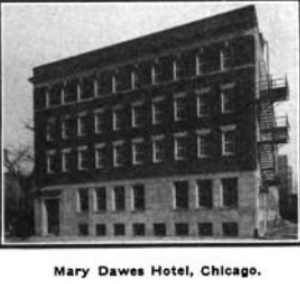
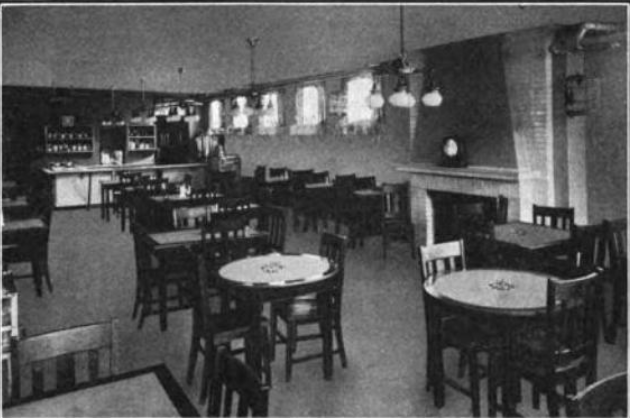
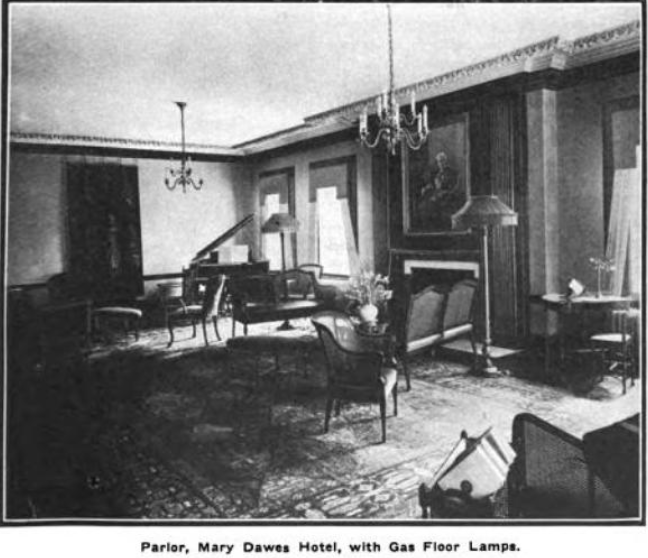
Sometime around late April to early May in 1919 — Vera Trepagnier traveled from Rock Island to Chicago. After checking into the Mary Dawes Hotel, an all-female establishment, Vera immediately set about enacting her single-step plan: Wait outside before the P. F. Volland Company’s office building until the man himself exited, then ambush him with an ultimatum: Either return the diminutive portrait of George Washington or pay $5,000.

So Vera waited. In rain and shine, she stayed vigilant until finally, on May 5, 1919, Vera seized the gold-plated opportunity her persistence presented her. Upon arriving for her self-appointed vigil, Vera spotted Volland’s car pulled against the curb. Knowing for certain he was on the premises, Vera, employing the alias Mrs. Martin, bamboozled her way through the lobby and reception until she stood before Paul F. Volland’s private office. 

Upon emerging and catching sight of Vera, Volland uttered, “Oh, it’s you.” 

Ignoring Paul F. Volland’s less-than-auspicious greeting, Vera Trepagnier launched into her demand for her money or property. Undoubtedly wishing to avoid providing fruit for the office gossips, as he knew Vera was more than capable of making a scene, Volland escorted her into his office whilst reiterating his position — she needed to speak with his lawyers about the Trumbull portrait, not him. 

Despite Volland’s unwelcome visitor, the outer office activity continued to hum along…..Until a single report rang out from the otherside of Volland’s office doors and brought everyone running. Unceremoniously bursting into the room, two clerks found Volland dying on the floor from a bullet wound to his chest while Vera stood across the office, calmly staring out a window. 

Crime & Christie: George Washington, Art, and Revolution

Recently, on a whim, I reread the Miss Marple short story The Bloodstained Pavement. After finishing the story (for the umpteenth time), an idle thought crossed my mind: I wonder if an artist has ever solved a crime whilst painting a painting? Curiosity sparked, I plugged in some keywords into an old newspaper archive.

It came back with:

Diverted by this curious headline (mere minutes after my original query flew through my head), I jotted down the brief list of names printed below the photo collage. Deciding I could spare a few seconds to suss out the meaning of this singular bit of news — I, in a fair imitation of The Fool, blithely stepped off an unobserved precipice.

Fast forward several months.

Surfacing from a mares’ nest of mind-boggling murders, wafer-thin defenses, and musical numbers — I’d grasped a slender thread (loosely) linking The Bloodstained Pavement and the aforementioned fantastic headline to a crap ton of crime in Chicago spanning betwixt 1907 to 1919. 

And it all starts with an artist named John Trumbull.

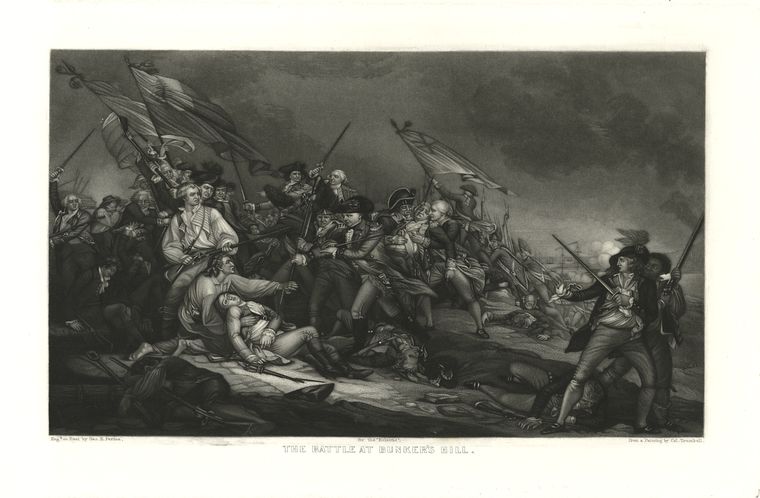
Never heard of him before? Well, ten to one, you’ve probably seen his work: in history books, if you’ve ever been to the rotunda in the U.S. Capitol building (in Washington D.C.), scanned the back of a two-dollar bill, or gazed upon Alexander Hamilton’s portrait on a ten spot. How did Trumbull find himself commissioned with such momentous projects? Well, between being the son of Connecticut’s Governor, graduating from Harvard, and serving under George Washington & Horatio Gates during the American Revolution — Trumbull met a plethora of the fledgling country’s early leaders. 

However, before Trumbull became known for his hyper-detailed life-sized scenes, earned a commission from Congress, or painted the portraits of several founding fathers — he sailed for London in 1780. Unsurprisingly, whilst in the capital of the UK, Trumbull met up with Benjamin Franklin. (Seriously, Trumbull’s life is a who’s who of historical figures.) Franklin, in turn, introduced the aspiring artist to Benjamin West — whose subject matter meshed well with Trumbull’s artistic aspirations. Under West’s tutelage, Trumbull began practicing painting techniques by filling small canvasses with images of the war he’d fought in and miniature portraits. 

Apparently, Trumbull enjoyed the latter exercise so much that he’d go on to paint over 250 of these mini-pics over the next 63-ish years. 

Amongst the bevy of minis Trumbull created was a portrait of George Washington (one of his favorite subjects). Painted in predominantly blues and golds on an oval-shaped piece of ivory, it measured 2.25 by 1.75 inches. According to legend, after completing the Lilliputian sized portrait, Trumbull presented it to a Virginian bride as a wedding gift. After this, this unnamed bride moved both herself and the pocket-sized portrait to Kentucky. Next, the fun-sized painting relocated with one of her kids to Tennessee, her grandkids decamped with it in tow to Arkansas, and finally, it wound up in Louisiana, where it was gifted to Vera Trepagnier. 

Elizabeth Vera McCullough or Vera (as she seemed to prefer), was born into a wealthy family in Belfast, Ireland, around 1860. Round about the age of seventeen, she and her family immigrated to the U.S. and settled in Louisiana. Sometime over the next seven years, Vera caught the eye of her future husband and sugar planter — Francois Edmund Trepagnier. The two married around 1886, when Vera was 24 and Francois was 52 (give or take). They had a son by the following year. 

(Upon marrying Francois, Vera also became the stepmother to three kids from Francois’s first marriage — the eldest of whom was only two years younger than herself….which sounds….awkward.)

Fast-forward four years to when the Trepagnier sugar plantation flooded and ruined their entire crop. In the wake of the devastation and unable to recover, Francois and Vera were forced to economize: first, they let go of all their servants, then sold all their furniture, and finally, the plantation itself. Sadly, despite trying to find a fresh start in Florida, the pressure of unexpectedly tumbling downwards through a significant number of tax brackets proved too much for Francois. Who, whether by illness or suicide (it’s unclear), passed away around 1891. 

Despite losing her husband, estate, and way of life, Vera retained possession of the diminutive Trumbull portrait.

In 1916, during the WWI war effort, about twenty-five years after these life-altering events, found Vera working for the Treasury Department in Washington D.C. Now a grandmother who wanted to help her grandson get a good education, Vera finally decided to investigate the legend around her pocket-sized portrait. Placing the ivory miniature beneath the lens of a microscope for a better look at the artist’s signature, Vera discovered the painting’s lore true. Even better, thanks to the private tutors who’d educated her in her youth, Vera not only knew who Trumbull was, she understood how valuable a rendering of George Washington by his hand could be. 

With this knowledge, Vera traveled to Philadelphia, hoping to make money off the tiny thing while (hopefully) retaining possession of it. 

(Cue dramatic music.)

Absinthe: People have killed for less…But not by much.

Now that we’ve established absinthe’s meteoric rise and even faster fall in the realm of public opinion, we can now focus on my original question: Why haven’t I read mysteries where, during the summing up, the malefactor yells, “Absinthe made me murder/rob/eat Uncle Singin McBuzzleworth!”

One Unscientific Opinion/Answer: The “Absinthe made me do it!” defense didn’t hold up in real-life courtrooms. 

When examining classic mystery and real-life motives like avarice, revenge, envy, and sex — the “Absinthe made me do it!” defense appears weak by comparison. Moreover, despite large swaths of the population (within many countries) purportedly believing absinthe poisoned the minds and hearts of any who partook of the Green Fairy’s potion — defense councils were still hard-pressed to engender enough sympathy in jury members to make this justification stick. 

Take the case of Auguste-Leon Thabuis. 

Near the township of Dole in the department of Jura in France sits Saint-Ylie Hospital (or Asylum; the French translator app I used was not flawless). Back in 1909, the 1,500 people (or so) residing within Saint-Ylie were separated into different pavilions by age and gender then sub-divided further based on their ailment — those possessing some sort of paralysis lived in one ward, those with mental health issues in another, and the “incurables” (their word, not mine) lived in their own wing. 

In April 1909, the hospital director hired Auguste-Leon Thabuis to work in the men’s paralysis ward. Besides discovering he owned a terrific thirst, which he quenched at a nearby tavern, hospital administrators found no problem with Thabuis’s work.

Fast forward seven months.

On Friday, November 19, 1909, Thabuis reported to his supervisor that Justin Garneret (age 61) had died. Busy with one thing or another, Thabuis’s superior didn’t take the time to look the body over, instead they told Thabuis to get on with it. Which he did — leaving Justin Garnet’s body in his room, Thabuis went to prepare the earth for her newest resident — as he also moonlighted as a gravedigger and amphitheater boy for the hospital when needed.

Now it’s unclear precisely what roused the other nurses’ suspicions, perhaps because Justin Garneret’s death came completely out-of-the-blue or the curious piece of serendipity which found four other patients passing away, about one every other day, on Thabuis’s watch starting on November 10, 1909. Either way, they snuck a peek at Mr. Garneret’s body whilst Thabuis was away….And were rewarded with the sight of darkening fingermarks encircling Mr. Garneret’s neck. 

Fetching Hospital Director Bierry and Chief Physician Santenoise, the nurses explained their misgivings and subsequent discovery. 

At about this point, Thabuis returned to Mr. Garneret’s room with a coffin. In the ensuing conversation, during which I imagine Thabuis sweating more than a few bullets, Dr. Santenoise questioned the nurse about the undeniable signs of strangulation. Unfortunately (for Thabuis), the Chief Physician didn’t buy the story he spun: That one of the lunatics must’ve snuck out of their ward, into his, strangled Mr. Garneret, then crept back to their room — their absence and presence remaining undetected by everyone the entire time.

When the public prosecutor, examining magistrate, their clerk, and two trained forensic examiners answered Dr. Santenoise’s summons, Thabuis told them that Mr. Garneret attacked him and he’d been forced to defend himself. This explanation, which went over about as well as his first, prompted Thabuis’s immediate arrest — during which he cried out, “I’m innocent! I’m innocent!” Mr. Garneret’s autopsy, carried the same night around eight pm, confirmed the nurses’ worst fears — he was indeed murdered.

The Question Was: Did the other four patients who died under Thabuis’s care over the past eight days meet the same fate? 

Performing a quadruple exhumation and autopsy the following Friday, authorities found some answers. Sadly, the bodies of the first two possible victims decomposed to the point where murder couldn’t be conclusively proven. The third victim, Francoise-Emile Menefere (age 54), bore bruises in the outline of two hands around his neck and a bruise on his chest. The fourth victim, Xavier Guinez (age 54), sported a similar bruising pattern as well as a row of four broken ribs and other defensive injuries. (It seems in addition to using his hands, the murderer used his knees to compress his victim’s chest to hasten the deed.)

With cause of death now established and confident they had their man, investigators turned to motive…..which proved troubling. Not because they found its establishment difficult but because the only dependable benefit Thabuis received from any of the deaths was the single extra franc he earned for each grave he dug. This veritable pittance was hastily spent at the neighborhood tavern. Where, when “flush” with cash, Thabuis reputedly drank up to four liters of wine and twenty-two glasses of absinthe.

All these facts & theories, together with the unsavory intelligence Thabuis sent notes to grieving families asking if they’d like him to maintain their loved ones’ graves in exchange for a small donation, emerged during his trial, which commenced in July of 1910. (It’s unclear if Thabuis wrote the families of the men he murdered.) This seedy behavior, coupled with a job history that included terminations due to theft, insolence towards a nun, coming to work while inebriated, and serving a three-month prison sentence for insulting a Swiss police officer — didn’t help his case. 

However, his public defender, Milleret, was up to the task.

Amongst the sixteen witnesses called by the prosecution, Milleret determined that while all the nurses, who’d first raised the alarm, believed Thabuis culpable in the murder of Mr. Garneret (based on his and their movements that day), none could confidently assign his hand to the deaths of Mr. Menefere or Mr. Guinez. While the prosecution argued that Mr. Garneret’s murder proved the pattern. Milleret countered this by pointing out that the prosecution could not call a single “reliable” eyewitness to the crimes.

(Now, here comes the cream, at least for the question I’m trying to answer.)

In a Classic Scenario of ‘I didn’t do it. But if I did it.’: Milleret attempted to establish that Thabuis suffered from a classic case of hereditary degeneration and, therefore, shouldn’t be held accountable for his actions. (Yes, this case explicitly put absinthism to the test.) Not only did Thabuis prefer the embrace of the green fairy above all others — Milleret argued this devotion/addiction decayed Thabuis’s moral fiber to the point where taking another man’s life in pursuit of another glass felt justifiable. Moreover, due to weak genes he’d inherited from his father, whose excessive drinking sent him to an early grave six years prior, Thabuis’s ethical putrefaction was all but guaranteed.

It’s unclear if the alienist the prosecutor brought in successfully refuted Thabuis’s defense or (more likely in my estimation due to the slant of the newspaper reports) the members of the jury couldn’t overcome the repugnance of Thabuis killing a man for a single franc. Either way, it only took the jury three-quarters of an hour to find Thabuis guilty of Mr. Garneret’s murder and sentence him to seven years in prison and a ten-year ban of stay. (I’ve no clue what that last bit means. Maybe it banned him from working in another hospital for ten years after his release?)

In any case, the regular rejection of Magnan and Legrain’s absinthism defense by juries presents a fascinating counterpoint to the anti-absinthe campaign, which embraced these theories and was, at that moment in time, gaining momentum across several continents. Perhaps if women, the backbone of the temperance movement, were allowed to serve on juries during this period, acquittals based on the “Absinthe made me do it!” wouldn’t have been rarer than hen’s teeth.

Moreover, the lack of acquittals based solely on “Absinthe made me do it!” may have signaled to Golden Age mystery writers the inherent weakness in this particular solution. Since their livelihoods were based on fashioning viable and (generally) believable solutions for their readers, placing the blame solely on absinthe for the unfortunate fate befalling Uncle Singin McBuzzleworth could place a lackluster ending on an otherwise strong story — which might cause an author to lose readers. 

An idea I imagine any pro would find insupportable.

My 52 Weeks With Christie: A.Miner©2024

Absinthe: Let’s All Panic!

While increased availability and/or Magnan and Legrain’s theories swayed some back towards wine (which most experts considered harmless), a far greater number now viewed the absinthe as a guilty pleasure — which only enhanced its protracted pizzaz. This not-so-subtle brush-off made teetotalers, doctors, and winemakers despaired over the idea that they may never rid themselves of the glittering Green Fairy. 

Then Jean Lanfray came along.

Originally a Frenchman, Jean Lanfray lived and worked in Switzerland. Arriving home on the afternoon of August 28, 1905, Lanfray promptly picked a fight with his wife over the state of his boots. Seems she hadn’t gotten around to waxing them as he’d requested and, in short order, both spouses were seething. When Lanfray told his wife to shut up….She said, “I’d like to see you make me!” Whereupon he fetched his Vetterli rifle — shot his wife in the head, turned the gun on his two daughters (both under five), then attempted to kill himself.

After his arrest, the reeling residents of Commugny (the town in which Lanfray and his family lived) attended a townhall meeting on September 3, 1905, where they learned Lanfray ingested two ounces of absinthe and that his wife was about four months pregnant with their son at the time of her murder. Horrified at the latter revelation and feeling powerless in the wake of this senseless violence, townsfolk needed someone or something to blame. Unable to put Lanfray immediately on trial, as he lay in a nearby hospital recovering from his suicide attempt, they chose absinthe as their scapegoat. Within days of the assembly, the citizenry sent a petition with 82,000 signatures to their state capital, asking legislators to ban the “Green Monster”.

The unintended consequence of the community’s appeal? They set a clear defense strategy for Lanfray’s lawyers — absinthe made him do it. An assertion medical experts supported during Lanfray’s brief trial. Absinthe notwithstanding, the fact Lanfray also quaffed seven glasses of wine, six glasses of cognac, two coffees laced with brandy, and two creme de menthes on that fateful Monday diluted the effectiveness of this defense. And while this prodigious intake prior to the murders and his very obvious remorse kept his neck out of the noose, on February 23, 1906 a jury found Lanfray guilty of murder. 

Three days after being sentenced to thirty years imprisonment Lanfray, haunted by his own actions,  would hang himself in his jail cell.

Despite the clear flaw in the blame game being played (i.e. the liters of other alcohol Lanfray consumed), on May 15, 1906, the Canton of Vaud (the state where Commugny is located) banned absinthe. Shortly thereafter, Geneva followed suit in response to their own absinthe-drinking husband named Sallez, who murdered his wife about a month after Lanfray’s crimes. (Brazil and Belgium beat both to the punch by banning absinthe outright in 1905.)

Temperance unions extracted an entirely different lesson from this series of tragic events. 

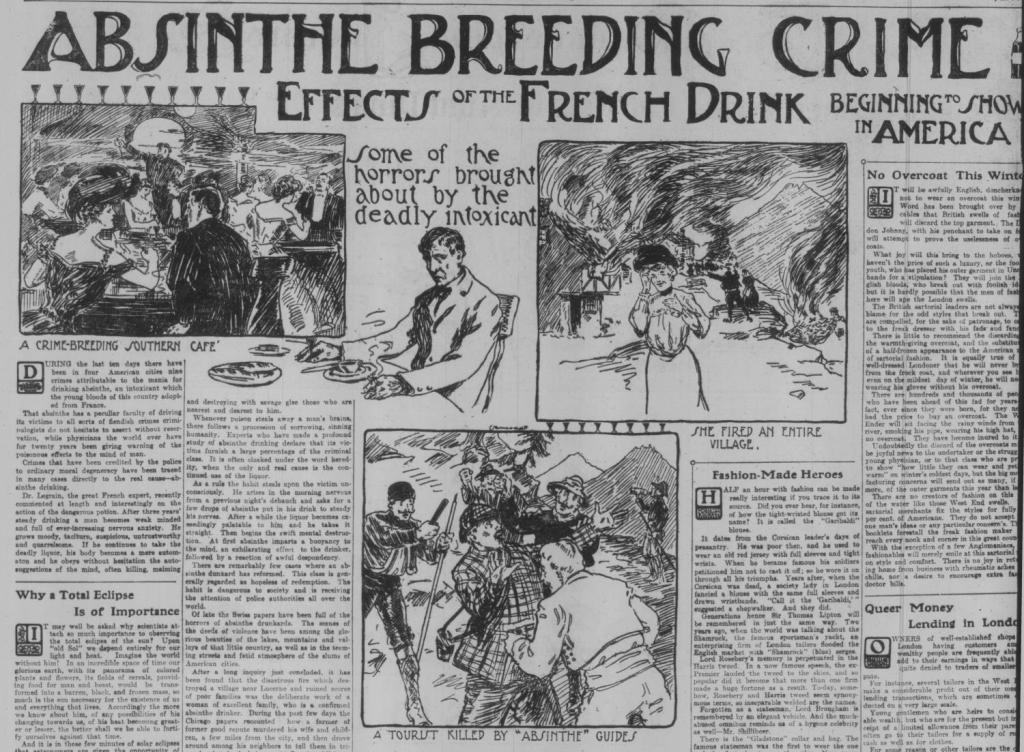
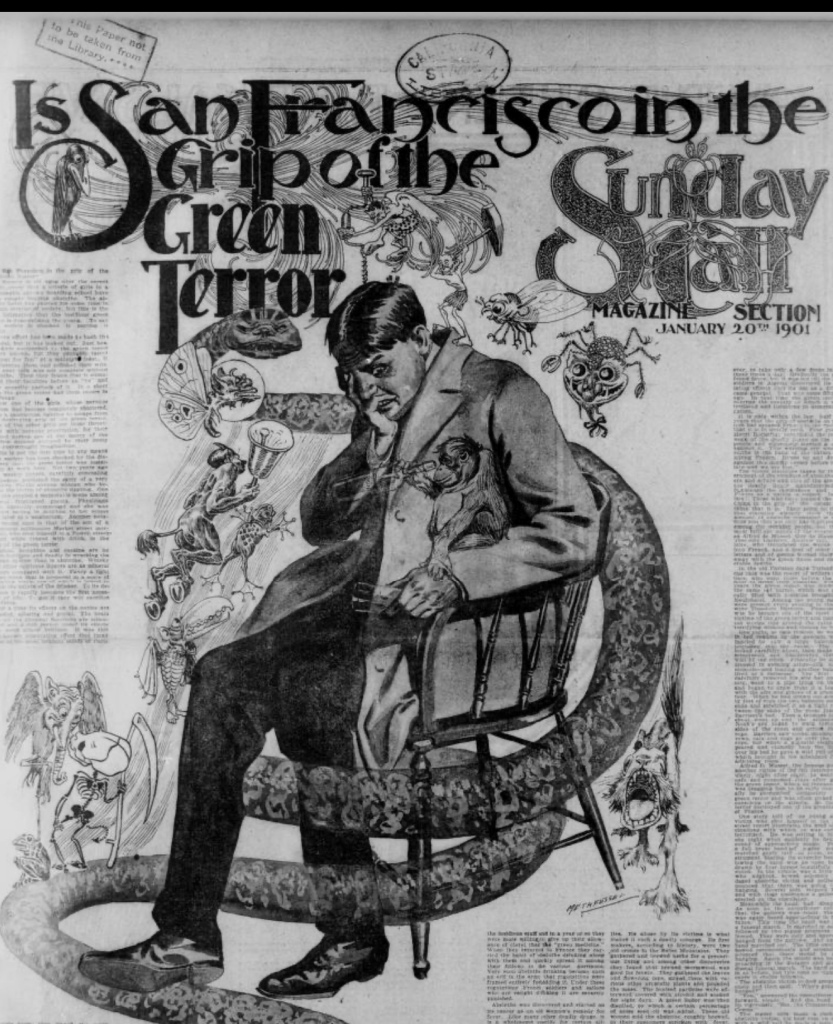
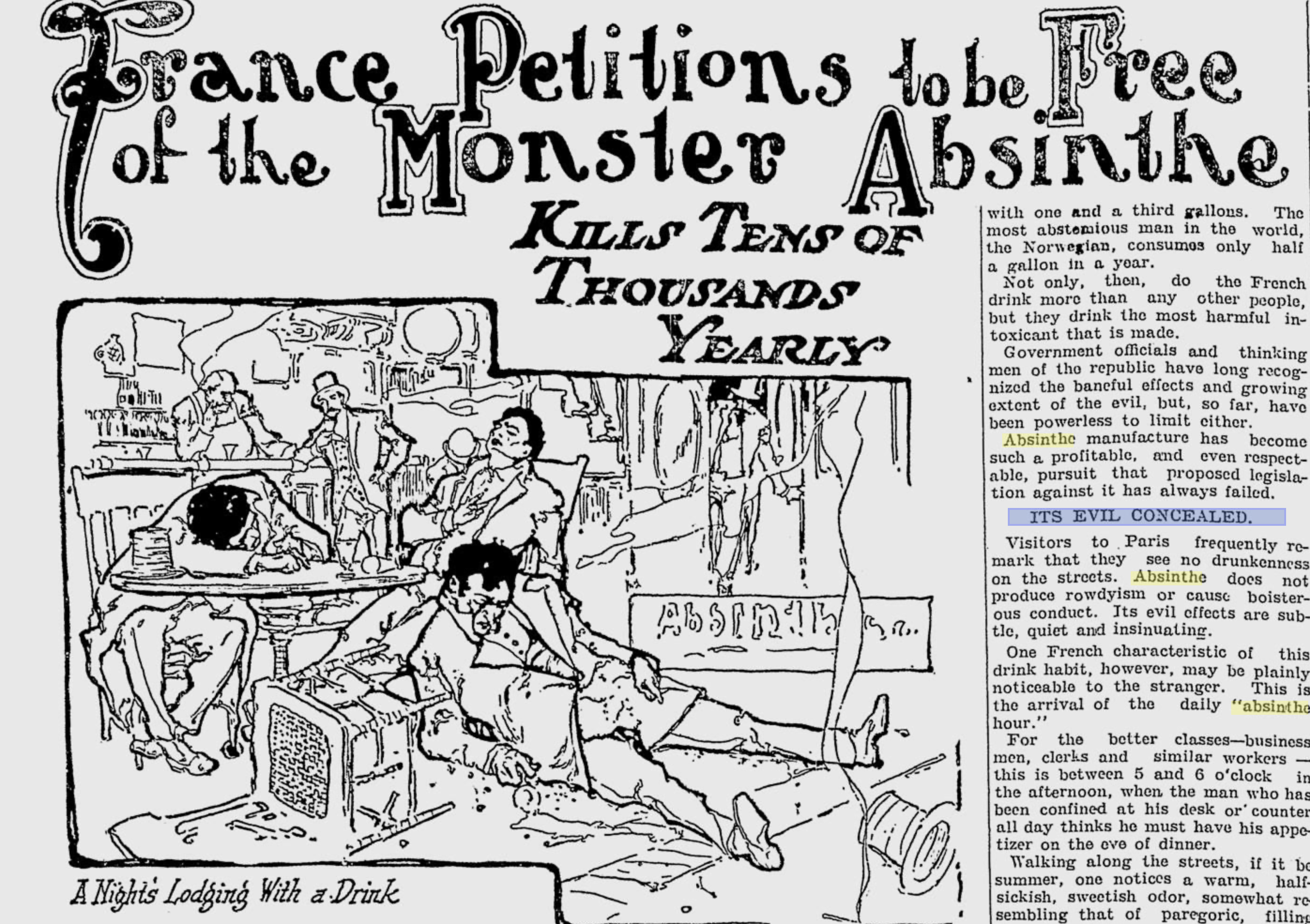
They discovered a potent weapon in their fight — moral panic. By spotlighting every crime where absinthe played a role, even a minor one, they could catastrophize the “threat” absinthe posed to society’s safety and wellness. To this end, not only were Magnan’s skewed scientific experiments widely reprinted along with his theories on absinthism, Legrain lent his time, reputation, and words: “….after three years’ absinthe drinking a man becomes weak minded…moody, taciturn, suspicious, eccentric, untrustworthy and apt to quarrel without cause. If he continues to take the deadly liquor his body becomes an automaton, and he obeys without hesitation the auto-suggestions of his mind often killing, maiming and destroying with savage glee those nearest and dearest to him.” 

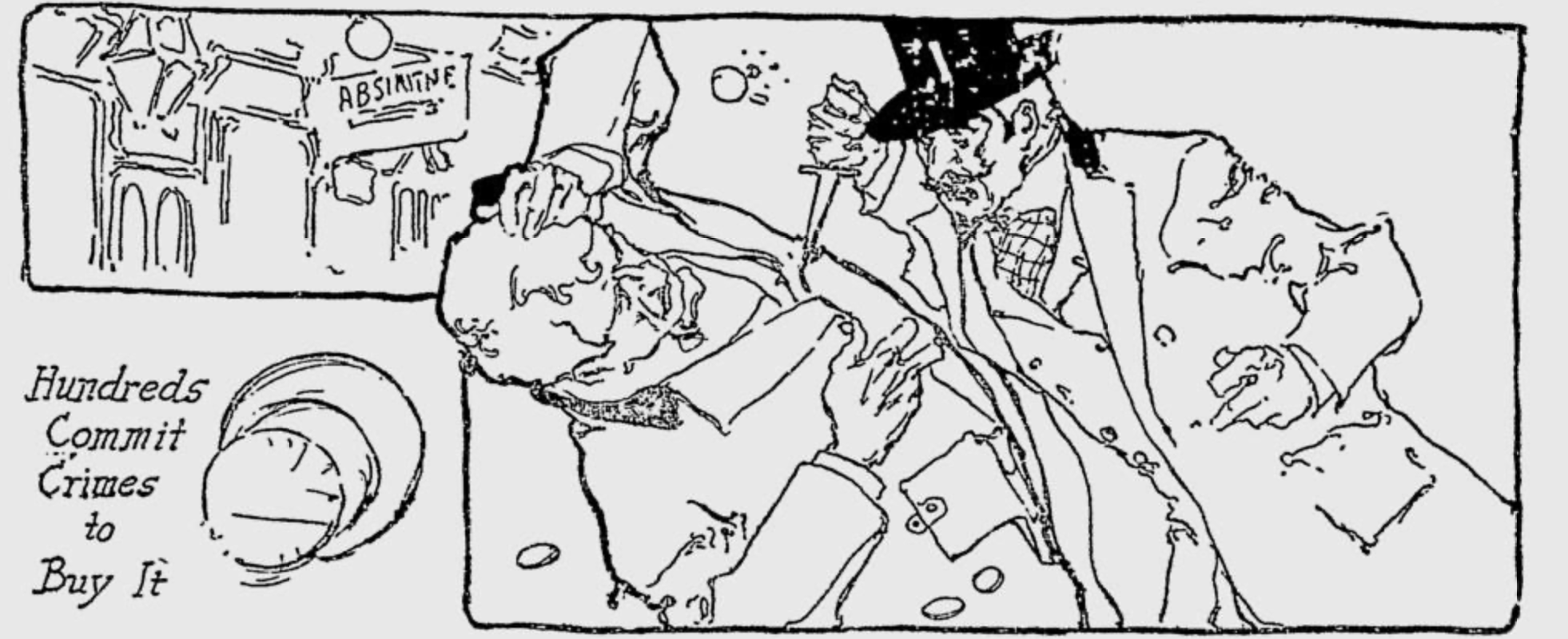
Fanning the anti-absinthe flames further, temperance unions and their members began churning out art, movies, and pamphlets corroborating these scientific findings. The most effective arrow in their quiver? Syndicated newspaper articles, in which the author detailed the alarming or violent behavior of absinthe drinkers. Amongst the many offenses attributed to “absinthe fiends” were: A) A man named Valentin Boyer, who was convinced that his enemies were persecuting him via electricity. When circumstances forced him to enter Paris, he donned a 385-pound coat made of copper and a hat made of lead with a visor covering his face. He was promptly arrested for his odd appearance. B) A man attending a national fete set fire to 37 dresses as he couldn’t resist applying his cigar to every blue dress he saw. C) A woman of good standing was arrested and imprisoned for setting fire to a village near Lucerne and destroying several houses owned by “the poor.” D) Near Nyon, an absinthe addict maimed cattle and set a series of fires. E) A 12-year-old girl was stabbed to death near Thorwaldensen’s Lion of Lucerne by a man employed at a match factory in Geneva. F) A man decapitated a young girl in Lausanne. G) Six Valois guides murdered a tourist and hacked him to pieces. H) Whilst in police psychiatric care, it was noted absinthe addicts would often try to bite off and eat pieces of their friends and family’s faces when they leaned in for a kiss. 

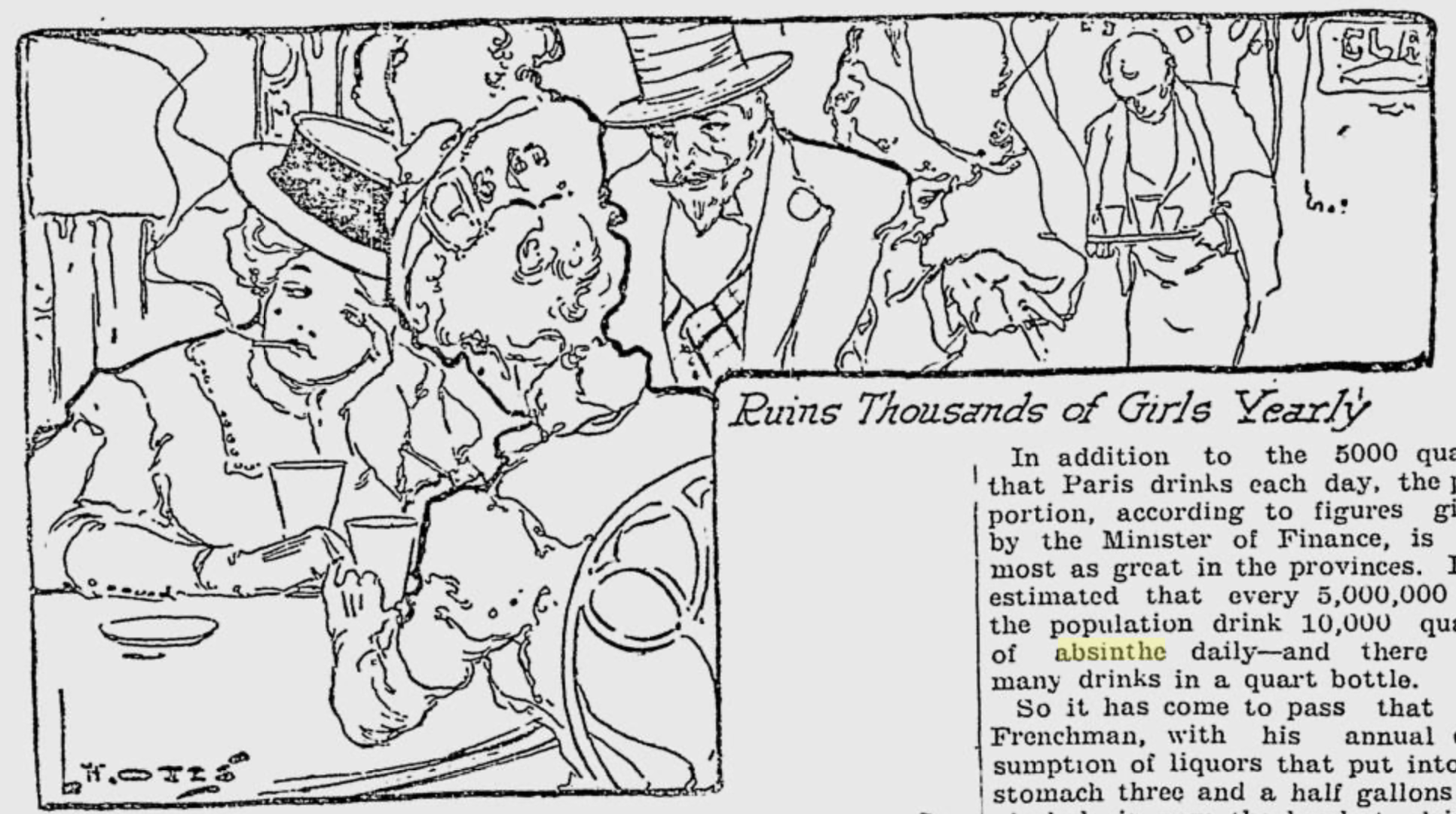
Unsurprisingly, these tales of arson, murder, and cannibalism snowballed as editors keen on increasing their readership (and/or were part of the temperance movement themselves) lept onto the anti-absinthe bandwagon. Not only did they feature any local/regional cases that even tangentially intersected with the “green monster.” They also published their own exposes on the dangers absinthe posed to their communities. Some linked the drink to the same dangers posed by opium or morphine. Others warned husbands to watch their wives lest they be lured into absinthe dens and robbed of their pin money and jewelry while they lay in an absinthe-induced stupor. Still others advised parents to keep a weather eye on their daughters lest absinthe tempt them into a wickedness and ruin.

At some point, one bright bulb took this fear-mongering to another level by linking Magnan and Legrain’s theories of social degeneration due to absinthe drinking to the bitter loss of Alsace-Lorraine during the Franco-Prussian War in 1871. Doubling down newspapers across the world started questioning France’s fighting fitness (and, by extension, every other country that allowed absinthe within its borders). Thereby creating a green-tinted scapegoat for the growing anxiety and helplessness people felt as they watched Germany, the Austro-Hungarian Monarchy, and the Ottoman Empire growing stronger as the world hurtled towards 1914 and the start of World War One. (Though they didn’t know it yet.)

Unsurprisingly, this relentless pressure and constant fear bore fruit in 1909 when the Netherlands banned the spirit. Switzerland amended its constitution to add an absinthe prohibition in 1910, the USA’s Pure Food and Drug Act barred its import in 1912, and France banned the spirit in 1914. 

From the Office of Cynical Speculation: When reading these “reports” of absinthe induced crimes cracks start to appear when they inevitably reference the Lanfray case. Rarely do any of these “news stories” cite Lanfray by name; none mention the date of his offenses or conviction, nor the specific town where the murders took place. They generally refer to him as a farmer living near Coppet who murdered his young wife and children. 

Why so vague? Not only with Lanfray but in the description of the other cases? Other than the rare mention of Lanfray by name, only the first of my examples ever mentioned one of these “absinthe fiends” by name — few gave a specific location and none contained a firm date.

Playing Devil’s Advocate Here: They could have omitted these details to keep the newspaper column under a specific word count. Or perhaps the authors thought these examples were so famous everyone would instantly get the reference. I know the Lanfray case became the cause célèbre in Europe for a time thanks to the anti-absinthe movement. So, it’s not out of the realm of possibility.

However, the doubting Thomas living in the back of my brain wonders if the lack of detail stems from the desire to obfuscate the particulars of their examples…..In order to make it difficult for the public or their opponents (of which there were more than a few, though they were far less organized and funded) to suss out details which didn’t align with the thrust of the anti-absinthe campaigner’s aims. Again, take the Lanfray case as an example. If those unfamiliar with the murders learned of the liters of wine and wine-based beverages he consumed and compared it to the two ounces of absinthe….Well, people might draw a different conclusion and blame the wrong kind of alcohol — which flies in the faces of winemakers’ self-interest. Hence why it may’ve been left out.

So what about the other examples of absinthe-induced crimes? Do they own similar inconsistencies? 

I don’t know. I attempted to verify the finer points of the other cautionary tales and came up with bupkis. I couldn’t find a single newspaper piece aligning with the criminal information outlined in these syndicated articles. In fairness, these purported transgressions are well over a century old, and my French (while improving) is still lackluster at best. 

While, I do not believe the authors made this anecdotal evidence up….…I am not sure they were above exaggeration either.

My 52 Weeks With Christie: A.Miner©2024
Rough on Rats: Pressing Her Luck

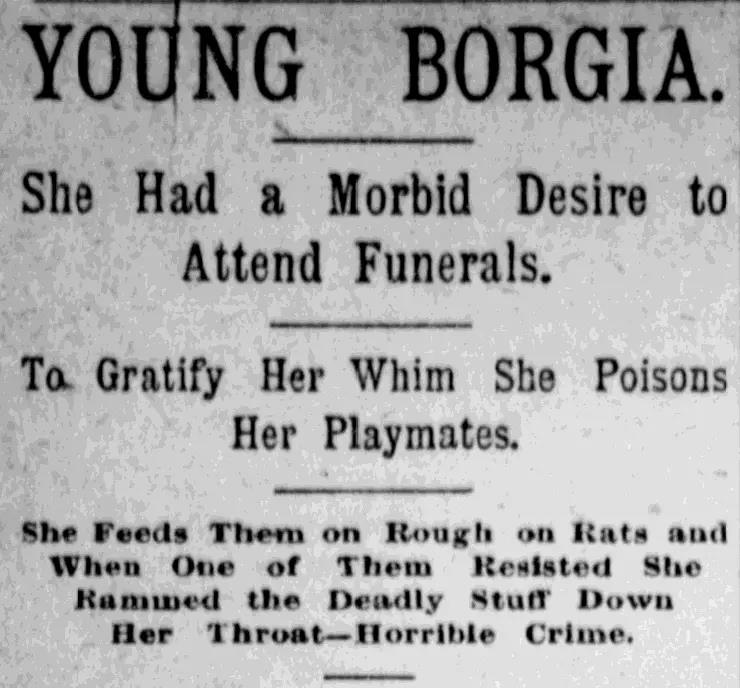
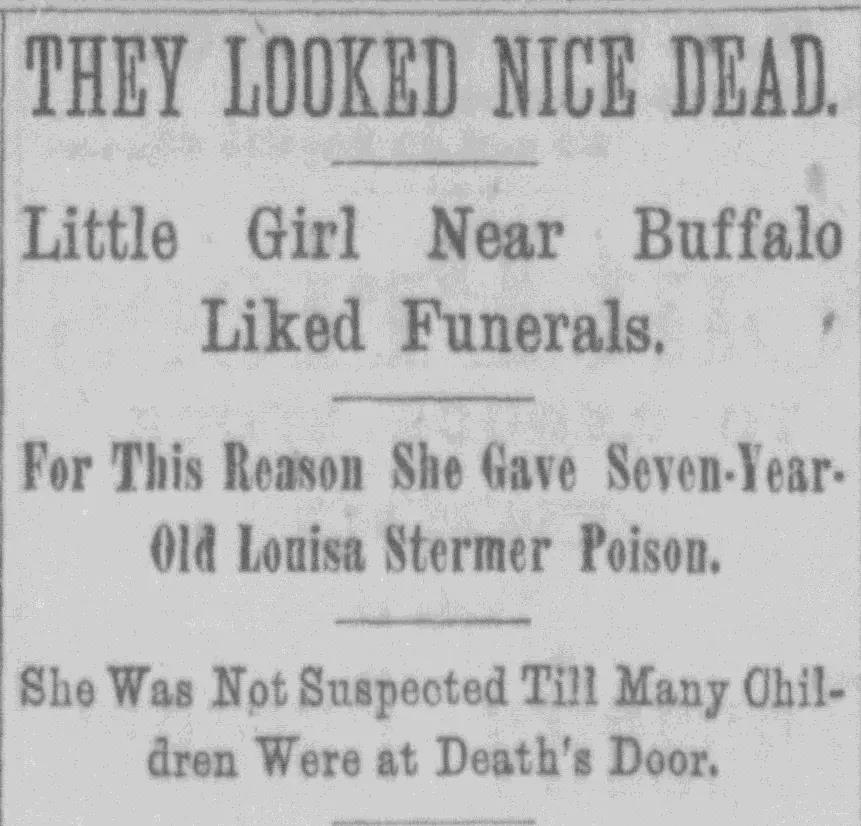
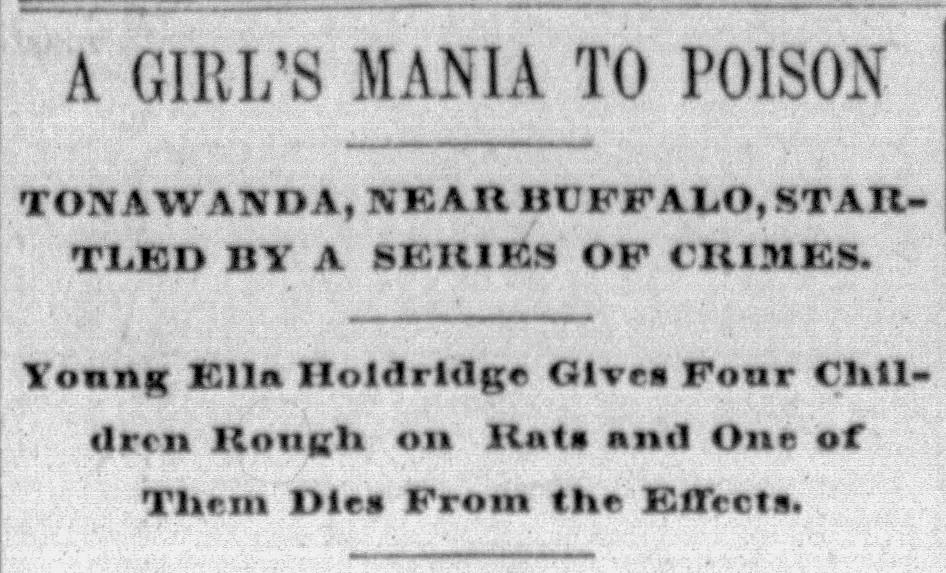
Flush with success and brimming with confidence over her first induced funeral, Ella Holdridge waited (about) five days before feeding her obsession with death, funerals, and wakes. 

Only this time, Ella made a mistake.

Whilst plenty of people noticed the two girls playing together on the day Leona fell ill, no one for a moment suspected Ella played a role in the toddler’s lingering death. Mainly because of the two-year-old’s inability to utter anything sensible after ingesting the water Ella polluted with Rough on Rats. 

However, this time, Ella targeted a pair of sisters — Susie & Jennie Eggleston.

Due to the sensationalization of this case, there’s some ambiguity on what exactly happened next. (Newspapers of this era absolutely loved to hype up crimes like this — often at the expense of the facts.) However, these things seem certain: In and around July 16, 1892, Mrs. Eggelston decided to go shopping in Buffalo, NY (about twelve miles from their neighborhood in Tonawanda) — leaving her daughters at home. Now, one way or another, either knowing beforehand via the neighborhood grapevine or sussing out the intelligence from the pair as they played on their front porch — Ella realized the lack of adult supervision afforded her an opportunity to generate a double funeral. 

Using her status as an older kid (as she was fourteen to their ten and five) and the promise of making them “something nice,” Ella managed to herd the two inside their house. After (possibly) locking the doors after they went inside, Ella made a pot of cocoa with a generous measure of her secret ingredient, Rough on Rats, thrown in. When one of the sisters complained about the cocoa’s taste and refused to drink anymore, Ella compelled the girl to drink it: Through either verbal coercion, pushing her onto a sofa and pouring it down her throat, or throwing her onto the floor and forcing the liquid between her lips. After ensuring Susie and Jennie finished their mugs of cocoa, Ella told them not to tell anyone about what happened and left.

Later that evening, both girls became extraordinarily ill and their parents sent for Dr. Edmunds.

As both Susie and Jennie had been the picture of health prior to their mother’s trip into Buffalo and they’d pretty much identical symptoms which started nearly simultaneously — Dr. Edmunds suspected they’d gotten into something poisonous. Can you imagine his surprise upon learning about Ella’s strange-tasting hot chocolate and even stranger behavior? Then word reached him about another kid a few doors down who was desperately sick — with the same symptoms as the Eggelston sisters.

Seems sometime during the day, Ella also administered some Rough on Rats to five-year-old Ervin Garlock.

Whilst doctors worked diligently to save the lives of the three kids — news of Ella’s possibly poisonous food and drink spread like wildfire around the neighborhood of Kohler and Morgan Street. Leading every parent hither, thither, and yon to interrogate their children as to whether they’d eaten anything given to them by Ella.

After Susie, Jennie, and Ervin’s lives were back on solid footing, Dr. Edmunds and Dr. Harris compared notes….and discovered Leona’s symptoms mirrored those of the other poisoned children. Unsurprisingly, the duo of doctors took their suspicions to Justice of the Peace Rogers and Coroner Hardleben — who called Ella in for questioning posts haste.

At first, the fourteen-year-old denied everything. 

However, when one of the officials bluffed and told Ella someone had seen her making the cocoa, and they knew she’d put poison in it — she opened her eyes wide and said….“Dear me, is that so?” And went on to make a full confession. Telling the adults she’d poisoned Susie and Jennie: “…because she wanted to go to a funeral, and thought they would look so nice dead.” When they asked after Leona’s murder: “Yes, she’s dead. Poor L{eona} But she looked awful pretty and her funeral was awful nice.” When Justice of the Peace Richard asked why she used Rough on Rats, Ella replied: “If it killed rats and mice it would kill children.

(Prompting authorities to exhume poor Leona’s body and send her stomach to Dr. Vandenbergh for analysis.)

On July 16, 1892, Ella was charged with murder.….and this is where things get a bit murky. 

I know on July 18, 1892, Franklin Holdridge (Ella’s Dad) committed Ella to the care of Father Baker’s Institution at Limestone Hill. I believe the “institution” the papers referenced was a protectory. 

Protectories are akin to nonreligious reform or industrial schools. They took in all kinds of kids, from orphans to juvenile delinquents — educated them in religion, morals, and science, then trained them in a trade or for a manufacturing position. Whilst not a prison, Father Baker’s protectory would afford far more supervision and possible rehabilitation for a budding poisoner. (It undoubtedly gave Ella space from her obsession because I can’t imagine the nuns or priests in charge would’ve allowed her to attend funerals or visit the graveyard — given her history.)

In any case, this prompt change of address not only kept the children in Ella’s old neighborhood safe, including her much younger siblings, it might’ve also (possibly) given the jury a reason to find her not guilty. 

I say possibly because, unfortunately, I can’t find any direct news pieces on Ella’s trial. Save a blurb written just under eight years after the events of July 1892. It states that despite Ella’s confession and testimony in which she reiterated her belief that Leona and the others would “…look well dead…” a “…jury didn’t see fit to punish her.” 

Perhaps Ella pleaded insanity? Or, due to her age, her lawyers argued she didn’t understand the enormity of her actions? Or maybe they didn’t want to send a pretty young girl to jail for the rest of her life. I don’t honestly know. However, I suspect it didn’t hurt that of her four victims — Susie, Jennie, and Ervin managed to live through the ordeal she put them through.

I also reckon Ella remained in Father Baker’s care for a spell after her trial, though this is purely conjecture on my part. (Mostly because I can’t see a way for her to return home to Tonawanda after killing a child, no matter the outcome of a trial. Though again, it is possible.)

However, I do know that by the time Ella was about 24, she was married to a man named Neil McGilvray with a baby daughter on the way. In 1905, they had another daughter. In 1908, the family moved to Monessen, Pennsylvania, where Ella would remain for the next 37 years until her death in 1945 at the age of 65.

Rough on Rats: Ella’s Deadly Obssession

Roughly forty years after the publication of Moby Dick and seventy years before Graham Young’s initial poisoning spree — a fourteen-year-old girl named Ella Holdridge lived with her family and three siblings in the small town of Tonawanda in Erie County, New York. Unlike Captain Ahab, who was obsessed with a great white whale or Graham Young, who’s idée fixe was poisons — Ella was spellbound by death.

Whenever she discovered someone in the community passed away — Ella would (according to her stepmother) literally jump for joy, clap her hands, and exclaim, “He’s Dead! He’s Dead!” Her excitement not only stemmed from the death itself but from the knowledge there would be a funeral, a wake, and a fresh grave in her near future. Because, irregardless if she was invited or not, if Ella could attend — she would turn up….Shouldering her way to the front of the queue at the viewing, then to the grave’s edge to witness the coffin being lowered into the earth.

It’s unclear from where Ella’s fascination with death and funerals sprung. Perhaps Ella dimly recalled watching her mother slowly succumb to TB, the inevitable funeral, and the wake that followed. Though as Ella was only 2 or 3 years old at the time, those memories would be murky — but still echoing somewhere within her mind. Or maybe her interest was sparked by newspaper reports of Jack the Ripper’s bloody exploits in Whitechapel — the serial killer’s frenzied attacks roughly spanned the years between Ella’s ninth and thirteenth birthdays. It’s also possible Ella was just naturally inclined towards the macabre. Irregardless of whatever sparked Ella’s interest in death and all its trappings — she was hooked. 

Unfortunately, in the summer of 1892, a drought occurred in the local cemeteries — i.e., a distinct lack of funerals.

Okay, so here’s the thing: During my research, I found a number of GLARING inconsistencies in the news reports pertaining to this case. So, I fact-checked this case as well as I could after 130 years….Which led to a vexing urge to box the ears of the original reporters….

Unlike some of the articles I’ve read from around this time, none of the newspapers (I found) list Ella’s address. However, the Buffalo Weekly Express does mention Ella’s neighborhood. Using a helpful map ap, I discovered three cemeteries lie less than a mile from the cross-streets mentioned: Tonawanda City Cemetery, Saint Francis Cemetery, and Salem Church Cemetery. All of whom were in operation at this time and aligned with Ella’s stepmother’s intelligence.

Next, I found between the three aforementioned cemeteries, there were only 14 burials between January – April, 0 in May and 2 in June. Assuming Ella could only attend a fraction of these 16 funerals — due to things like school, family commitments, and whether or not the deceased family actually held a service. I imagine Ella was desperate to satiate her obsession by the time July of 1892 rolled around.

Which might help to explain what happened next. 

Unlike Graham Young, whose idée fixe I sincerely doubt would allow him to stoop to using a poison as inelegant as Rough on Rats (unless he’d no other options, in other words, during his incarcerations) it suited Ella Holdridge’s purposes just fine. 

On July 7, 1892 — while playing with two-year-old Leona Stermer, Ella gave her a glass of adulterated water. Within hours, Leona was writhing in pain and violently ill. Leona’s parents called in Dr. Harris, who thought she’d contracted cholera morbus (what we now call gastroenteritis) and treated her thusly. Sadly he was unsuccessful as Leona died two days later. (And yes her name is Leona Stermer — not Louisa Sterner, Zoena Stuermer, or Lena as reported in various newspapers. It took some serious crosschecking, but I finally pinned down Leona’s correct name.)

Unbeknownst to the Stermers and Dr. Harris — whilst Leona lay dying, Ella would regularly sidled up and surreptitiously watched the goings on inside the house. After gauging the distress she’d witnessed, Ella would dash back home and say things to her stepmother like: “I guess she’d almost dead now!” (Interestingly enough, this behavior lines up with Graham Young’s during his second poisoning spree. Apparently, he would repeatedly call the hospitals, where his colleagues lay dying of the poison he administered to them, to “check” on them. Presumably so he could update his scientific journals with the most accurate information he could obtain.)

Needless to say, when Leona Stermer was buried on July 11, 1892 — Ella was front and center during the planning, preparation, and execution of Leona’s funeral rites….And no one, not even Ella’s parent’s, suspected anything was amiss with the toddler’s death.

Yet.

My 52 Weeks With Christie: A.Miner©2023

Rough on Rats: Obsession, Melville, & the Tea Cup Poisoner

Captain Ahab & The Whale — a bleak tale about a great man who gradually immolating every part of himself on a pyre of obsession until all that remains is ash and a single all-consuming desire for revenge. Beyond laying bare a treacherous side of the human psyche, Melville’s masterpiece, Moby Dick, shows us how a person caught in the grips of a powerful obsession can justify nearly anything — including the sacrifice of a ship and its entire crew (save Ishmael). While I realize scouring the high seas for a giant white leg-eating sperm whale doesn’t occupy most people’s minds the way it did Ahab’s — it’s still a compelling tale…..and a cautionary one as well.

Especially when it concerns children. 

Hyperfocusing on things like space, dinosaurs, books, animals, or other similar subjects is a well-known phenomenon. This intense interest in a single subject gives natural parameters for their exploration of the world while allowing their curiosity to flourish. This zeroed-in interest often dilutes or fades when they hit school — as they’re exposed to all sorts of new ideas, people, and tedium. 

However, sometimes, just sometimes, a kid’s fascination takes a darker turn and doesn’t dissipate like so much smoke in the wind. 

Couple this all-consuming passion with immature moral muscles — you occasionally find yourself facing a kid like Graham Young. Who started wending his way down the pathway of obsession at an early age. It started with reading true crime (no biggie). Then, he became a fanboy of either Dr. Crippen or William Palmer and their poisons. (I’ve read accounts identifying one or the other as Young’s role model. Whichever way it went — labeling either as your idol isn’t exactly great.) Not to mention his enthusiasm for black magic and the Nazis.

Then Young found his calling.

At the age of twelve, Young entered secondary-school and started taking chemistry — which dovetailed nicely with his fascination with toxic metalloids, plants, and elements. At first, he satiated his idée fixe by studying books on advanced toxicology. Then, at the age of thirteen, armed with an extensive knowledge of both subjects — Young hoodwinked a local chemist into selling him antimony, digitalis, arsenic, and thallium.

Whereupon Young moved on to the practical application of poisons. 

At first, Young experimented on a fellow student, but when the boy’s parents pulled him from school, Young moved on….And began conducting his research on his relations. Amongst other appalling familial poisoning episodes: Young sent his sister, Winifred, to the hospital by lacing her tea with belladonna. Next, Young committed what he thought of as a perfect murder by slowly killing his stepmother with thallium. (While Young confessed to Molly Young’s murder nine years later, this claim has never been verified — mainly because, at Young’s suggestion, her remains were cremated.) At Molly’s wake, Young tipped antimony into a jar of mustard pickles, sickening another relative. Finally, Young turned his full attention onto his father, whom he nearly sent to an early grave via antimony poisoning less than a month after murdering his stepmother.

However, Young’s preoccupation with poisons was not unknown.

Aware of the trouble befalling his family and others around him, Young’s science teacher searched his school desk and found several vials of poison and notebooks detailing things like dosages and symptoms. Taking his suspicions to the school’s headmaster, the two devised a trap: They arranged an interview between a careers counselor, who was actually a trained psychiatrist, and Young. During their discourse, the professional headshrinker managed to get Young to reveal his comprehensive and sweeping knowledge of his favorite subjects — poisons and toxicology. Weighing his troubling conversation against the spat of the “illnesses” plaguing those within Young’s sphere — the mental health professional took his misgivings to the authorities……Who saw fit to arrest Young on May 23, 1964, at which point they found his store of thallium and antimony.

In short order, Graham confessed, pleaded guilty, and became one of the youngest inmates in Broadmoor’s history at the age of fourteen. (For Those of You Who Don’t Know: Broadmoor’s the oldest high-security psychiatric hospital in England and second only in fame/infamy to Bethlem Royal Hospital, aka Bedlam.)

This change of address barely slowed Young down. 

Soon after Young arrived at Broadmoor, another patient died after ingesting cyanide, a nurse discovered his coffee laced with toilet cleaner, and a caustic cleaning powder somehow found its way into a communal tea urn. Whilst an obvious suspect, Young was not brought up on charges in any of these incidences — as it’s unclear if he actually committed them. Young only ceased his claims of poisoning people during his incarceration after figuring out that if he feigned being cured of his fascination, he could win his freedom — which he did in 1971 at the age of (around) 24.

Unable or unwilling to eschew his love of bottles bearing a skull and crossbones, it didn’t take long for Young to return to his old ways.

Mere months after his release, Young once again secured an array of toxics — which he didn’t hesitate to dispense. By misrepresenting himself to a prospective employer, Young obtained a job where no one knew of his past offenses, which allowed him to poison with impunity. Before the shadows of suspicion thickened around him, Young administered thallium or antimony to his coworkers en masse via his tea trolly duties, targeting five individuals specifically and killing two others. 

Earning him the moniker: The Tea Cup Poisoner — a nickname Young apparently loathed.

Thankfully, by the summer of 1972, Young was back behind bars — where he’d stay until his death in 1990 at the age of 42. (This is a vastly simplified history of Young’s life and crimes. For a more thorough account of his diabolical deeds, listen to episode #6 of The Poisoner’s Cabinet.)

Whilst the lion’s share of youthful passions don’t end up creating a poisoner, Graham Young demonstrates how many steps beyond the pale an idée fixe can take a kid. But here’s the horrible thing: whilst Young is one of the most infamous killer kids — he’s not the only one who’s journeyed down this treacherous path and left a body count in their wake…..

My 52 Weeks With Christie: A.Miner©2023